How to Report Online Blackmail With Private Photos in Pakistan
Someone threatening to leak your photos or chats? Do not pay. Save evidence, report to NCCIA on 1799, and get it removed. PECA section 21 allows up to 5 years.
If someone is threatening to share your private photos, videos or chats, do not pay and do not delete anything. Save the evidence, then report to the National Cyber Crime Investigation Agency (NCCIA) on its 24/7 helpline 1799 or at complaint.nccia.gov.pk. Sexual blackmail is a crime under section 21 of PECA 2016, with up to five years in prison.
This happens to far more people than admit it. NCCIA's own homepage counts more than 140,000 complaints in 2026, and says 29 per cent came from women. You are not the one who did something wrong. The person threatening you is.
We read NCCIA's website, its complaint form and its FAQ page, the Prevention of Electronic Crimes Act 2016 (PECA) on the Pakistan Code, and Meta's sextortion guidance on 3 October 2026. Here is what to do, in order.
Do not pay, and do not delete anything
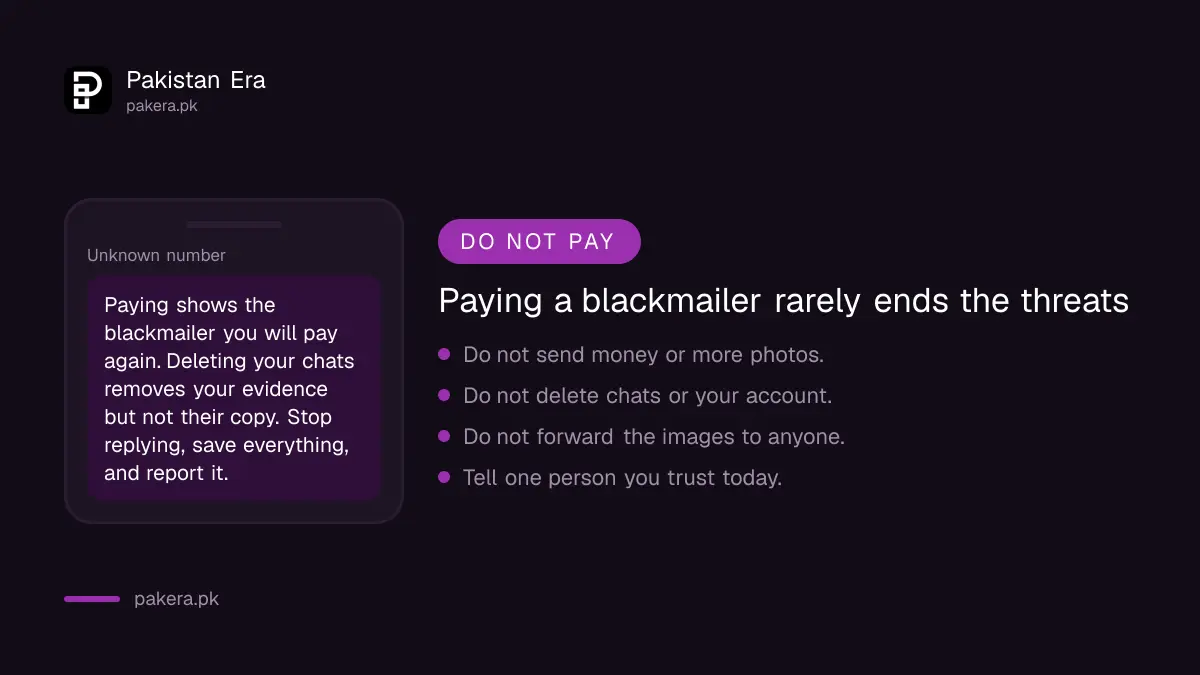
Paying almost never ends the threats. It tells the blackmailer you will pay again. Deleting chats or your account removes your evidence but not their copy. Stop replying, keep everything, and tell one person you trust today.
Meta, which runs Facebook, Instagram and WhatsApp, gives the same advice in its safety centre: "Cooperating or paying rarely stops their threats." If you have already paid, stop now. It is not too late to report.
Meta lists warning signs: a stranger who rushes into romance, a fake modelling offer, or several fake identities. Some blackmailers use edited or AI-made pictures. Section 21 of PECA covers a face placed on a sexual image too, so a fake picture is still a crime.
Save the evidence before you block
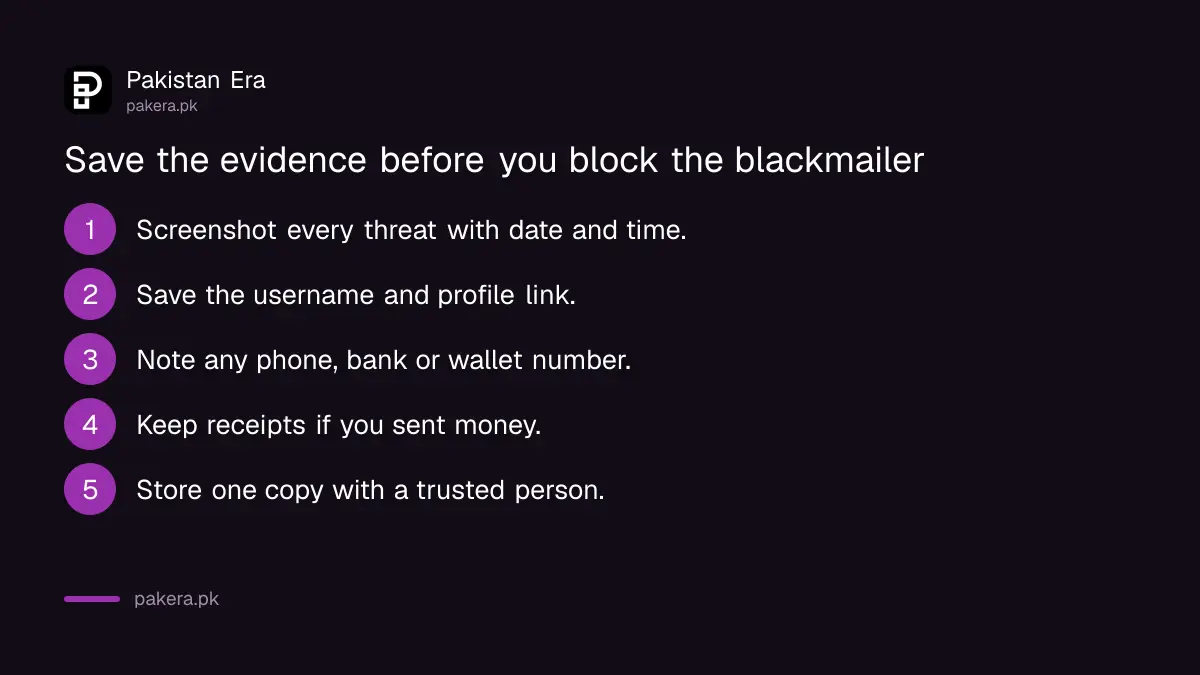
Take screenshots of the threats, the profile, the username, the profile link and any phone number or payment account. Note the dates and times. Then block and report the account. NCCIA asks for a copy of your evidence with every complaint.
- Screenshot every threatening message, with the date and time visible.
- Open the blackmailer's profile and save the username and the profile link.
- Write down any phone number, email, bank account or wallet number they gave you.
- If you sent money, keep the transaction receipt or SMS.
- Save everything in one folder, and email a copy to yourself or a trusted person.
Do not crop or edit the screenshots. Do not forward the private images to anyone, even to prove your case. Describe them in your complaint, and the investigating officer will ask for what they need.
If the blackmailer got into one of your accounts, take it back first. The steps differ by app, and there are separate fixes to recover a hacked Instagram account and a hacked WhatsApp account.
Report to NCCIA through any of its four channels
NCCIA's FAQ lists four ways to complain: the Pakistan Citizen Portal, its online form at complaint.nccia.gov.pk, email to helpdesk@nccia.gov.pk, or a visit to a Cybercrime Reporting Centre. You will still need to visit a centre in person to verify your complaint.
| Channel | Details we read on NCCIA's site |
|---|---|
| Helpline | 1799, shown as 24/7 |
| Online form | complaint.nccia.gov.pk: name, CNIC, gender, mobile, city, crime details |
| helpdesk@nccia.gov.pk | |
| Citizen Portal | Pakistan Citizen Portal app or website |
| In person | Cybercrime Reporting Centre: written application, CNIC copy, evidence copy |
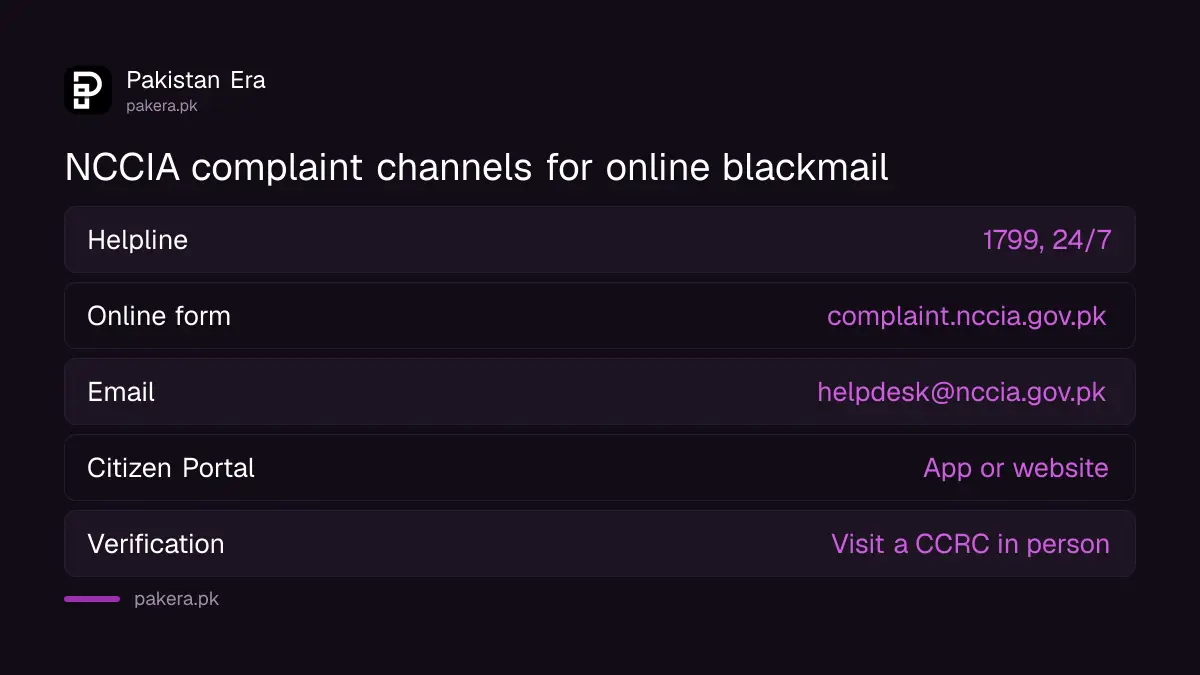
The FAQ says that under S.R.O. 05/2020 a complainant must visit a Cybercrime Reporting Centre in person for verification. NCCIA lists centres in cities including Islamabad, Rawalpindi, Lahore, Karachi, Peshawar, Quetta, Multan, Faisalabad, Hyderabad and Gilgit.
If you live abroad, NCCIA asks you to name a relative or lawyer in Pakistan to follow the case at any centre. You give their name, city, phone number, postal address and CNIC. Without one, NCCIA says you can complain through INTERPOL or the Pakistani embassy. The wider process, including fraud and hacking, is covered in how to report a cybercrime in Pakistan.
PECA 2016 makes sexual blackmail a crime with up to five years in prison
Section 21 of PECA punishes anyone who uses sexual images, videos or threats online to blackmail or harm. The penalty is up to five years, a fine of up to Rs 5 million, or both. It rises to seven years if the victim is a child.
| Law | What it covers | Maximum penalty |
|---|---|---|
| PECA s.21(1) | Sexual images, fake face swaps or sexual threats used to blackmail or harm | 5 years, Rs 5 million fine, or both |
| PECA s.21(2) | The same offence against a minor | 7 years and Rs 5 million fine |
| PECA s.24 | Cyber stalking, including sharing a photo or video without consent | 3 years, Rs 1 million fine, or both |
| PPC s.384 | Extortion: getting money or property by putting someone in fear | 3 years, fine, or both |
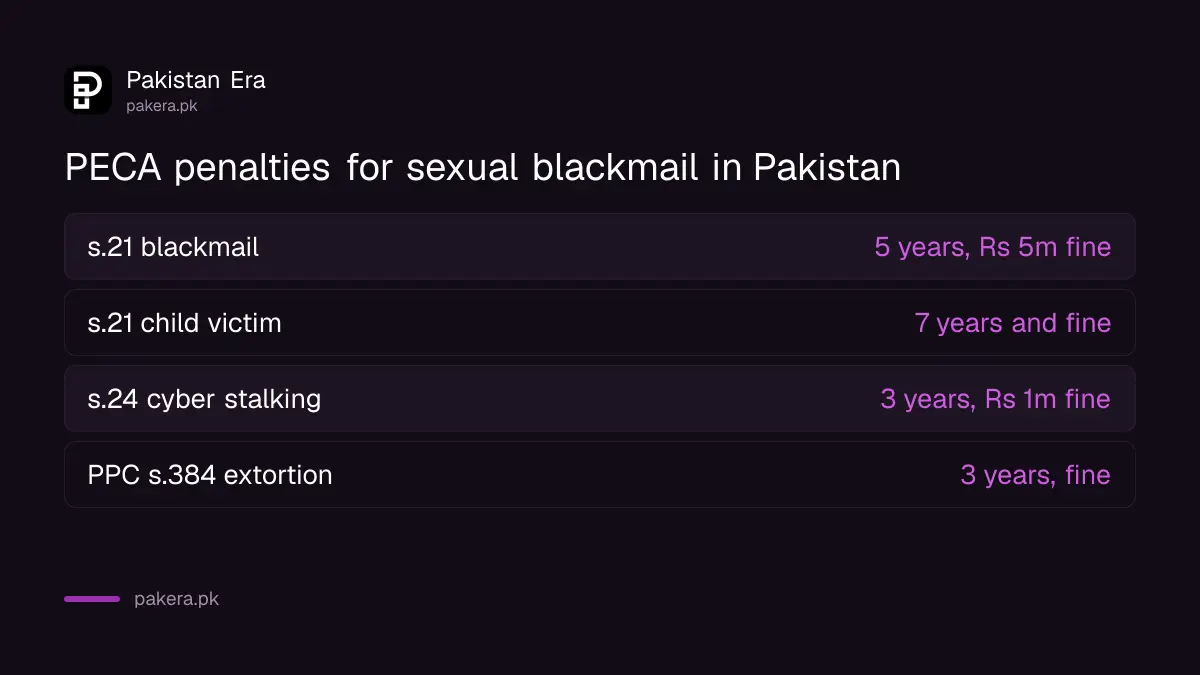
Section 29 of PECA, added in 2025, set up NCCIA to investigate these offences and moved the old FIA Cyber Crime Wing into it. Its officers have the same powers as police.
The law also protects victims. Section 30B calls for a victim protection system that includes hiding identity and giving evidence by video link. Section 30C says trials of offences against minors are held in private.
Get the images taken down through the platform and PTA
Report the profile and any shared image on the app first, because that is fastest. If it stays online, apply for removal. Section 21(3) of PECA lets a victim, or a child's guardian, apply to the regulator for the content to be removed or blocked.
Meta's help centre says you should report anyone threatening to share private messages, photos or videos using the built-in reporting options. After removal, it says it uses photo matching to help stop the same image being shared again on Facebook, Instagram and Messenger.
The 2025 amendment names a new Social Media Protection and Regulatory Authority as the body for removal requests. Until it is set up, section 50A keeps the Pakistan Telecommunication Authority (PTA) in that role. On 3 October 2026, PTA's complaint portal still offered an "Unlawful Online Content Related Complaint" type. The steps are in how to report unlawful online content to PTA.
If the blackmailer made a fake account in your name, report that profile separately. The process to report a fake Facebook profile works even without an account.
Help for women and for parents of children
Women in Punjab can call the Punjab Women's Helpline 1043, which the Punjab Commission on the Status of Women says gives 24/7 legal advice. Parents should know that the law treats a child victim more seriously, and the trial is held in private.
If your child tells you about a threat like this, stay calm. Anger makes children hide the next problem. Save the evidence with them, report it, and remember that the crime is the blackmailer's, not theirs.
A lawyer can help if the case goes to court. If cost is the problem, you can ask for a free lawyer in Punjab through legal aid.
Common questions
Should I pay the blackmailer to delete my pictures?
No. Paying rarely stops the threats and often leads to more demands. Save the evidence and report it instead.
What is the NCCIA helpline number?
1799. NCCIA's website shows it as a 24/7 helpline.
Can I report online blackmail without going to an office?
You can start online, by email or through the Citizen Portal. NCCIA's FAQ says you must still visit a Cybercrime Reporting Centre in person to verify the complaint.
What if the photos are fake or edited?
It is still a crime. Section 21(1)(a) of PECA covers putting a person's face on a sexual image or video.
Will my name become public if I complain?
Section 30B of PECA calls for protection that includes hiding the identity of victims and witnesses. Trials involving children are held in private.
Can I complain from abroad?
Yes. Name a relative or lawyer in Pakistan to follow the case, or complain through INTERPOL or the Pakistani embassy where you live.
How we verified this
What we checked, where we read it, and what we could not confirm.
Last checked on 3 October 2026. The 1799 helpline, the 2026 complaint figures, the four complaint channels, the documents for a written complaint, the in-person verification rule under S.R.O. 05/2020, the overseas route and the list of centres were read on NCCIA's FAQ page, its homepage and its complaint form. PECA sections 21, 24, 29, 30B, 30C and 50A were read in the consolidated Act on the Pakistan Code, and section 384 of the Pakistan Penal Code there too. Meta's advice was read in its safety centre and help centre. The PTA complaint type was read in PTA's complaint portal. The 1043 helpline was read on the Punjab Commission on the Status of Women website. We did not file a complaint, and NCCIA publishes no response time. This is general information, not legal advice.
About the author
Public Services and Education Journalist
Fajr Riaz is a journalist and content writer at Pakistan Era, based in Lahore. She covers the questions people meet in everyday life in Pakistan: how a public service works, what a change in the rules means, and where to find a reliable answer.