How to Remove a YouTube Video of You With a Privacy Complaint in Pakistan
File a YouTube privacy complaint from Pakistan to remove a video showing your face, name, CNIC or phone number, or an AI fake of you. Steps, who can file, rules
Someone posted a video of you on YouTube without your permission? Ask the uploader to take it down first. If they refuse, or you do not feel safe contacting them, file a privacy complaint through YouTube's Privacy Complaint Process at support.google.com/youtube/answer/142443. Choose what is happening, add the video link and the timestamps where you appear, and submit. It is free and the uploader is not given your name or contact details.
YouTube removes content under its privacy rules only when you are uniquely identifiable in it, meaning other people could recognise you. A first name with no context, or a face that flashes past for a second, usually does not qualify.
YouTube removes videos that show you without permission
YouTube's privacy guidelines cover three cases: your image or full name shared without permission, other personal details such as your phone number or CNIC number, and AI fakes of your face or voice. They apply worldwide, even where local law allows the video.
| What was posted | Report it as |
|---|---|
| A video or photo of your face, or your voice | Personal image or full name |
| Your full name in the title, description or tags | Personal image or full name |
| Your home address, email or phone number | Other personal info: contact info |
| Your CNIC or other ID number | Other personal info: identification info |
| Your bank account or card number | Other personal info: financial info |
| An AI face swap or fake voice of you | Altered or synthetic content |
Some problems are not privacy cases. If someone copied a video you made, that is a copyright complaint. If someone insults or targets you, YouTube treats it as harassment and you report the video. If you are in physical danger, go to the police first.
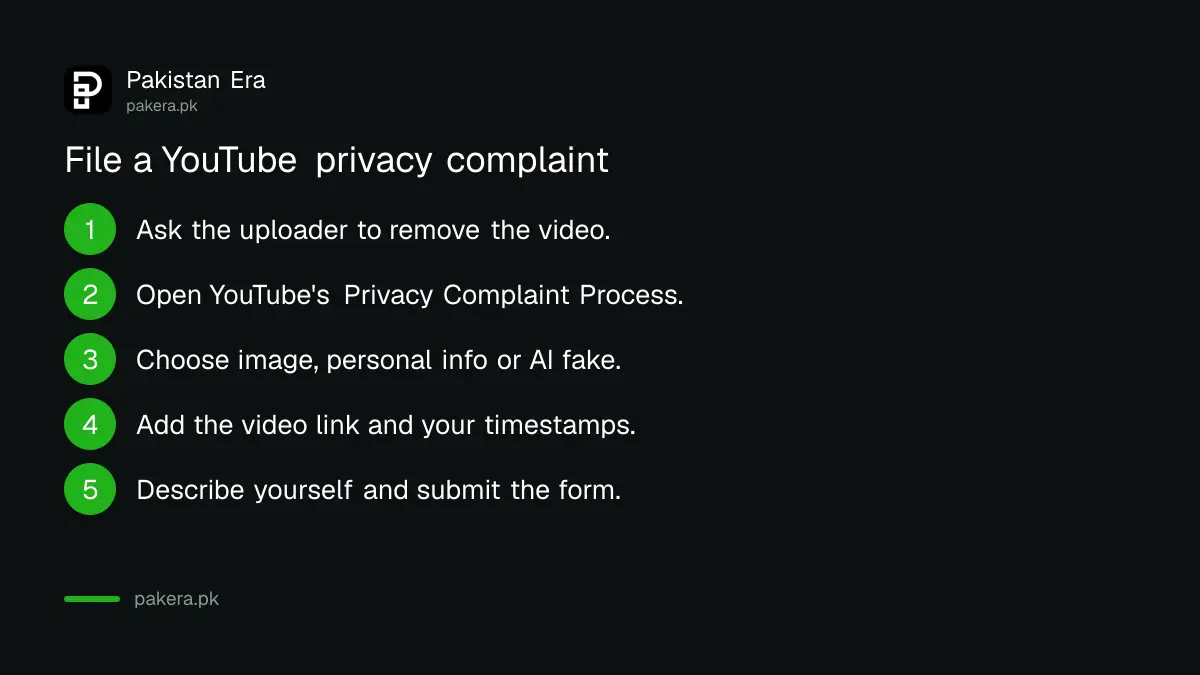
How to file a YouTube privacy complaint, step by step
The process has six short screens. Keep the video link ready, note every minute and second where you appear, and use an email address you check, because YouTube sends updates and questions there.
- Contact the uploader if you feel safe doing so. Some channels list a contact email in their About section.
- If that fails, open YouTube's Privacy Complaint Process and tap Continue.
- Answer the harassment question. Choose I still want to submit a privacy complaint if the issue is your privacy.
- Confirm you have read the Community Guidelines, and accept the warning that false claims can get your own account suspended.
- Pick what is happening: your image or full name, other personal info, or altered or synthetic content.
- Fill in the form with the video URL, timestamps and a description of you, then submit.
Write a complaint YouTube can act on
- Paste the full video URL. For a whole channel, the URL is not required.
- Give timestamps for every place you appear, such as 0:45 and 3:10.
- Say what you are wearing or doing, so the reviewer can tell you apart from others in the frame.
- For a comment, say so in the description and put the commenter's username in the username field.
What happens after you complain
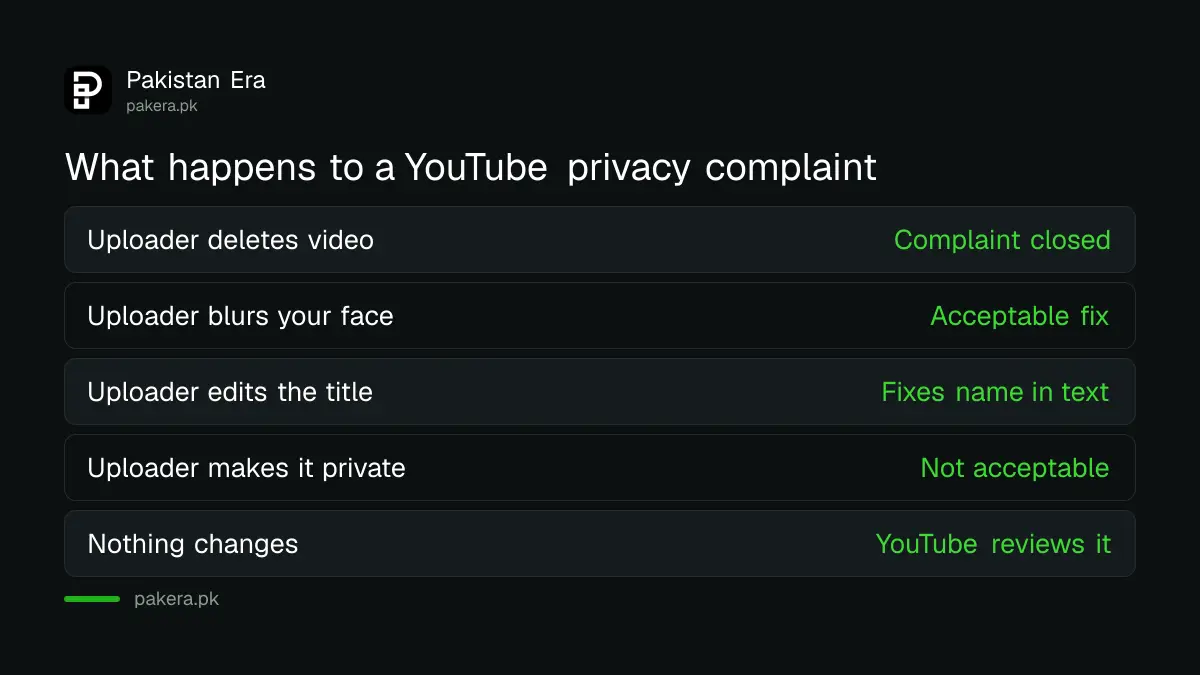
YouTube may first email the uploader and give them time to remove or edit the private details. The uploader can delete the video, edit the title or description, or blur faces in YouTube Studio. If the problem stays up, YouTube reviews the complaint itself.
Making the video private does not count. YouTube says this is not an acceptable fix because the uploader can switch it back to public at any time.
In its review, YouTube weighs public interest, newsworthiness, consent, and whether the information is already public. It also considers whether a video shows someone's moment of death or critical injury. YouTube makes the final decision.
An uploader whose video is removed should not post a new version with the same people. YouTube says it suspends accounts that keep breaking people's privacy.
Who can file, and who cannot
The person in the video must file the complaint. A parent or legal guardian can file for a child, and a legal representative can file for a client. Brothers, sisters, husbands, wives, cousins, coworkers and companies cannot file on someone's behalf.
| Who is filing | Accepted |
|---|---|
| The person in the video | Yes |
| Parent or legal guardian of that person | Yes |
| Lawyer or legal representative | Yes |
| Close family of a person who has died | Yes, after the death is verified |
| Husband, wife, brother, sister, cousin | No |
| Coworker, employer or a company | No |
YouTube also accepts a complaint from someone else when the person has no access to a computer or the internet, or is a vulnerable individual. In a family where only one member is online, help the person in the video fill in the form in their own name.
AI fakes of your face or voice
YouTube takes complaints about realistic AI content that looks or sounds like you. Examples include a face swapped onto another body, or a fake voice saying things you never said. It checks whether the content is realistic, labelled as AI, and identifies you.
YouTube also weighs parody, satire and public interest. A clearly labelled joke about a politician is treated differently from a realistic fake of a private person. Creators who post AI content must label it, and disclosing AI-altered content in YouTube Studio explains what that label is.
Stay safe, and when to go to NCCIA
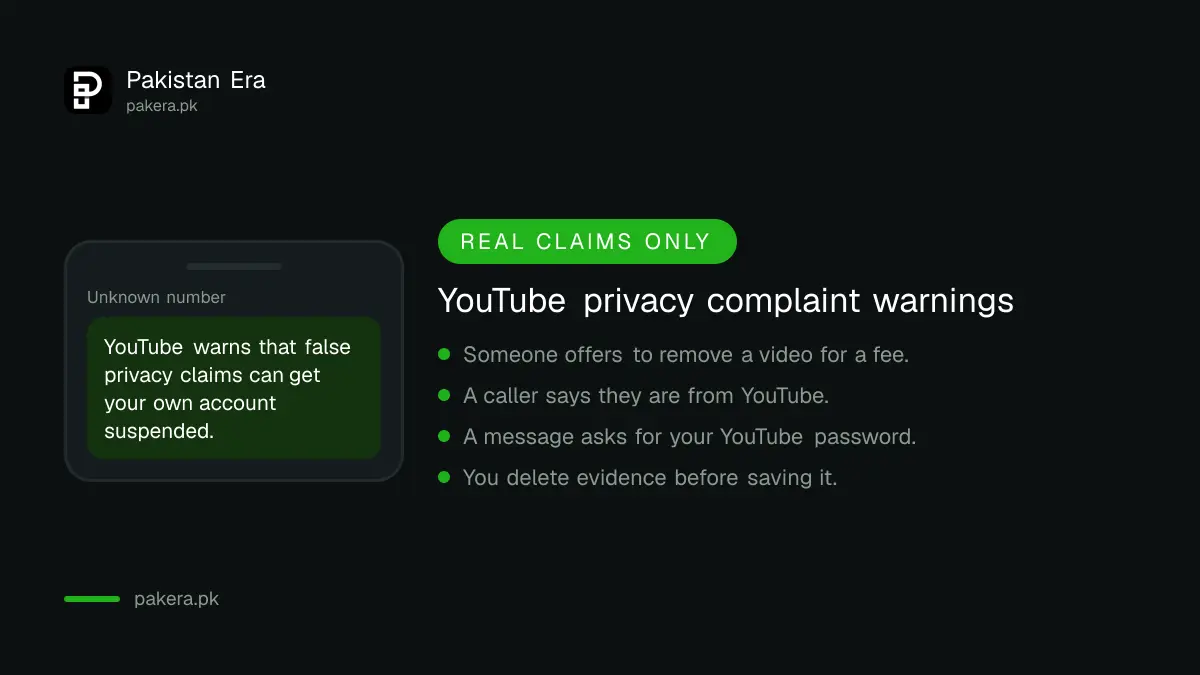
Use the complaint only for real privacy problems. YouTube warns that false or harassing claims can get your own account suspended. If the video comes with threats, blackmail or stalking, save the evidence and complain to NCCIA as well.
- YouTube staff never ask for your password. Anyone calling or messaging "from YouTube" to remove a video for a fee is a scammer.
- Save the video link, the channel link and screenshots before you report. Once the video is gone, you cannot open it again to show NCCIA.
- Abusive comments rather than a whole video? YouTube comment settings let a channel owner hold or block them.
- For a child being bullied online, Pakistan's cyberbullying law and how to report it covers the legal route.
- NCCIA handles cybercrime complaints. The NCCIA Islamabad and Rawalpindi office lists one regional contact.
Common questions
How long does a YouTube privacy complaint take?
YouTube may first give the uploader time to act, then reviews the complaint itself. It sends updates to the email in your form, and may ask you for more information.
Will the uploader know I complained?
YouTube says it does not share your name or contact details with the person who posted the content.
Can I report a video of my sister or wife?
No. YouTube does not accept complaints from brothers, sisters, husbands, wives or cousins. She must file it herself, unless she has no internet access or is a vulnerable individual.
Can I get a news video about me removed?
Possibly not. YouTube weighs public interest and newsworthiness, so genuine news coverage is less likely to come down than a private video of a private person.
Is making the video private enough?
No. YouTube says making a video private is not an acceptable fix, because it can be switched back to public at any time.
How we verified this
What we checked and where we read it.
Last checked 25 November 2026. We checked YouTube Help's Privacy Complaint Process and each of its screens, the YouTube privacy guidelines (who can file, how to write a complaint, what uploaders can do) and the protecting your identity page (the factors YouTube considers).
Free on WhatsApp
Get last dates and rule changes on WhatsApp
We post new last dates, fee changes and fixes for common problems, a few short posts a day.
Follow Pakera on WhatsAppOther followers cannot see your number.
Pakera Solves It
Which online process wasted your time this week?
A portal that will not load, a form nobody explains, a complaint that went nowhere. Tell us. Every week we pick one, solve it step by step and publish the answer.
About the author

Technology Journalist & Multimedia Producer
Ahmad Ali is a technology journalist and multimedia producer at Pakistan Era, joining the team in October 2026. He covers consumer technology and digital life for Pakistani readers, combining research with hands-on product testing.