420 PPC in Pakistan: Cheating Punishment, Bail and Compromise Explained
420 PPC cheating in Pakistan: up to 7 years and fine, cognizable and non-bailable, compoundable by the victim with court permission, plus Sections 417 to 419.
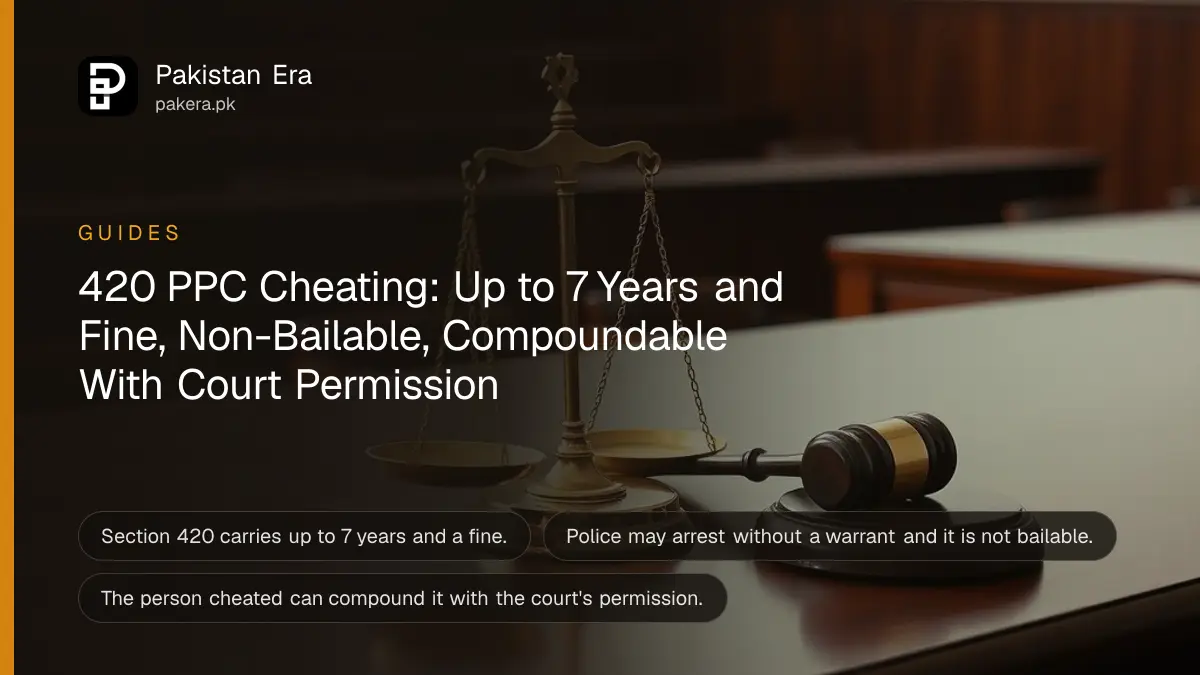
Short answer: Section 420 of the Pakistan Penal Code (PPC) punishes cheating that makes the victim hand over property or sign a valuable document. It carries up to 7 years in prison and a fine. Under the Code of Criminal Procedure (CrPC), 420 is cognizable and not bailable, and it can be compromised by the person cheated, but only with the court's permission.
"420" has become slang in Urdu for a fraudster, and the section is just as common in FIRs. Property deals that fall through, fake job offers, a car sold twice, a plot file that does not exist: police often add 420 to all of them. Here is what the section actually needs, what it carries, and how bail and compromise work.
What Section 420 PPC says
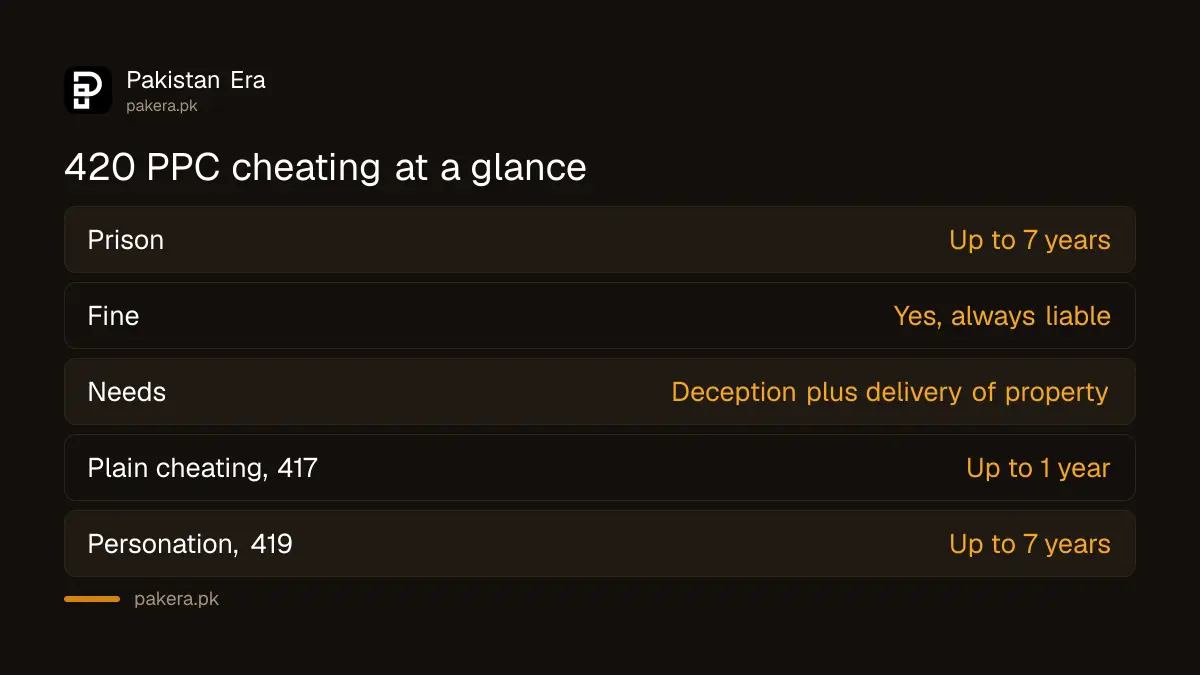
Section 420 applies when someone cheats and thereby dishonestly induces the person deceived to deliver any property, or to make, alter or destroy a valuable security. The punishment is imprisonment of either description for up to 7 years, and the offender "shall also be liable to fine".
Two parts must both be there. First, there must be cheating as Section 415 defines it: deceiving a person and, fraudulently or dishonestly, inducing him to deliver property or to do something he would not otherwise do. Section 415 adds that a dishonest concealment of facts is also a deception.
Second, the cheating must lead to delivery of property or to a valuable security being made, changed or destroyed. A cheque, a sale deed, a stamp paper agreement or a receipt can all be "valuable securities", because they create or transfer a right in money or property.
The other cheating sections
Section 420 is the most serious of the general cheating sections. The lighter ones are used when no property changes hands, or for special cases.
| Section | Offence | Maximum in the PPC |
|---|---|---|
| 417 | Cheating | 1 year, or fine, or both |
| 418 | Cheating someone whose interest you were bound to protect | 3 years, or fine, or both |
| 419 | Cheating by personation | 7 years, or fine, or both |
| 420 | Cheating and dishonestly inducing delivery of property | 7 years and fine |
The PPC raised Section 419 from three to seven years in 1981. The CrPC schedule row for 419 still reads "Ditto", carried from the three-year row above it, so read the PPC text for the punishment.
420 PPC is cognizable and not bailable
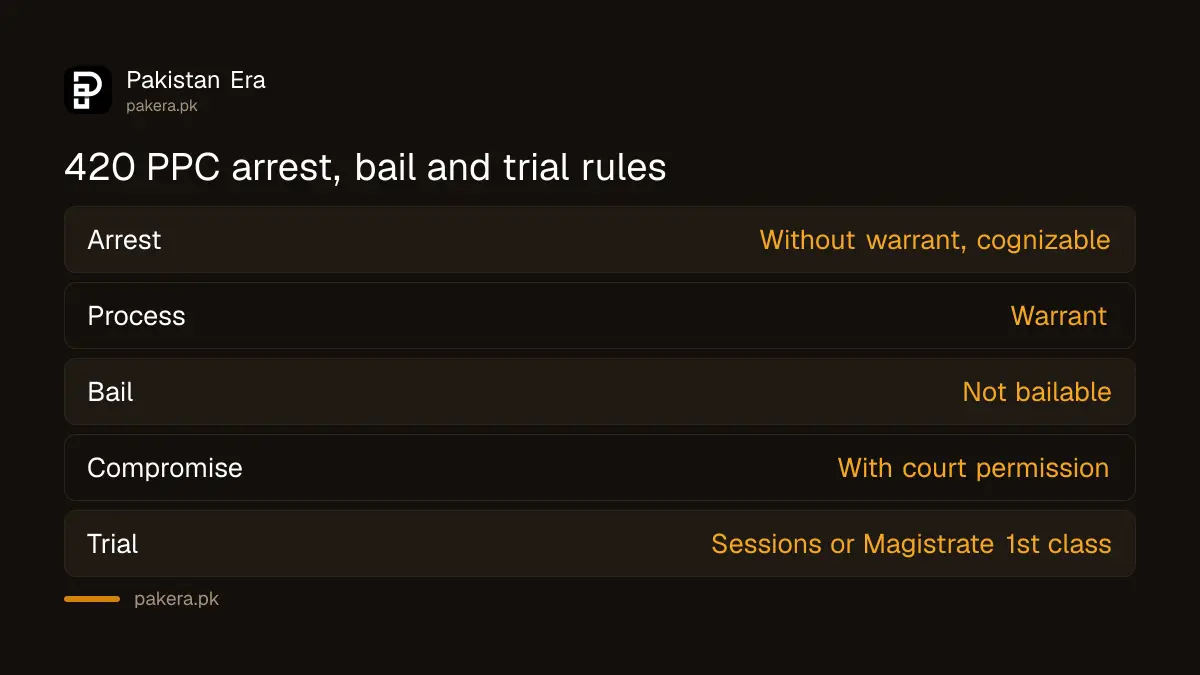
The CrPC's second schedule says police may arrest without a warrant for Section 420, a warrant issues in the first instance, and the offence is not bailable. A Court of Session or a Magistrate of the first class tries it.
- Cognizable: police can register an FIR and arrest without a warrant.
- Not bailable: bail is not a right. The accused applies, and the court decides on the facts.
- Trial court: Court of Session or Magistrate of the first class.
Plain Section 417 is the opposite: police shall not arrest without a warrant, and it is bailable. That difference is why the section number in your FIR matters so much. The general rules on applying for bail are in bailable and non-bailable offences, and the sureties a court asks for are in standing surety for a bail bond.
A 420 case can be settled, with the court's permission
Section 345(2) of the CrPC lists Section 420 among offences that may be compounded "with the permission of the Court before which any prosecution for such offence is pending". The person who compounds is the person cheated. A compromise accepted under Section 345 has the effect of an acquittal.
- The person cheated and the accused agree terms, usually the return of the money or property.
- They write the compromise down and sign it, often on stamp paper with witnesses.
- The compromise is filed in the trial court, or in the appeal court if there is already a conviction.
- The court records the statement of the person cheated to confirm it is voluntary.
- The court grants permission and records the composition, which acquits the accused.
Two limits apply. Sections 417 to 420 all need the court's permission, so a private settlement on its own does not end the case. And once there is a conviction and an appeal is pending, Section 345(5) says no composition is allowed without the appeal court's leave. The wider rules are in settling a criminal case under Section 345.
420 is often charged with other sections
A cheating FIR rarely stands alone. Police commonly add a forgery section if documents were faked, Section 406 if property was entrusted and then misused, and Section 489-F if a cheque bounced.
- Bounced cheque: Section 489-F is its own offence, compoundable by the person in whose favour the cheque was issued.
- Online fraud: a scam over a phone call, app or social media may also fall under the cybercrime law, and you can report it to the NCCIA.
- Breach of trust: Section 406 applies where property was entrusted and then dishonestly kept or used.
What to do if you were cheated, or accused under 420
If you were cheated, collect the proof before you go to the police: receipts, bank transfer slips, agreements, messages and witnesses. If you are accused, speak to a criminal lawyer before you go to the police station, and keep copies of every payment you made.
A victim should give a written application at the police station and keep a copy. If the station will not register a cognizable offence like 420, you can complain to senior police officers or apply to the Sessions Judge as Justice of the Peace under Section 22-A of the CrPC. A complaint that shows only an unpaid debt can be treated as a civil dispute, so set out the deception itself: the false promise, the fake document or the hidden fact.
Free legal help is available. The Supreme Court's legal aid helpline is 1818, and district legal aid committees can assign a lawyer to people who cannot pay. The full PPC sections list shows how 420 sits beside other common offences.
Common questions
What is the punishment for 420 PPC in Pakistan?
Up to 7 years of imprisonment of either description, and a fine. The fine is not optional, as the section says the offender "shall also be liable to fine".
Is 420 PPC bailable?
No. The CrPC schedule lists it as not bailable, so the accused must apply and the court decides. Section 417, plain cheating, is bailable.
Is 420 PPC compoundable?
Yes, with the permission of the court where the case is pending. The person cheated compounds it under Section 345(2) CrPC.
Can police arrest without a warrant in a 420 case?
Yes. The schedule says police may arrest without a warrant, which makes 420 a cognizable offence.
Which court tries a 420 PPC case?
A Court of Session or a Magistrate of the first class, as the CrPC schedule names both.
Is every failed business deal a 420 case?
No. Section 420 needs deception that induced the delivery of property. A simple failure to pay or a broken contract, without that deception, is usually a civil matter.
How we verified this
What we checked and where we read it.
Sections 415 to 420 are from the Pakistan Penal Code PDF, and the second schedule rows and Section 345 tables are from the Code of Criminal Procedure PDF, both on the Ministry of Law's Pakistan Code website. The CrPC edition carries footnotes up to the Criminal Laws (Amendment) Act 2025. The PPC shows Section 419 raised to seven years by the Criminal Law (Amendment) Ordinance 1981, while the CrPC schedule row still carries the older figure by "Ditto". This page explains the law and is not legal advice.
Last checked 15 November 2026.
About the author

Global Affairs & Political Economy Writer
Muhammad Hatim is a book lover who started writing because he enjoys it. At Pakistan Era he writes about international relations, geopolitics and the global economy, with a particular interest in South Asia and the forces behind current events.