506 PPC in Pakistan: Criminal Intimidation Punishment, Bail and How to Report a Threat
506 PPC in Pakistan: up to 2 years for a threat, 7 for a death threat, bailable and non-cognizable, so police need a Magistrate's order. How to report it.
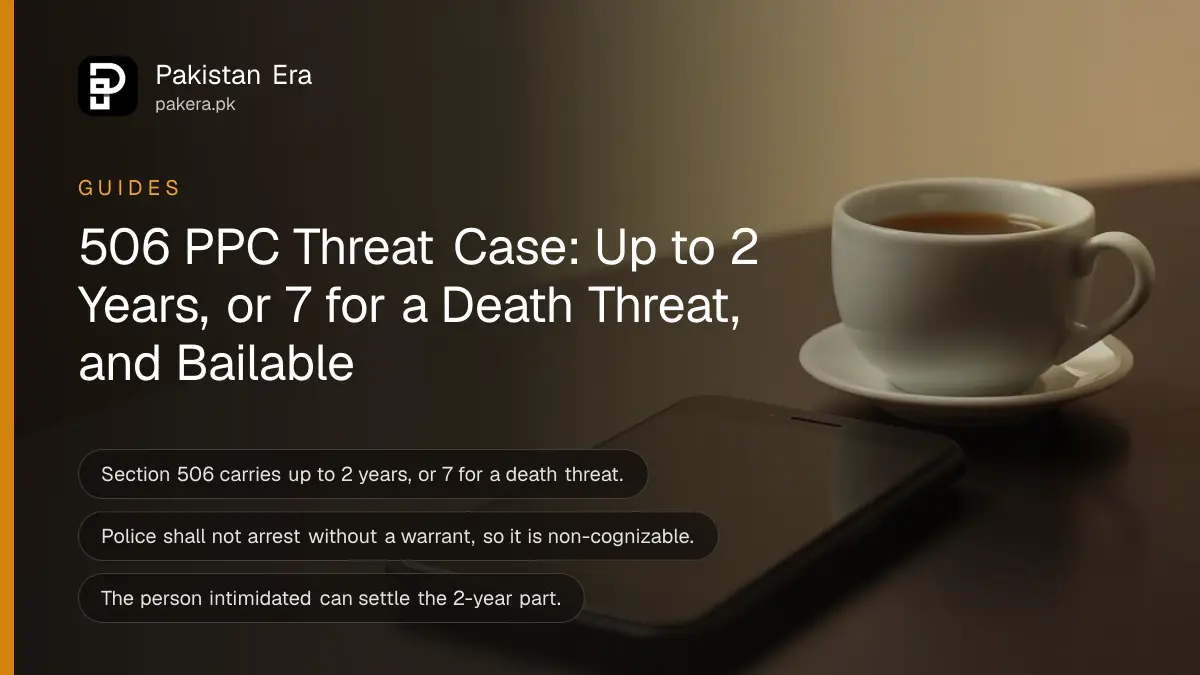
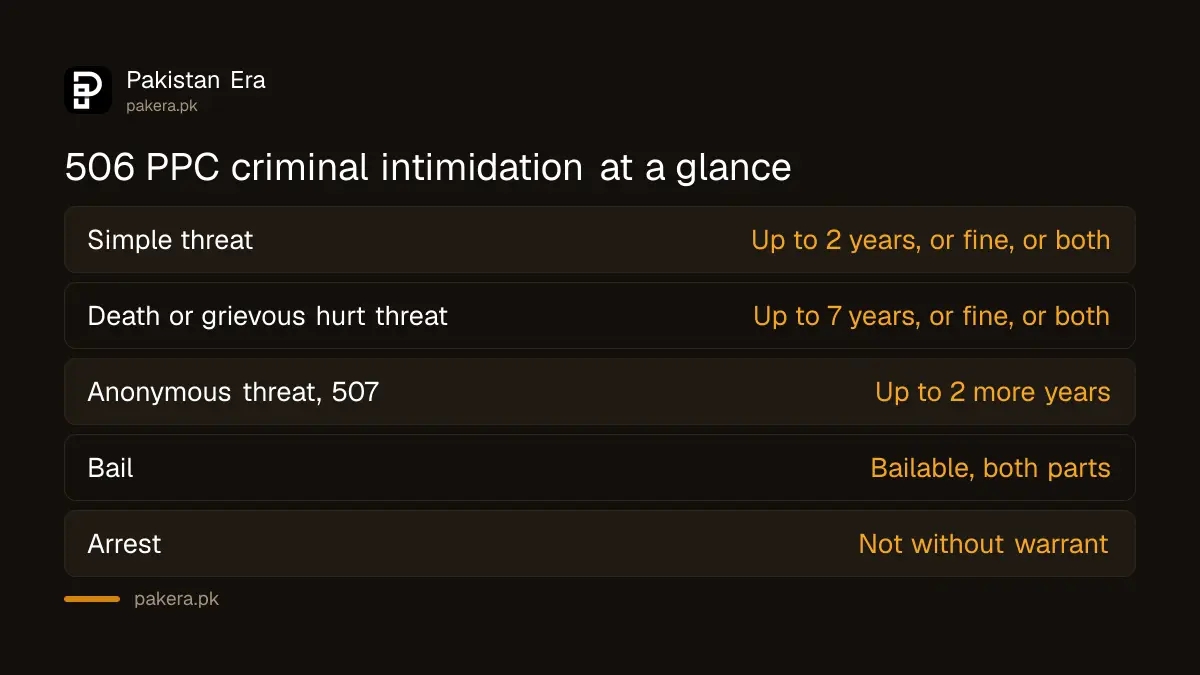
Short answer: Section 506 of the Pakistan Penal Code (PPC) punishes criminal intimidation, meaning a threat meant to frighten someone or force them to act. A simple threat carries up to 2 years, or a fine, or both. A threat to kill, cause grievous hurt, burn property or accuse a woman of unchastity carries up to 7 years. Both parts are bailable, and the Code of Criminal Procedure (CrPC) says police shall not arrest without a warrant.
Section 506 turns up in FIRs after family quarrels, land disputes, loan recovery and messages that say "you will see what happens". It is often added beside a heavier section. On its own, it works differently from most offences people know, because it is non-cognizable. That changes how you report it.
What criminal intimidation means under Section 503
Section 503 PPC defines criminal intimidation as threatening a person with injury to his body, reputation or property, or to someone he cares about, to alarm him or to make him do something he need not do, or stop doing something he has a right to do.
The threat can be about the person himself or about "any one in whom that person is interested", such as a child or a parent. A threat to the reputation of a dead relative also counts, under the section's Explanation. The PPC's own example is a man who threatens to burn another's house to make him drop a civil suit.
The intent is the key. The words must be meant to cause alarm or to force an act. Angry words with no such aim are a weaker case.
Section 506 has two levels of punishment
The first part of Section 506 gives up to 2 years, or a fine, or both, for any criminal intimidation. The second part raises the maximum to 7 years for the most serious threats, listed in the section itself.
| Type of threat | Maximum | Arrest | Bail | Compromise |
|---|---|---|---|---|
| Any criminal intimidation (506, first part) | 2 years, or fine, or both | Not without warrant | Bailable | Compoundable by the person intimidated |
| Threat to cause death or grievous hurt, destroy property by fire, commit an offence punishable with death, life or 7 years, or impute unchastity to a woman (506, second part) | 7 years, or fine, or both | Not without warrant | Bailable | Not compoundable |
| Threat by anonymous message, or hiding who sent it (507) | Up to 2 more years on top of 506 | Not without warrant | Bailable | Not compoundable |
Section 504, intentional insult meant to provoke a breach of the peace, is often charged with 506. It carries up to 2 years, or a fine, or both, and is also bailable and compoundable.
506 is non-cognizable, so police need a Magistrate's order
The CrPC's second schedule says that for both parts of Section 506 police "shall not arrest without warrant". That makes 506 a non-cognizable offence. When 506 is the only offence reported, police enter it and send you to the Magistrate under Section 155.
This is the part that frustrates most complainants. When a station says a pure threat case needs the court, it is following the Code. Section 155(1) tells the officer to enter the substance of the information in a book and refer you to the Magistrate. Section 155(2) says no police officer shall investigate a non-cognizable case without the order of a Magistrate.
The routes from there are:
- Magistrate's order: ask the Magistrate to order police to investigate, explained in when police say an offence is non-cognizable.
- Private complaint: file a criminal complaint under Section 200 directly in the Magistrate's court.
- With a cognizable offence: if the threat came with an assault, a theft or a shot fired, the FIR is registered for that offence, and 506 is added to it.
Bail and compromise in a 506 case
Both parts of Section 506 are bailable, so an accused person has a right to bail on giving a bond, with sureties if asked. The first part can be compounded by the person intimidated without court permission. The 7-year part cannot be compounded at all.
Section 345(1) of the CrPC lists "Criminal intimidation except when the offence is punishable with imprisonment for seven years" among the offences the person intimidated can settle. A settlement in that case has the effect of an acquittal. For the serious threats in the second part, the court has to decide the case on the evidence. The general bail rules are in bailable and non-bailable offences, and compromise rules in Section 345 compounding.
What to do if you are being threatened
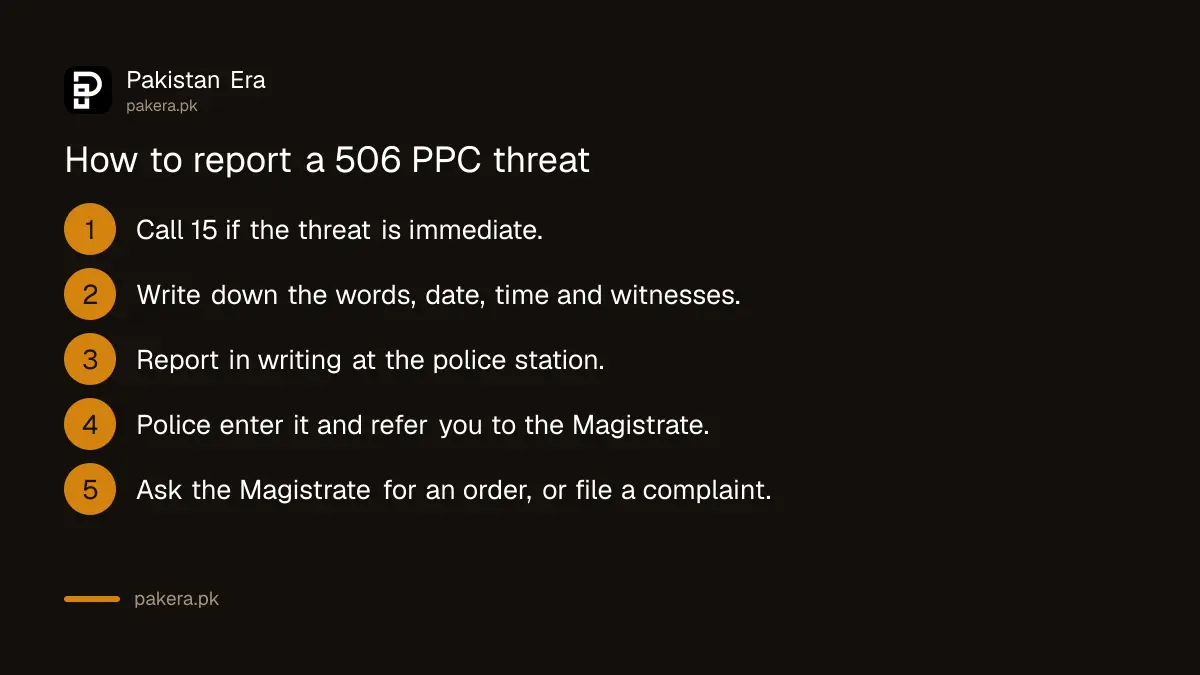
Write down each threat the day it happens: date, time, place, the exact words and who heard them. Keep screenshots and call records. If you are in danger now, call the police on 15 first. Then use the reporting route that fits the facts.
- Get safe first. Call 15 if the threat is immediate.
- Record the threat. Exact words, date, time, place and witnesses.
- Save digital proof. Screenshots with the number or profile visible, voice notes and call logs.
- Report at the police station in writing. Keep a copy, even if they enter it under Section 155.
- Go to the Magistrate. Ask for an order to investigate, or file a private complaint.
Threats sent online, through fake profiles or with intimate images, can also fall under the cybercrime law. You can report a cybercrime to the NCCIA alongside the 506 route.
Common questions
What is the punishment for 506 PPC?
Up to 2 years, or a fine, or both, for a simple threat. Up to 7 years, or a fine, or both, for a threat to kill, cause grievous hurt, burn property or impute unchastity to a woman.
Is 506 PPC bailable?
Yes. The CrPC schedule lists both parts of Section 506 as bailable.
Is 506 PPC cognizable?
No. The schedule says police shall not arrest without a warrant, so it is non-cognizable. Police need a Magistrate's order to investigate it alone.
Is 506 PPC compoundable?
The first part is, by the person intimidated. The 7-year part is not, under Section 345(1) CrPC.
What is 506 part 2?
It is the second paragraph of Section 506, for threats to cause death, grievous hurt or destruction by fire, or to impute unchastity to a woman. It carries up to 7 years.
Can a threat on WhatsApp be a 506 offence?
Yes, if it meets Section 503. Section 507 adds up to 2 years when the sender hides his identity.
How we verified this
What we checked and where we read it.
Sections 503 to 507 are from the Pakistan Penal Code PDF, and the second schedule rows, Section 155 and the Section 345 tables are from the Code of Criminal Procedure PDF, both on the Ministry of Law's Pakistan Code website. The CrPC edition carries footnotes up to the Criminal Laws (Amendment) Act 2025. Emergency number 15 is the national police line. This page explains the law and is not legal advice.
Last checked 15 November 2026.
About the author

Global Affairs & Political Economy Writer
Muhammad Hatim is a book lover who started writing because he enjoys it. At Pakistan Era he writes about international relations, geopolitics and the global economy, with a particular interest in South Asia and the forces behind current events.