How to Apply for the 75% Subsidy on Certified Pulses Seed in Balochistan
Balochistan offers 75% off certified moong, mash, masoor and gram seed in 23 districts, due in the first week of November 2026. See the form and papers.
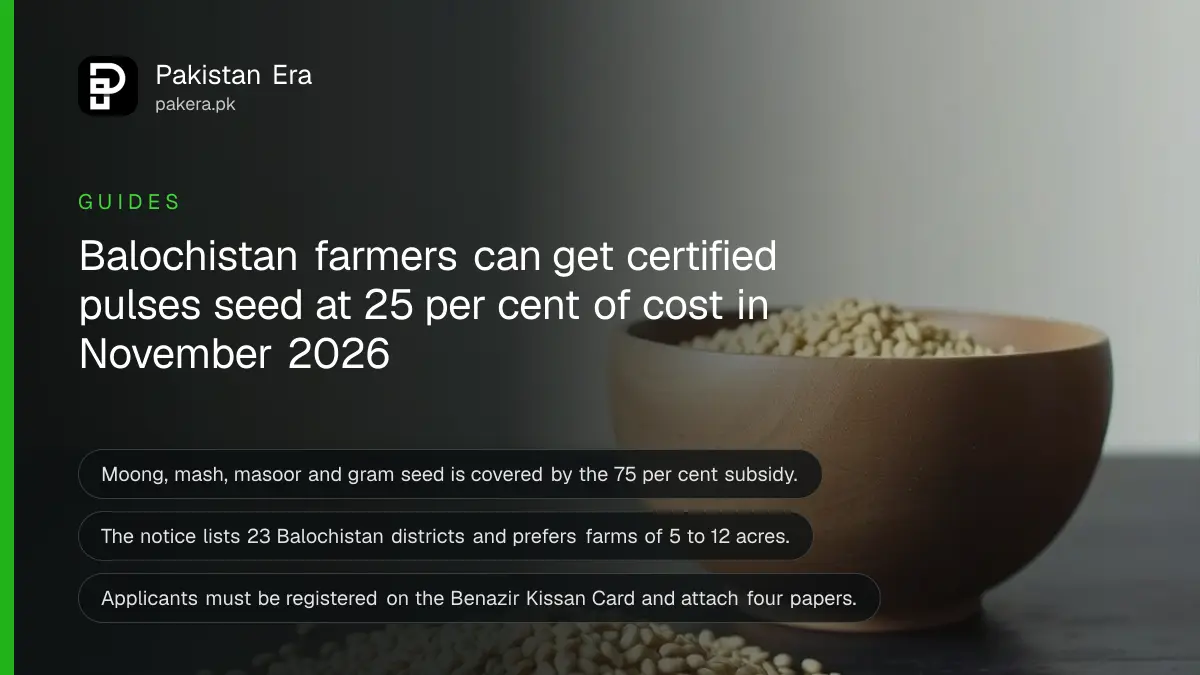
Short answer: The Government of Balochistan says it will give a 75 per cent subsidy on certified seed of moong, mash, masoor and gram (chana) in the first week of November 2026. The farmer pays 25 per cent. You must be registered on the Benazir Kissan Card and you apply on a one-page form from your district Agriculture (Extension) office.
A farmer in Kharan or Zhob who wants to try a pulse crop usually faces the same problem: certified seed costs more than the saved seed in the shed. This scheme cuts that price to a quarter. The catch is paperwork, and it starts before the seed arrives.
We opened the Agriculture Extension Balochistan website, balochistankissan.gob.pk, on 12 October 2026. We read the notice, the district list and the application form. The notice carries a date of 9 August 2026. It names no closing date for applications, so we cannot give you one.
The subsidy covers four pulses and the farmer pays 25 per cent
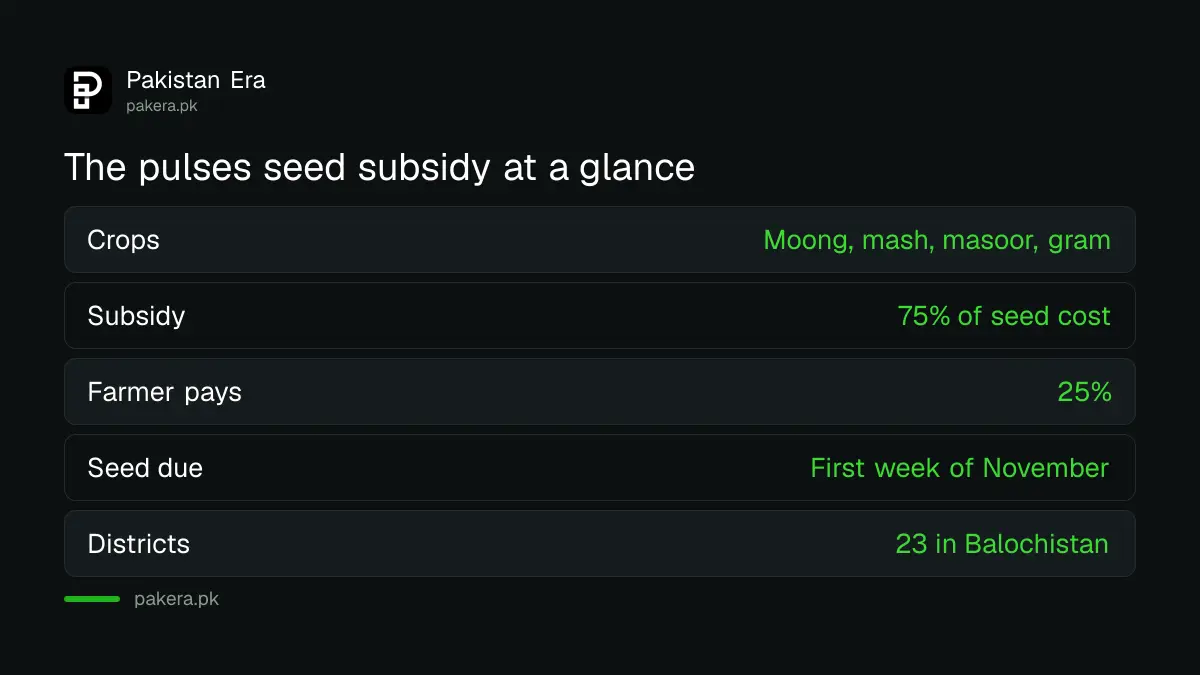
The notice offers certified seed of moong, mash, masoor and gram (chana) at a 75 per cent subsidy. The farmer pays 25 per cent of the seed cost. The government pays the remaining 75 per cent. Seed is due in the first week of November 2026.
Certified seed is seed that has been tested for purity and germination before sale. It costs more than seed you keep from last year's crop, which is why the subsidy matters. The notice does not give a price per kilogram, so we cannot tell you the rupee amount you would pay.
| Item | What the notice says |
|---|---|
| Crops | Moong, mash, masoor, gram (chana) |
| Subsidy | 75 per cent of certified seed cost |
| Farmer pays | 25 per cent |
| Seed supply | First week of November 2026 |
| Districts | 23 districts of Balochistan |
| Priority | Farmers with 5 to 12 acres |
Only farmers in 23 listed districts can apply
The notice lists 23 eligible districts. These are Chagai, Noshki, Loralai, Musakhel, Barkhan, Zhob, Sherani, Killa Saifullah, Sibi, Harnai, Kohlu, Dera Bugti, Naseerabad, Jaffarabad, Kachhi, Jhal Magsi, Khuzdar, Awaran, Kharan, Washuk, Kech, Panjgur and Gwadar.
Quetta, Pishin, Lasbela, Mastung and Kalat are not on this list. The same portal covers 36 districts in its dealer and market pages, so the pulses list is clearly narrower. If your district is missing, the notice gives no route for you. Call the helpline before you spend money on copies.
You need Benazir Kissan Card registration, land papers and irrigation
The notice sets four conditions. You must be registered under the Benazir Kissan Card. You must own the land or hold a documented lease. The crop needs adequate irrigation. Farmers with 5 to 12 acres get priority.
Registration comes first. If you are not on the card yet, our guide on how to check your Benazir Kissan Card registration status shows the portal route. Do that before you queue for a form.
"Adequate irrigation" is not defined in the notice. The form asks you to name your source: tubewell, canal, karez or other. It also asks you to say yes or no to whether the water is adequate. An officer checks this, so answer honestly.
Attach four documents to the application form
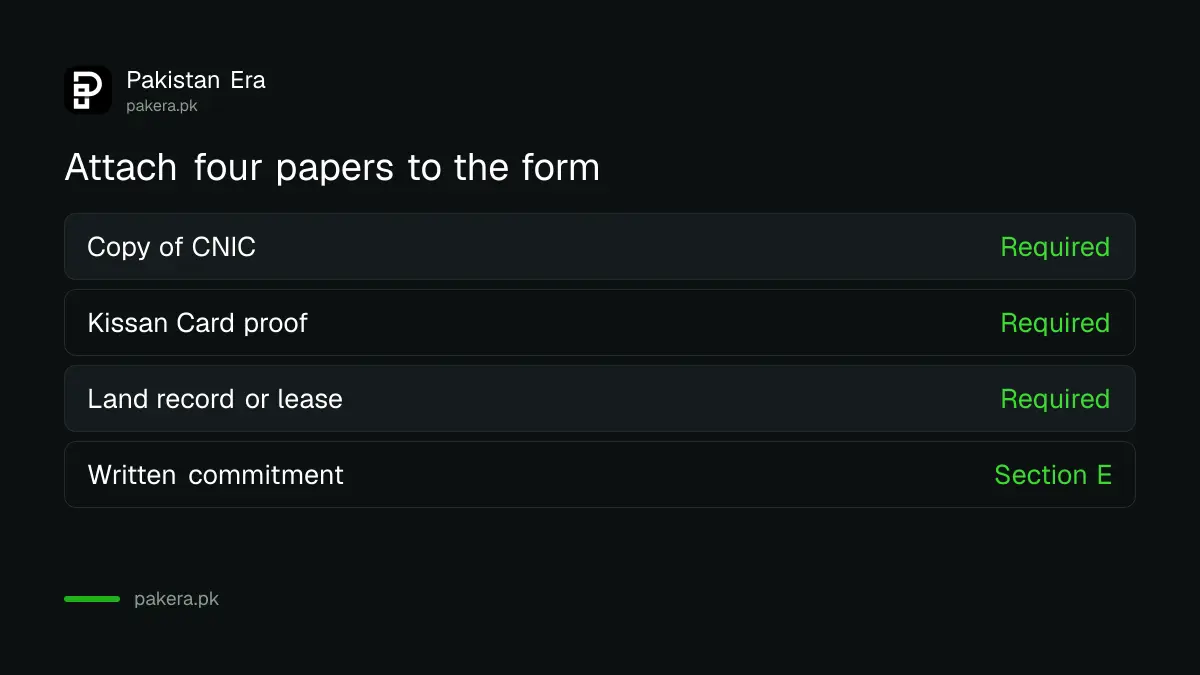
The form asks for a copy of your CNIC, a copy of your Benazir Kissan Card or registration proof, your land ownership document or lease agreement, and a written commitment to grow the pulses. Missing any one can lead to rejection or a hold.
- Get the form from the Agriculture (Extension) office in your district. The notice also links a downloadable copy of the form on the portal.
- Fill Section A: your name, father's or husband's name, CNIC, mobile number, Benazir Kissan Card registration number, village or union council, tehsil and district.
- Fill Section B: total landholding in acres, area you will put under pulses, owner or lease, khasra or khewat number, irrigation source and whether it is adequate.
- Fill Section C: tick each pulse you want, and write the area in acres and the seed you need in kilograms.
- Attach the four documents listed in Section D.
- Sign Section E, or put your thumb impression, and hand the form in at the district office.

Section E is a promise you can be held to
Section E is a declaration with ten points. By signing, you promise to grow only the pulse varieties supplied, to care for the crop, to follow department instructions and to allow inspection of your farm. A false statement can cancel the subsidy.
Read it before you sign. The declaration says the department may inspect your farm from time to time. It also says that if any information is found false, your application may be cancelled and the subsidy withdrawn. Do not claim more acres than you hold.
The bottom of the form is for office use. The officer ticks whether your card is verified, whether the land record is verified, whether you are in the 5 to 12 acre priority group, and whether the application is approved, rejected or on hold. That tells you where a refusal can come from.
What the notice does not tell you
The notice does not state an application deadline, a maximum quantity per farmer, a price per kilogram or the name of the seed varieties. The form refers to "pulses varieties provided under this project". These details are likely to come from your district office.
Ask four things when you hand in the form. What is the last date? How many kilograms can one farmer take? What will the 25 per cent come to in rupees? Where and when will the seed be handed out? Write the answers down with the date and the officer's name.
If the district office cannot help, the department's helpline is 0311-1333294, and the office is the Directorate General Agriculture Extension near Sariab Police Station, Sariab Road, Quetta. The email on the portal is dgagriextqta@gmail.com.
Wheat farmers get a different scheme. For Sindh, see the Rs 14.9 billion wheat subsidy. For Punjab, the route runs through the Punjab Kissan Card, which is a separate card with separate rules.
Common questions
Who can get the 75 per cent pulses seed subsidy in Balochistan?
Farmers registered on the Benazir Kissan Card in the 23 listed districts. They must own or lease the land and have adequate irrigation. Farmers with 5 to 12 acres get priority, according to the notice.
Which pulses are covered?
Moong, mash, masoor and gram (chana). The notice names only these four, and only certified seed.
How much does the farmer pay?
The farmer pays 25 per cent of the certified seed cost. The notice does not state a rupee price per kilogram.
When will the seed be given out?
The notice says the first week of November 2026. It does not name the collection points, so ask your district Agriculture (Extension) office.
Is there a last date to apply?
The notice we read on 12 October 2026 gives no last date. Ask your district office and get the answer in writing.
Can a tenant farmer apply?
Yes, if you hold a documented lease agreement. Attach the lease to the form with your CNIC and card proof.
How we verified this
What we checked, where we read it, and what we could not confirm.
We read the notice titled "75% Subsidy: Certified Pulses Seed for Farmers" and its application form at balochistankissan.gob.pk on 12 October 2026. The notice is dated 9 August 2026. We did not read an application deadline, a price list or a seed quantity limit because the portal does not publish them. We did not submit a form.
About the author

Public Services and Education Journalist
Fajr Riaz is a journalist and content writer at Pakistan Era, based in Lahore. She covers the questions people meet in everyday life in Pakistan: how a public service works, what a change in the rules means, and where to find a reliable answer.