Finance Minister Leaves for IMF Meetings in Bangkok, With 60 Meetings and All 3 Rating Agencies
Muhammad Aurangzeb left for the IMF and World Bank meetings in Bangkok on 10 October 2026. See who he meets, what was not announced and what it means for you.
Finance Minister Muhammad Aurangzeb left for Bangkok on 10 October 2026 to lead Pakistan at the IMF and World Bank Annual Meetings, which run from 12 to 18 October. The Finance Division says he has more than 60 meetings lined up, including talks with Fitch, Moody's and S&P, the three agencies that grade Pakistan's credit.
The Finance Division's statement is short on dates and long on names. It does not say that any loan will be signed or any deal closed in Bangkok. It says the minister will explain Pakistan's reforms to lenders, investors and rating agencies. This report sets out what was announced, what was not, and why a rating meeting matters to the cost of living.
The Finance Minister left Pakistan on 10 October for Bangkok
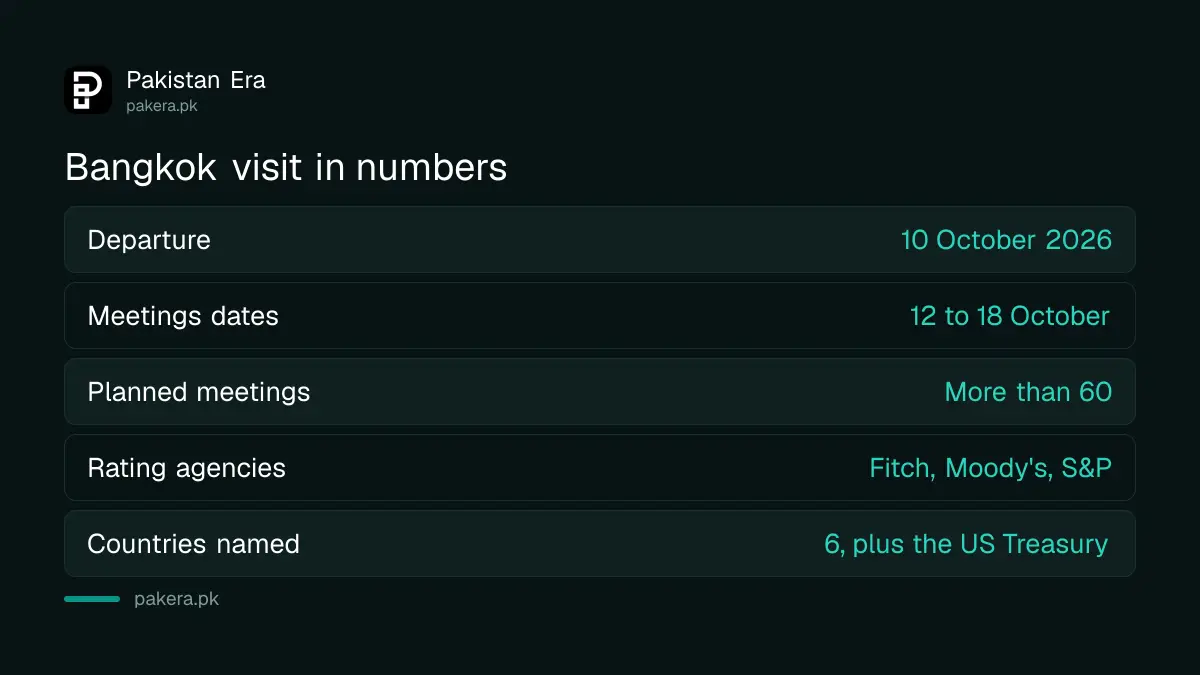
Senator Muhammad Aurangzeb, Federal Minister for Finance and Revenue, departed on Saturday 10 October 2026 to lead Pakistan's delegation. The Annual Meetings run from 12 to 18 October. The Finance Division release is Press Information Department release No. 126, dated 10 October.
The release says he will hold "over 60 high-level engagements". That is a count of meetings, not of agreements. Most such meetings are closed-door briefings, and the outcomes show up weeks later, if at all, as a rating note, a loan, or a bond sale.
He will meet all three credit rating agencies
The release says the minister will "engage with all three major global sovereign credit rating agencies, Fitch Ratings, Moody's and S&P Global". A sovereign credit rating is a grade for a whole country. It tells foreign lenders how likely the government is to repay on time.
Pakistan's grades today are B3 at Moody's, B at S&P and B- at Fitch, as we set out in our credit rating explainer. All three are in the single B band, below investment grade. A meeting does not change a grade. The agencies decide on their own schedule, and the release gives no date for any review.
Why should a shopper care? A better grade lowers the interest Pakistan pays on foreign borrowing. That cost lands on the budget, and the budget is where fuel levies, power tariffs and tax rates are set. After the September sale, Pakistan owes about $230 million a year in interest on its two new Eurobonds alone, by our sum in the Eurobond list.
The programme covers lenders, investors and 6 countries
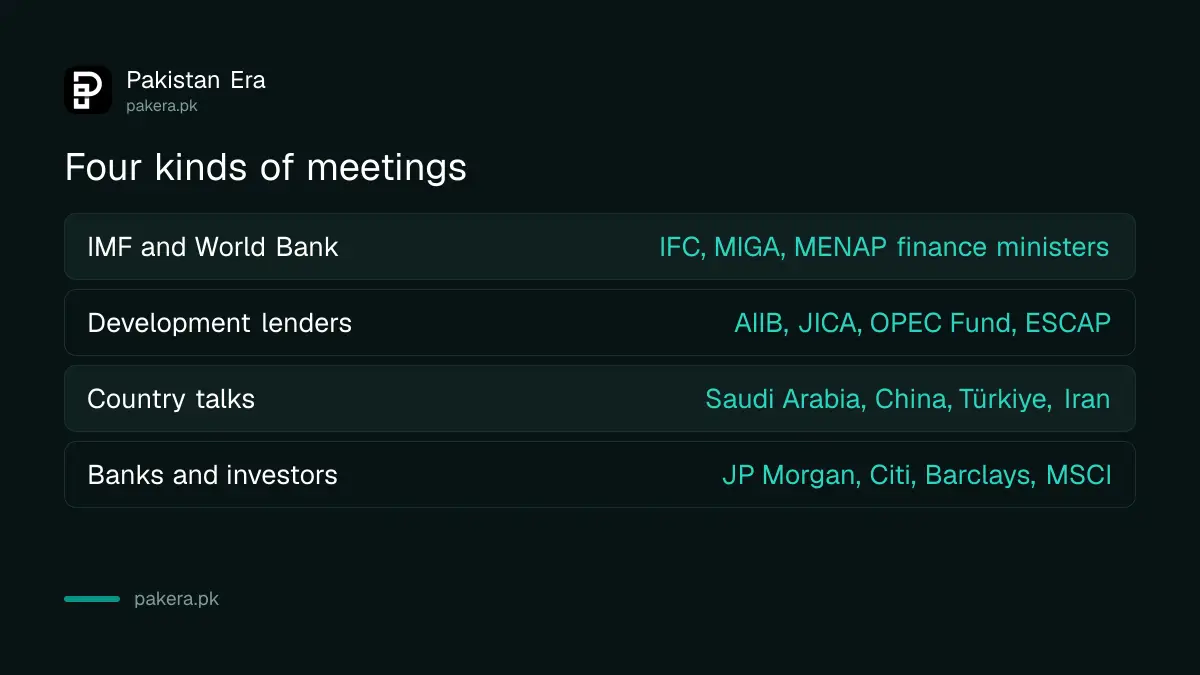
The release groups the meetings into four kinds. Here is the list as the Finance Division gave it.
| Type of meeting | Who the release names |
|---|---|
| IMF and World Bank Group | IMF leadership, World Bank leadership, IFC, MIGA, the IMF chief's meeting with finance ministers of the Middle East, North Africa, Afghanistan and Pakistan region |
| Development lenders | AIIB, OPEC Fund, Saudi Fund for Development, ITFC, JICA, ECO Trade and Development Bank, UN ESCAP, IOM |
| Country talks | Saudi Arabia, China, Türkiye, Iran, the United Kingdom, Thailand, and the US Department of the Treasury |
| Banks and investors | JP Morgan, Citi, Deutsche Bank, Standard Chartered, MUFG, Mashreq, Dubai Islamic Bank, Barclays, Bank of America, Jefferies, MSCI and others |
It also names a meeting with Alibaba International Digital Commerce on Pakistan's digital economy and e-commerce. And it lists forums he will attend, including the G-24 finance ministers, the V20 ministerial dialogue and a session called "Mitigating Sovereign Risks in Market-Access Countries".
What the release does not say
The statement is a list of intentions. It names no figure for new money. It does not say Pakistan will ask for a loan, a rating upgrade or a new bond. It does not mention the IMF Executive Board vote that must follow the 7 October agreement.
Here is what to hold in mind while reading Bangkok headlines this week:
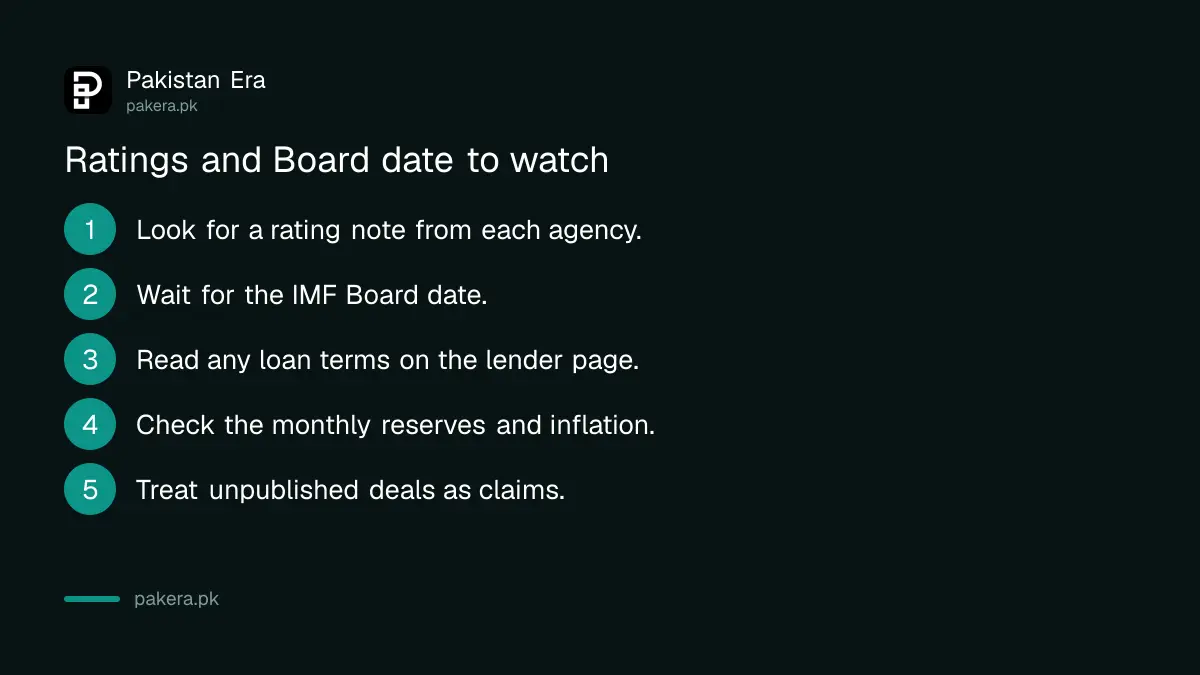
- The Annual Meetings are not an IMF Board meeting. The Board votes separately, and no date has been announced.
- A meeting with a rating agency is a briefing. The grade changes only when the agency publishes a decision.
- The $1.2 billion agreed on 7 October is not released until the Board approves, as our report on the IMF staff-level agreement explains.
- Any deal announced in Bangkok is a claim until the lender or the Finance Division publishes the terms.
The full calendar of the week, including the 13 October release of the IMF's new Pakistan forecast, is in our guide to the Bangkok meetings.
What the visit means for an ordinary household
Nothing changes in your bill or your pump price because of this trip. The effects, if any, are slow and indirect. They run through three routes.
- Borrowing cost. A calmer rating outlook can lower what Pakistan pays to borrow abroad. That leaves more room in the budget.
- Dollar flows. Talks with banks, investors and development lenders aim at more dollar inflows. More dollars support the rupee and the reserves.
- Trade and jobs. Meetings with Saudi Arabia, China, Türkiye, Iran and the UK are about trade and investment, which feed exports and jobs.
The release itself frames the visit as a move "from macroeconomic stabilization towards sustainable, investment and export-led growth". That is the government's description, and results will show in the official monthly numbers for reserves, exports and inflation, which you can check using our steps for the State Bank and Bureau of Statistics pages.
Common questions
When did the Finance Minister leave for Bangkok?
He departed on Saturday 10 October 2026, according to the Finance Division release of the same day.
Which rating agencies will he meet?
All three major ones: Fitch Ratings, Moody's and S&P Global. The release gives no meeting dates.
Will Pakistan get the $1.2 billion IMF money in Bangkok?
No. The money follows only after the IMF Executive Board approves the 7 October agreement. The Annual Meetings are not a Board meeting.
How many meetings are planned?
The release says more than 60 high-level engagements, with lenders, countries, banks, investors and policy groups.
Does this change petrol, electricity or tax rates?
No. The release announces no change to any rate. Those are set by separate notifications.
How we verified this
What we checked, where we read it, and what we could not confirm.
Last checked 11 October 2026, about 3 am PKT. We read Press Information Department release No. 126 (the Bangkok visit), dated 10 October 2026. The current ratings and bond figures come from our earlier explainers. The household effects section is our own reading, not a government statement.
About the author

Global Affairs & Political Economy Writer
Muhammad Hatim is a book lover who started writing because he enjoys it. At Pakistan Era he writes about international relations, geopolitics and the global economy, with a particular interest in South Asia and the forces behind current events.