Pakistan Banks Charged 11.89% on New Loans in September 2026, Paid 9.14% on Deposits
SBP data out on 19 October 2026: banks in Pakistan charged 11.89% on new loans in September and paid 9.14% on deposits earning profit. See what changed.
Short answer: Banks in Pakistan charged an average of 11.89% on new loans in September 2026, down from 11.99% in August, according to State Bank of Pakistan (SBP) figures released on 19 October 2026. The average rate on deposits that earn profit rose to 9.14% from 9.07%. Both figures are provisional.
We read SBP's table of weighted average lending and deposit rates on 20 October 2026. It is the monthly figure for what banks actually charged borrowers and paid savers, not the rate they advertise. "Weighted" means a big loan counts for more than a small one. The table lists the September numbers as provisional and the August numbers as revised.
Banks charged 11.89% on new loans in September 2026
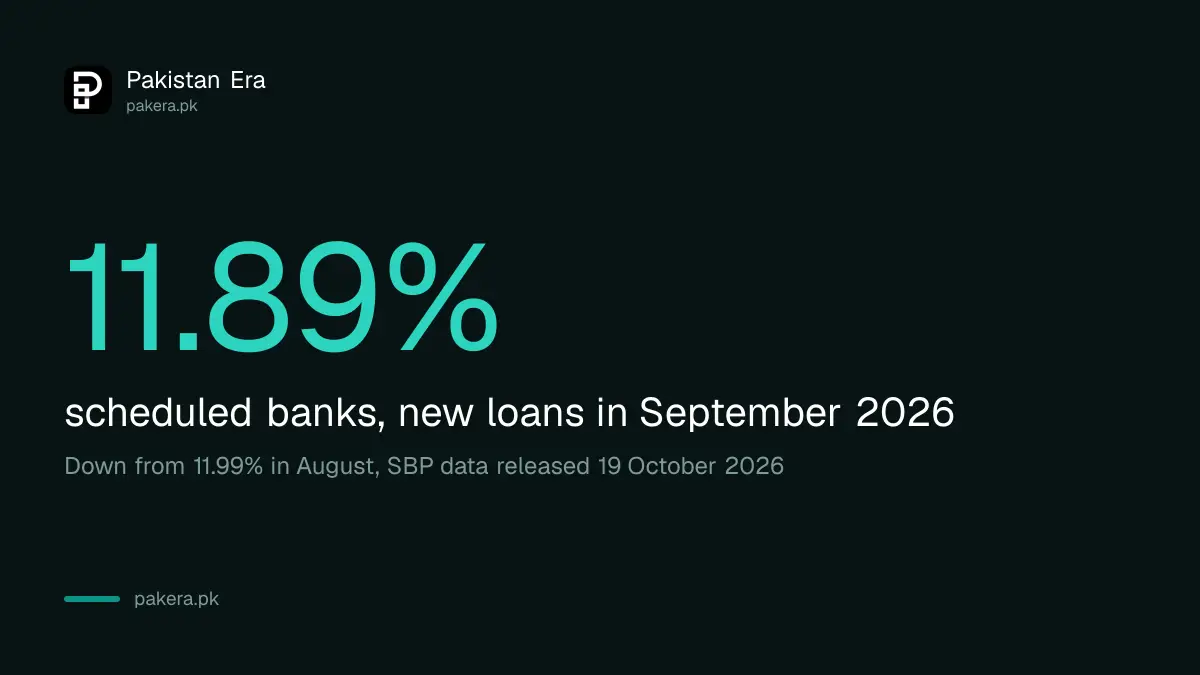
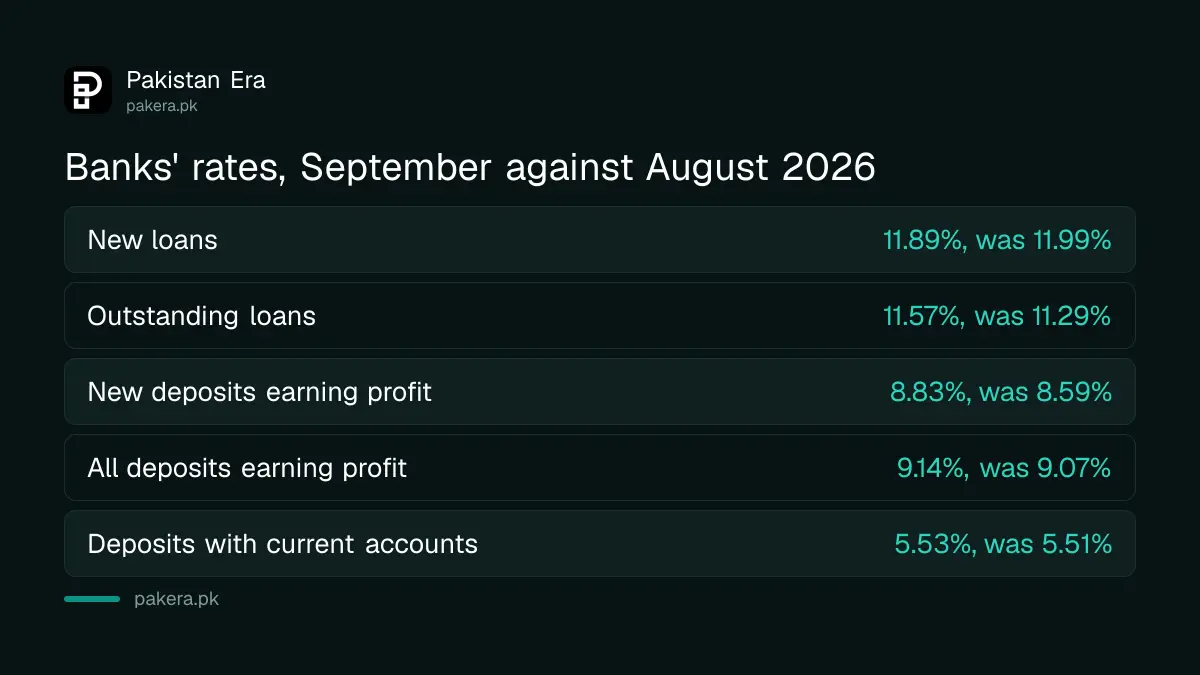
The average rate on new loans from scheduled banks was 11.89% in September 2026, against 11.99% in August and 11.82% in September 2025. That is 0.39 points above SBP's 11.5% policy rate, which the State Bank held on 14 September.
New loans here means every rupee disbursed in the month, including loans that were renewed, rolled over or repriced. Running finance lines count too. If a loan carried no markup at all, it pulls the average down, so SBP also shows a second figure without those. Excluding zero markup loans, new lending cost 11.94%, down from 12.26%.
The cost of all loans still on banks' books went the other way. The outstanding loan rate rose to 11.57% from 11.29% in August. Old loans reset to KIBOR every few months, so this figure moves later than the new loan rate. For how a reset reaches your own instalment, see what the policy rate does to your loan EMI.
Savings accounts and deposits earned 9.14% on average
Deposits that earn profit paid an average of 9.14% in September 2026, up from 9.07% in August and 8.39% a year earlier. Counting current accounts that pay nothing, the average across all deposits was 5.53%. New deposits placed during the month earned 8.83% when zero profit accounts are left out.
| Scheduled banks, % a year | September 2026 | August 2026 | September 2025 |
|---|---|---|---|
| New loans | 11.89 | 11.99 | 11.82 |
| All outstanding loans | 11.57 | 11.29 | 11.24 |
| New deposits, profit earning only | 8.83 | 8.59 | 8.46 |
| All deposits, profit earning only | 9.14 | 9.07 | 8.39 |
| All deposits, with current accounts | 5.53 | 5.51 | 5.20 |
Most big banks pay exactly 10% on ordinary savings accounts because SBP sets a minimum for individuals. The 9.14% average sits lower because it also covers term deposits, company money and other balances that do not get that minimum. Current rates bank by bank are in our list of savings account profit rates.
The gap between loans and deposits narrowed to 2.94 points
On the books, banks earned 12.08% on loans that carry markup and paid 9.14% on deposits that earn profit in September. The gap is 2.94 points, down from 3.18 in August. Counting current accounts that pay nothing, the gap widens to 6.04 points, because those balances cost banks nothing.
That second number explains why banks push current accounts so hard. Every rupee sitting in a current account is free money for the bank. If you keep a large balance there for months, you are funding that gap yourself. Moving the idle part to a savings account or a term deposit is the simple fix.
Savings still earn less than September inflation of 10.3%
Inflation was 10.3% in September 2026, so a deposit earning the 9.14% average lost about 1.16 points of buying power before tax. A savings account at the 10% minimum lost about 0.3 points. Tax on profit widens the loss further.
The September inflation figure comes from the Pakistan Bureau of Statistics. Banks deduct tax on profit at source before it reaches you, and non-filers pay a higher rate than filers. So the real return after tax is lower again. Our check of National Savings against a bank savings account works through the after tax numbers.
Microfinance banks charged 34.40% and paid 12.38%
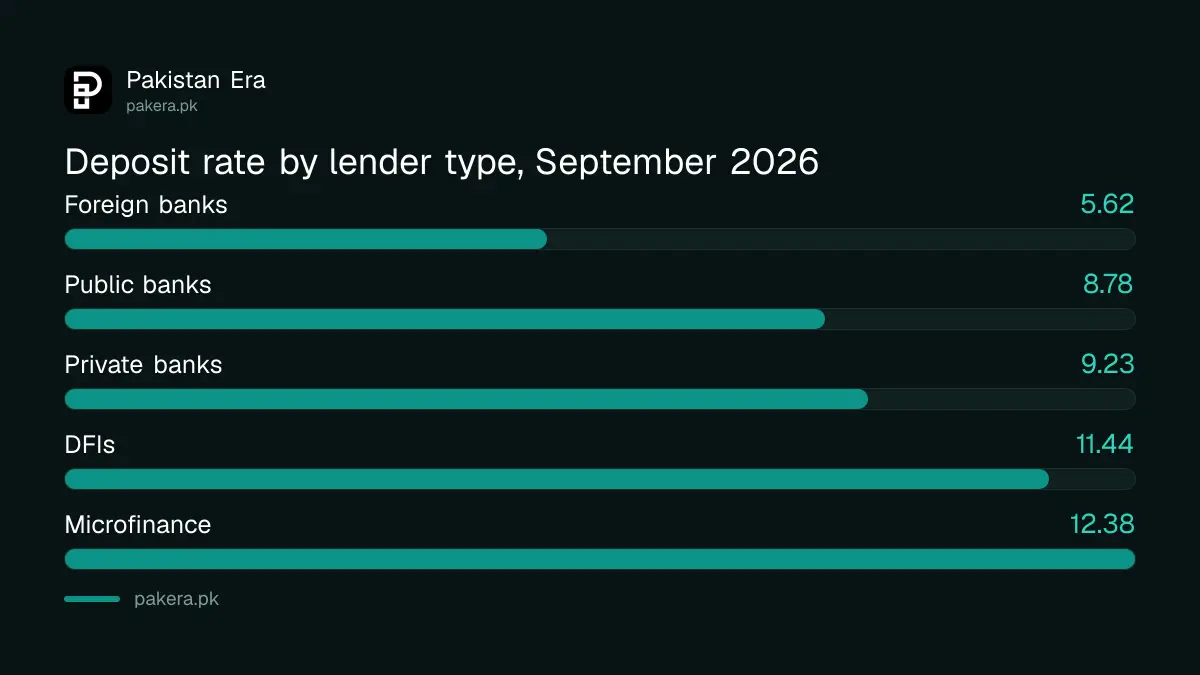
Rates differ widely by type of lender. Microfinance banks charged 34.40% on new loans in September and paid 12.38% on profit earning deposits. Private banks charged 11.96% and paid 9.23%. Public sector banks charged 12.41% and paid 8.78%.
| Lender type | New loans, % | Deposits earning profit, % |
|---|---|---|
| Public sector banks | 12.41 | 8.78 |
| Private banks | 11.96 | 9.23 |
| Foreign banks | 5.30 | 5.62 |
| Development finance institutions | 12.30 | 11.44 |
| Microfinance banks | 34.40 | 12.38 |
One line looks odd. Foreign banks' new loan rate dropped to 5.30% from 12.26% in August. SBP's table does not explain it. Foreign banks lend little in Pakistan, so a few large cheap loans can swing their average. We report the figure as SBP printed it and do not read anything into it.
What these numbers mean before the 26 October decision
SBP's Monetary Policy Committee meets on 26 October 2026. If it moves the policy rate, new loan rates follow within days, while outstanding loans and deposits follow over the next few months. The September figures are the baseline any change will be measured against.
Three of ten committee members voted to raise the rate in September, according to the minutes of the September meeting. The preview of the 26 October meeting sets out the dates. If you are deciding between a loan now and later, these are the steps to take:
- Note the rate on your own loan offer and compare it with the 11.89% average.
- Ask the bank whether your rate is fixed or KIBOR plus a spread.
- For savings, check your statement shows at least 10% on an ordinary savings account.
- Check again after 26 October, since savings floors move from the first day of the next month.
The August figures are in our report on what banks charged and paid in August.
Common questions
What is the average bank lending rate in Pakistan now?
Scheduled banks charged 11.89% on new loans in September 2026, SBP data shows. Loans already on the books averaged 11.57%. Your own rate depends on KIBOR, your bank's spread and the type of loan.
What do banks pay on deposits on average?
Deposits that earn profit averaged 9.14% in September 2026. Including current accounts that pay nothing, the average was 5.53%.
Why is the average deposit rate below the 10% savings minimum?
The 10% minimum applies to ordinary savings accounts of individuals with balances up to Rs 10 million. The average also covers term deposits, company deposits and other balances outside that rule.
Are these final figures?
No. SBP marks September 2026 as provisional and revises it the next month. The August numbers in our table are the revised ones.
Why did foreign banks show a 5.30% loan rate?
SBP gives no reason in the table. Foreign banks are a small part of lending, so a few large loans at low rates can move their average sharply.
When does SBP publish the October figures?
The September table came out on 19 October, so October's figures should follow in the second half of November. SBP lists the release on its economic data page.
How we verified this
What we checked, where we read it, and what we could not confirm.
Last checked 20 October 2026. Every rate on this page comes from SBP's table of overall weighted average lending and deposit rates, listed as released on 19 October 2026 on SBP's economic data page, which we downloaded and read on 20 October 2026. The policy rate of 11.5% and the 26 October meeting date are from SBP's monetary policy page. The gaps between rates and the after inflation figures are our own arithmetic. We could not find an SBP explanation for the drop in foreign banks' loan rate.
About the author

Public Services and Education Journalist
Fajr Riaz is a journalist and content writer at Pakistan Era, based in Lahore. She covers the questions people meet in everyday life in Pakistan: how a public service works, what a change in the rules means, and where to find a reliable answer.