Check What Banks Charge and Pay in Pakistan: 11.99% on New Loans, 9.07% on Savings, August 2026
Banks charged 11.99% on new loans and paid 9.07% on profit-paying deposits in August 2026, SBP data shows. See rates by bank type and how to use them.
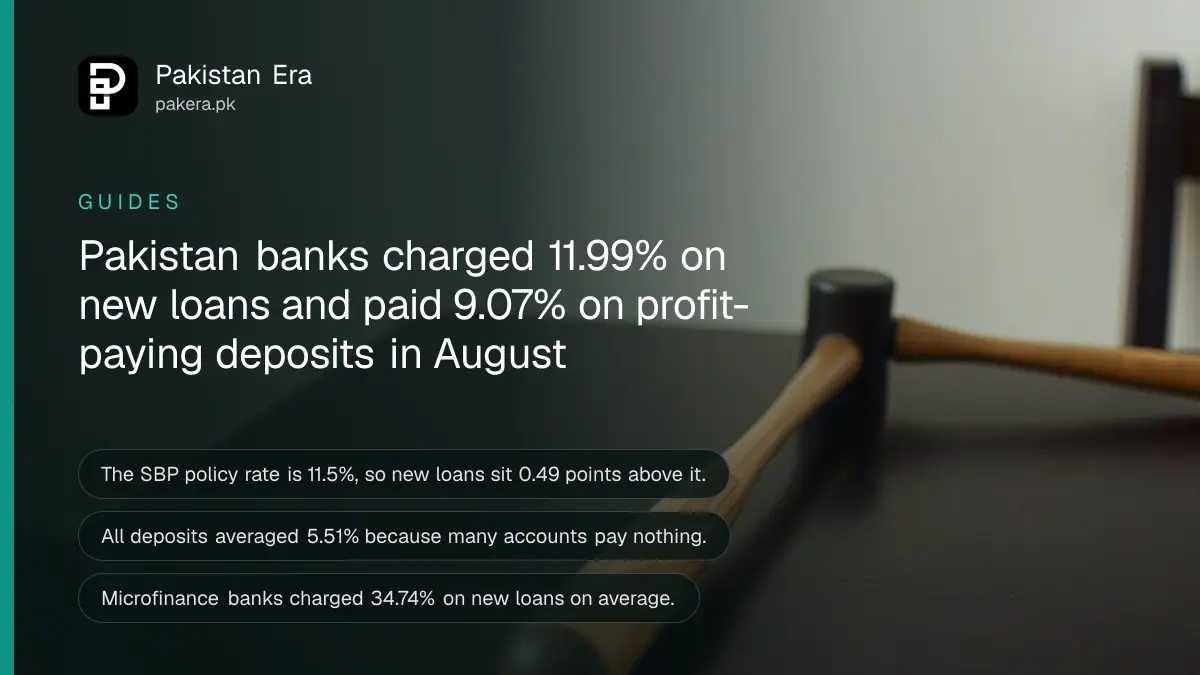
Short answer: In August 2026, scheduled banks in Pakistan charged an average of 11.99 per cent on new loans, says the State Bank of Pakistan (SBP). On deposits they paid 5.51 per cent when all accounts are counted, or 9.07 per cent on accounts that actually pay profit. The SBP policy rate is 11.5 per cent. These are provisional figures.
Before you sign a loan or open a savings account, it helps to know what the whole banking system is doing. A bank quoting you 14 per cent on a loan is above the average. A bank paying 6 per cent on your savings is below what interest-bearing deposits earned. This page puts the SBP's monthly numbers in plain order so you can check any offer against them.
We read the SBP table "Overall Weighted Average Lending and Deposit Rates" on 12 October 2026. SBP listed it on its Economic Data page on 18 September 2026 and marks August 2026 as provisional.
New loans cost 11.99 per cent on average in August 2026
The table reports rates "weighted" by size. A large loan counts for more than a small one. For all scheduled banks, new loans disbursed in August carried an average rate of 11.99 per cent. Excluding loans between financial institutions it was 12.15 per cent.
| Measure, scheduled banks | August 2026 | July 2026 | August 2025 |
|---|---|---|---|
| New loans | 11.99% | 11.93% | 11.87% |
| Loans outstanding | 11.29% | 11.27% | 11.33% |
| Fresh deposits, all accounts | 4.17% | 3.97% | 5.32% |
| Deposits outstanding, all accounts | 5.51% | 5.60% | 5.31% |
| Deposits outstanding, profit-paying only | 9.07% | 9.20% | 8.44% |
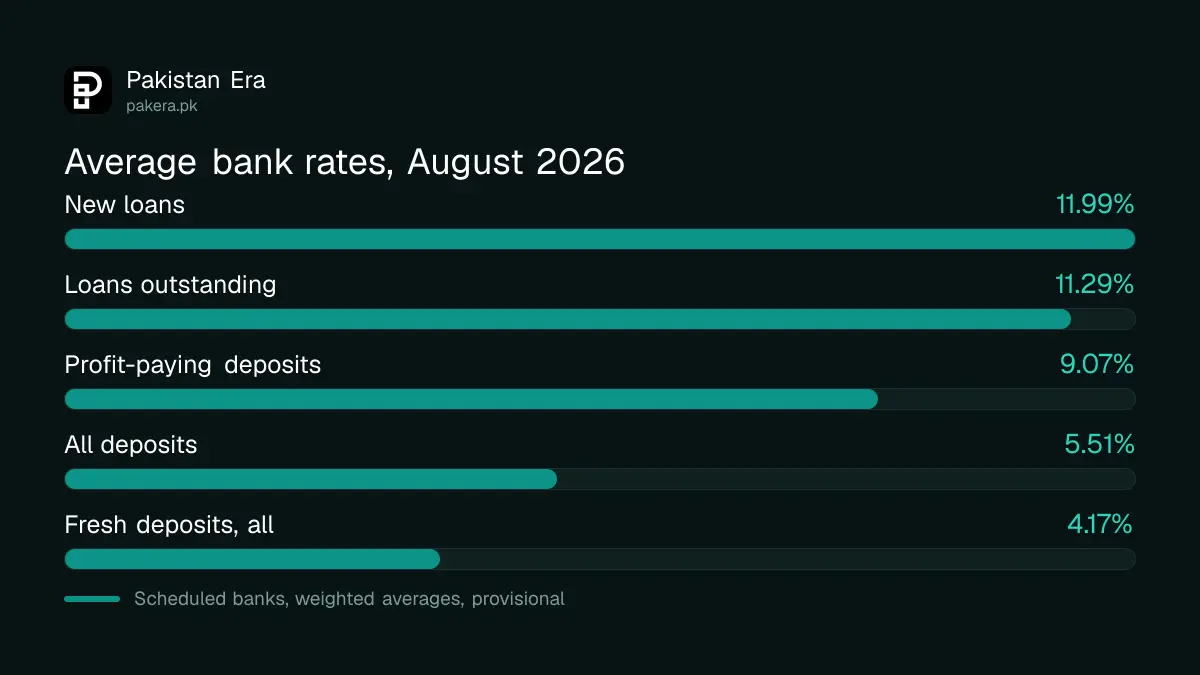
The July figures are revised and the August figures are provisional, so they may move. All rows are for scheduled banks and include lending between financial institutions. The last row leaves out zero-rate accounts, as the next section explains.
Savers got 5.51 per cent, but 9.07 per cent on accounts that pay
Many bank accounts, such as current accounts, pay nothing. The SBP shows deposit rates two ways. Including those zero-rate accounts, the average on all outstanding deposits was 5.51 per cent. Excluding them, the average on accounts that pay profit was 9.07 per cent.
The second number is the better guide to what a savings account can pay. For the actual offers, see our table of savings account profit rates in October 2026. At about 10 per cent at most big banks, they sit just above the 9.07 per cent system average.
Savers still trail prices. Consumer inflation was 10.3 per cent in September, as we covered in the September inflation report. A deposit earning 9.07 per cent loses about 1.2 percentage points of buying power, by our subtraction. Our guide on whether your savings beat inflation shows how to work it out for your own balance.
The spread between loans and deposits is about 2.9 points
New loans cost 11.99 per cent. Profit-paying deposits earned 9.07 per cent. The gap is 2.92 percentage points, by our subtraction. That gap pays for bank costs, bad loans and profit.
The new loan rate is also 0.49 points above the SBP policy rate of 11.5 per cent. Our explainer on what the policy rate does to your loan EMI shows how banks price off it, and the KIBOR rate is the benchmark most loans follow.
- The SBP sets the policy rate, 11.5 per cent in September 2026.
- Banks price loans off KIBOR, which follows the policy rate.
- They add a margin for risk and cost.
- The weighted average lands near 12 per cent.
Public, private and foreign banks price differently
The table splits banks by ownership. New loans averaged 12.39 per cent at public sector banks, 11.95 per cent at private banks and 12.26 per cent at foreign banks. Development finance institutions averaged 12.27 per cent.
On outstanding deposits that pay profit, private banks averaged 9.17 per cent, public sector banks 8.69 per cent and foreign banks 5.63 per cent. Microfinance banks charged far more on new loans, 34.74 per cent on average, which is why a microfinance loan needs close reading.
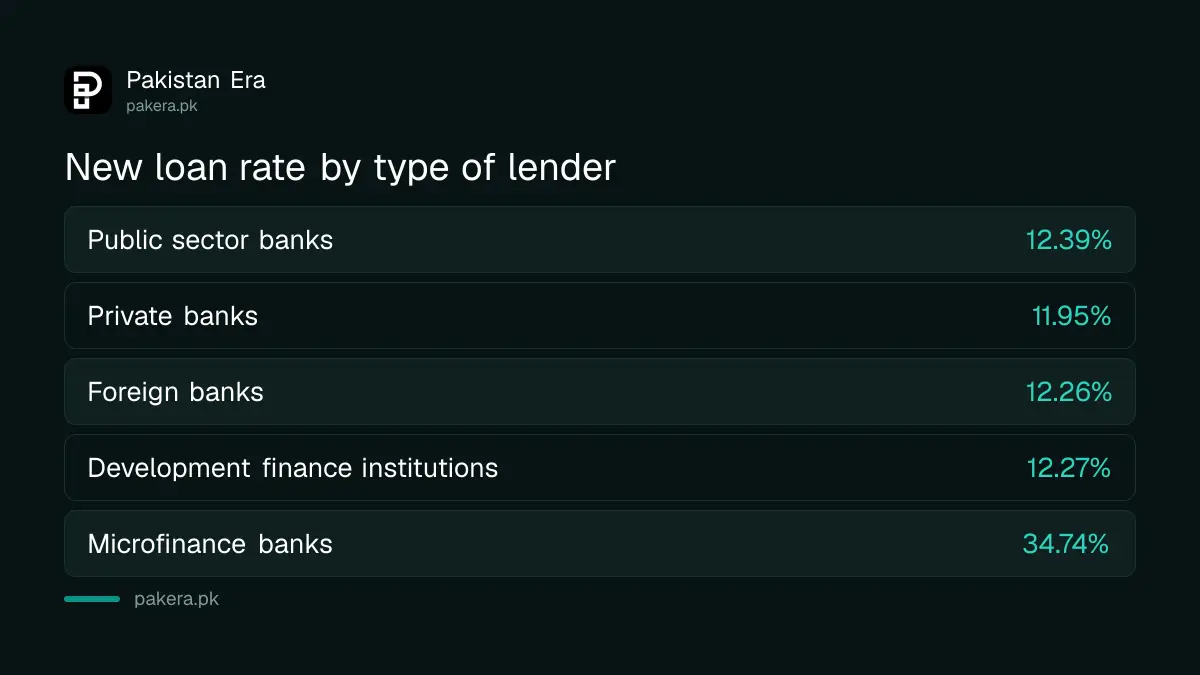
These are group averages. Your own bank, your credit record and the loan type decide your rate. Business, car, home and personal loans all differ. If you borrow to buy or build, see how banks compare in the solar loan comparison or the SME loan guide.
How to use these numbers before you borrow or save
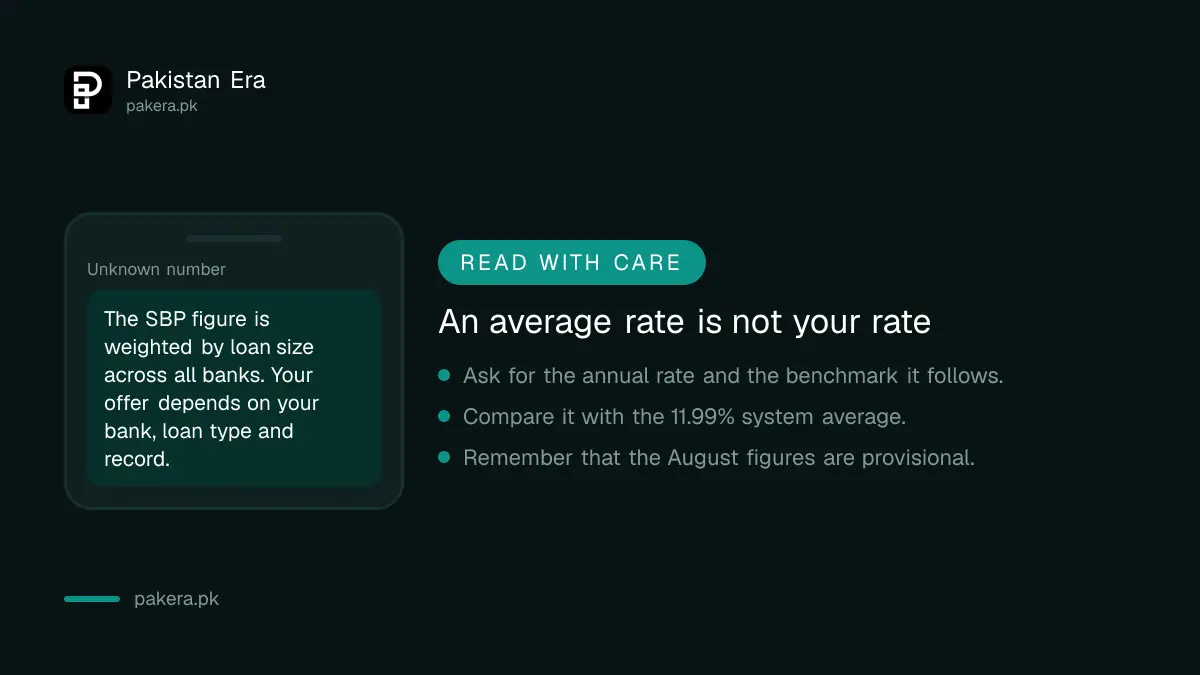
Ask for the loan's annual rate and the benchmark it follows. If the offer is well above 12 per cent for a salaried borrower, ask why. If your savings account pays under 9 per cent, ask about a term deposit or a different product.
Do not treat the average as a promise. Because the average is weighted by size, large borrowers count for more than small ones, so a small borrower may be priced differently. A rate above or below the line is a question to ask, not proof of a good or bad deal.
Common questions
What is the average bank lending rate in Pakistan?
It was 11.99 per cent on new loans from scheduled banks in August 2026, according to provisional SBP data. The rate on loans already outstanding was 11.29 per cent.
What do banks pay on deposits?
The average on all outstanding deposits was 5.51 per cent. On deposits that pay profit it was 9.07 per cent.
Why are there two deposit rates?
One counts zero-rate accounts such as many current accounts, and the other leaves them out. The second shows what profit-paying accounts earn.
Is the average rate the rate I will get?
No. It is a weighted average across all loans. Your rate depends on your bank, loan type, security and record.
Where can I find the table myself?
Open the SBP Economic Data page and look under banking statistics for weighted average lending and deposit rates. It is updated monthly.
How we verified this
What we checked, where we read it, and what we could not confirm.
We read the State Bank of Pakistan Economic Data page and its weighted average lending and deposit rates table on 12 October 2026. August 2026 is marked provisional. The SBP updates the table monthly, so check the date on the page.
About the author

Global Affairs & Political Economy Writer
Muhammad Hatim is a book lover who started writing because he enjoys it. At Pakistan Era he writes about international relations, geopolitics and the global economy, with a particular interest in South Asia and the forces behind current events.