Benazir Nashonuma: Rs 2,000 or Rs 2,500 a Quarter Is Held Until You Comply
BISP says Rs 2,000 a quarter for women and boys, Rs 2,500 for girls, is held until you eat 90% of the Nashonuma sachets and keep visits. See what to prove.
Short answer: In Benazir Nashonuma, BISP's own registration document says Rs 2,000 a quarter for a pregnant or breastfeeding woman or a boy, and Rs 2,500 for a girl, is held back until you show compliance. You must eat at least 90 percent of the nutrition sachets and keep up health visits and vaccinations.
A mother walks out of the facilitation centre with a bag of sachets and a date to come back. She assumes the cash will arrive on its own. It does not. A part of it is locked behind a check, and the check is about the sachets she is carrying.
We read BISP's Benazir Nashonuma registration process document on the BISP downloads page on 12 October 2026. Our earlier guide to registering for Nashonuma said we could not confirm the cash figure on BISP's page. This document does state it, and this article sets out what it says and what it leaves open.
BISP holds back Rs 2,000 or Rs 2,500 a quarter until you comply
The document says Rs 2,000 goes to a pregnant or lactating woman and to a male child in the programme, and Rs 2,500 to a girl child, over a quarter. That amount is withheld and linked to eating the nutrition food and using health services.
| Who | Amount held per quarter | Nutrition food |
|---|---|---|
| Pregnant or lactating woman | Rs 2,000 | Maamta, 75 gram sachet, one a day |
| Boy aged 6 to 23 months | Rs 2,000 | Wawamum, 50 gram sachet, one a day |
| Girl aged 6 to 23 months | Rs 2,500 | Wawamum, 50 gram sachet, one a day |
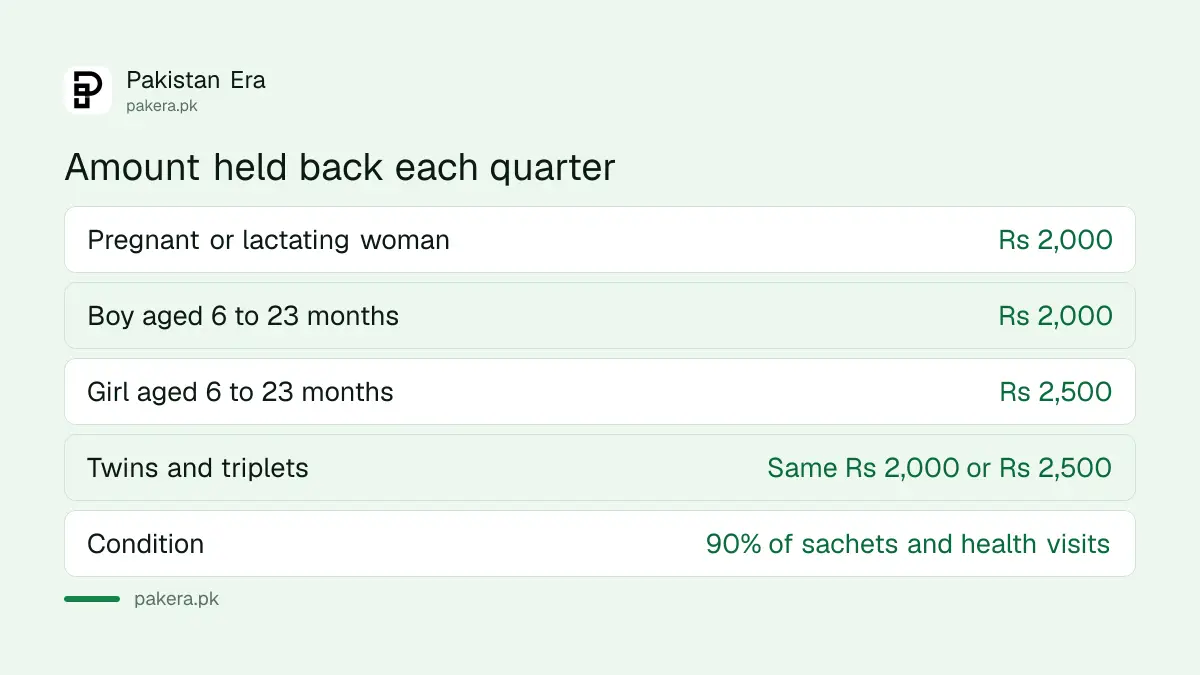
For twins and triplets, the same Rs 2,000 or Rs 2,500 is treated as the compliance amount. The document says payment is processed straight after BISP verifies that the quarter's conditions were met.
One thing to keep straight: this is the conditional part of the money, not the whole of your BISP income. The regular cash is a separate payment, explained in how much the BISP Kafaalat payment is.
The 90 percent rule is about finishing the sachets
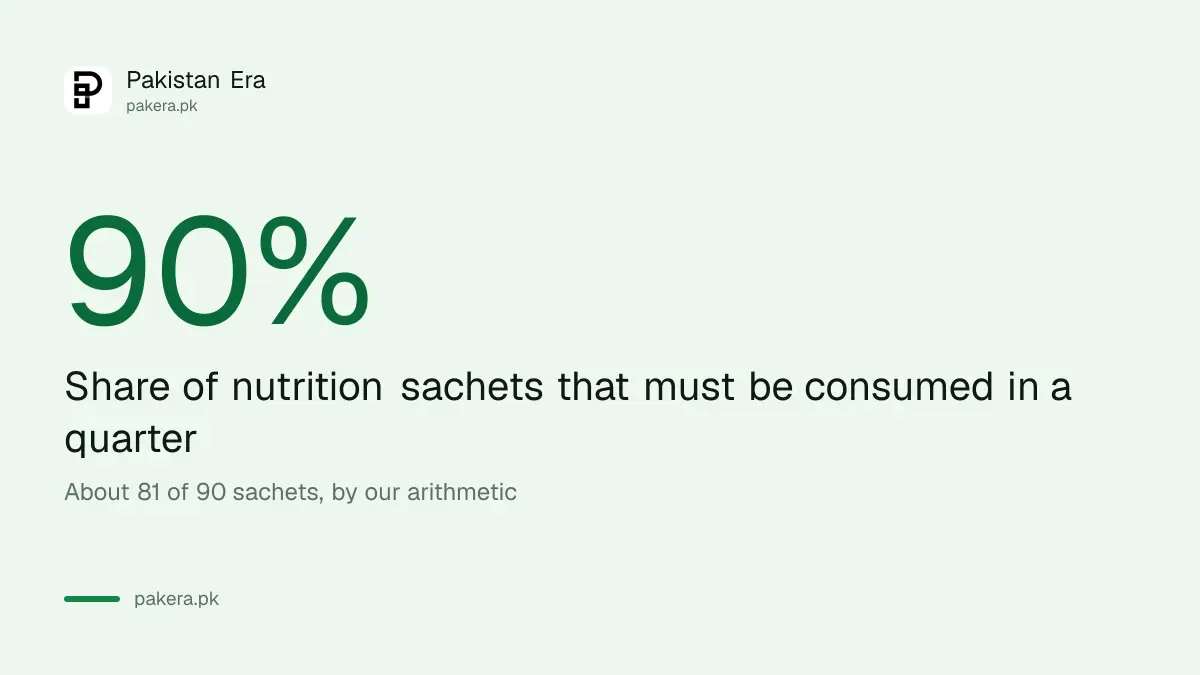
BISP ties the money to consuming at least 90 percent of the specialised nutrition food it provides, as well as antenatal care, postnatal care and routine immunisation. If a quarter has 90 days and you get one sachet a day, 90 percent is about 81 sachets, by our arithmetic.
The document names the two foods. Maamta, a 75 gram sachet, is for pregnant and lactating women. Wawamum, a 50 gram sachet, is for children aged 6 to 23 months. Each is one sachet per day. Each product is named for one group, so keep it for that person.
The document does not explain how consumption is counted. It does not say whether empty sachets are collected, or whether staff ask questions at the visit. Ask the facilitation centre what proof it wants, and keep the empty packets until the quarter is cleared.
You prove eligibility at the facilitation centre with a doctor's check
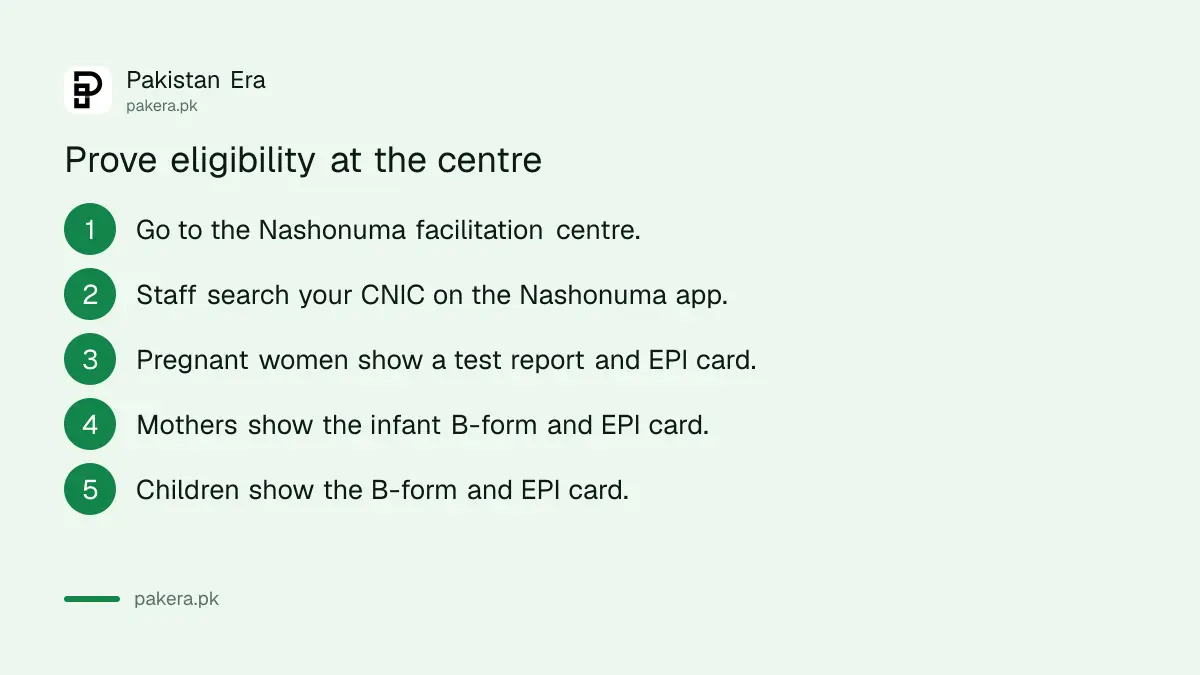
Eligible households are those with an active BISP Kafaalat beneficiary and a pregnant or lactating woman, or a child aged 6 to 23 months. You enrol at a Nashonuma facilitation centre, where your CNIC is searched in the NSER database on the Nashonuma Android app.
- Go to the nearest Nashonuma facilitation centre with the original CNIC.
- Staff search your CNIC in the NSER database on the Nashonuma app.
- A pregnant woman shows a pregnancy test or confirmation report and an EPI vaccination card, with the tetanus (TT) dose in the second trimester.
- A breastfeeding mother shows the B-form of the newborn and the EPI card.
- A child aged 6 to 23 months shows the B-form and the EPI card.
If the doctor cannot verify the pregnancy, or the child's age, you are sent to the registration counter. There the file is marked not eligible for the programme.
Check the household record if the quarter is not paid
If the money has not arrived, the question is which condition was not met. It may be the sachets, the clinic visit, or the vaccination record. Ask the centre which one it recorded, and ask for the date of the next visit so you can fix it before the quarter closes.
BISP's September 2026 newsletter describes a training session on Phase III of the programme and a planning session for Nashonuma 3.0, both for BISP officials and field teams. We cannot say whether the Rs 2,000 and Rs 2,500 amounts, or the 90 percent rule, were changed for that phase. The registration document we read has a 2022 date in its file name.
So take the figures as the last amounts BISP has published in this document. Confirm them at the centre when you enrol. For a complaint, call BISP on 0800-26477, or send the CNIC to 8171 to check your payment status as described in our 8171 guide.
Nobody may take a cut of a conditional payment
Nashonuma money is paid after a check, so women often wait longer than for Kafaalat. That wait is where agents and middlemen try to step in. BISP's documents do not describe any fee for enrolment or for clearing the compliance check.
Do not hand over your phone, SIM or PIN to anybody who offers to "release" the quarter's amount. If a person asks for a share, note the name and place, and report it to the BISP office or on the free helpline.
Common questions
How much money is held back in Benazir Nashonuma?
BISP's document says Rs 2,000 a quarter for a pregnant or lactating woman and for a boy, and Rs 2,500 a quarter for a girl, is held until compliance is verified.
What does 90 percent compliance mean?
It means consuming at least 90 percent of the nutrition sachets provided, along with antenatal care, postnatal care and routine immunisation.
Who can register for Nashonuma?
Active BISP Kafaalat beneficiary households with a pregnant or lactating woman, or a child aged 6 to 23 months.
What documents are needed at the centre?
The CNIC, a pregnancy confirmation report and EPI card for a pregnant woman, or the child's B-form and EPI card for a newborn or a child.
Are the amounts current in 2026?
The figures come from a BISP registration document dated 2022 in its file name. Confirm the current amount at your facilitation centre.
How we verified this
What we checked, where we read it, and what we could not confirm.
We read the Benazir Nashonuma registration process document, the downloads list and the September 2026 newsletter on the BISP website on 12 October 2026. We did not test the Nashonuma app or visit a centre. Amounts and rules may have changed for the third phase of the programme, so check with a facilitation centre before you rely on them.
About the author

Public Services and Education Journalist
Fajr Riaz is a journalist and content writer at Pakistan Era, based in Lahore. She covers the questions people meet in everyday life in Pakistan: how a public service works, what a change in the rules means, and where to find a reliable answer.