Check for CCHF After a Tick Bite or Animal Contact in Pakistan: NIH Signs and Steps
NIH advisory on CCHF: 82 confirmed cases and 20 deaths in 2025. See the signs after tick bites or livestock contact and when to go to hospital in Pakistan.
Short answer: Crimean-Congo haemorrhagic fever (CCHF) spreads by tick bite and by contact with the blood or tissue of infected animals. NIH's April 2026 advisory says to watch for sudden high fever, headache, body pain and bleeding signs after tick or livestock contact. There is no vaccine for people. Go to a hospital and say you had animal or tick contact.
A butcher in Quetta handles a goat the day it arrives from across the border. Three days later he has a high fever and a pounding headache. He assumes it is flu. CCHF looks like flu at first, and that is why NIH wants the animal contact mentioned early.
We read the National Institutes of Health advisory dated 7 April 2026 on 12 October 2026. This article turns it into a check for families, herders and anyone who handles livestock. It is not a diagnosis.
CCHF is a tick-borne virus with a high death rate in Pakistan
CCHF is a viral disease carried by ticks, especially the Hyalomma kind. NIH says the global death rate is 10 to 40 per cent. Pakistan has seen sporadic cases since the first human case in 1976, and Balochistan is the most affected province.
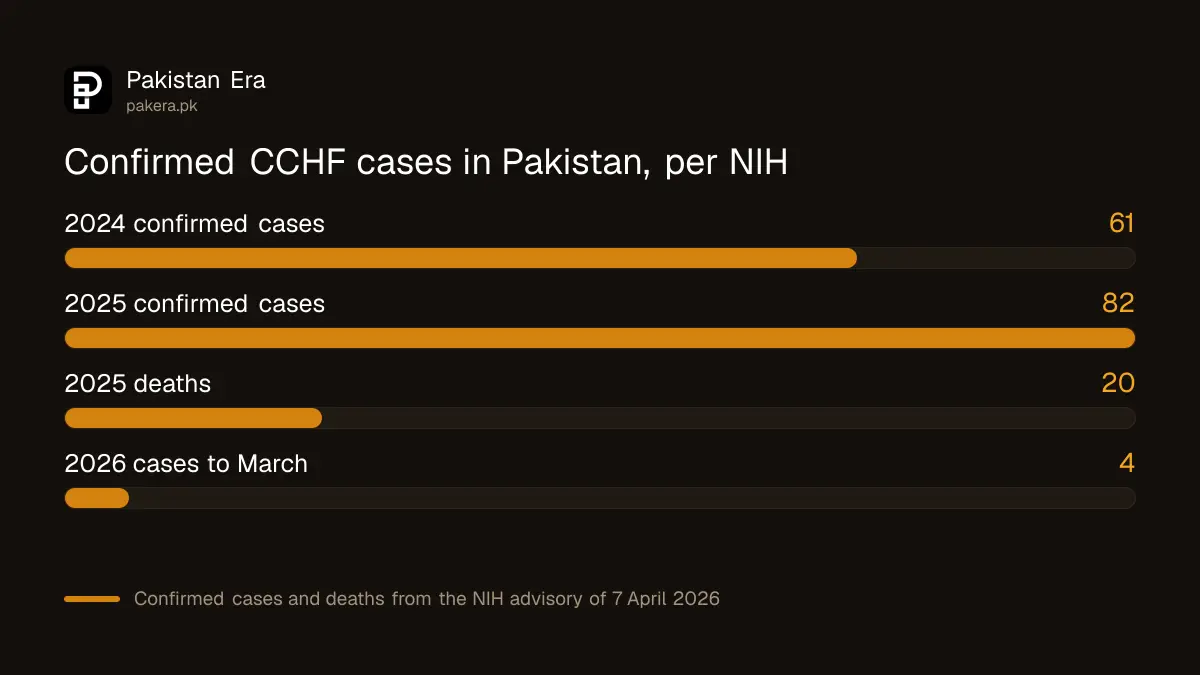
NIH reports 61 confirmed cases in 2024, with a death rate of 15 per cent. In 2025 it reported 82 confirmed cases with 20 deaths, a death rate of about 24.4 per cent. As of March 2026 four cases had been reported.
| Year | Confirmed cases | Deaths or death rate |
|---|---|---|
| 2024 | 61 | Death rate 15 per cent |
| 2025 | 82 | 20 deaths, about 24.4 per cent |
| 2026 to March | 4 | Not stated in the advisory |
NIH also warns that the illness can mimic dengue haemorrhagic fever, so a patient with fever and bleeding needs a proper history. Dengue is far more common. See the dengue warning signs for that case.
How people catch it, and how long it takes to show
NIH lists two main routes. One is a tick bite. The other is contact with infected animal blood or tissue during or right after slaughter. A sick person can also pass it to others through blood or body fluids, and hospitals can spread it through unsafe injection practice.
After a tick bite, symptoms usually start in 1 to 3 days, and at most 9. After contact with infected blood or tissue, they usually begin in 5 to 6 days, with a documented maximum of 13 days. People most at risk are herders, livestock and slaughterhouse workers, vets and health workers in endemic areas.
Animals usually show no illness, so a healthy looking goat can carry the virus. That is why NIH asks for protective clothing, not just a visual check.
Signs to watch for after a tick bite or animal contact
NIH says the onset is sudden. Early signs are high fever, headache, back pain, joint pain, stomach pain, diarrhoea and vomiting. Red eyes, a flushed face and a red throat are common.
- Fever above 38 degrees Celsius for more than 3 days but less than 10, with animal contact
- Bleeding from the gums or frequent nosebleeds
- Red spots or large bruises on the skin
- Yellow skin or eyes, confusion or drowsiness in severe cases
- Bleeding at injection sites
The advisory says bleeding signs can begin around the fourth day of illness. People who recover usually start improving around the ninth or tenth day. Do not wait for bleeding before you go to hospital. High fever after livestock contact is reason enough.
What to do if you handled livestock or found a tick
NIH's practical steps focus on prevention and early care. There is no safe, widely available vaccine for people. Treatment is supportive care, and the antiviral ribavirin has been used with apparent benefit.
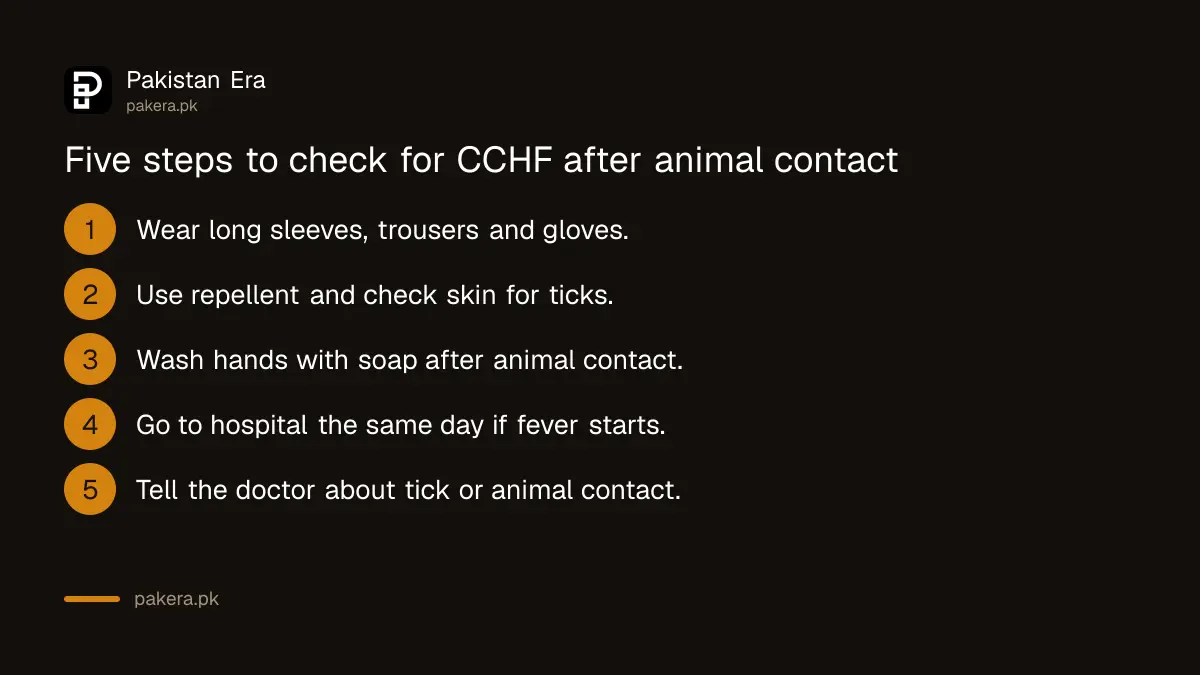
- Wear long sleeves, long trousers and gloves when you handle animals, especially at slaughter.
- Use an approved repellent on skin and check clothes and skin for ticks. Remove any tick safely.
- Wash your hands with soap after contact with animals or with an ill person.
- If fever starts within about two weeks of tick or animal contact, go to a hospital the same day.
- Tell the doctor the dates and the type of animal contact so CCHF can be tested for.
The advisory gives no home treatment, so do not try one. A fever with bleeding signs needs a hospital. The look-alike illnesses are compared in telling chikungunya from dengue.
Carers, slaughterhouses and herd owners have extra steps
Carers should wear gloves and protective gear when looking after an ill person and wash hands with soap. NIH says safe burial practice means avoiding contact with the body fluids of the deceased and using protective equipment.
For animals, NIH says quarantine of animals, about 30 days where possible, before slaughter. It also says to treat animals with approved acaricides, which kill ticks, and to give ivermectin 24 to 30 days before slaughter to animals with ticks. Ask a vet before you treat. Dog bites and snakebites have their own steps in snakebite first aid and dog bite care.
NIH also advises that the Lalli, or myna, a bird that eats ticks off animals, should not be shot or killed.
Common questions
Is there a CCHF vaccine?
NIH says no safe and effective vaccine is widely available for human use. Prevention depends on avoiding ticks and unprotected contact.
Can CCHF pass from person to person?
Yes. NIH says it can pass through contact with blood, secretions or body fluids, and in hospitals through poor infection control.
Which province has the most cases?
NIH says Balochistan is the most affected, linked to livestock moving across the border from Afghanistan and Iran. Cases appear in other provinces too.
Is it only an Eid problem?
The advisory was written ahead of Eid-ul-Azha because of more animal contact. Ticks are active in warm seasons, so the risk follows livestock handling and warm weather.
Where is CCHF tested?
NIH says suspected samples are tested by PCR and serology under high biosafety conditions. A doctor sends the sample with a clinical summary.
How do I tell it from dengue?
You cannot reliably at home. NIH says the signs can look alike. Animal or tick contact is the clue to tell the doctor.
How we verified this
What we checked, where we read it, and what we could not confirm.
We read NIH's Advisory for Prevention and Control of CCHF dated 7 April 2026 and the NIH advisories page on 12 October 2026. We could not find a 2026 case total after March. This is a summary of the advisory and not medical advice.
About the author

Public Services and Education Journalist
Fajr Riaz is a journalist and content writer at Pakistan Era, based in Lahore. She covers the questions people meet in everyday life in Pakistan: how a public service works, what a change in the rules means, and where to find a reliable answer.