Check the Cotton Spot Rate and Phutti Price in Pakistan: How to Read the KCA Rate
Read the KCA cotton spot rate per 37.32 kg maund and the phutti price per 40 kg in Pakistan, plus PCGA arrivals of 4.74 million bales by 31 October 2026.
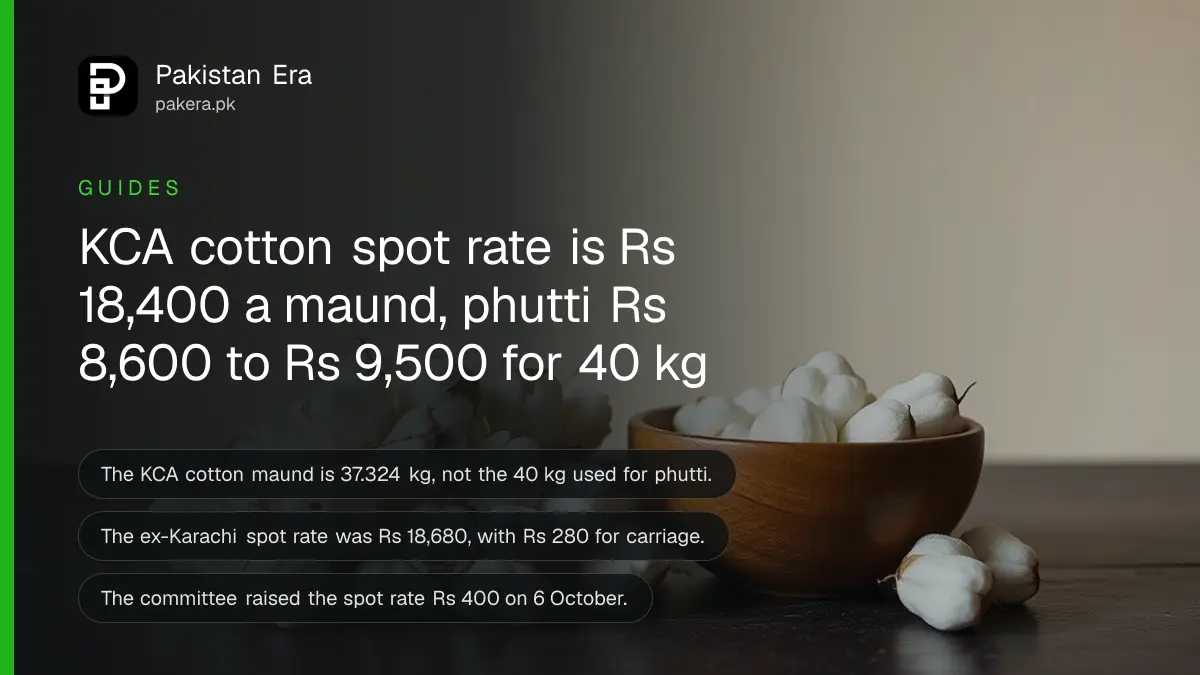
Short answer: The Karachi Cotton Association (KCA) spot rate is the daily price of ginned lint for a 37.32 kg maund, set by its Rates Committee at 12 noon. It is not the phutti price. On Thursday 8 October 2026 the rate was reported at Rs 18,400 ex-gin, with phutti (unginned seed cotton) at Rs 8,600 to Rs 9,500 for 40 kg.
A grower hears one rate from the ginner, another from a neighbour and a third on the phone. All three can be right, because they measure different goods, in different weights, at different points on the road. This page shows how to read each number.
One warning first. KCA's own spot rate page still shows the sheet for Friday 23 June 2023 as of 8 November 2026. So the daily rate now reaches growers through the KCA's notice as printed in the press, and every October figure below is marked reported. Check the newest notice before you sell.
The KCA spot rate is for lint cotton, not phutti
The KCA spot rate is the price of ginned cotton lint, called "cotton" in the market. It is a benchmark set by a committee each trading day. Phutti, the raw seed cotton a farmer picks, trades at a separate quote per 40 kg.
Many farmers compare the two directly and think they are being cheated. They are different goods. Lint is what is left after a ginning factory removes the seed. The spot rate tells you what a ginner can expect for the lint, so it sets the ceiling for what the factory can afford to pay for phutti.
The KCA sheet names its base grade: grade 3, staple length 1-1/16 inch, micronaire between 3.8 and 4.9 NCL. The KCA page says the rate is "valid for the day established by the Rates Committee at 12:00 Noon", and it publishes grade and staple margins for each fortnight. Micronaire is a measure of fibre fineness and maturity. If your cotton is of a different grade, the buyer will price it above or below the base.
On 8 October the sheet was reported at Rs 18,400 ex-gin and Rs 18,680 ex-Karachi
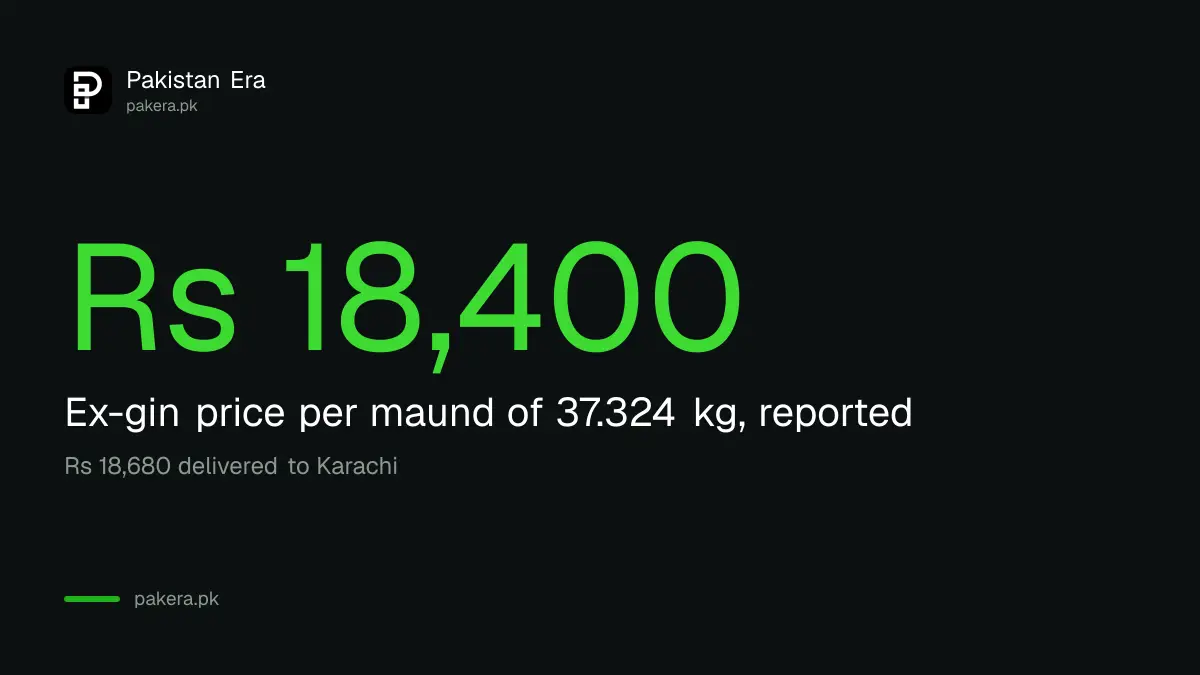
The rate sheet for Thursday 8 October, as reported, gives four numbers. Ex-gin is the price at the ginning factory. Upcountry is the cost of carrying it to Karachi. Spot rate ex-Karachi is the sum. The sheet gives each in two weights.
| Item | Per 37.324 kg maund | Per 40 kg |
|---|---|---|
| Ex-gin price | Rs 18,400 | Rs 19,719 |
| Upcountry cost | Rs 280 | Rs 300 |
| Spot rate ex-Karachi | Rs 18,680 | Rs 20,019 |
The cotton maund on this sheet is 37.324 kg, shown as 37.32 kg on the KCA's own page. That is smaller than the 40 kg maund used for wheat and phutti. If you compare cotton to wheat per maund without converting, you are comparing two different weights.
One detail in the sheet does not add up. Its "difference" column shows +400 against the previous day, but the previous day's ex-Karachi figure printed beside it is the same Rs 18,680. That looks like a printing slip in the comparison column, so rely on the rate itself. Check the sheet's newest copy before you quote it.
Phutti sold for Rs 8,600 to Rs 9,500 for 40 kg across provinces
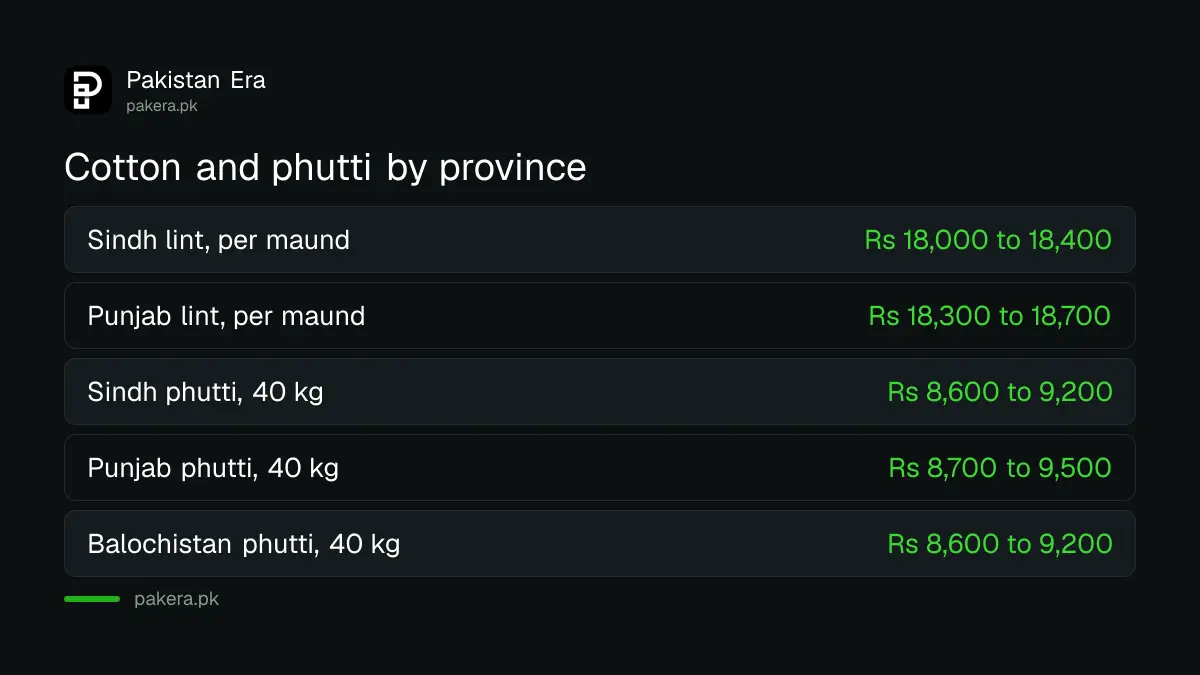
A market report for Thursday 8 October put phutti at Rs 8,600 to Rs 9,200 in Sindh and Balochistan, and Rs 8,700 to Rs 9,500 in Punjab. Lint cotton was Rs 18,000 to Rs 18,400 in Sindh and Rs 18,300 to Rs 18,700 in Punjab. Both are per maund and per 40 kg respectively.
| Province | Cotton lint, per maund | Phutti, per 40 kg |
|---|---|---|
| Sindh | Rs 18,000 to Rs 18,400 | Rs 8,600 to Rs 9,200 |
| Punjab | Rs 18,300 to Rs 18,700 | Rs 8,700 to Rs 9,500 |
| Balochistan | Rs 18,300 to Rs 18,400 | Rs 8,600 to Rs 9,200 |
The same report put polyester fibre, a competing raw material for mills, at Rs 445 a kg. Polyester matters because mills switch between the two when cotton gets dear.
These are market ranges quoted by a cotton analyst, not a government price. Nothing in them is binding on a buyer. The spread inside each province is large, which is why a written receipt matters.
The spot rate moved Rs 400 up and Rs 200 down in early October
The committee cut the spot rate by Rs 200 a maund on 1 October and again on 2 October. It raised it by Rs 400 to Rs 18,200 on Tuesday 6 October. By Thursday 8 October the rate was reported unchanged at Rs 18,400.
So the price moves in small steps, and a week of data tells you more than one day. Production for the whole Kharif season was estimated at 6.7 million bales against a target of 9.64 million, which we covered in our Rabi 2026-27 plan report.
Arrivals reached 4.74 million bales by 31 October
The Pakistan Cotton Ginners' Association (PCGA) publishes arrival figures every fortnight, collected with the KCA. Its statement dated 3 November 2026 counts the phutti that reached ginning factories by 31 October.
| Area | Arrivals by 31 Oct 2026, bales | Same date in 2025, bales | Change |
|---|---|---|---|
| Punjab | 1,998,944 | 1,909,080 | Up 4.71% |
| Sindh | 2,743,686 | 2,528,176 | Up 8.52% |
| Pakistan | 4,742,630 | 4,437,256 | Up 6.88% |
The same statement shows 648,034 bales lying unsold in factories. Bahawalnagar led Punjab with 526,442 bales and Sanghar led Sindh with 1,211,029. When unsold stock builds up, ginners have less reason to raise their phutti offer, so watch this line as well as the rate.
How to check the price before you sell your phutti
Look up the KCA spot rate, convert it to your weight, then ask the ginner for his phutti quote and compare it with the provincial range. Get the weight and moisture written down before the cotton leaves your yard.
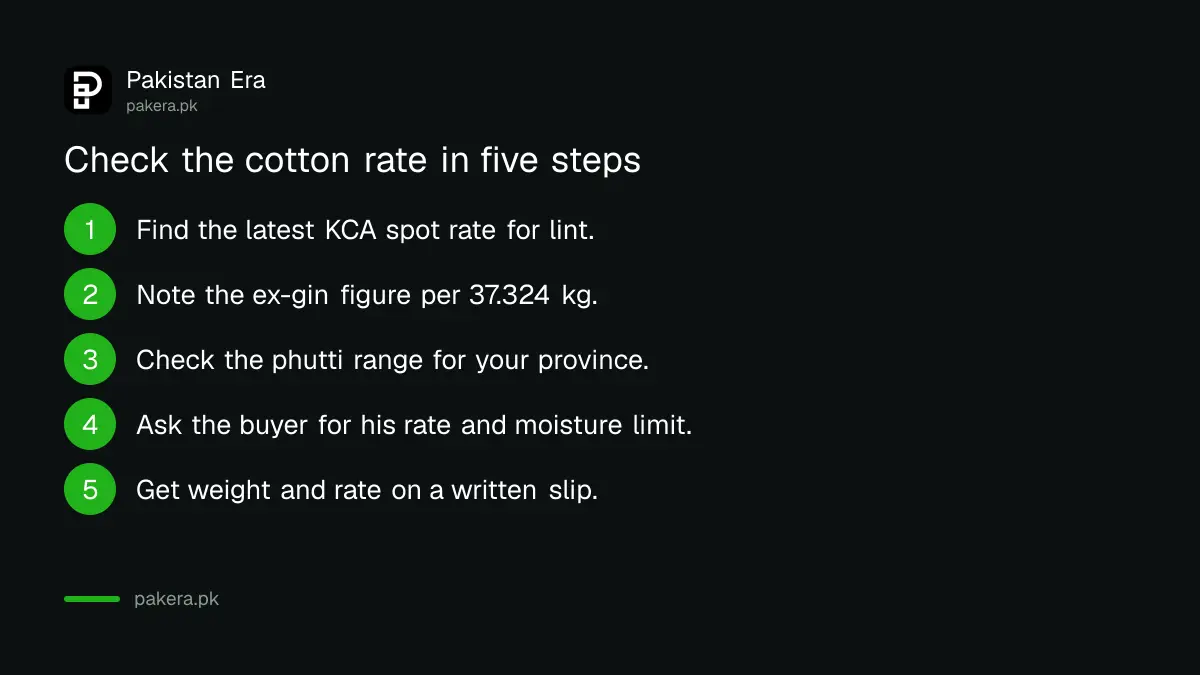
- Find the latest KCA spot rate for lint, per 37.324 kg maund.
- Note the ex-gin figure, because that is what the ginner receives at the factory.
- Check the phutti range for your province, quoted per 40 kg.
- Ask the buyer for his rate and the moisture limit he accepts.
- Get the weight and rate on a written slip before you load.
For wholesale crop prices in Punjab markets, the government's AMIS price service lists daily mandi rates, though it quotes per 100 kg. If a scale looks wrong, our note on reporting a tampered scale tells you where to complain.
Farmers who lease Punjab state land to grow cotton can check who qualifies under the Apna Khet, Apna Rozgar scheme. Exporters shipping lint or yarn out of Karachi should also check that the ship is not on Karachi Port's blacklist before booking cargo.
Common questions
What is the KCA spot rate?
It is the daily benchmark price of ginned cotton lint, set by the Karachi Cotton Association's spot rate committee. It is quoted per 37.324 kg maund for base grade 3 cotton.
Is the KCA spot rate the price a farmer gets?
No. It is a lint benchmark. A farmer sells phutti, which has seed and moisture, and the price differs by grade, weight and location.
How many kilograms are in a cotton maund?
The KCA rate sheet uses 37.324 kg. The phutti quote and the wheat maund use 40 kg. Convert before you compare.
What was the phutti price on 8 October 2026?
A market report put it at Rs 8,600 to Rs 9,500 for 40 kg, depending on province and quality. Punjab had the highest top end.
How much cotton has reached the factories this season?
PCGA counted 4,742,630 bales by 31 October 2026, up 6.88% on the same date in 2025.
Is the KCA spot rate an official support price?
No. The KCA spot rate is a market benchmark and not a government rate.
How we verified this
What we checked and where we read it.
Last checked 8 November 2026. The sources are the KCA spot rate page, which still shows the 23 June 2023 sheet, and the PCGA arrival statement of 3 November 2026 from its arrival reports page. The October rates come from a published copy of the KCA notice and daily market reports of 12 October 2026, so they are marked as reported. For mandi prices, see the Punjab government's AMIS service.
Free on WhatsApp
Get last dates and rule changes on WhatsApp
We post new last dates, fee changes and fixes for common problems, a few short posts a day.
Follow Pakera on WhatsAppOther followers cannot see your number.
Pakera Solves It
Which online process wasted your time this week?
A portal that will not load, a form nobody explains, a complaint that went nowhere. Tell us. Every week we pick one, solve it step by step and publish the answer.
About the author

Public Services and Education Journalist
Fajr Riaz is a journalist and content writer at Pakistan Era, based in Lahore. She covers the questions people meet in everyday life in Pakistan: how a public service works, what a change in the rules means, and where to find a reliable answer.