Check Your Home Fuel Bill Against Pakistan's Average: Electricity 56%, Gas 19%, Firewood 17%
See how Pakistani homes split fuel and lighting money: electricity 55.91%, gas 18.85%, firewood 17.23%. Compare your own winter bill with the PBS survey shares.
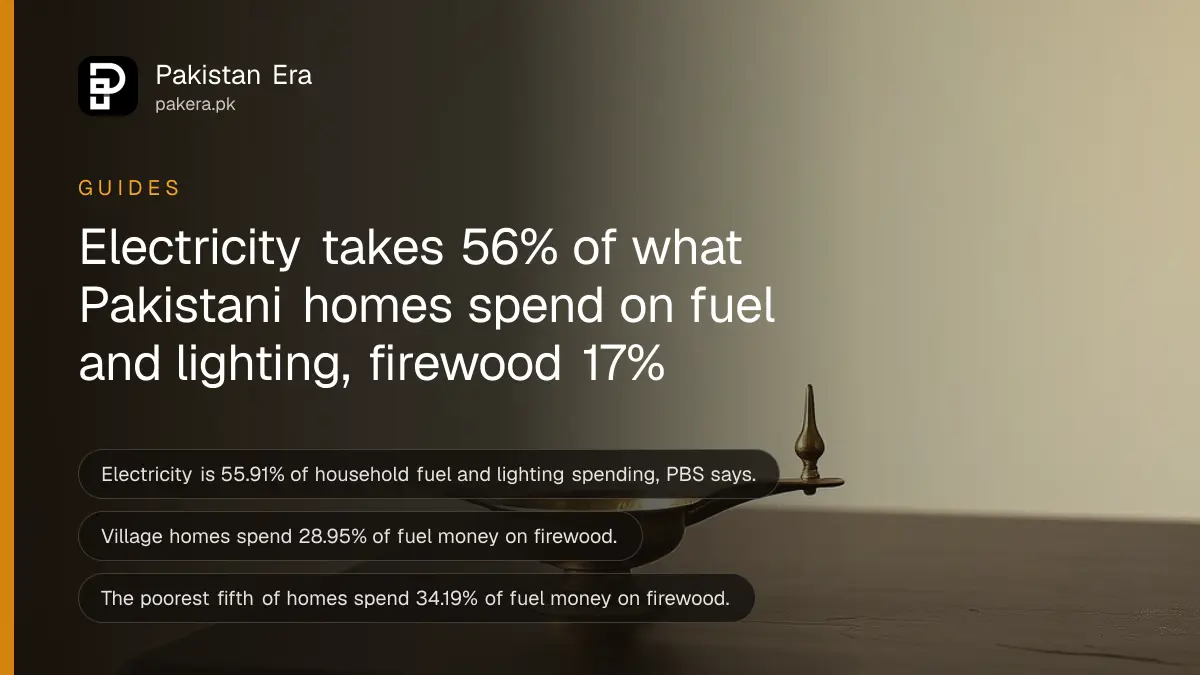
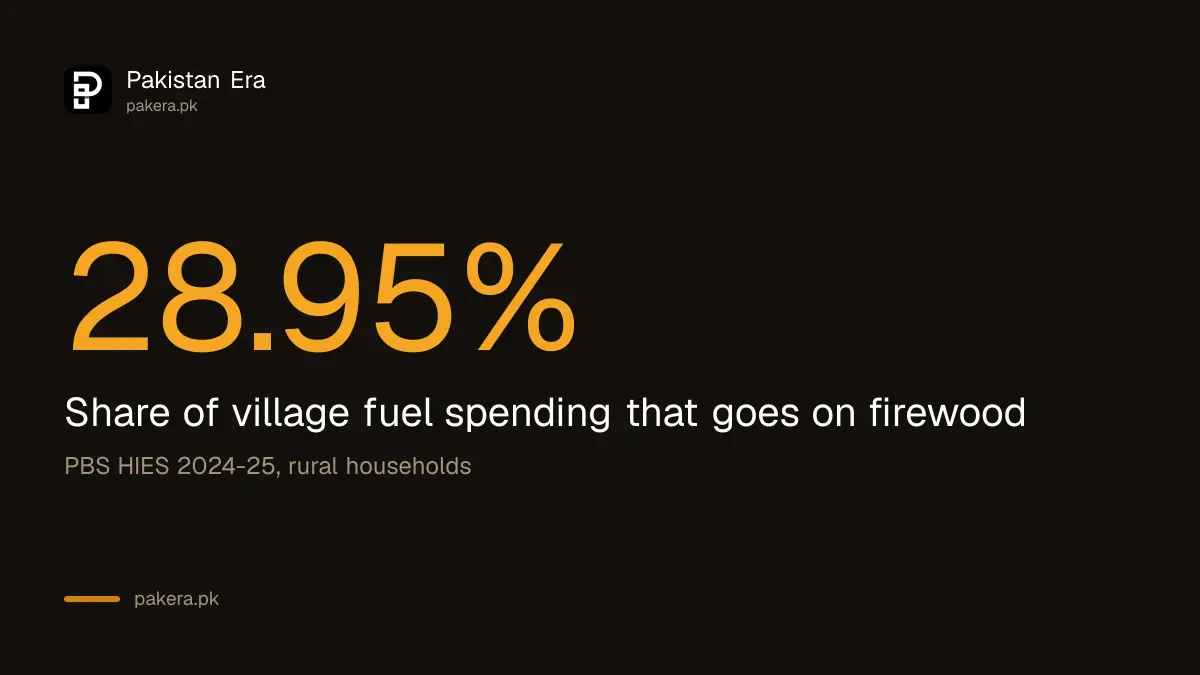
Short answer: The Pakistan Bureau of Statistics (PBS) says electricity takes 55.91 per cent of what Pakistani households spend on fuel and lighting. Piped or cylinder gas takes 18.85 per cent and firewood 17.23 per cent. In villages firewood is the second biggest item at 28.95 per cent. Use these shares to check your own winter fuel bill.
Winter changes the fuel bill in almost every home. A gas heater runs for hours, a geyser works harder, and families that cook on wood burn more of it. Before you decide your bill is too high or too low, it helps to know what a normal split looks like.
We read the PBS Household Integrated Economic Survey (HIES) 2024-25 report on 13 October 2026, including its tables on fuel and lighting. The survey ran from September 2024 to June 2025 and covered over 32,000 households. The shares below are shares of fuel and lighting money, not litres, cubic metres or units.
Electricity is the biggest fuel cost for most homes
PBS reports that electricity ranks first among household fuel and lighting costs at 55.91 per cent nationally. Gas, piped or cylinder, is second at 18.85 per cent. Firewood is 17.23 per cent. Everything else, such as kerosene, charcoal and dung cakes, is small.
These are shares of money spent. A family that pays Rs 10,000 a month for fuel and lighting would, on the national average, spend about Rs 5,590 on electricity, Rs 1,885 on gas and Rs 1,723 on firewood. That is our arithmetic, not a PBS figure, and no real home matches an average.
Villages burn far more firewood than cities
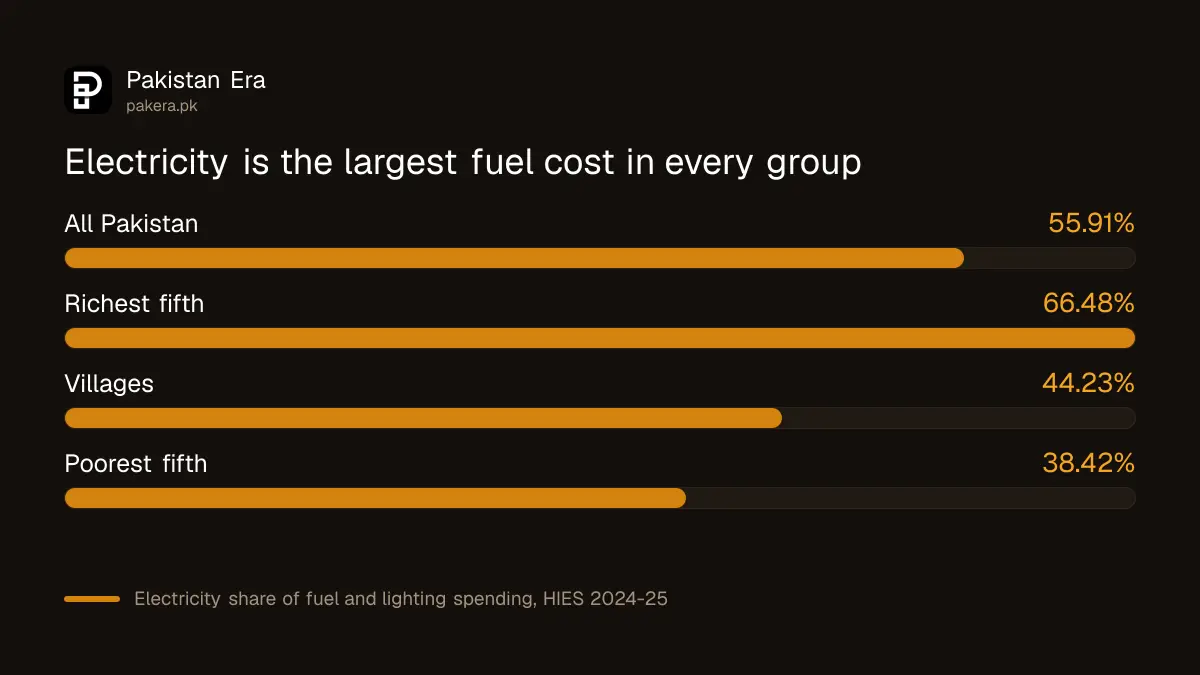
PBS says electricity is first in both city and village homes. In villages firewood is second at 28.95 per cent, ahead of gas at 13.27 per cent. In cities gas is second, and its share has risen sharply to 24.76 per cent.
| Household group | First item | Second item |
|---|---|---|
| All Pakistan | Electricity 55.91% | Gas 18.85% |
| Cities | Electricity | Gas 24.76% |
| Villages | Electricity 44.23% | Firewood 28.95% |
| Poorest fifth of homes | Electricity 38.42% | Firewood 34.19% |
| Richest fifth of homes | Electricity 66.48% | Gas 22.29% |
The table shows a clear pattern. The poorer the home, the more it leans on wood. The richer the home, the more it spends on electricity and gas.
Poorer homes rely on wood and farm waste
In the poorest fifth of homes, PBS says electricity is 38.42 per cent of fuel and lighting spending and firewood is 34.19 per cent. Dung cakes take 5.92 per cent in that group. Gas is only 7.77 per cent there, against 22.29 per cent in the richest fifth.
The survey notes that the share spent on firewood, dung cakes, cotton sticks and other farm waste falls sharply as households spend more. PBS describes this as a shift from traditional fuels to electricity and gas as spending rises.
Wood smoke indoors is a health risk, especially for children. If your home cooks on wood, a ventilated stove or a cylinder, even for part of the week, is a real gain.
How to check your own fuel and lighting split
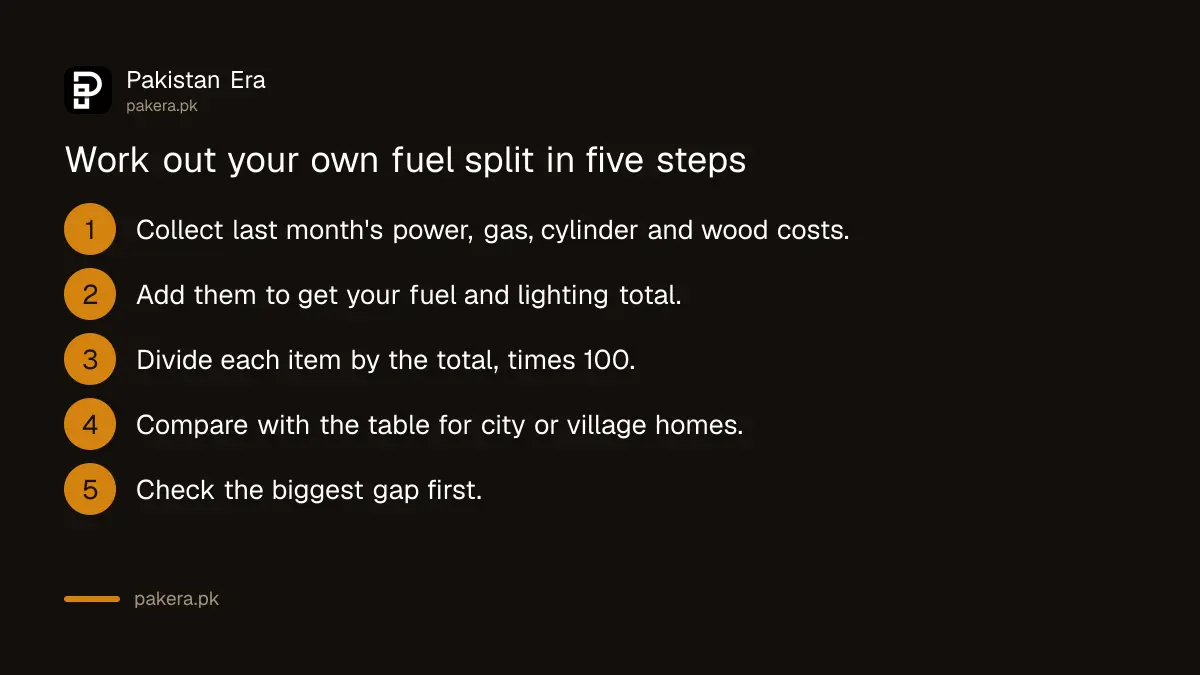
Add up one month of fuel and lighting costs and divide each item by the total. Then set your shares beside the table above. A big gap does not prove a mistake, but it shows where to look first.
- Collect last month's electricity bill, gas bill, cylinder receipts and what you paid for wood.
- Add them. This is your fuel and lighting total.
- Divide each item by the total and multiply by 100.
- Compare with the table for your kind of home, city or village.
- Look at the largest gap and check that bill first.
If electricity is far above 56 per cent, read the bill itself. Our explanation of home electricity slab rates shows how a few extra units can move you into a higher rate.
Winter gas use can lift your share quickly
The HIES covers a full year, so it averages summer and winter together. In winter, homes with a piped connection use more gas for heaters and geysers, and the gas share of your own bill will likely be higher than the yearly figure.
Gas bills depend on slabs, so a small rise in use can raise the rate you pay. The page on Sui gas slab rates for winter explains how the bill is built. Heater safety matters as well, and the SSGC rules for gas heaters and geysers are worth reading before the cold sets in.
PBS does not publish a winter-only split in the report we read, so we cannot give you an official winter average. Treat the national figure as a yearly reference.
What the survey cannot tell you
The figures are shares of spending, not units. They also do not say whether a household can afford the fuel it wants. A poor home that burns wood may want gas but not have a connection. A share of 34 per cent for wood is not a choice in that case.
The survey is also from 2024-25. Electricity and gas rates have moved since then, so the shares today may differ. Use them to see the pattern, not to predict your bill.
Common questions
What share of fuel spending goes on electricity in Pakistan?
PBS puts it at 55.91 per cent nationally in the HIES 2024-25 report. It is the largest item in cities and in villages.
How much do Pakistani households spend on firewood?
Firewood is 17.23 per cent of fuel and lighting spending nationally. In villages it is 28.95 per cent, and in the poorest fifth of homes it is 34.19 per cent.
Is gas more important in cities?
Yes. PBS says the gas share in cities rose sharply to 24.76 per cent, against 13.27 per cent in villages.
Do these shares show litres or units used?
No. They show shares of the money spent on fuel and lighting. They do not measure how much energy a home used.
Does the survey show winter spending only?
No. The survey ran from September 2024 to June 2025 and the report we read gives yearly averages, not a winter split.
Where can I read the report?
It is on the PBS website under the Household Integrated Economic Survey, listed in the link below.
How we verified this
What we checked, where we read it, and what we could not confirm.
Last checked on 13 October 2026, Pakistan time. We read the PBS HIES 2024-25 report, section 3.10 on fuel and lighting. The rupee examples are our own arithmetic. The report prints some tables in a way that mixes columns, so we used only the figures PBS states in its text and in its fuel chart.
About the author

Public Services and Education Journalist
Fajr Riaz is a journalist and content writer at Pakistan Era, based in Lahore. She covers the questions people meet in everyday life in Pakistan: how a public service works, what a change in the rules means, and where to find a reliable answer.