Islamabad Domestic Violence Act 2026: What Counts and the Penalty
Islamabad's 2026 domestic violence law lists stalking, insults and false claims as abuse. See the 6 month to 3 year jail term, fine and appeal limits.
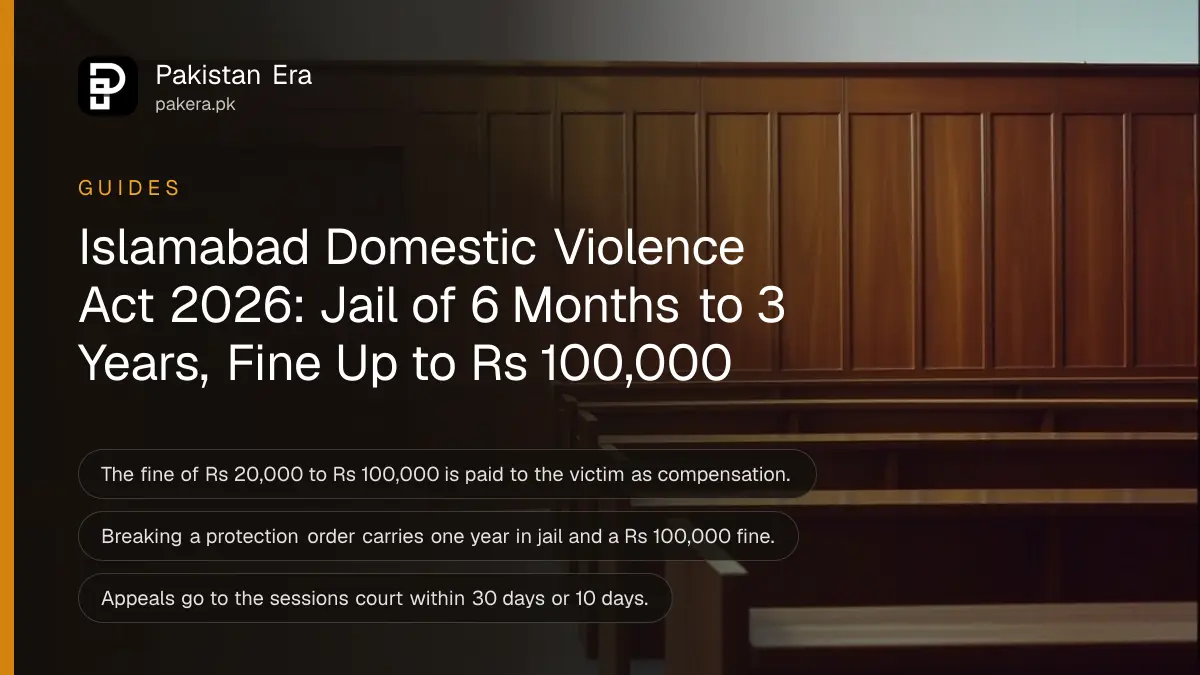
Under Islamabad's Domestic Violence (Prevention and Protection) Act, 2026, domestic violence that is not already a Penal Code offence carries simple imprisonment of 6 months to 3 years and a fine of Rs 20,000 to Rs 100,000, paid to the victim as compensation. Breaking a court's protection order is a separate offence with one year in jail.
The Act covers the Islamabad Capital Territory only. It was assented to on 26 January 2026 and published in the Gazette the next day. We read its Gazette text on 22 October 2026. This page explains what the law counts as violence and what happens to the person who commits it. The steps for a victim are in the guide to filing a petition in Islamabad.
The Act counts physical, psychological and sexual abuse as domestic violence
Section 3 defines domestic violence as acts of physical, psychological and sexual abuse that cause fear or physical or psychological harm. They must be committed by someone the victim lives or lived with. Acts that are already Penal Code offences stay under the Penal Code.
That last point matters. Murder, hurt, rape and kidnapping remain ordinary crimes tried by the regular court. The new Act fills the gap below them: conduct that hurts or frightens but may not be a named offence. The Act says the court looks at the overall facts of each case.
Psychological abuse includes stalking, abandonment and threats of divorce on false grounds
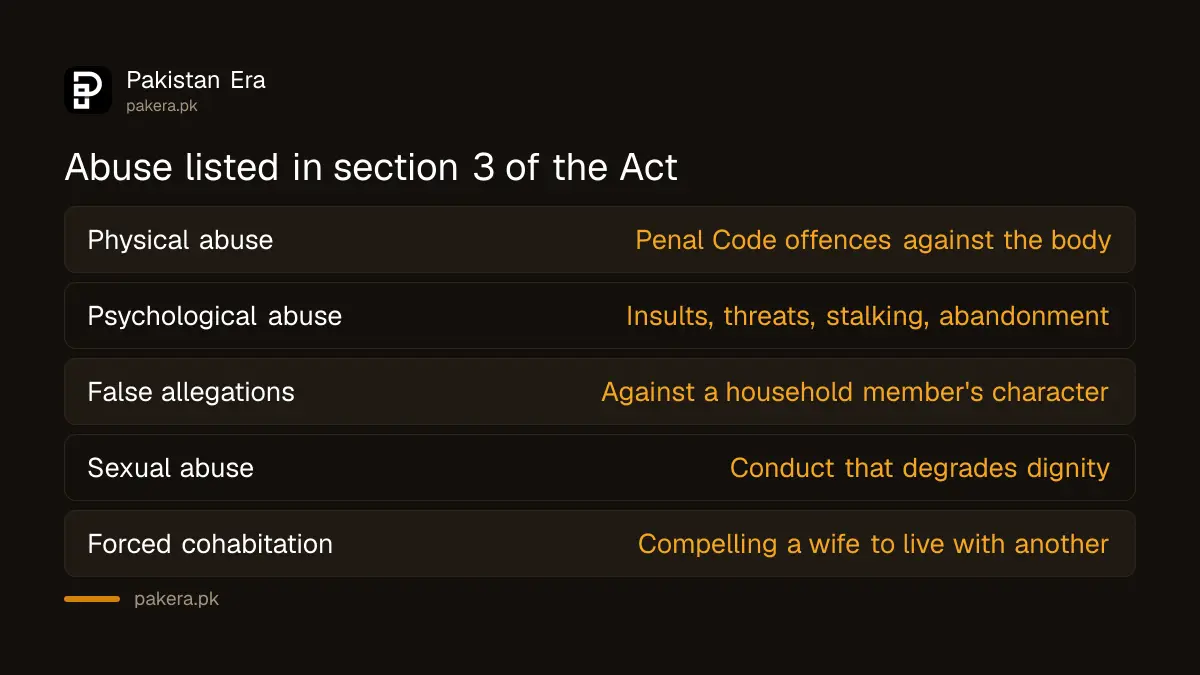
Section 3 lists forms of psychological and verbal abuse. The list says it is not limited to these examples. Every item describes a pattern of degrading or humiliating behaviour, not one angry remark.
| Listed conduct | Example in plain words |
|---|---|
| Obsessive jealousy | Repeatedly invading privacy, freedom or security |
| Insults or ridicule | Mocking the person in front of others |
| Threats of physical pain | Threatening a spouse or household member |
| Threats of divorce or second marriage | On a baseless claim of insanity or infertility |
| False allegations on character | Against a woman or any household member |
| Abandonment | Willful or negligent |
| Stalking and harassment | Following, repeated unwanted contact |
| Forcing cohabitation | Compelling a wife to live with anyone but her husband |
Sexual abuse covers any conduct of a sexual nature that humiliates, degrades or violates dignity. Physical abuse covers the offences listed in several chapters of the Penal Code.
The punishment is 6 months to 3 years plus a fine paid to the victim
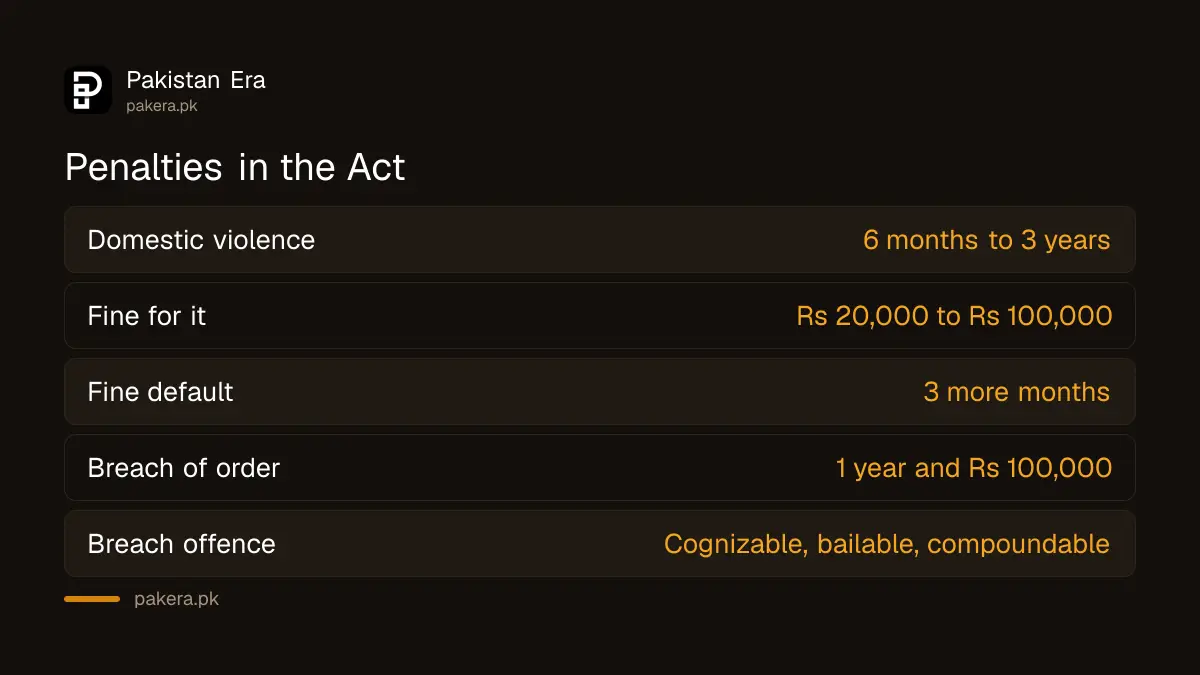
Section 4 sets simple imprisonment of not less than six months and not more than three years, depending on gravity. The fine is at least Rs 20,000 and at most Rs 100,000, and it goes to the aggrieved person as compensation. If the fine is not paid, the court can add three months.
Anyone who helps or encourages the offence gets the same punishment. A relative who joins in can therefore be named. The Act does not say who investigates a section 4 offence, and we did not find rules that answer this.
Breaking a protection order is a separate offence with one year in jail
Section 12 makes it an offence to breach a protection, interim, residence or custody order. The punishment is imprisonment of one year and a fine of Rs 100,000, paid to the aggrieved person. The offence is cognizable, bailable and compoundable.
Cognizable means police can act without a court warrant. Bailable means the accused has a right to bail. Compoundable means the case can be settled between the parties. The idea of settling criminal cases is explained in compromise in compoundable offences, though that page covers the general rule under the Criminal Procedure Code.
Appeals go to the sessions court in 30 or 10 days
Section 13 allows an appeal to the court of sessions within 30 days of a sentence for breach under section 12, and the sessions court should decide within 60 days. A final decision in the main petition can be appealed within 10 days.
Ten days is short. Anyone planning to challenge a final order should ask for the certified copy at once. For the wider picture of criminal appeals, see how to appeal a criminal conviction.
The protection machinery depends on rules we could not find
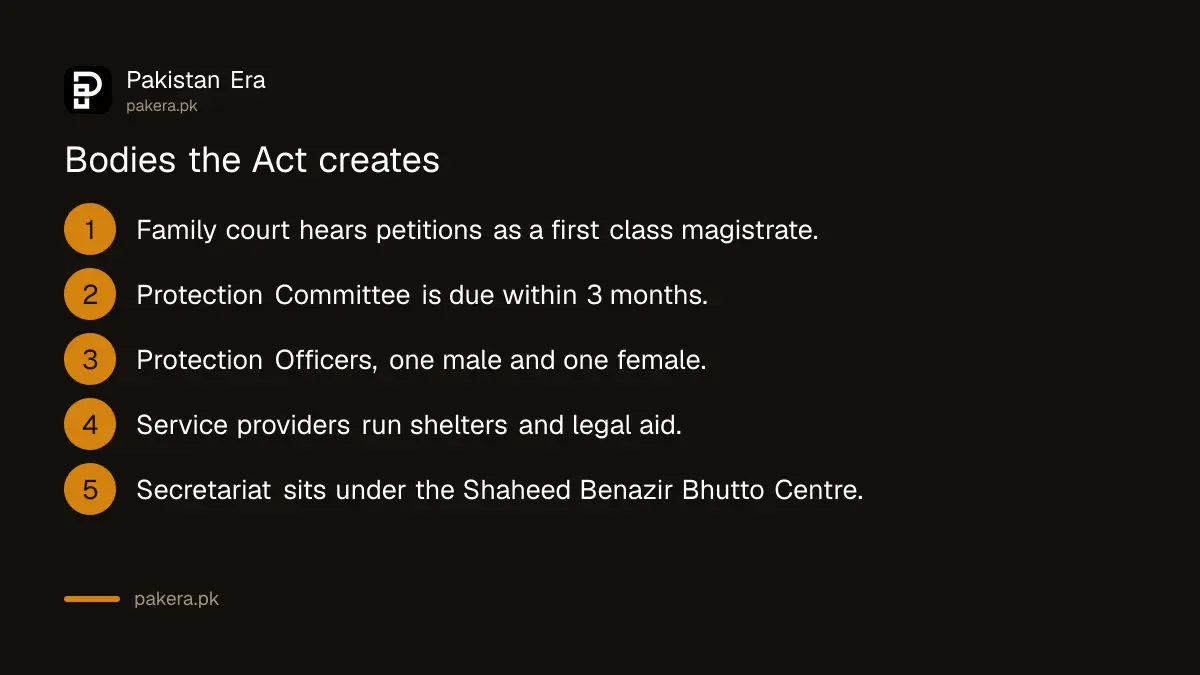
The Act sets up a Protection Committee, with members from the Family Protection and Rehabilitation Centre, the National Commission on the Status of Women, a doctor or psychologist, a law officer and a police inspector. It must be notified within three months of the Act. Protection Officers follow once rules are framed.
- Ask the Ministry of Human Rights whether the committee has been notified.
- Ask who the current male and female Protection Officers are.
- Ask where the secretariat, under the Shaheed Benazir Bhutto Centre for Women, sits.
- If no answer comes, a lawyer can file the family court petition directly.
Common questions
What is the punishment for domestic violence in Islamabad?
It is 6 months to 3 years of simple imprisonment and a fine of Rs 20,000 to Rs 100,000 for acts that are not Penal Code offences.
Is a verbal insult domestic violence?
It can be, if it is part of a pattern of degrading or humiliating conduct that causes fear or psychological harm. One remark alone is unlikely to meet the test.
Does the Act protect a husband?
Yes. It protects women, men, transgender persons, children and vulnerable persons who live or lived with the respondent.
What if the abuser has committed a crime like assault?
Then the Penal Code applies and the regular court tries it. The Act says such offences are punished as the Penal Code provides.
Can the case be settled?
A breach of a protection order is compoundable under section 12. For the main section 4 offence the Act is silent, so ask the court.
Who tries the offence?
The family court, which has the powers of a first class magistrate under this Act. Section 14 says the Family Courts Act, 1964 governs the procedure.
How we verified this
What we checked, where we read it, and what we could not confirm.
Last checked 22 October 2026. We read the Gazette of Pakistan Extraordinary of 27 January 2026 carrying Act No. X of 2026 on the National Assembly website. We did not find rules under the Act, a notification of the Protection Committee or the names of Protection Officers, so we cannot say they exist. We did not read any court judgment on the Act. This page is general information, not legal advice.
About the author

Senior Writer, Public Services and Technology
Shahid joined us in 2024 as an author. He is a senior contributor to Pakistan's leading technology websites. He writes detailed articles, mostly covering his expertise in the latest tech, mobiles, apps, gadgets, and step-by-step guides. His ideology is to help people understand the latest trends and explain complex methods through very easy-to-understand guides.