Check If Your Load Shedding Is Legal in Pakistan and How to Complain
NEPRA allows load shedding only on NTDC's instruction and in a set order. Check your cuts against Rule 4(f), keep a 7 day log and file a complaint with NEPRA.
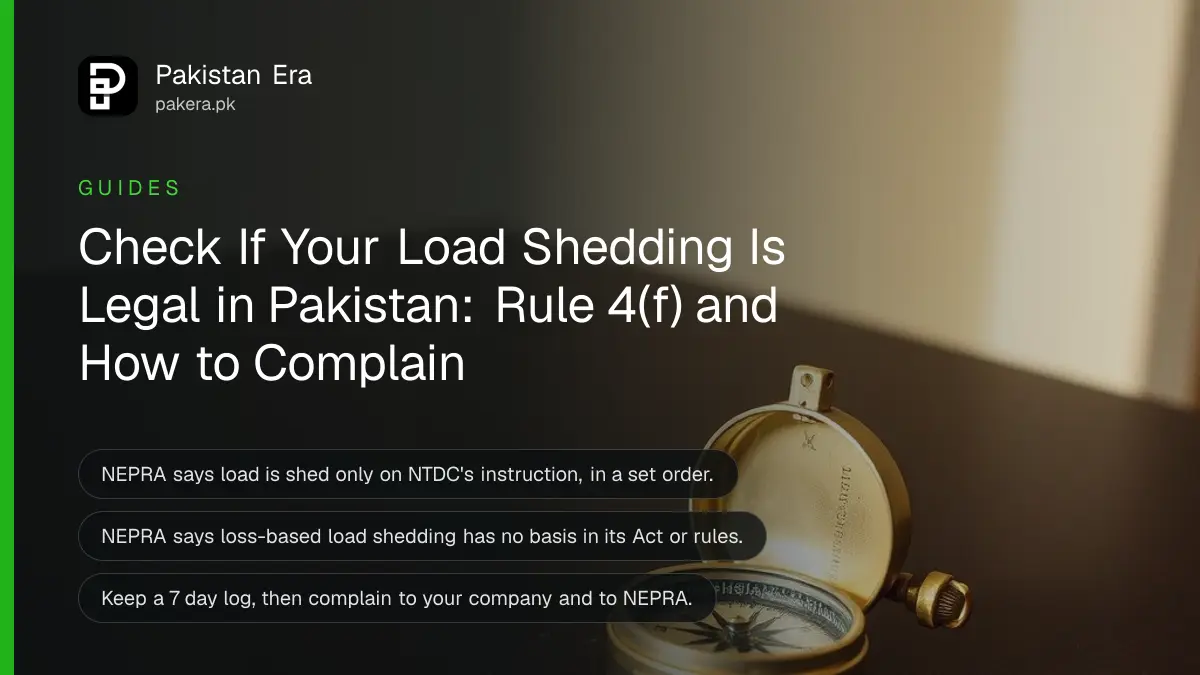
Short answer: Under NEPRA's rules, an electricity company may cut load only when the National Transmission and Despatch Company (NTDC) instructs it, and it must follow a set order and rotate the cuts fairly. NEPRA says cutting a feeder because of its losses is not allowed. If your cuts run longer than your schedule, complain to your company, then to NEPRA, with a written log.
Many people in Pakistan think load shedding is a fact of life with no rules. It has rules. They are short, they are published, and NEPRA quotes them in its own orders.
We read two NEPRA orders on this on 12 October 2026: one on K-Electric dated 31 August 2026 and one on HESCO dated 22 July 2026. This guide uses the rules and findings in those orders. Your own feeder may differ, and we did not check any individual consumer's cuts.
The rule is Rule 4(f) of NEPRA's performance standards
Rule 4(f) of the NEPRA Performance Standards (Distribution) Rules, 2005 says a distribution company must have plans to shed up to 30 per cent of its load when NTDC instructs it. NTDC gives the quantity and the time. The company must then follow a fixed order of priority.
| Order | Who is cut |
|---|---|
| First | Rural areas, and urban homes where separate feeders exist |
| Second | Urban consumers other than industry |
| Third | Agriculture, where there is a dedicated supply |
| Fourth | Industry |
| Last | Schools and hospitals, then defence and strategic sites |
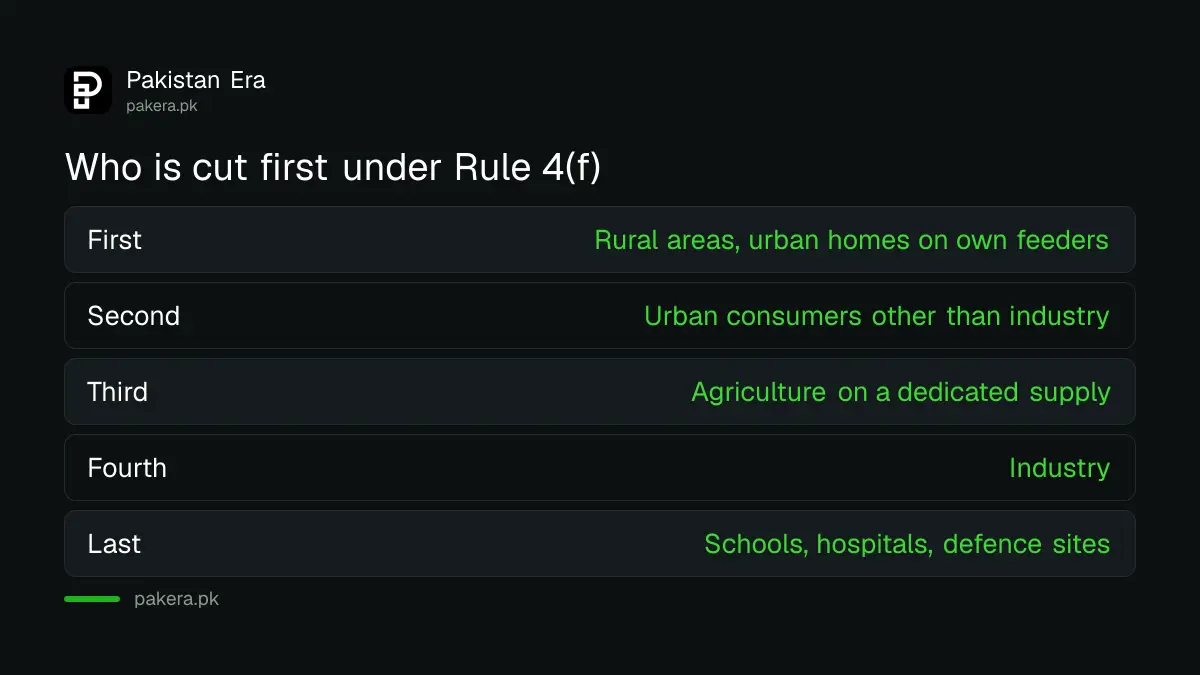
The same rule asks the company to rotate cuts within each group, so the burden is shared. It also says the principle of proportion must be kept, so no one class is loaded too much.
Cuts for a feeder's losses are not recognised by NEPRA
NEPRA says load shedding that depends on a feeder's aggregate technical and commercial (AT&C) losses has no basis in the NEPRA Act or the company licence. In the K-Electric order it said commercial or revenue-based load shedding finds no recognition in the law.
The idea behind the practice is simple. A feeder where many users do not pay, or where there is theft, gets longer cuts. NEPRA's objection is that bill-paying homes on that feeder are cut too. Its answer is to disconnect the defaulter, run anti-theft drives and improve the line.
Our report on NEPRA's order to K-Electric has the Karachi figures.
Where the company and NEPRA disagree
HESCO told NEPRA that its load shedding follows a direction of the Ministry of Energy (Power Division) of November 2017. NEPRA's order says the 2017 policy cannot override its Act and rules. Both sides are on the record, so treat this as a live dispute.
HESCO described the policy this way: feeders with 0 to 20 per cent losses are exempt, and higher-loss feeders get 2 to 12 hours of cuts. NEPRA noted that IESCO, GEPCO and FESCO have brought about 99 per cent of their feeders to within 20 per cent losses, so they no longer need such cuts.
In its 22 July 2026 order NEPRA rejected HESCO's request to review an earlier decision. That earlier decision, of 15 September 2025, fined HESCO Rs 100,000 and told it to stop loss-based load shedding. HESCO's own papers describe that fine as a daily amount.
NEPRA tracks cuts by feeder every week
NEPRA says its regional offices pick five feeders a week and compare the hours scheduled with the hours cut. In the HESCO order, data from January 2025 to March 2026 showed actual cuts consistently above the schedule.
The order lists many feeders in the same row pattern: 2 hours scheduled for a category III feeder, and 12 hours or more cut in the field. That is the kind of gap you should look for in your own log.
How to check your cuts and complain
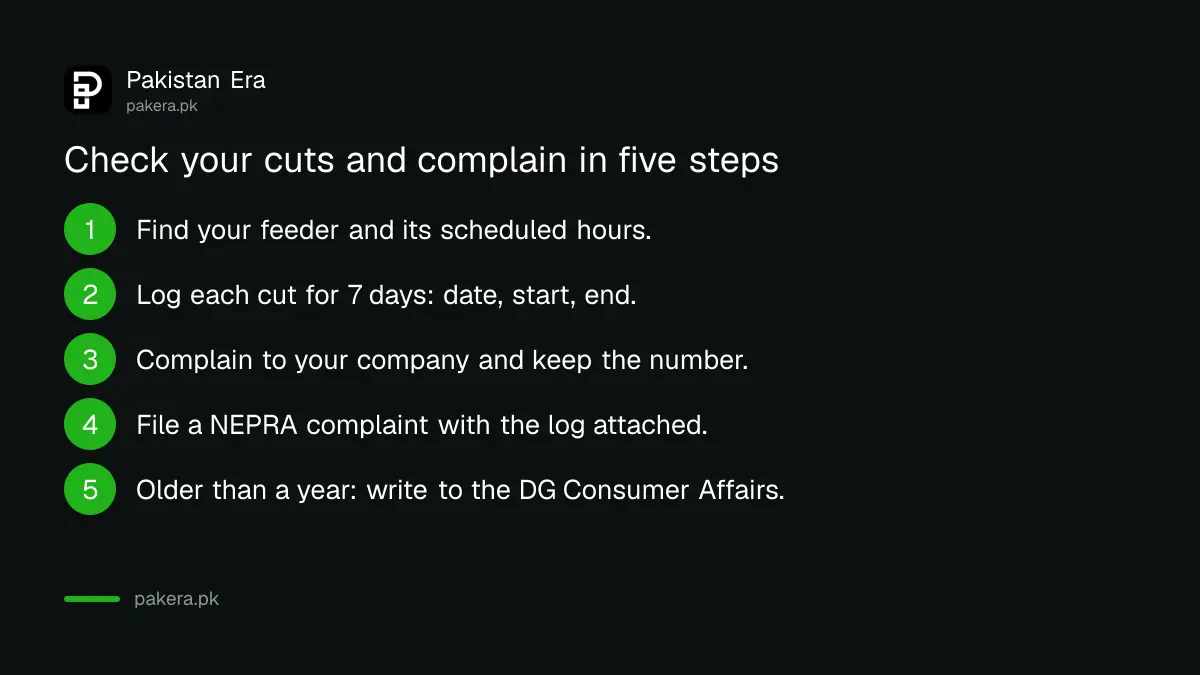
Keep a log for at least seven days with the date, the start time and the end time. Then compare it with the hours your company publishes. If you cannot find a schedule, ask your company's complaint line for the hours set for your feeder and write down the answer.
- Find your feeder name on the bill, if your company prints it, and ask the company for its scheduled hours.
- Write each cut in a simple table: date, start, end, total hours.
- Complain to your electricity company and keep the complaint number.
- If nothing changes, file a complaint on NEPRA's online form. It asks for your CNIC, your consumer number, what you tried with the company and the nearest NEPRA complaint office. You can attach a PDF or JPG up to 2.5 MB.
- For a complaint that is more than one year old, the form says to write to the Director General Consumer Affairs at NEPRA.
Our guides on complaining about a wrong electricity bill and the NEPRA Asaan Approach app show the same route for other faults. Karachi readers can also see how to check their K-Electric schedule.
Common questions
Is all load shedding illegal in Pakistan?
No. Load shedding is allowed when NTDC instructs it for a real shortage or a system problem. What NEPRA objects to is cutting for a feeder's losses, or cutting beyond the published schedule.
Who decides how many hours my area gets?
The company prepares the schedule, within NTDC's instructions and the Rule 4(f) order. NEPRA monitors it and can fine a company that does not follow the rules.
Can I get compensation for hours of unannounced cuts?
We did not find a fixed amount in the orders we read. HESCO itself told NEPRA that gaps remain on compensation for outages. Ask NEPRA what remedy applies when you file.
Is a cut for repair or maintenance load shedding?
No. Planned shutdowns for repair are a different thing and are normally announced. Our guide on planned power shutdowns in LESCO and IESCO areas covers how to check them.
Does my company have to show me the schedule?
K-Electric publishes feeder schedules online. For other companies, we did not verify a published feeder schedule, so ask your sub-division in writing and keep the reply.
What if the company says my feeder has high losses?
That is the loss-based practice NEPRA says has no legal cover. Say so in your complaint and quote Rule 4(f) and the order dates given above.
How we verified this
What we checked, where we read it, and what we could not confirm.
We read NEPRA's order on K-Electric load shedding (31 August 2026) and its order on HESCO's review motion (22 July 2026) on nepra.org.pk on 12 October 2026, and its online complaint form the same day. We did not read the Ministry of Energy's 2017 direction, so what we say about it comes from the HESCO order.
About the author

Tax, Bills and Technology Writer
Ali Akhtar is a young and curious voice here at Pakistan Era. He is currently pursuing his A-Levels and has a growing interest in Pakistan’s changing industrial landscape and educational trends. Ali likes to write in a way that helps him explain and explore the world around him. His writing reflects the perspective of the new generation navigating the evolving trends of Pakistan where technology, youth innovation, and shifting opportunities are reshaping the country’s future.