NEPRA Orders K-Electric to Stop Unannounced and Loss-Based Load Shedding in Karachi
NEPRA's 31 August 2026 order tells K-Electric to stop unannounced and loss-based load shedding in Karachi. See what it found and how to complain if cuts go on.
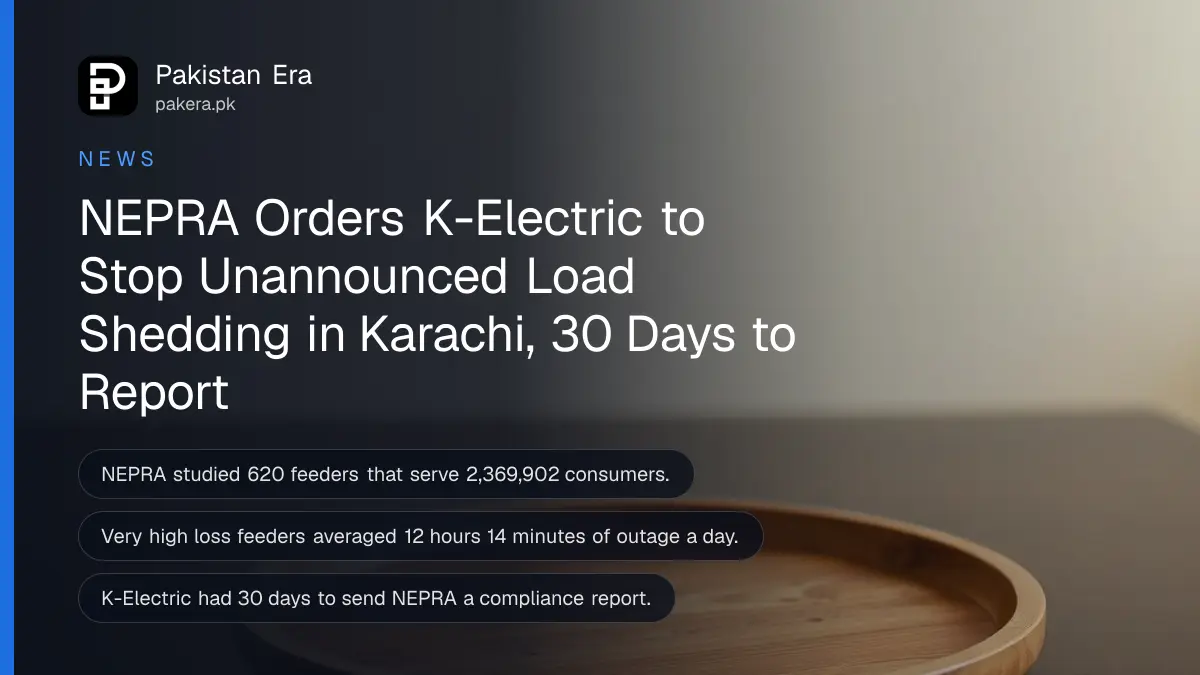
Short answer: On 31 August 2026 the National Electric Power Regulatory Authority (NEPRA) ordered K-Electric to stop unannounced and excessive load shedding in Karachi, and to stop cutting power to a whole feeder because of its losses. K-Electric had 30 days to send NEPRA a compliance report. The order is in force, and you can complain if your feeder is still cut beyond its schedule.
Two streets in Karachi can sit on different feeders and get very different hours of power. That gap is what NEPRA examined. It looked at 620 feeders that serve 2,369,902 consumers, and it found that the real outages ran longer than K-Electric's own schedules.
We downloaded the order from NEPRA's website on 12 October 2026 and read all 11 pages. We did not find a K-Electric compliance report on NEPRA's site, so we cannot say whether the company has complied. This piece reports what the order says. It is not a verdict on anyone.
NEPRA's order bans unannounced and loss-based load shedding
The order is dated 31 August 2026 and is issued under Section 27C of the NEPRA Act, 1997. It is a prohibitory order. It tells K-Electric to stop unannounced, unscheduled or excessive load shedding, and to stop load shedding based on feeder losses.
The losses in question are called AT&C losses, short for aggregate technical and commercial losses. They mean units that are lost on the line or not paid for. K-Electric used a loss-based policy to decide how many hours each feeder gets. NEPRA says the Act, the licence and the rules do not recognise that policy.
The order also says that consumers who pay their bills must not lose supply because of defaults or theft by others on the same feeder.
What NEPRA found on 620 feeders
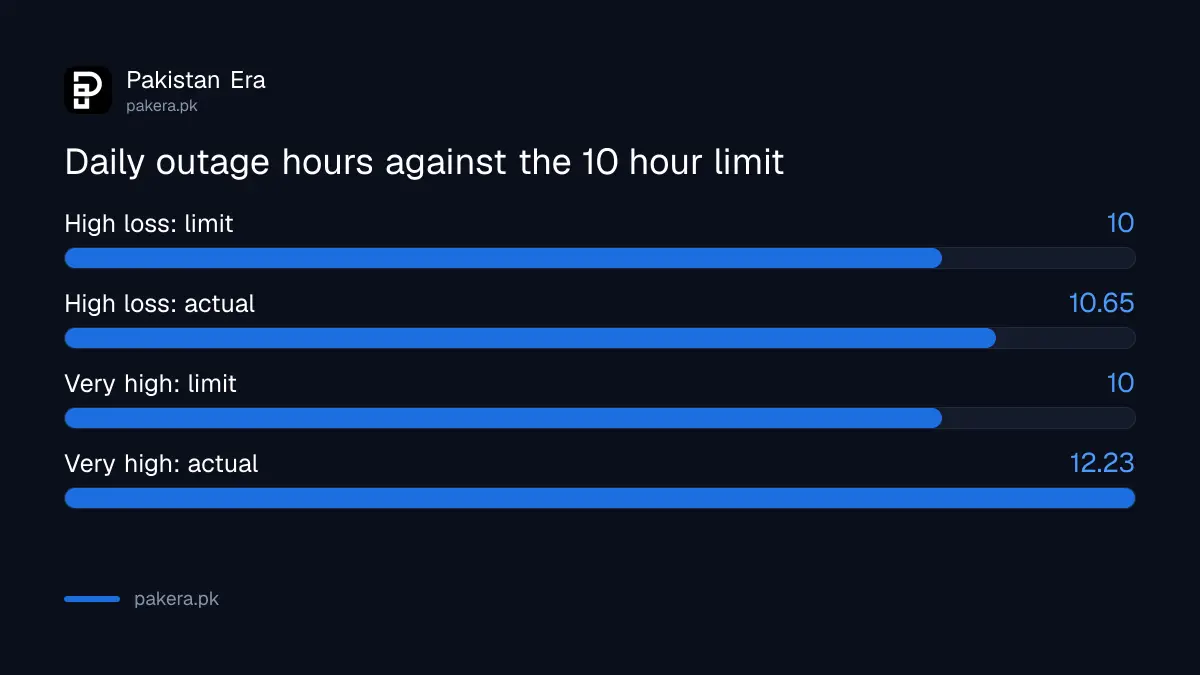
NEPRA took data from K-Electric on three groups of feeders. On the very high loss and high loss feeders, the real average outage was above the 10 hour schedule. On the medium loss feeders, most were above the 6 hour limit.
| Feeder group | Feeders | Consumers | What NEPRA recorded |
|---|---|---|---|
| Very high loss | 316 | 1,177,900 | Average outage 12 hours 14 minutes against a 10 hour schedule |
| High loss | 171 | 707,365 | Average outage 10 hours 39 minutes against a 10 hour schedule |
| Medium loss | 133 | 484,637 | 91 feeders above the 6 hour limit |
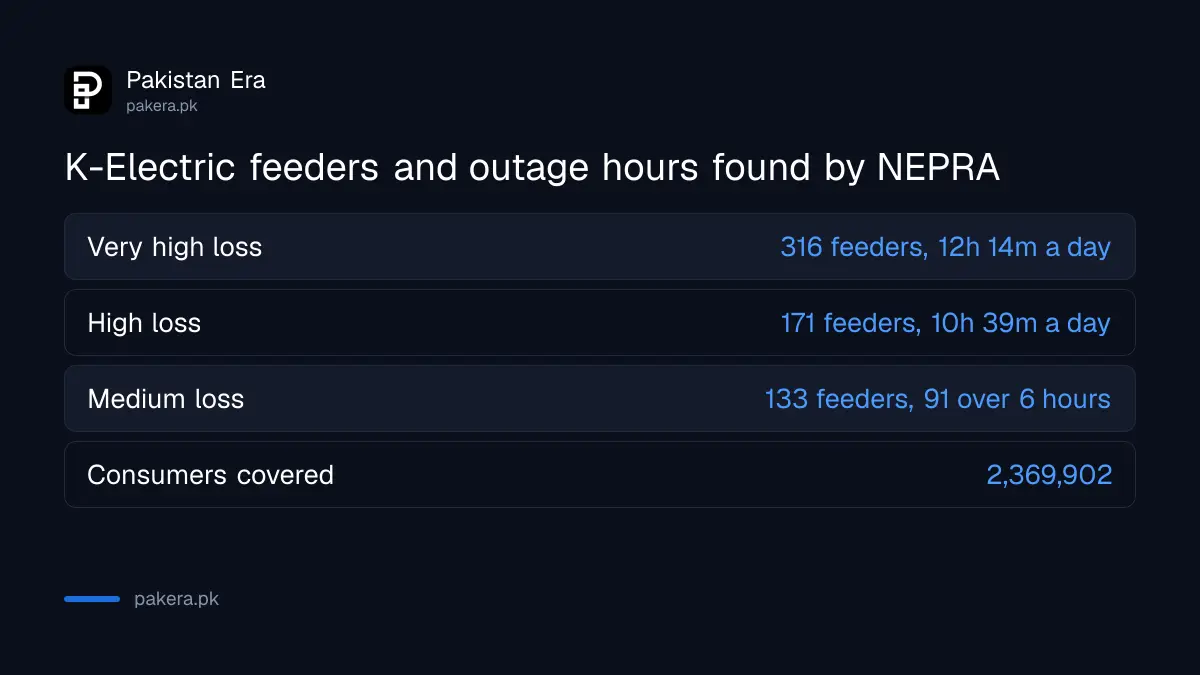
In the very high loss group, 288 of 316 feeders ran past the 10 hour schedule. Of those, 128 feeders averaged 13 hours 3 minutes and 51 feeders averaged 14 hours 50 minutes. In the high loss group, 81.9 per cent of feeders went past 10 hours.
NEPRA calls this a pattern where scheduled load shedding is the base, and extra unannounced hours are added on top of it.
The legal rule: load shedding only on NTDC's instruction
NEPRA says a distribution company may shed load only when the National Transmission and Despatch Company (NTDC) instructs it, for a system emergency, a voltage or frequency problem, or a generation shortfall. Revenue recovery and loss reduction are not listed as reasons.
The order quotes Rule 4(f) of the NEPRA Performance Standards (Distribution) Rules, 2005. That rule sets the order in which load is shed and asks for rotation and proportion. It also quotes a Peshawar High Court judgment, which held that loss-based load shedding has no lawful authority.
Our guide to checking the K-Electric load shedding schedule shows how to find the hours KE has published for your feeder.
What K-Electric must now do
The order asks K-Electric to do three things at once. It must stop the cuts, use other ways to cut losses, and report back. NEPRA gave a 30 day limit for the compliance report and for a time-bound plan on Aerial Bundled Cables.
- Stop unannounced, unscheduled or excessive load shedding.
- Stop load shedding based on AT&C losses at feeder level.
- Disconnect individual defaulters or thieves under the proper procedure.
- Run anti-theft drives and prosecute under the penal laws, with the police.
- Send a plan for Aerial Bundled Cables, insulated overhead cables that are hard to tap, within 30 days.
- Send a full compliance report within 30 days.
This is the second order on the same issue
NEPRA fined K-Electric Rs 50 million on 4 April 2024 for load shedding based on losses. The order says K-Electric appealed to the NEPRA Appellate Tribunal and that the appeal was still pending when this order was written.
The new order also says a complaint from the Karachi Chamber of Commerce and Industry led to a separate show cause notice, which is still open. The Pakistan Telecommunication Authority also told NEPRA that long outages push mobile sites onto diesel generators.
Karachi's tariff is a different matter. Our explainer on the uniform tariff for Karachi covers that.
How to complain if your feeder is still cut for too long
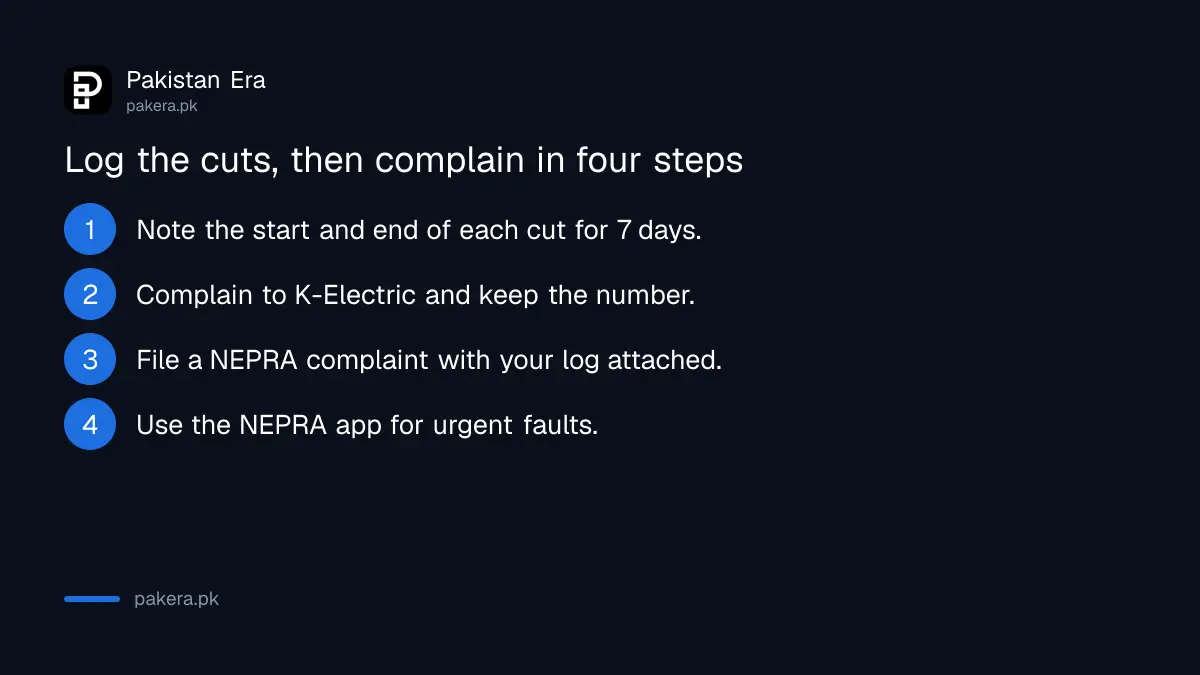
Write down each cut for seven days, with the start and end time. Complain to K-Electric first and keep the complaint number. If the problem continues, file it with NEPRA and attach your log. Say which feeder you are on, if your bill shows it.
The steps for the company side are in our guide to a K-Electric complaint on 118. For an urgent fault you can also use the NEPRA Asaan Approach app.
Common questions
Is load shedding in Karachi now banned?
No. NEPRA banned unannounced, excessive and loss-based load shedding. Cuts ordered by NTDC for a real shortage are still allowed under the rules, as long as they follow the set order and are shared fairly.
Does the order apply to areas outside Karachi?
The order names K-Electric and its service territory. It does not name other companies. A separate NEPRA order from July 2026 deals with the same practice at HESCO in Hyderabad.
Will my feeder get fewer cuts straight away?
We cannot say. The order sets a 30 day deadline for a compliance report, and we did not find that report. Check your own hours against KE's schedule and keep a log.
Can K-Electric still cut power to a person who does not pay?
Yes. The order says individual defaulters and thieves can be disconnected under the proper procedure. It rules out cutting the whole feeder.
Has a court stopped this order?
We found no stay on this order. A Sindh High Court hearing reported for 15 October concerns K-Electric's tariff appeals, which is a separate matter. We did not read court records, so treat that as reported.
Where is the order published?
It is on NEPRA's website under its M&E decisions for August 2026, with the reference LAD-01 and the date 31 August 2026.
How we verified this
What we checked, where we read it, and what we could not confirm.
We read the order of the Authority on unannounced and excessive load shedding in Karachi, dated 31 August 2026, on nepra.org.pk on 12 October 2026. Figures on feeders, consumers and hours are NEPRA's, taken from data K-Electric supplied. We did not verify them independently. NEPRA's complaint form is on the same site.
About the author

Tax, Bills and Technology Writer
Ali Akhtar is a young and curious voice here at Pakistan Era. He is currently pursuing his A-Levels and has a growing interest in Pakistan’s changing industrial landscape and educational trends. Ali likes to write in a way that helps him explain and explore the world around him. His writing reflects the perspective of the new generation navigating the evolving trends of Pakistan where technology, youth innovation, and shifting opportunities are reshaping the country’s future.