How to Check a Rs 5,000 Note Is Genuine in Pakistan: 10 SBP Security Features
Check if a Rs 5,000 note is genuine in Pakistan with the State Bank's own list: watermark, thread, colour-shifting ink, raised print and serial numbers.
Short answer: Hold the Rs 5,000 note to the light and check four things first: the "5000" figure that joins up across front and back, the thin thread with "5000" in it, the Quaid-e-Azam watermark on the left, and the crescent and star that change from green to golden when you tilt the note. The State Bank lists many more features.
A Rs 5,000 note changes hands fast: at a wedding hall, a used-car deal, a cash payment for rent. That is when a fake gets passed, because nobody stops to look. Ten seconds is enough if you know where to look.
We read the State Bank's own page on the security features of the Rs 5,000 note on 14 October 2026. Everything below is from that page. We did not hold a note under ultraviolet light for this piece, so the light test is the State Bank's description, not our test.
Four checks you can do in your hand
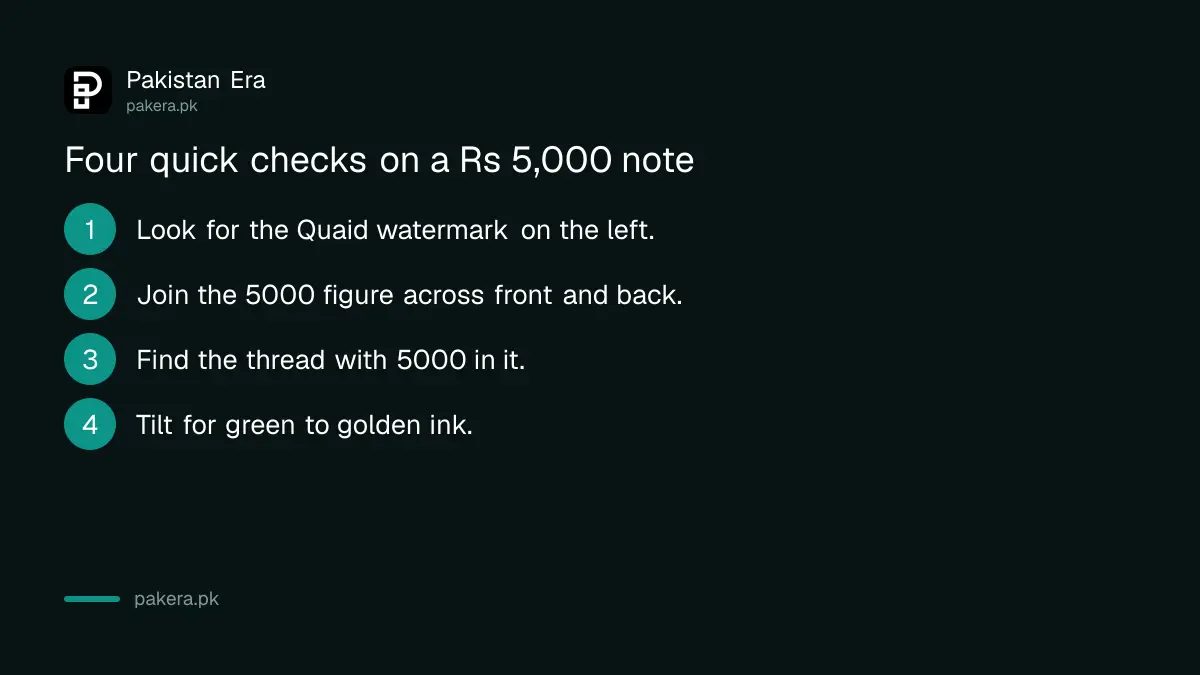
Look at the watermark, the see-through figure, the thread and the colour-shifting ink. These four need only daylight and a few seconds. A genuine note shows all four. If one is missing or looks printed on, treat the note as doubtful.
Start with the watermark. The State Bank says the portrait of the Quaid-e-Azam in national dress, a sherwani, appears at the left of the front as an enlarged watermark. The note's value appears below that portrait as an "electrotype" watermark, a second, tone-shaded mark you see against the light.
Next the see-through figure. The value figure is printed partly at the top left of the front and partly at the top right of the back. Hold the note up and the two halves should join into one complete figure.
The thread and the colour-shifting ink
A thin window thread runs from top to bottom at the left of the front and carries "5000". It looks like silver dashes on the surface and a solid line against the light. The crescent and star at the right of the front change from green to golden as you tilt the note.
The State Bank adds that the thread shows yellow and blue bands under ultraviolet light. Most of us do not carry a UV lamp, so treat it as a bonus check.
The colour-shifting ink is called optical variable ink. Tilt the note slowly. A flat green or flat gold that never moves is a warning sign. A copier or home printer cannot reproduce a change of colour like this.
The touch, the lines and the numbers
Feel the front. The State Bank says the front is printed by the intaglio process, a raised ink, and that three raised circles at the left let blind people recognise the value by touch. Intaglio lines run along the left and right edges. Paper copies feel flat.
| Feature | Where to look | What the State Bank says |
|---|---|---|
| Enlarged watermark | Front, left | Quaid-e-Azam in sherwani |
| Electrotype watermark | Below the portrait | Shows the value |
| Window thread | Front, left, top to bottom | "5000" in the thread, silver dashes |
| See-through figure | Top left front and top right back | Halves join in the light |
| Latent image | Right of the portrait | "5000" shows at an angle |
| Optical variable ink | Front, right | Crescent and star, green to golden |
| Raised circles | Front, left | Three circles for touch |
| Micro lettering | Top right and bottom left | Tiny "5000" near portrait and thread |
| Serial number | Top right and bottom left | Seven digits and prefix, magnetic ink |

Two more details. The note carries the year of production at the right of the front. It also carries a seven-digit serial number with a prefix at the top right and bottom left, printed in magnetic ink. Both numbers on one note should match.
A routine that takes ten seconds
Do the same order each time: look at the note against the light, tilt it, feel it, then read the serial numbers. Doing it in the same order makes it quick. Never skip the light test when the note is large or the seller seems in a hurry.
- Hold the note to the light. Check the portrait watermark, the thread and the joining figure.
- Tilt it. Watch the crescent and star shift from green to golden.
- Run a finger over the front. Feel the raised ink and the three circles.
- Check the two serial numbers match and look evenly printed.
- If a feature fails, do not accept it. Ask for another note, or take it to a bank.

If a note is only worn or torn, it is a different problem. See how to exchange torn or damaged banknotes. For the wider cash picture, read how many banknotes are in circulation. And the State Bank has said old notes stay valid while new designs wait, in the note on new currency designs.
Where fakes cause trouble beyond cash
Cash is not the only thing that gets faked. A screenshot of a payment can look as real as a note. Check whether a payment actually arrived before you hand over goods.
The same habit of checking the original source applies to prize bonds. See how to check a prize bond is real.
Common questions
What is the fastest check for a Rs 5,000 note?
Hold it to the light. The "5000" figure should join up across the front and back, and the thread should show as a line.
Does the colour-shifting ink matter?
Yes. The crescent and star at the right of the front should move between green and golden when you tilt the note.
Do I need a UV lamp?
No. UV light is an extra check. The State Bank says the thread shows yellow and blue bands under it, but the light and touch tests work without it.
What is intaglio printing?
It is a raised ink. You can feel it on the front of a genuine note, especially the three circles at the left and the lines at the edges.
What should I do with a note I think is fake?
Do not pass it on. Take it to a bank and ask the staff to check it, and keep the details of where you got it.
How we verified this
What we checked, where we read it, and what we could not confirm.
Last checked on 14 October 2026, Pakistan time. We read the State Bank's page Security Features of 5000 Rupees. We did not test a note under UV light, and we did not read the State Bank's pages for other denominations. We also could not find a step-by-step State Bank process for handing in a suspected fake, so the last step above is our advice, not a rule.
About the author

Public Services and Education Journalist
Fajr Riaz is a journalist and content writer at Pakistan Era, based in Lahore. She covers the questions people meet in everyday life in Pakistan: how a public service works, what a change in the rules means, and where to find a reliable answer.