Check a Trade Partner Against OFAC and UN Sanctions Lists Before an Iran Deal in Pakistan
Pakistan says it follows applicable sanctions. Search your Iran trade partner on the OFAC list and the UN list in 6 steps, owners and vessels included.
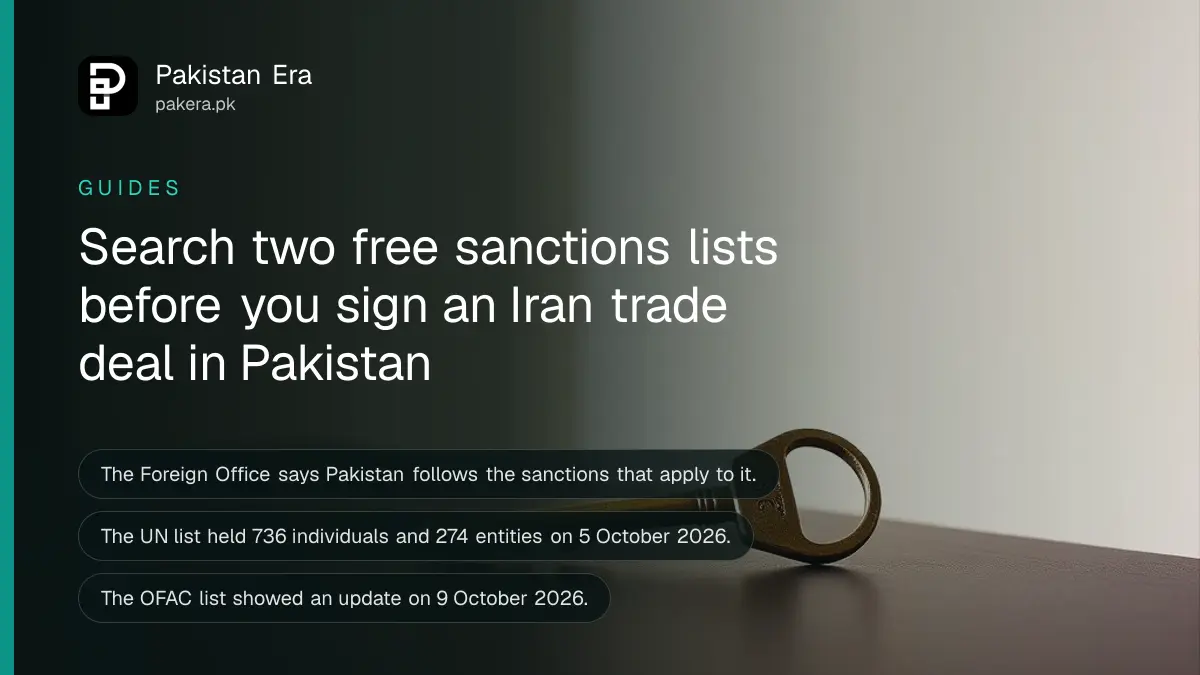
Short answer: Before you sign a deal with a buyer, seller or shipper tied to Iran, search their name on two free lists: the US Treasury's Sanctions List Search (OFAC) and the United Nations Security Council Consolidated List. Pakistan's Foreign Office says Pakistan follows the sanctions that apply to it, so a clean check on both is the minimum.
A trader at a border town hears that a buyer across the line pays well and pays fast. The paperwork looks fine. Nobody mentions that the buyer's owner may sit on a foreign sanctions list, and that a bank can freeze the payment weeks later. The check takes ten minutes. The freeze can take months to undo.
On 1 October 2026 and again on 9 October 2026, the Foreign Office was asked about trade with Iran and sanctions. Both answers are on the ministry's own website. We read them, and we opened the two lists named below on 12 October 2026. This is how to run the check, and what each list can and cannot tell you.
The Foreign Office says Pakistan follows applicable sanctions
At its 1 October 2026 briefing the Foreign Office said Pakistan adheres, and will continue to adhere, to all applicable sanctions regimes in accordance with international and domestic laws. On 9 October the spokesperson added that not all trade activity is subject to sanctions.
The spokesperson also said an earlier remark attributed to the ministry was taken out of context. That remark was reported as saying that unilateral sanctions, those not imposed by a UN Security Council resolution, would not stop trade with Iran. Its later statement reaffirmed that Pakistan follows applicable sanctions.
So the official position has two parts. Some trade is not under sanctions. Pakistan follows the regimes that apply. Neither statement tells you whether your specific buyer or cargo is safe. Only a list search can start to answer that.
One term needs a plain meaning. "Unilateral" means one country or a group acting alone, such as the United States, rather than the UN Security Council. The ministry did not say how Pakistani banks treat such lists, so ask your own bank.
The OFAC Sanctions List Search is the first stop
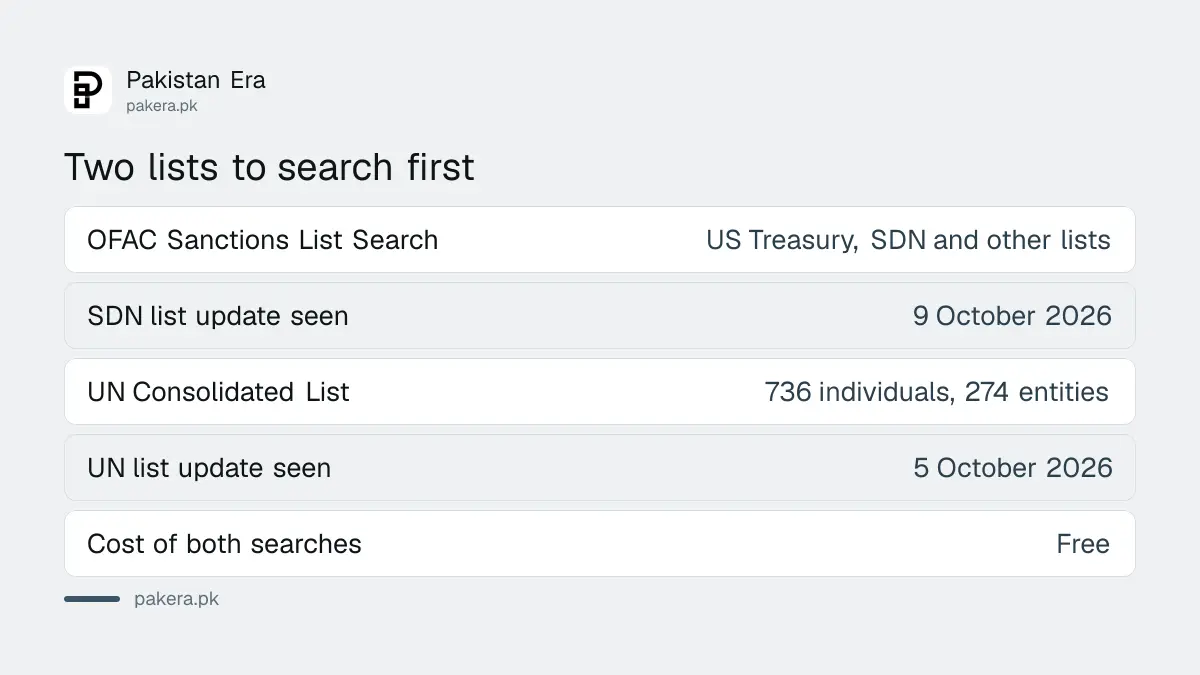
OFAC is the US Treasury office that keeps the Specially Designated Nationals and Blocked Persons list, called the SDN list. Its free Sanctions List Search covers the SDN list and several other OFAC lists. When we opened it, it showed the SDN list last updated on 9 October 2026.
The tool uses approximate matching. That means a misspelt name can still return a hit. You can set a minimum name score with a slider. A lower score returns more possible matches, and a higher score returns fewer. OFAC itself says it gives no advice on the right score, and that the tool is not a substitute for proper due diligence.
| Field in the tool | What to enter | Why it helps |
|---|---|---|
| Name | Company and owner names, in English spelling | Finds listed persons and close spellings |
| Address, City, Country | The buyer's trading address | Narrows hits to the right entity |
| ID number | Passport, registration or vessel number if you have it | Exact match, no guesswork |
| Program | Leave blank at first | The result shows the programme code for each hit |
| Minimum name score | Start at a low score, then raise it | Helps you see near matches without drowning in noise |
Check the owners, not only the company name
A company can be clean while its owner is listed. OFAC's published guidance says persons under its jurisdiction must block the property of listed persons, and also of any entity owned 50 percent or more, directly or indirectly, by one or more blocked persons.
So search three things: the trading company, each owner or director you can name, and the vessel or shipping line if goods move by sea. Ask the buyer for the registration papers and the owner's name. A buyer who will not give an owner's name has told you something useful.
Our guide to the bank's import and export price check explains the other screening step your bank will run on the same deal.
The UN Consolidated List covers the sanctions every member state must apply
The UN Security Council keeps one Consolidated List of people and groups under its sanctions committees. When we read the page on 12 October 2026 it listed 736 individuals and 274 entities and said it was last updated on 5 October 2026. It can be read as a web page, a PDF or an XML file.
This list is the one with a clear legal basis for every UN member state, Pakistan included. The permanent reference numbers show which regime a name belongs to. For example, numbers beginning with QD belong to the Al-Qaida regime, and numbers beginning with IR belong to the Iran regime.
Searching a name here does two jobs. It shows UN-listed names. And it shows you whether a name that appears on the US list also appears on the UN list. A name on the UN list is a firmer stop than a name on one country's list.
Run the check in six steps and keep a record
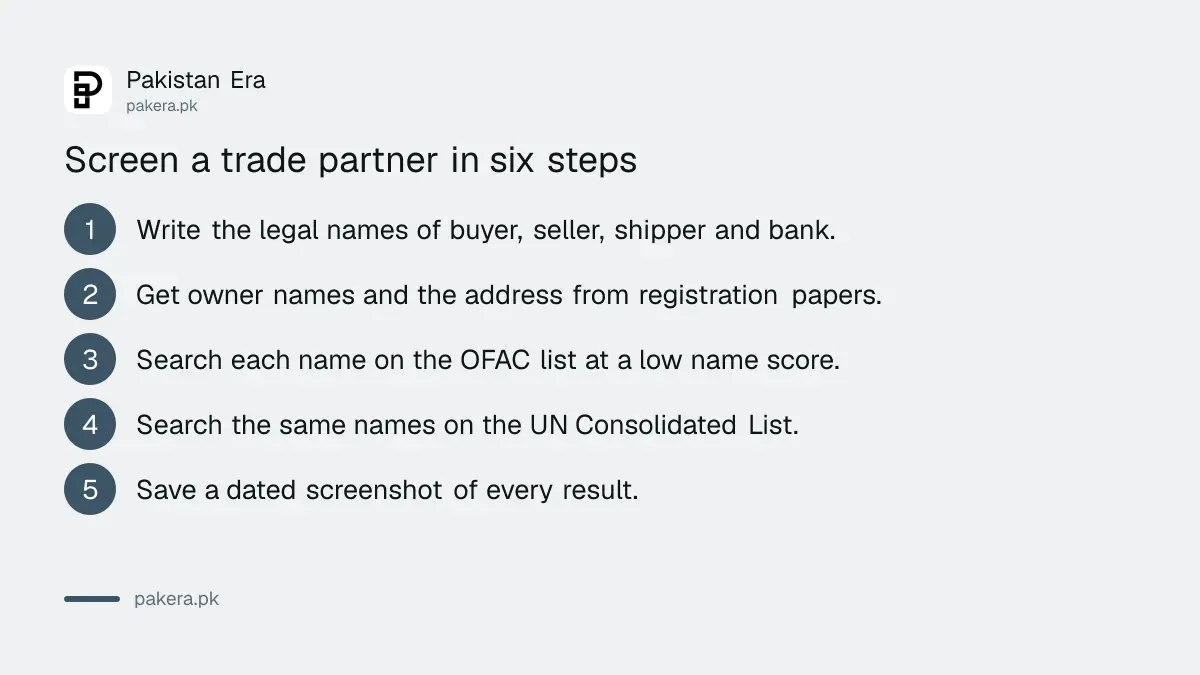
Do the search before you sign, and again before each payment. Lists change. Save a screenshot or PDF showing the date and the result, so you can show a bank or a customs officer what you checked.
- Write down the full legal name of the buyer, seller, shipper and bank.
- Get the owners' names and the trading address from registration papers.
- Search each name on the OFAC Sanctions List Search at a low name score.
- Search the same names on the UN Consolidated List.
- Save a dated screenshot of every result, including a "no match" result.
- If any name matches, stop and take the match to your bank or a lawyer before anything moves.
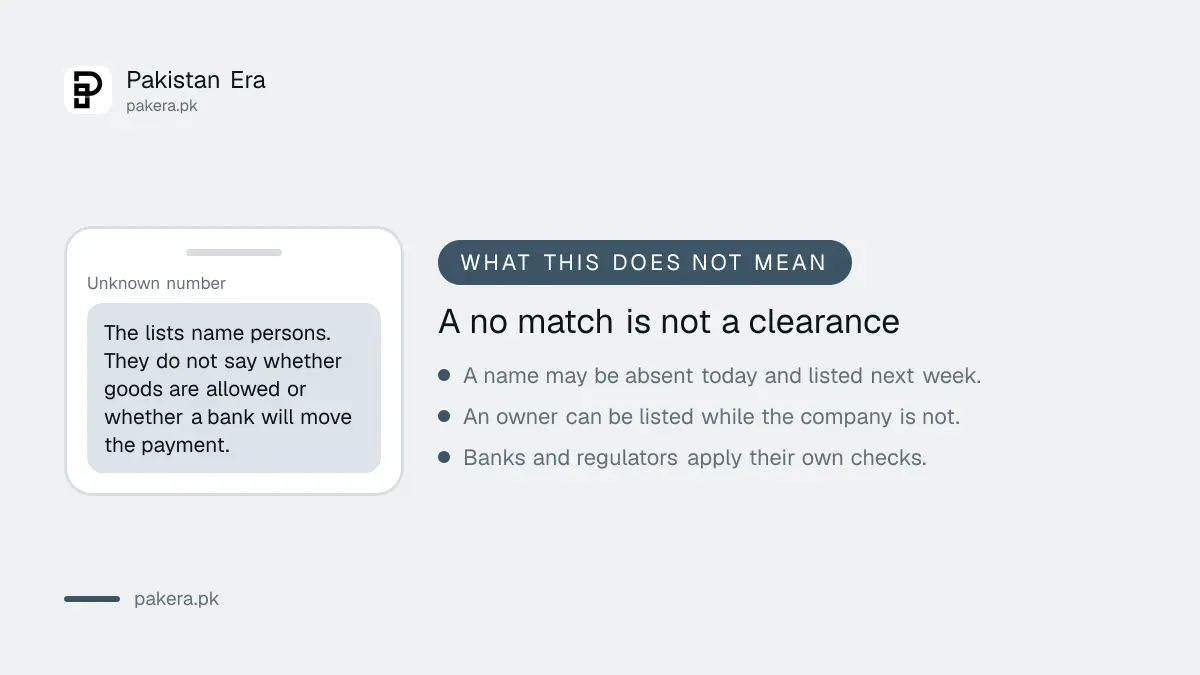
A "no match" is not a clearance. It means the name is not on those two lists on that day. Your bank may still ask questions, and a regulator may still look at the deal.
What a clean search does not tell you
The lists name persons. They do not say whether a type of goods is allowed, whether a payment route is open, or whether a bank will process the transfer. Those are separate questions with separate answers.
Pakistan's land route with Iran is a live one. Our report on the 24 hour border crossings with Iran covers the land route. The stated trade goal is in the note on the $10 billion trade target, which left sanctions unmentioned.
We could not open the Foreign Office's own "Important SROs" page, which the ministry's website menu points to, because the page blocked our request on 12 October. SROs are statutory orders. If your trade touches a UN-listed name, ask your bank or lawyer to read the current SROs directly. We have not read them and do not describe them here.
This is a checking guide, not legal advice. Do not rely on it to decide that a deal is lawful.
Common questions
Is trade with Iran banned for Pakistanis?
The Foreign Office said on 9 October 2026 that not all trade activity is subject to sanctions. It also said Pakistan follows the sanctions regimes that apply. Which rules apply to your deal depends on the goods, the parties and the payment route.
Which lists should I search first?
Start with the OFAC Sanctions List Search and the UN Security Council Consolidated List. Both are free and public. Search the company, its owners and the vessel.
Does a "no match" mean my deal is safe?
No. It only means the name did not appear on those lists on that day. Your bank, a regulator or a foreign partner may apply other rules.
What is the 50 percent rule?
Under OFAC guidance, an entity owned 50 percent or more, directly or indirectly, by one or more blocked persons is treated as blocked too. A company with no name on the list can still be caught through its owners.
How often do the lists change?
Often. When we read them, the OFAC SDN list showed an update on 9 October 2026 and the UN list showed 5 October 2026. Search again before every payment.
Who can tell me what a hit means?
Your bank's compliance team or a lawyer. OFAC runs a compliance hotline for questions about its own rules. Do not rely on an agent who offers to "clear" a name for a fee.
How we verified this
What we checked, where we read it, and what we could not confirm.
We read the Foreign Office transcripts of the briefings on 1 and 9 October 2026 on the Ministry of Foreign Affairs press releases page. We opened the OFAC Sanctions List Search and the UN Security Council Consolidated List on 12 October 2026. Sanctions change by notice, so check each list again on the day you pay.
About the author

Global Affairs & Political Economy Writer
Muhammad Hatim is a book lover who started writing because he enjoys it. At Pakistan Era he writes about international relations, geopolitics and the global economy, with a particular interest in South Asia and the forces behind current events.