How to Check and Report Low Voltage in Pakistan: NEPRA's 5% Rule and Complaints by Company
NEPRA says 95% of customers must get voltage within 5% of normal. See voltage complaints by company for 2024-25 and how to record readings and complain.
Short answer: NEPRA's rule says at least 95% of a company's customers must get voltage within 5% above or below the normal level. In 2024-25 K-Electric reported 167,850 voltage complaints, the most of any company. Log your voltage readings, then complain to your company first.
Low voltage burns out fans, fridges and pumps. High voltage can damage electronics. Both are a service fault, not something customers must accept.
We downloaded and read NEPRA's Performance Evaluation Report of Distribution Companies for 2024-25 from nepra.org.pk on 13 October 2026. It covers the year to June 2025. This guide uses Table 11, which counts voltage complaints for each company.
The rule allows only 5% above or below normal voltage
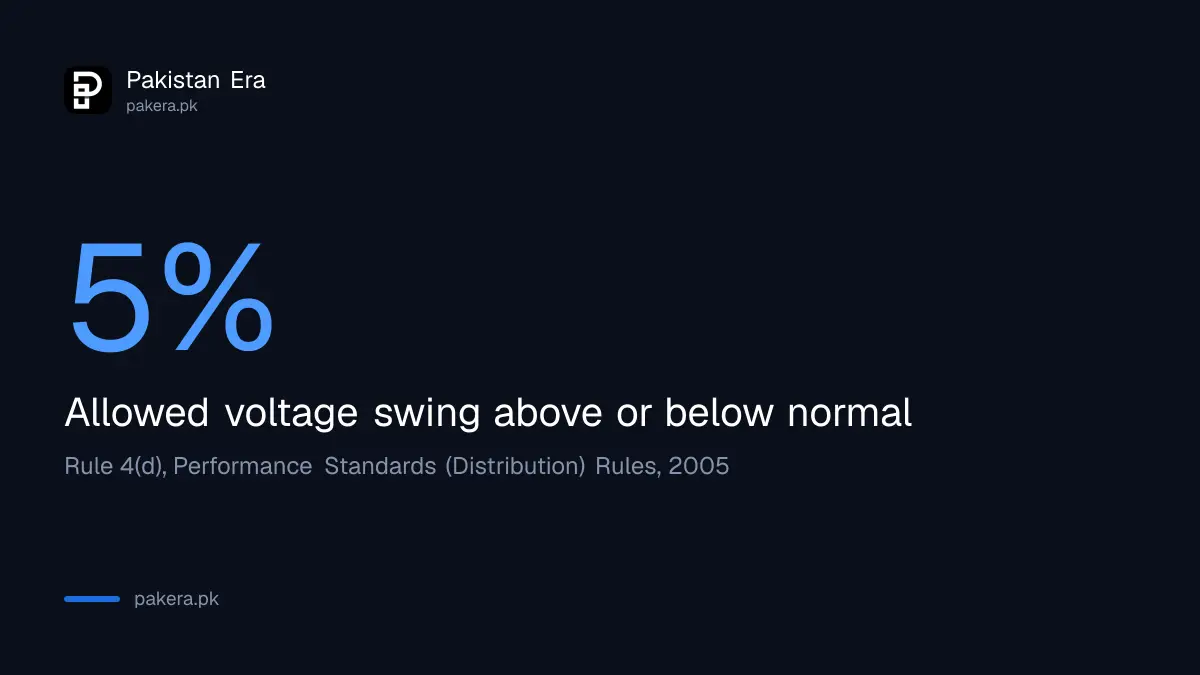
Rule 4(d) of NEPRA's Performance Standards (Distribution) Rules, 2005 says each company must supply at least 95% of its customers within 5% of the nominal voltage. The report tests this through voltage complaints, because companies do not measure every customer.
As a worked example only, if your nominal supply is 230 volts, 5% either way is about 218.5 to 241.5 volts. Check your nominal figure with your company, because we did not verify it in the report.
K-Electric recorded the most voltage complaints
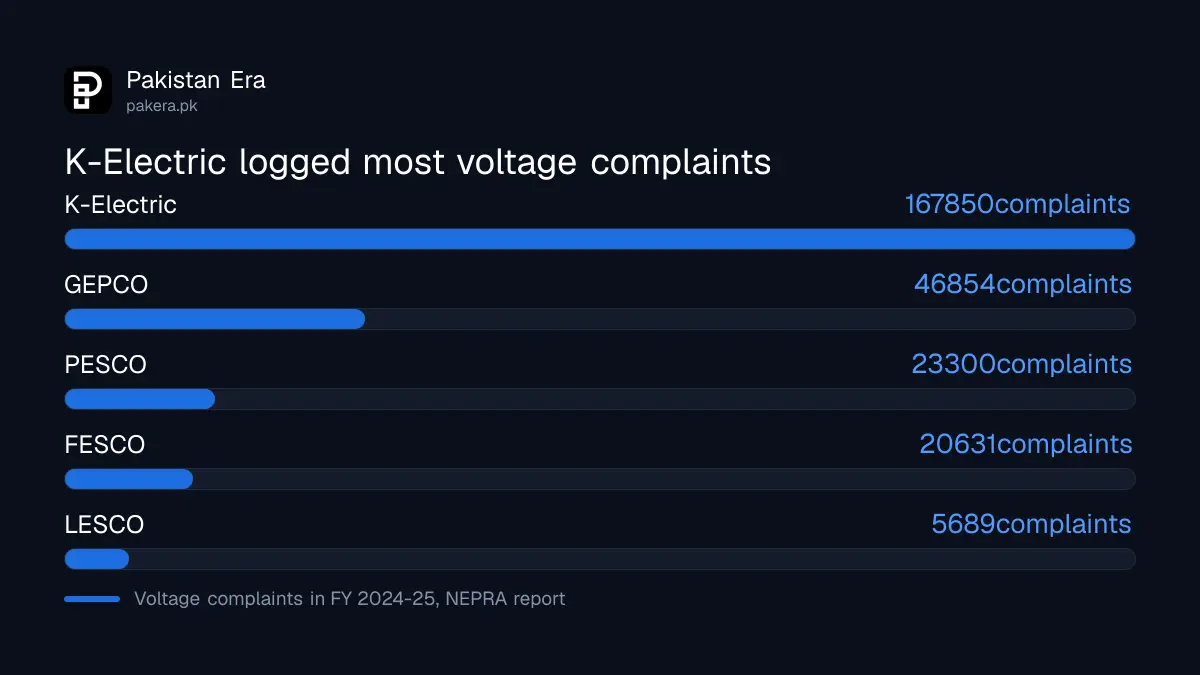
K-Electric reported 167,850 voltage complaints, about 4.4% of its 3,811,258 customers. GEPCO reported 46,854 and PESCO 23,300. The other companies reported far fewer, and NEPRA doubts the lowest figures.
| Company | Voltage complaints | Customers | Share of customers |
|---|---|---|---|
| K-Electric | 167,850 | 3,811,258 | 4.40% |
| GEPCO | 46,854 | 4,945,225 | 0.95% |
| PESCO | 23,300 | 4,021,225 | 0.58% |
| FESCO | 20,631 | 5,531,719 | 0.37% |
| LESCO | 5,689 | 7,054,612 | 0.08% |
| QESCO | 2,302 | 733,712 | 0.31% |
| IESCO | 1,592 | 3,997,826 | 0.04% |
| MEPCO | 3,050 | 8,250,448 | 0.04% |
| SEPCO | 845 | 828,053 | 0.10% |
| HESCO | 165 | 1,261,129 | 0.01% |
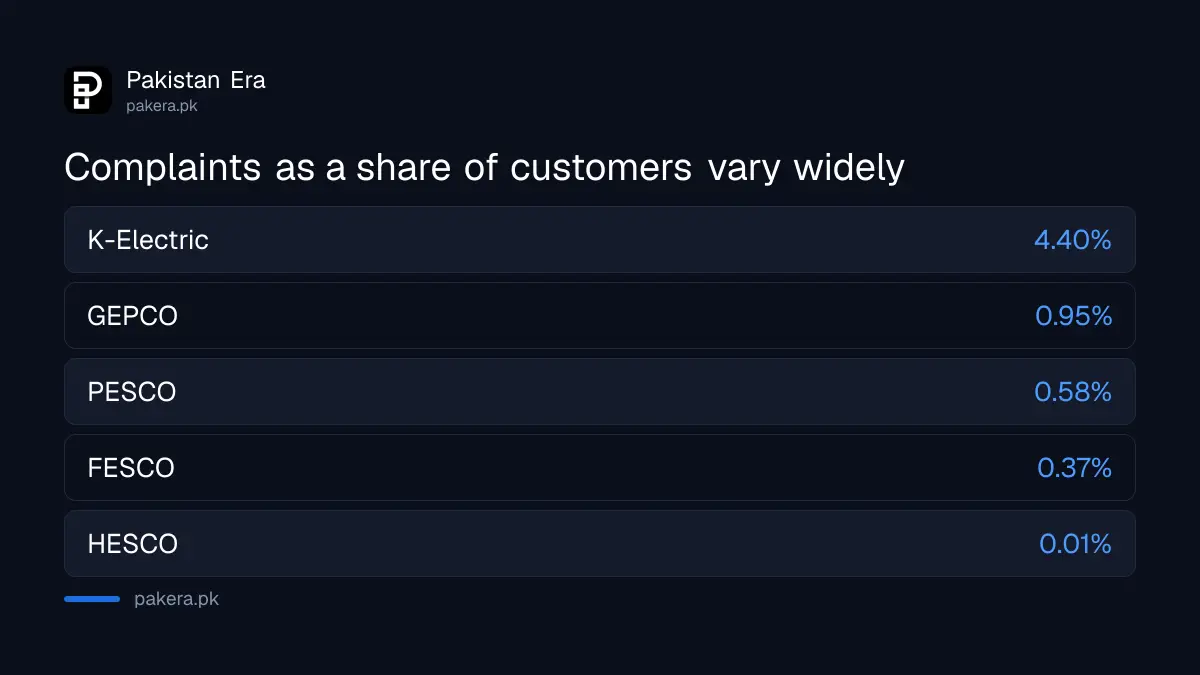
We worked out the last column by dividing complaints by customers. The report prints the same shares, apart from LESCO, where its printed 0.072% differs slightly from our 0.08%. We used our own division. Every company is far below the 5% allowed, which is why NEPRA says the results look too good.
NEPRA doubts the lowest numbers
NEPRA says SEPCO and HESCO reporting 845 and 165 complaints is hard to believe for 828,053 and 1,261,129 customers. It says the claim that over 95% of customers get proper voltage looks too hopeful and needs checking.
Low counts can mean customers have no easy way to complain, or that the company does not log calls. If the figure looks small, that is a reason to file your own complaint, not a sign that your voltage is fine.
Record your voltage before you complain
A plug-in voltage meter costs little in a local electrical shop. Take readings at the same plug, at different times of day, and write them down. A record showing repeated readings outside the allowed range is stronger than a phone call.
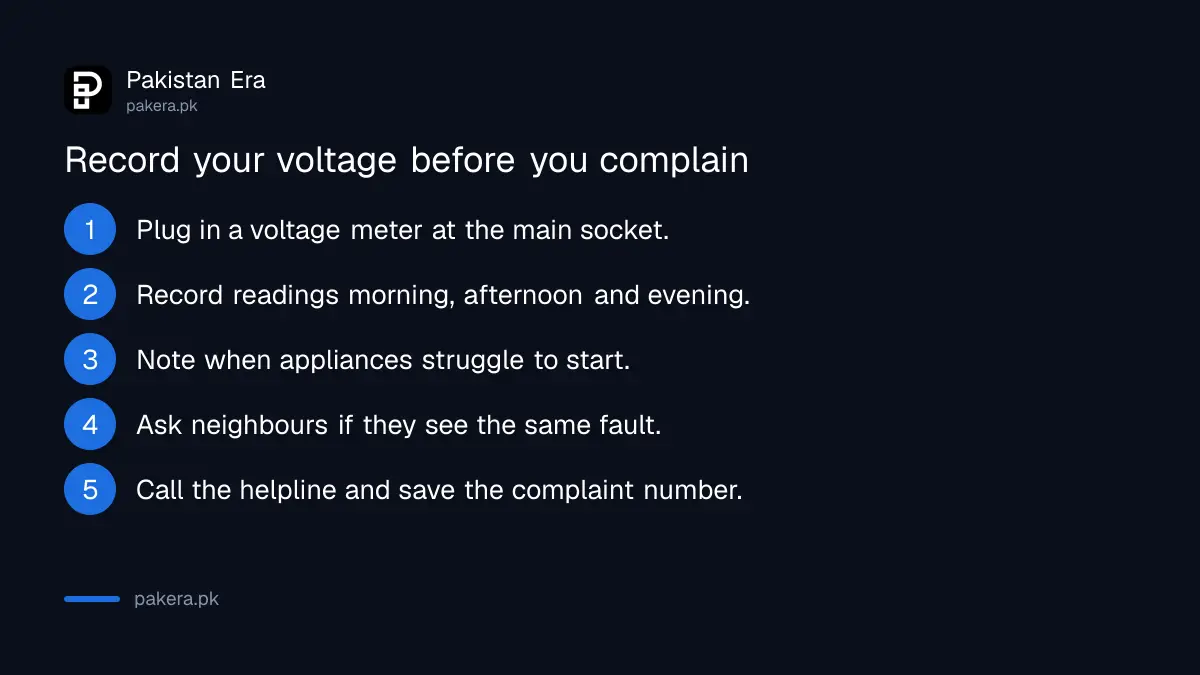
- Plug in a voltage meter at the main socket nearest your meter.
- Record the reading in the morning, afternoon and evening for a week.
- Note when appliances like your pump or air conditioner struggle to start.
- Ask neighbours whether they see the same problem. Street faults affect many homes.
- Call your company's helpline and save the complaint number.
Report it to the company, then NEPRA
NEPRA expects the company to get the first chance to fix the fault. Complain to the company and keep the number. If nothing changes, use the NEPRA Asaan Approach app or the steps in our guide to reporting low voltage, a sparking pole or a fallen wire.
The August 2026 NEPRA service regulations also put a clock on voltage complaints. They give 24 hours for a voltage fluctuation that needs no network work, as we explain in NEPRA's new service deadlines. Turn off sensitive devices while the voltage is unstable. A voltage stabiliser may protect a fridge, but we did not test any brand.
Do not open the meter or the service wire yourself. Voltage faults can come from an overloaded transformer, a loose neutral wire or a long line. Only company staff should work on those. Your job is to prove the problem with dates, readings and a complaint number.
If a neighbour has the same trouble, complain together. A shared complaint from one street points to the transformer or feeder, and that is the part the company must fix.
Common questions
What voltage range is allowed in Pakistan?
NEPRA's 2005 rules say within 5% above or below the nominal voltage for at least 95% of customers. The nominal figure for your connection should be confirmed with your company.
Which company had the most voltage complaints?
K-Electric, with 167,850 in 2024-25, according to Table 11 of NEPRA's report. GEPCO was next with 46,854.
Why are the numbers for SEPCO and HESCO so low?
NEPRA says they look too low for the number of customers and may show weak complaint recording. It did not say the supply there is better.
Does the report say who is at fault for low voltage?
No. The report counts complaints against a rule. It does not give causes for each case.
Should I buy a stabiliser?
A stabiliser may protect one appliance, but it does not fix the supply. Complain to your company first, because a street fault needs a company repair.
How long should the company take to fix it?
The August 2026 regulations give 24 hours for a voltage fluctuation that needs no network work. We read this in our earlier check of those regulations.
How we verified this
What we checked, where we read it, and what we could not confirm.
Last checked on 13 October 2026. Source: NEPRA Performance Evaluation Report of Distribution Companies, FY 2024-25, Section 2.7 and Table 11. Shares of customers are our own division of the printed counts.
About the author

Tax, Bills and Technology Writer
Ali Akhtar is a young and curious voice here at Pakistan Era. He is currently pursuing his A-Levels and has a growing interest in Pakistan’s changing industrial landscape and educational trends. Ali likes to write in a way that helps him explain and explore the world around him. His writing reflects the perspective of the new generation navigating the evolving trends of Pakistan where technology, youth innovation, and shifting opportunities are reshaping the country’s future.