Cheque Return Charges in Pakistan: What Banks Charge for a Bounced Cheque, Rs 250 to Rs 1,200
Cheque return charges at five Pakistani banks for July to December 2026 run from Rs 250 to Rs 1,200 per cheque, more on a loan instalment. See who pays.
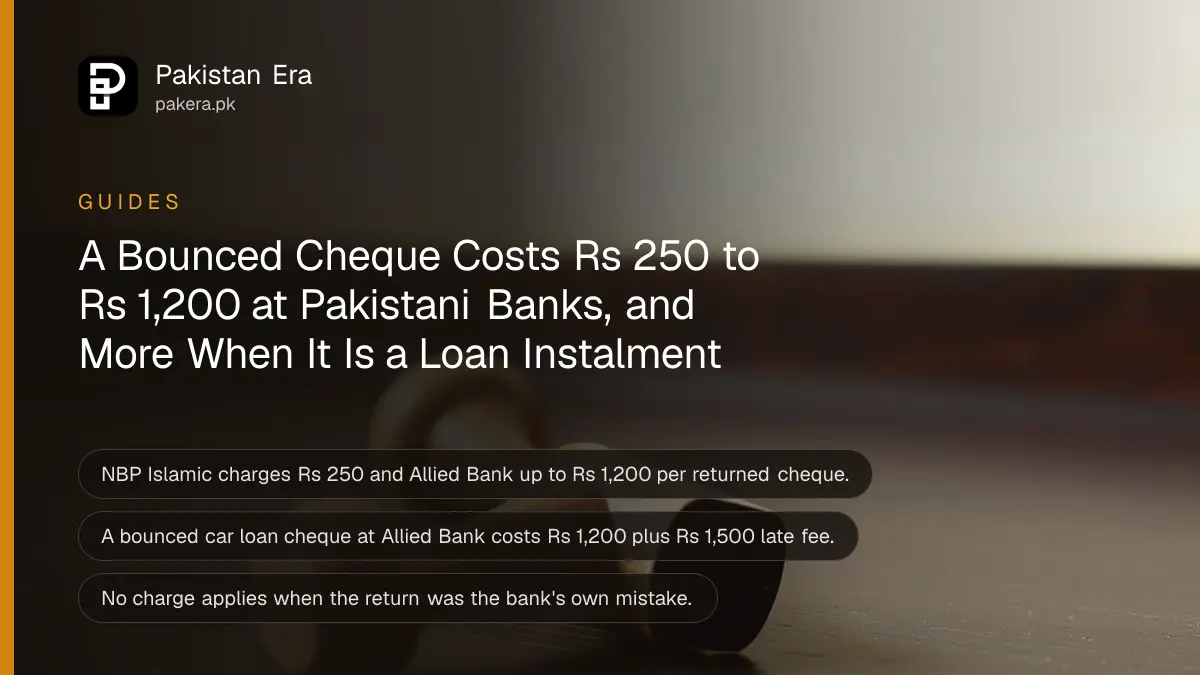
Short answer: When a cheque bounces in Pakistan, the bank that returns it charges the person who wrote it a cheque return fee of Rs 250 to Rs 1,200 in the July to December 2026 schedules we read: NBP Islamic charges Rs 250, ICBC Rs 300, BankIslami Rs 500, Dubai Islamic Bank Rs 600, and Allied Bank Rs 800 on a current account or Rs 1,200 on a savings account. A cheque written for a car loan instalment that bounces costs Rs 1,200 at Allied Bank on top of a Rs 1,500 late payment charge.
The return fee is only the first cost of a bounced cheque. The payee may charge you, the loan may go into arrears, and if the cheque was for a debt the payee can file a criminal complaint. We read five banks' schedules of charges on 19 October 2026 for the figures below, and FED is added to most of them.
A cheque is returned unpaid for a dozen reasons, and most of them are the writer's fault
Allied Bank's schedule lists the reasons it treats as the account holder's fault: insufficient balance, drawer's signature incomplete or different, cheque containing extraneous matter, payment stopped by the drawer, revenue stamp required or insufficient, and a mutilated cheque. The return memo stapled to the cheque names the reason, and that reason decides who pays.
The fee is charged by the drawer's bank, the one holding the account the cheque was written on, and it is debited from that account. The depositor's bank may charge its own customer a separate collection return fee, so a bounced cheque can cost both sides. Where the return is the bank's own error, the schedules say no charge applies.
Most returns are for the simplest reason: not enough money on the day the cheque arrived. Since cheques now clear as images under the Pakistan Express Clearing System, which SBP launched by circular on 5 October 2026, the day the cheque arrives can be the day after you hand it over.
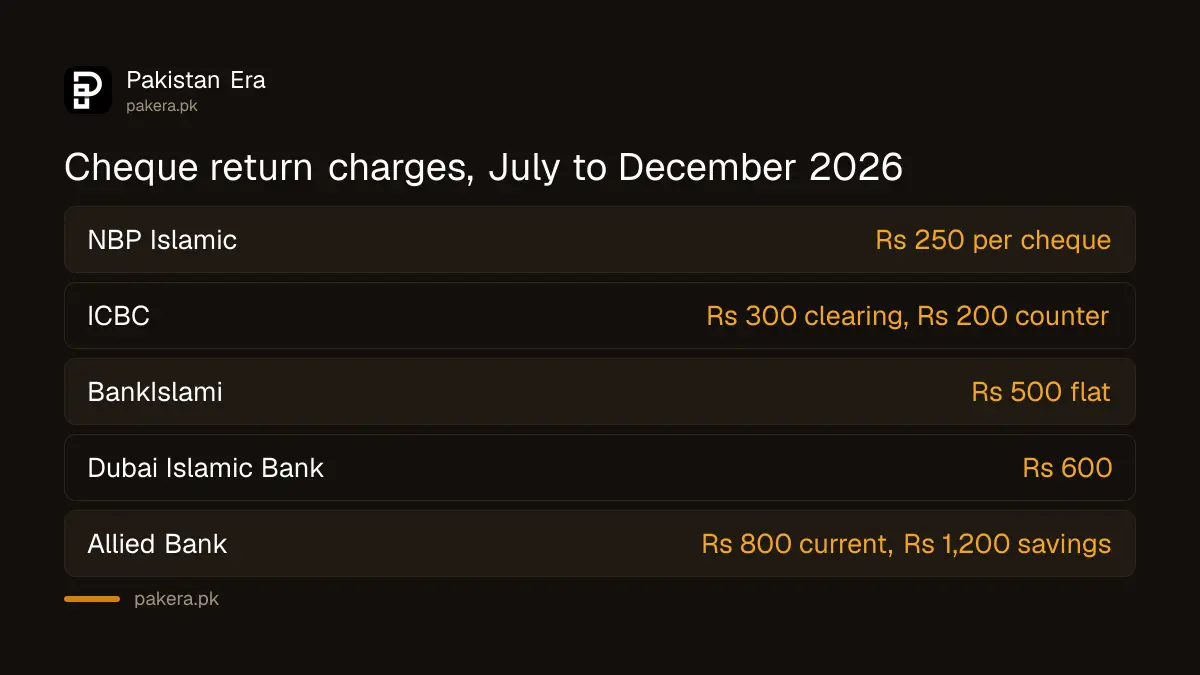
Return charges run from Rs 250 at NBP Islamic to Rs 1,200 at Allied Bank on a savings account
NBP Islamic charges Rs 250 per cheque on a rupee account and USD 5 on a foreign currency account when the fault is the client's. ICBC charges Rs 300 for a cheque returned in clearing and Rs 200 for a cash cheque at the counter. BankIslami charges Rs 500 for inward clearing or a cash cheque. Dubai Islamic Bank charges Rs 600 for inward clearing.
| Bank, schedule July to December 2026 | Cheque returned in clearing | Cheque returned at the counter | Notes |
|---|---|---|---|
| NBP Islamic Banking (Aitemaad) | Rs 250 per cheque, USD 5 foreign currency | No charge on a bearer cheque | Charged only when the fault is the client's |
| ICBC Pakistan | Rs 300 per cheque | Rs 200 per cheque | No charge if stopped by the drawer or the bank erred |
| BankIslami | Rs 500 flat, inward clearing or cash cheque | Rs 500 flat | Outward clearing return free |
| Dubai Islamic Bank | Rs 600 | Not listed separately | Free on some premium accounts |
| Allied Bank | Rs 800 current account, Rs 1,200 savings account, per cheque | Rs 550 current, Rs 700 savings | US$5 on foreign currency; no charge if the bank erred |
Allied Bank is the only bank in our set that charges savings account holders more than current account holders, and it does so on almost every cheque related line. If you write cheques from a savings account there, a current account would halve the return fee. Whether a bank may charge an account that keeps no minimum balance at all is covered in our page on SBP's no minimum balance rule.
A bounced loan instalment cheque costs the return fee plus a late payment charge
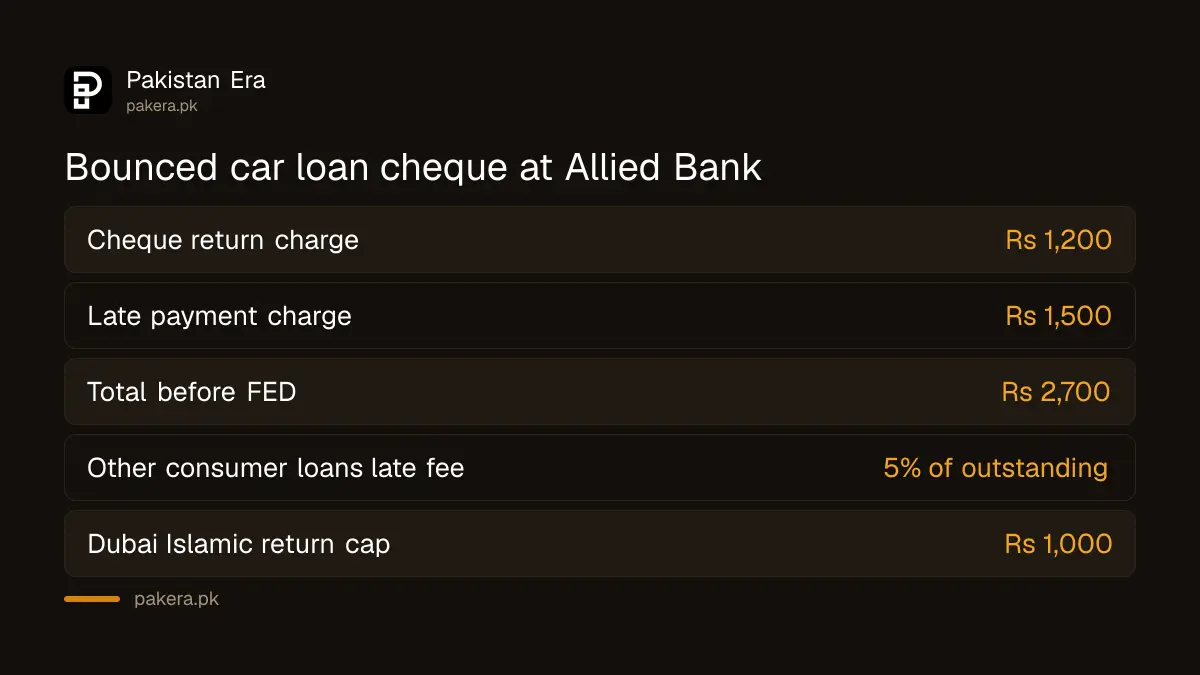
Allied Bank's car finance terms list a cheque return charge of Rs 1,200 per instance and a late payment charge of Rs 1,500 per instance, so one bounced instalment costs Rs 2,700 before FED. The same Rs 1,200 return charge appears under its other consumer financing, where late payment is 5 per cent of the outstanding amount.
Loan cheques bounce more than most because they are post dated and sit with the bank for months. If you know the balance will be short on the due date, pay the instalment through the app before the cheque is presented, then ask the bank to hold the cheque. That costs nothing. Letting it bounce and then paying costs the two charges and a mark on your credit history.
Dubai Islamic Bank's financing terms cap cheque return charges at Rs 1,000 per instance. Read the consumer financing section of your own bank's schedule, not just the account section, because the loan charges are separate and usually higher.
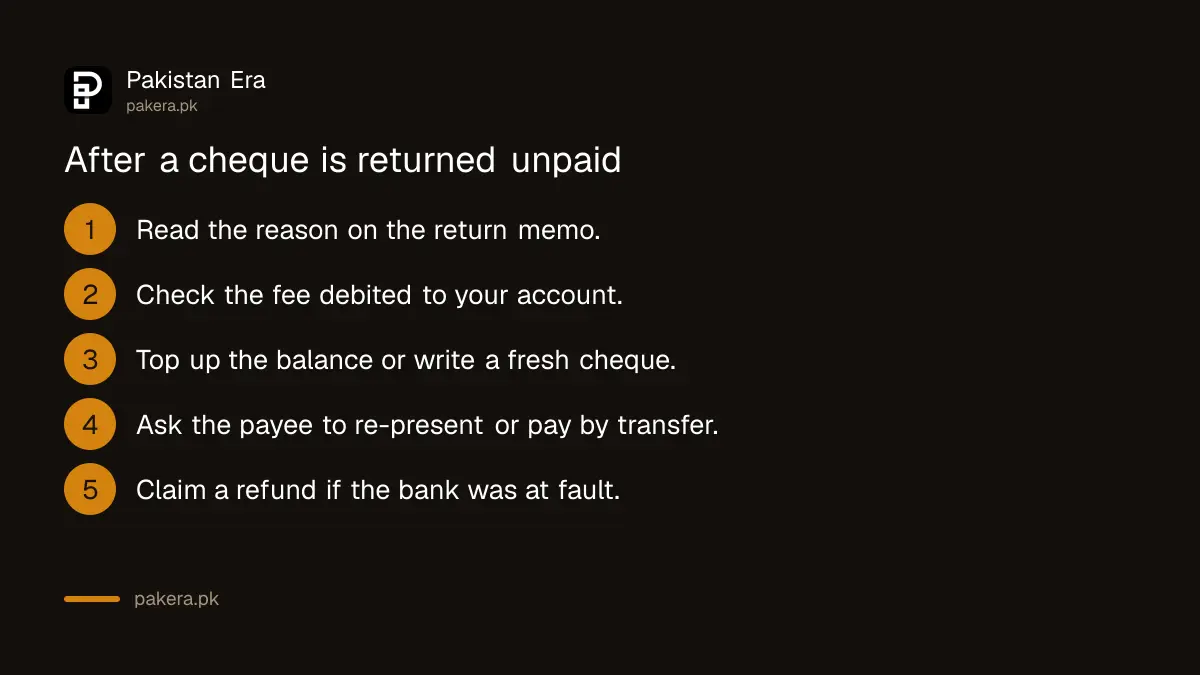
Fix the reason, then re-present the cheque or pay another way
Read the return memo first. If it says insufficient funds, deposit the shortfall and ask the payee to re-present; if it says signature differs or extraneous matter, write a fresh cheque; if it says payment stopped, that was your own instruction and the payee will want to know why.
- Get the return memo from the payee or your bank and read the stated reason.
- Check your account for the return fee and note the date; it is your evidence if the bank erred.
- Fix the cause: top up the balance, or write a new cheque in the form set out in writing a cheque correctly.
- Ask the payee to re-present, or pay by transfer and take the old cheque back.
- If the return was the bank's mistake, ask in writing for the fee to be reversed; escalate to SBP's Sunwai portal if it refuses.
A crossed cheque that was returned because it was presented for cash is the payee's error, not yours. The rules on crossed and account payee cheques explain which cheques can be cashed at the counter.
A bounced cheque for a debt can bring a criminal complaint under section 489-F
If the cheque was issued to repay a loan or fulfil an obligation and it is dishonoured dishonestly, the payee can file a complaint under section 489-F of the Pakistan Penal Code. The return memo is the first document in that case, which is why the reason on it matters more than the fee.
The bank fee and the criminal law are separate tracks. Paying the return charge does not settle the debt, and settling the debt does not refund the fee. What the law requires, and the defences a drawer has, are set out in our page on cheque bounce cases under section 489-F.
For the payee, a returned cheque also means a wasted trip and sometimes a fee from their own bank. Asking for a pay order or a Raast transfer instead of a personal cheque avoids all of it, and the fees worth avoiding across the board are in bank fees you can refuse.
Common questions about cheque return charges in Pakistan
How much does a bank charge for a bounced cheque?
Rs 250 to Rs 1,200 per cheque in the July to December 2026 schedules we read: Rs 250 at NBP Islamic, Rs 300 at ICBC, Rs 500 at BankIslami, Rs 600 at Dubai Islamic and Rs 800 or Rs 1,200 at Allied Bank by account type. FED is extra.
Who pays the cheque return charge?
The drawer, the person whose account the cheque was written on, when the return is their fault. The depositor's own bank may charge a separate collection fee. No charge applies when the bank erred.
Is there a charge if I stopped the cheque myself?
At ICBC no return charge applies for a stopped cheque. Allied Bank lists "payment stopped by drawer" among the reasons that attract its return charge. Check your bank's line.
What does a bounced loan instalment cheque cost?
At Allied Bank, Rs 1,200 for the return plus Rs 1,500 late payment on a car loan, or 5 per cent of the outstanding amount on other consumer loans. Dubai Islamic caps the return charge at Rs 1,000.
Can a bounced cheque lead to arrest?
A complaint under section 489-F of the Pakistan Penal Code is possible when a cheque for a debt or obligation is dishonoured dishonestly. The bank fee is a separate matter.
Can I get the return fee refunded?
Yes if the return was the bank's mistake. Ask in writing, then complain to SBP's Sunwai portal and the Banking Mohtasib if it is not reversed.
How we verified this
What we checked, where we read it, and what we could not confirm.
Last checked 19 October 2026. Charges are from the schedules of charges effective 1 July to 31 December 2026 of Allied Bank, BankIslami, Dubai Islamic Bank, NBP Islamic Banking and ICBC Pakistan, all read as PDFs on 19 October 2026. The PECS launch is from SBP's DI&SD Circular No. 02 of 2026. We could not read the schedules of HBL, UBL, MCB and Meezan, whose sites blocked automated reading, and HabibMetro's cheque return line for rupee accounts did not extract legibly, so those banks are not in the table.
About the author

Public Services and Education Journalist
Fajr Riaz is a journalist and content writer at Pakistan Era, based in Lahore. She covers the questions people meet in everyday life in Pakistan: how a public service works, what a change in the rules means, and where to find a reliable answer.