How to Write a Cheque Correctly in Pakistan: SBP Rules on Ink, Tape, Urdu and Signatures
SBP's cheque FAQ in plain words for Pakistan: use black or blue ink, no tape, no conditions, Urdu is accepted, and joint accounts can have two signers.
Short answer: Write your cheque in black or blue ink, never stick tape on it, never add a condition such as "pay only after delivery", and sign it yourself. SBP, Pakistan's central bank, set these rules in its cheque FAQ for banks. A cheque in Urdu is accepted.
A shopkeeper in Lahore hands over a cheque for rent. He used green ink, put a strip of tape over the amount "to stop changes", and wrote "payable after the goods arrive" at the bottom. The bank can refuse all three things. None of them is needed, and each one can delay or stop payment.
We read the State Bank of Pakistan's FAQ on the standard customer cheque layout, issued by its Payment Systems Department and updated in 2016. It answers 41 questions that banks asked. This page turns the parts that matter to a person writing a cheque into plain steps. The FAQ is addressed to banks, so what a bank does at its own counter can differ in small ways.
Black or blue ink is the safe choice
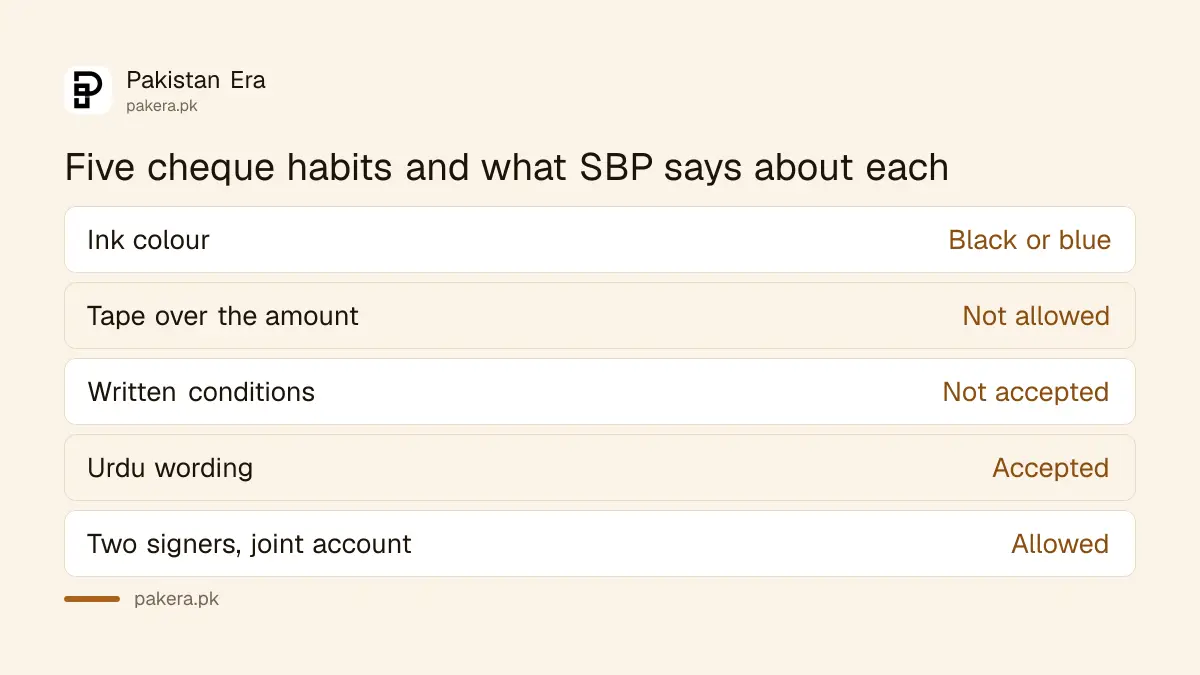
SBP names black and blue as the recommended ink colours for writing a cheque. It does not say other colours are banned. But if you want no argument at the counter, use one of the two. Use one pen for the whole cheque so the writing looks the same from start to end.
Write the amount in words and in figures, and make them match. Decimal amounts are acceptable on local and foreign currency cheques, according to the FAQ. The FAQ does not say what happens if the words and figures differ, but a mismatch is a common reason banks query a cheque, so check both before you sign.
For a foreign currency cheque, write the currency in the words, for example "Five thousand US Dollars only". SBP says a bank may accept words without the currency name, but it adds that customers should be taught to write it in full.
Tape and conditions can get a cheque returned
SBP says customers may not put scotch tape on a cheque to stop changes, and a paying bank should return such a cheque. The FAQ also says a cheque that carries any conditional statement should not be accepted by banks.
There is one exception for conditions. Federal and provincial government cheques with lines like "Not payable after" a date, or "Not payable through cash", may be accepted. A private cheque gets no such room.
To stop changes to your cheque, there is a better way than tape. Draw a line after the amount in words and write the figures without space on either side. Cross the cheque with two parallel lines and the words "Account Payee", which SBP describes as a way to protect a cheque from being cashed by someone else.
Urdu, your signature and joint accounts
Banks may accept cheques written in Urdu, SBP says. If the bank staff can read a regional language, a cheque in Balochi, Sindhi, Pashto or Punjabi can be accepted too. That last part depends on the person at the counter, so Urdu or English is safer.
For a joint account, SBP says more than one person can sign the cheque. Check how your account is operated, because some accounts need all holders to sign and some need one. Your account opening form records how the account is operated.
For company cheques, SBP says the drawer must sign. A bank may print a title such as "Manager" next to the signature space, but the person authorised must still sign.
Dates, stamps and old cheque books
SBP says banks may accept dates written with slashes, commas, dots or dashes. It adds that customers still need to be taught to fill the date as the cheque layout shows. Write the date in the boxes in the same style every time.
Old, non-standard cheque books remain valid. The FAQ says banks may keep accepting them until SBP reviews the matter and gives notice. We found no notice withdrawing them on SBP's circulars page on 13 October 2026.
The FAQ also says which stamps go where. A crossing stamp can sit on the top left of the front. Every other stamp, such as "Signature verified", goes on the back. Banks may put a "paid" stamp on the front after payment, but only where it does not cover key details.
| Item | What SBP says | What you do |
|---|---|---|
| Ink | Black and blue are recommended | Use black or blue |
| Tape on the cheque | Not allowed, cheque should be returned | Keep it clean |
| Conditions written on it | Should not be accepted | Write no conditions |
| Language | Urdu accepted | Use Urdu or English |
| Joint account | More than one person can sign | Follow the account's rule |
| Company cheque | The drawer signs | Sign above the line |
Write a clear cheque in six steps
These steps follow SBP's FAQ where it speaks, and common practice where it does not, in the order you write the cheque. A clear cheque matters more now, because SBP launched the Pakistan Express Clearing System on 5 October 2026, which clears cheques from their images. We explain that in the page on how PECS clears cheques by image. A cheque that scans badly is our concern here, not an SBP rule.
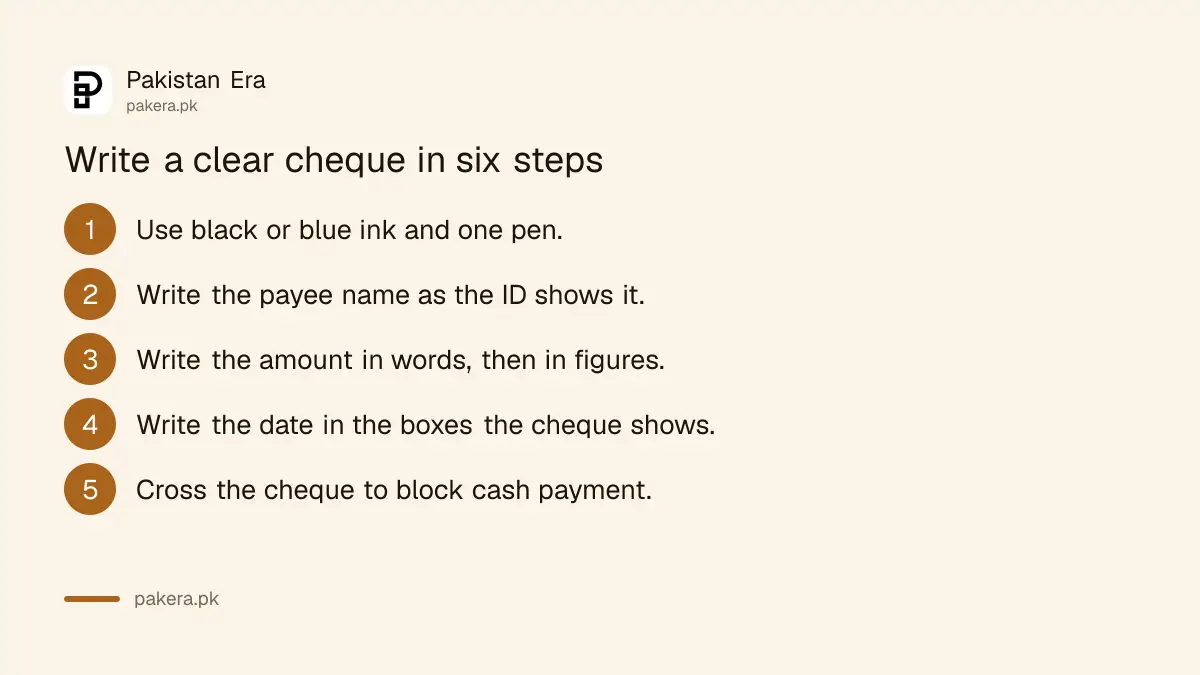
- Use black or blue ink and one pen.
- Write the payee name exactly as the person's ID shows it.
- Write the amount in words, then in figures. Make them match.
- Write the date in the boxes in the style the cheque shows.
- Cross the cheque if you do not want cash paid over the counter.
- Sign above the line, the same way you signed at the bank. Add no tape and no conditions.
If a cheque is returned for a reason you think is wrong, ask the bank for the reason in writing. What happens after a bounce is covered in the page on what to do when a cheque bounces. If you do not yet have a cheque book, the steps are in the guide to ordering a cheque book.
Common questions
Which ink colour should I use on a cheque in Pakistan?
Black or blue. SBP's cheque FAQ names these two as the recommended colours. It does not ban other colours, but black and blue avoid any dispute.
Can I put tape over the amount to stop changes?
No. SBP says tape is not allowed on a cheque and the paying bank should return it. Cross the cheque instead.
Is a cheque written in Urdu accepted?
Yes. SBP says banks may accept cheques written in Urdu. A regional language is accepted only if the bank staff can read it.
Can I write "pay after delivery" on a cheque?
No. SBP says cheques with any conditional statement should not be accepted. Government cheques with standard instructions are the only exception it names.
Can two people sign one cheque?
Yes, for a joint account. SBP says more than one person can sign. Check your account's operating rule to see if all holders must sign.
Do my old cheque books still work?
Yes. SBP's FAQ says banks may keep accepting old, non-standard cheques until SBP reviews and notifies. Ask your branch if it has a policy to replace them.
How we verified this
What we checked, where we read it, and what we could not confirm.
Last checked on 13 October 2026, Pakistan time. We read SBP's FAQs on standardization of customer's cheque layout, issued by its Payment Systems Department and updated in 2016, and SBP's circular launching PECS of 5 October 2026. The FAQ is addressed to banks and is several years old, so we could not confirm that no later instruction changes a point. We found no notice on SBP's circulars page that withdraws old cheque books. The advice to draw a line after the amount is common practice, not an SBP rule.
About the author

Public Services and Education Journalist
Fajr Riaz is a journalist and content writer at Pakistan Era, based in Lahore. She covers the questions people meet in everyday life in Pakistan: how a public service works, what a change in the rules means, and where to find a reliable answer.