How Businesses Buy Bulk SMS in Pakistan: Two Routes and PTA's 2026 Review of Corporate SMS
PTA's June 2026 paper asks if corporate SMS needs its own competition rules. See the two ways to buy bulk SMS in Pakistan and six questions to ask first.
Short answer: A business in Pakistan can buy bulk SMS in two ways: a direct contract with a mobile operator, or a licensed value added service (CVAS) provider that resells SMS using short codes. In June 2026 PTA asked whether corporate SMS should be a market with its own competition rules.
Every bank OTP, delivery alert and shop offer you receive is a corporate SMS. Someone paid for each one. Banks, schools, courier firms and online shops all use them.
We read PTA's consultation paper on this market on 13 October 2026. This page explains the two ways to buy, what PTA said, and what a business owner should ask before signing. PTA's paper is a proposal. We did not find a final decision on the pages we read.
PTA says corporate SMS is a separate market from normal SMS
PTA's paper of June 2026 says corporate SMS means bulk messages sent by companies, banks, government bodies and other organisations for alerts, transaction notices, promotions and public service messages. PTA treats it as a different product from the SMS you send a friend.
The reason is price. PTA says several companies and banks asked it to step in. Their complaint is that operators charge much more for corporate SMS than for ordinary person-to-person SMS, even though both use the same network.
PTA's paper does not publish the actual rates. It asks operators to send those figures to PTA, so we cannot say what a corporate SMS costs.
You can buy bulk SMS directly from an operator or through a licensed aggregator
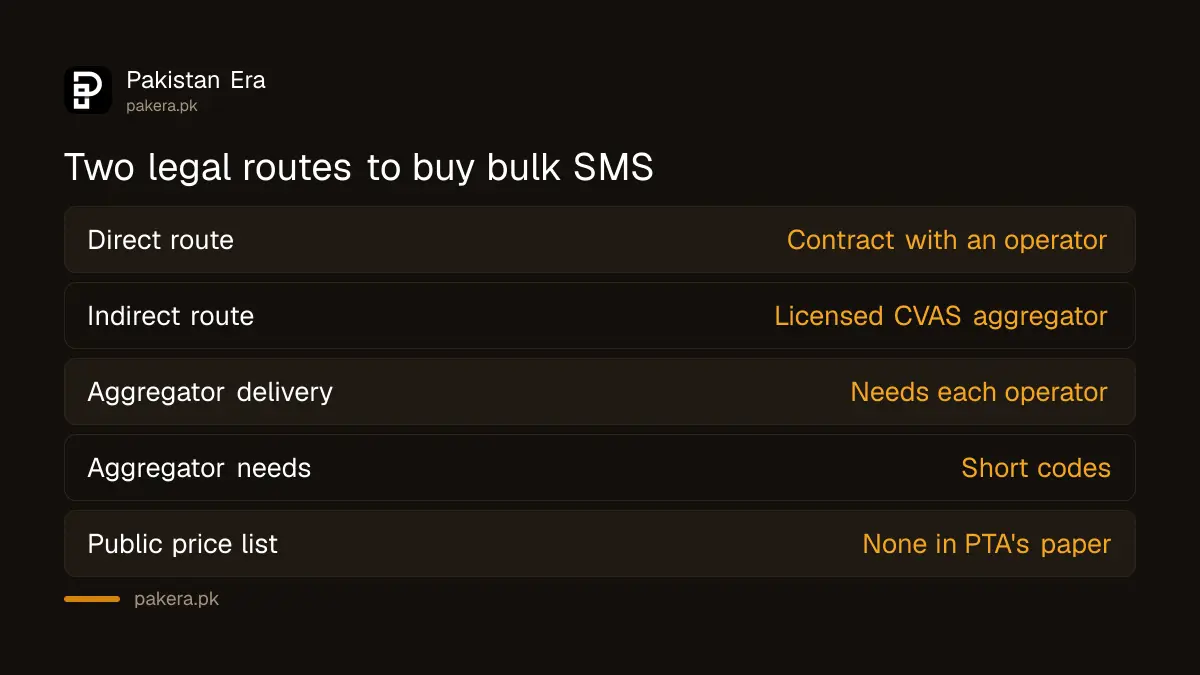
PTA describes two routes. The first is a direct contract between your business and a mobile operator. The second is an indirect route through a licensed CVAS provider, also called an SMS aggregator, which uses short codes and buys capacity from the operators.
| Point | Direct with an operator | Through a CVAS aggregator |
|---|---|---|
| Who you sign with | The mobile operator | A PTA-licensed CVAS provider |
| Who delivers the SMS | The operator | The aggregator, then each operator |
| Price depends on | Your contract | The aggregator and the operator rates behind it |
| Short codes | Not mentioned by PTA | Used by aggregators |
PTA notes that an aggregator cannot deliver messages alone. It must agree terms with each operator to reach that operator's customers. That is why an aggregator's price can follow the operators' price changes.
PTA thinks each operator controls delivery to its own customers
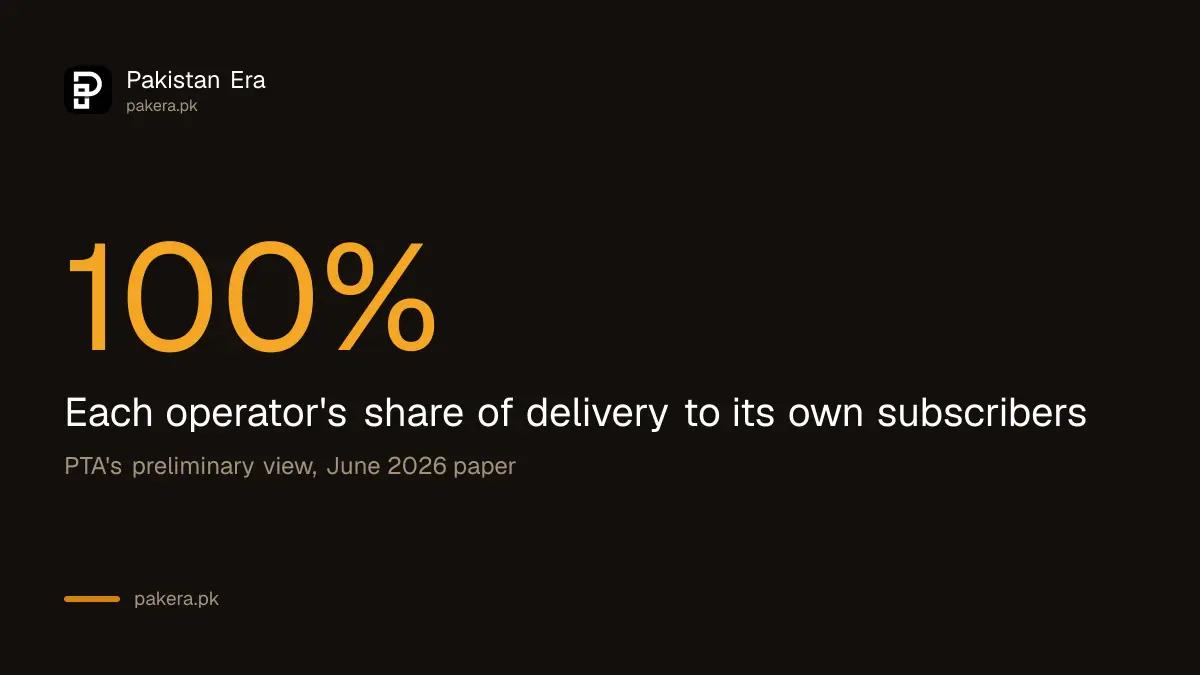
PTA's preliminary view is that each mobile operator is the only way to deliver an SMS to its own subscribers. It says this gives every operator a 100 percent share of delivery on its own network, and so significant market power (SMP) in corporate SMS.
The normal test in PTA's rules is a share of more than 25 percent of a market. The paper argues that corporate SMS is different, because no one else can deliver to an operator's customers without that operator's agreement.
This is PTA's draft thinking. A final decision, if one is made, would come through a formal determination. Until then, nothing about your contract has changed because of this paper.
Why banks still use SMS for OTPs and alerts
PTA says SMS reaches every mobile subscriber without a smartphone, an app or an internet connection. For regulated sectors such as banking, SMS is often a required or security-critical channel because it ties a message to a phone number.
PTA also says other channels, such as WhatsApp Business, email and push notifications, depend on data and apps, so they cannot fully replace SMS. That is why banks keep paying for it, and why price matters to them.
For you as a customer, the lesson is practical. Treat any SMS that asks for money or an OTP with care, even if it looks like it came from your bank. Read how to verify a payment is real and not a fake SMS, and how to check a fake PTA, NCCIA or bank call.
Questions to ask before you sign for bulk SMS
Because the rates are not public, a business owner has to ask. Use the list below with every operator and aggregator, and keep the answers in writing. A seller who will not put a rate in writing has told you something.
- What is the price per SMS, in rupees, for each network?
- Does the price differ for OTP and transaction messages, and for promotional messages?
- Does the seller hold a PTA licence, and what is the licence number?
- Which short code or sender name will the messages use?
- What happens to unsent or failed messages? Are they charged?
- Can the price change during the contract, and with what notice?
If you need your own number for customers to call or text, PTA's fees for it are set out in what PTA charges for a UAN, toll-free or short code number. PTA is also reviewing competition more widely, as in the 2026 draft telecom competition rules.
If you receive unwanted promotional SMS, you can stop spam SMS and marketing calls with 3627.
Common questions
What is corporate SMS?
It is bulk SMS sent by businesses, banks, government bodies and other organisations for alerts, transactions, promotions and public messages.
Did PTA fix a price for corporate SMS?
No. The consultation paper does not set a price. It asks whether corporate SMS should be a market with its own competition rules and asks operators for data.
Who can sell bulk SMS in Pakistan?
PTA names two routes: mobile operators with direct contracts, and licensed CVAS providers or SMS aggregators that use short codes.
Why does PTA think operators have market power?
PTA says each operator is the only way to deliver SMS to its own subscribers, which gives it 100 percent of delivery on its own network.
Has PTA made a final decision?
We did not find one on the PTA pages we read. The comment period on the paper closed on 19 June 2026.
Can WhatsApp replace SMS for OTPs?
PTA says not fully. Other channels need data and apps, while SMS reaches every subscriber and is often required in banking.
How we verified this
What we checked, where we read it, and what we could not confirm.
Last checked on 13 October 2026, Pakistan time. We read PTA's consultation papers page and its Consultation Paper on Identification of Corporate SMS as a Relevant Market for SMP Determination, dated 4 June 2026. The paper gives no rates, no operator shares and no final decision, so we state none. Rates and licence status for any seller must be confirmed with that seller and with PTA.
About the author

Technology Journalist & Multimedia Producer
Ahmad Ali is a technology journalist and multimedia producer at Pakistan Era, joining the team in October 2026. He covers consumer technology and digital life for Pakistani readers, combining research with hands-on product testing.