Crop Burning in Punjab: The Fine, the Rules and How to Report It
Stubble burning is banned in Punjab. The fine starts at Rs 15,000 an acre and doubles on a repeat. See the full fine table and how to report a burning field.
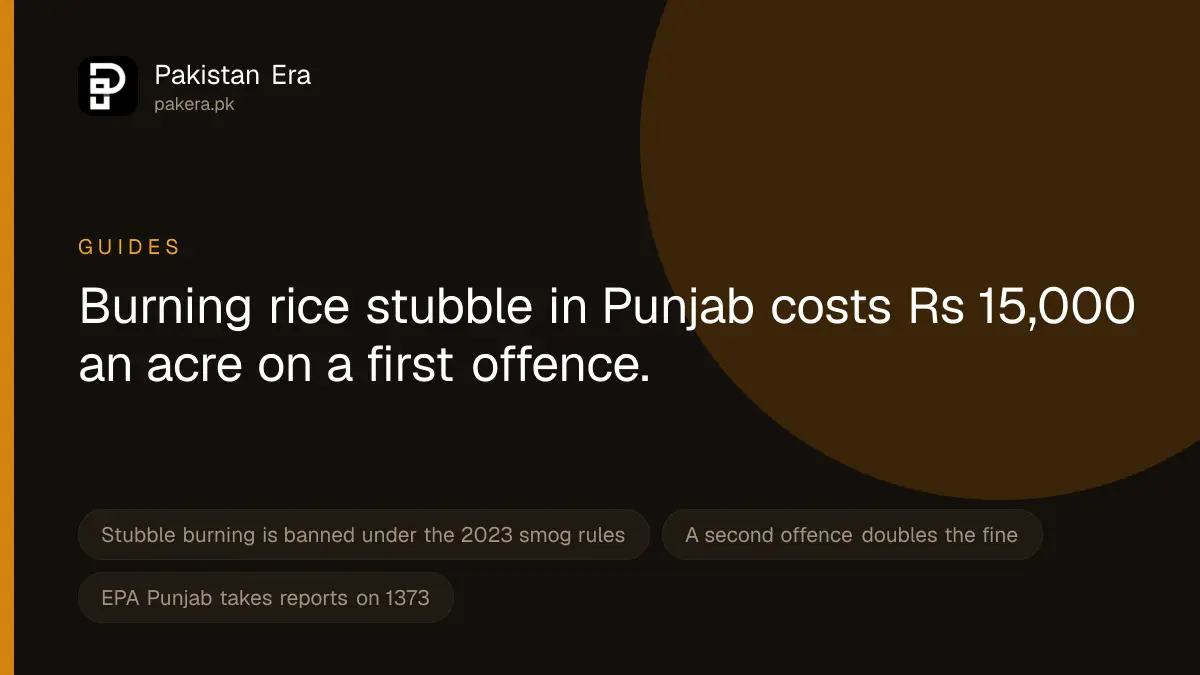
Burning crop stubble is banned in Punjab. The fine starts at Rs 15,000 for up to one acre, rises with every acre burnt, and doubles on a second offence. To report a fire, call the EPA Punjab helpline on 1373 or file on the Green Punjab app or the Pakistan Citizen Portal.
Update, 10 October 2026: The Agriculture Department has confirmed a super seeder rental subsidy of Rs 5,000 an acre, up to Rs 25,000. See how to apply.
The rice harvest is under way, and Punjab's Agriculture Department says it has "zero tolerance" for residue burning this season. We read the rule that makes crop burning illegal, and the fine table behind it, in the Punjab Gazette copy published by the Environment Protection Department on 24 September 2026.
Stubble is the stalk left standing in the field after a crop like rice or wheat is cut. Setting fire to it is the cheapest way to clear a field for wheat. It is also one of the sources of the winter smog that settles over Lahore and central Punjab every year.
Stubble burning is banned under the 2023 smog rules
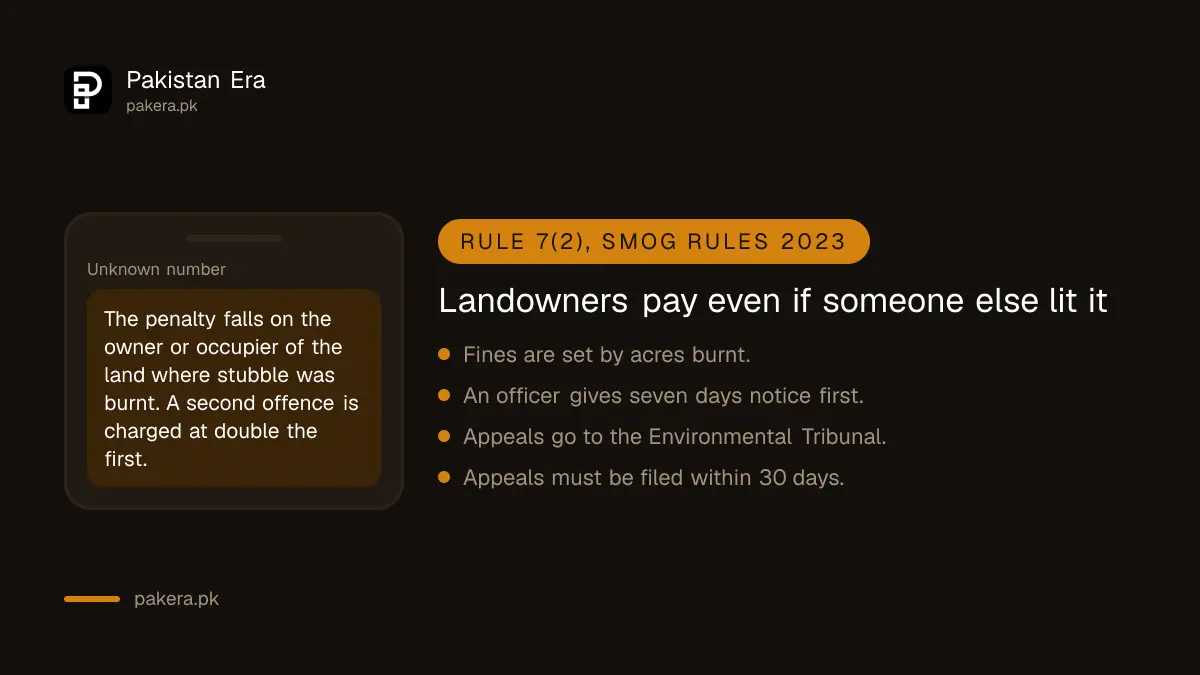
Rule 7 of the Punjab Environmental Protection (Smog Prevention and Control) Rules 2023 says no person shall be allowed to burn stubble in the province. The fine falls on the owner or occupier of the land where the burning happened, not only on whoever lit the fire.
The rules were made under section 31 of the Punjab Environmental Protection Act 1997, by notification No. SO(T)/EPD/1-215/2023 dated 6 June 2023. They were published in the Punjab Gazette on 7 June 2023 and came into force at once. So this is a notified, enforceable rule, not an announcement.
The fine table also covers "toxic agricultural waste burning", so burning other crop waste falls under the same row.
The owner rule matters for landlords. If a tenant or a hired hand burns your field, the rule still names the owner or occupier. Agree with anyone working your land, before harvest, that nothing gets burnt.
The fine is charged by the acre and doubles on a repeat
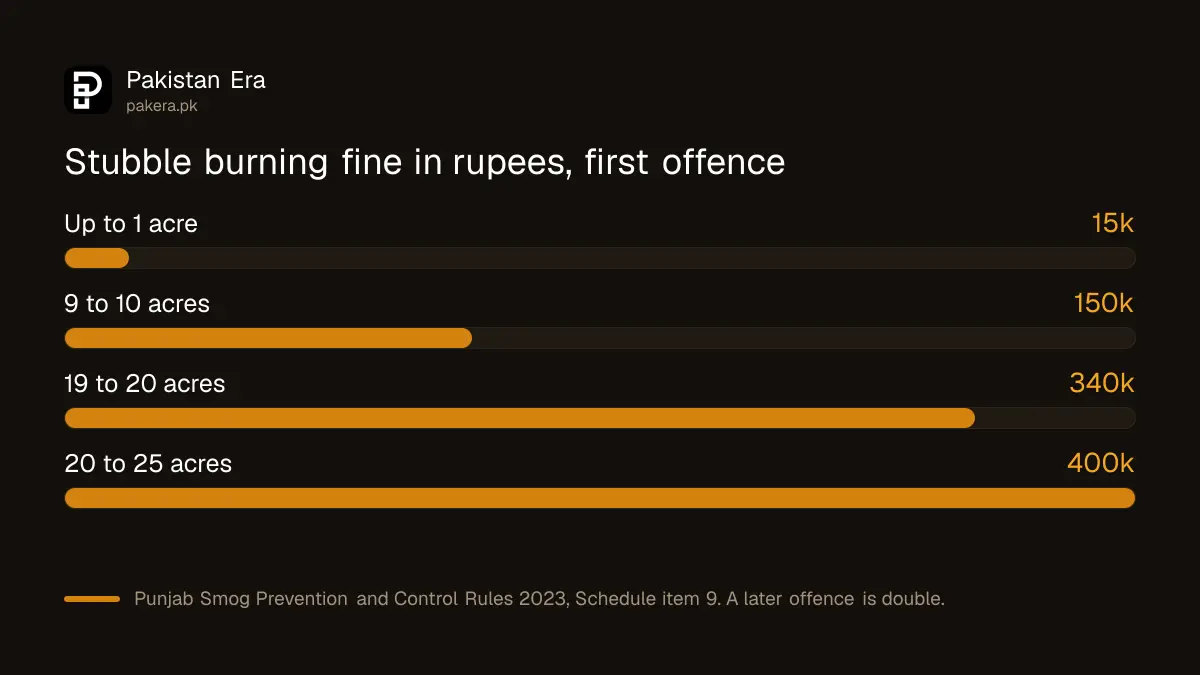
A first offence costs Rs 15,000 for up to one acre and Rs 150,000 for nine to ten acres. Above 25 acres it is Rs 500,000 plus Rs 30,000 for each extra acre. Any later offence is charged at double the penalty.
The full schedule, as printed in the Gazette:
| Area burnt | First offence |
|---|---|
| Up to 1 acre | Rs 15,000 |
| 1 to 2 acres | Rs 30,000 |
| 2 to 3 acres | Rs 45,000 |
| 3 to 4 acres | Rs 60,000 |
| 4 to 5 acres | Rs 75,000 |
| 5 to 6 acres | Rs 90,000 |
| 6 to 7 acres | Rs 105,000 |
| 7 to 8 acres | Rs 120,000 |
| 8 to 9 acres | Rs 135,000 |
| 9 to 10 acres | Rs 150,000 |
| 10 to 11 acres | Rs 170,000 |
| 11 to 12 acres | Rs 190,000 |
| 12 to 13 acres | Rs 205,000 |
| 13 to 14 acres | Rs 225,000 |
| 14 to 15 acres | Rs 245,000 |
| 15 to 16 acres | Rs 260,000 |
| 16 to 17 acres | Rs 280,000 |
| 17 to 18 acres | Rs 300,000 |
| 18 to 19 acres | Rs 320,000 |
| 19 to 20 acres | Rs 340,000 |
| 20 to 25 acres | Rs 400,000 |
| Above 25 acres | Rs 500,000 plus Rs 30,000 per acre above 25 |
One oddity is worth knowing. The Gazette says the rate from 10 to 20 acres "would be Rs 20,000" per acre, but three of the steps it prints go up by Rs 15,000. We have copied the printed amounts exactly. If you are ever fined in that band, ask the officer which figure was used.
The fine is an administrative penalty. That means an officer of the Environmental Protection Agency (EPA) can impose it after a seven day notice, without a court case.
Other smog offences carry their own fines
The same 2023 schedule fines burning rubbish in the open at Rs 5,000, smoky vehicles at Rs 2,000, and brick kilns without zigzag technology at up to Rs 500,000. Repeat offences cost more, and a kiln can be demolished.
| Offence | First offence | Each later offence |
|---|---|---|
| Stubble or toxic agricultural waste burning | Rs 15,000 per acre band, see above | Double the penalty |
| Burning solid waste, litter or other waste in the open | Rs 5,000 | Rs 10,000 |
| Smoke emitting vehicle on the road | Rs 2,000 | Rs 4,000 |
| Brick kiln not on zigzag technology | Rs 100,000 to Rs 500,000 | Demolition of the kiln |
| Excessively smoky factory or business | Rs 100,000 to Rs 500,000 | Rs 600,000 to Rs 1,000,000 |
| Tyre pyrolysis plant | Rs 100,000 to Rs 500,000 | Rs 600,000 to Rs 1,000,000 |
A tyre pyrolysis plant burns old tyres to make oil. The rules ban them outright in Punjab.
The fine is not the only thing an officer can do
On top of the fine, rule 12 lets the EPA stop the activity, seize goods, seal premises and register a criminal case. Anyone penalised can appeal to the Environmental Tribunal within 30 days, and the tribunal must decide within 15 days.
The Act behind the rules goes further. Under section 17 of the Punjab Environmental Protection Act 1997, as amended up to 2017, a court can fine up to Rs 5 million for some offences. A repeat offender can face up to two years in prison.
Police can be involved too. The Agriculture Department's own daily smog tally, dated 23 September 2026, lists one FIR registered this season. An FIR (First Information Report) is the police record that starts a criminal case. District administrations have also used section 144 orders, a temporary ban under the Code of Criminal Procedure, against crop burning. These orders have been reported, but no 2026 notification was available for us to read, so treat them as unconfirmed and check with your Deputy Commissioner's office for your district.
You can report a burning field in five steps
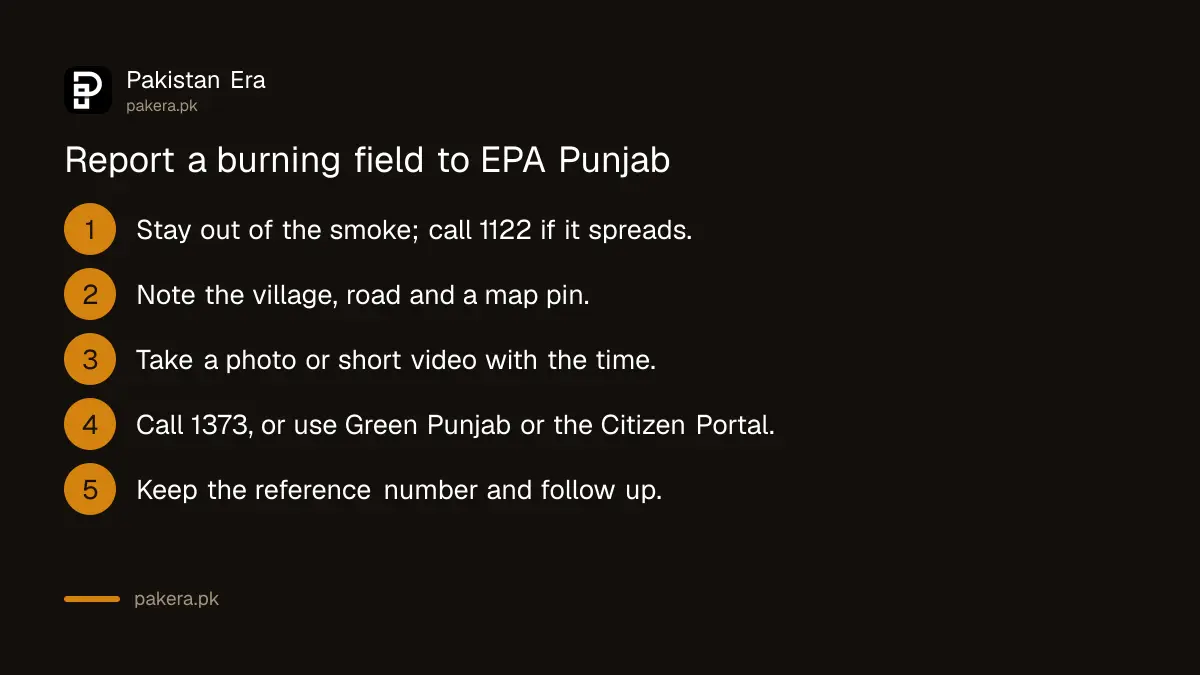
Note the place and time, take a photo or video, then report it to EPA Punjab on 1373, the Green Punjab app or the Pakistan Citizen Portal. The rules accept a written complaint from anyone.
- Stay safe first. Do not walk into smoke or a burning field. If the fire is spreading towards homes, call Rescue 1122 before anything else.
- Record the location. Note the village, the nearest road and the mauza (revenue village) if you know it. Drop a pin on your phone map. A report without a place is hard to act on.
- Take a photo or short video. Include the time. Show the field, not people's faces.
- Report it. Call the EPA Punjab helpline, 1373, which the Environment Protection Department lists on every page of its site. Or use the Green Punjab app on Android, built for smog complaints. Or file with the Environment Protection Department on the Pakistan Citizen Portal, which the EPA's complaint cell says it answers.
- Keep your reference number. If nothing happens, follow up with the same reference. A written complaint also leaves a record the EPA must deal with.
Two details stood out when we read the official pages. First, the EPD site labels 1373 "For ETS and other Inquiries", so the line is not only for smog. Second, the Green Punjab app's store listing names garbage and hospital waste burning, smoky kilns and vehicles, and factories. It does not name crop burning in so many words. We did not file a test complaint, so we cannot tell you how fast either route responds.
Rule 12(7) says the EPA may start proceedings "upon complaint in writing by any person". Filing on the Pakistan Citizen Portal works the same way as for any other department: pick the Environment Protection Department and attach your photo.
If you want to know what happened to complaints in your district, a request under Punjab's right to information law can ask the EPA for the number of fines and cases recorded.
Farmers have cheaper options than paying the fine
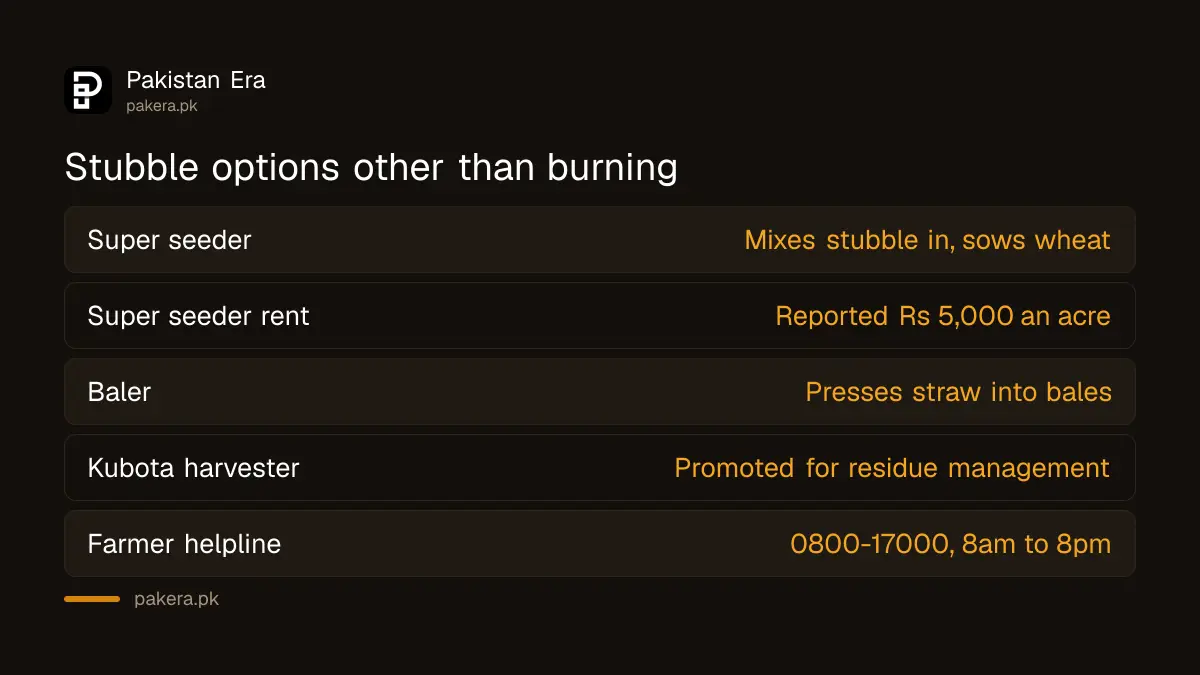
The Agriculture Department is pushing super seeders, balers and Kubota harvesters. A 60 per cent subsidy on super seeders was announced in March 2025, and a rent subsidy of Rs 5,000 an acre was reported this month.
A super seeder is a tractor-mounted machine that cuts the rice stubble, mixes it into the soil and sows wheat in one pass. So there is nothing left to burn. A baler presses loose straw into bales that can be sold or fed to animals.
| Option | What it does | Support and status |
|---|---|---|
| Super seeder, buy | Mixes stubble into soil and sows wheat in one pass | 60% subsidy in the third phase announced on 10 March 2025; needed a 65 hp tractor. Whether a new round is open now, we could not confirm |
| Super seeder, rent | Hire a machine from a farmer who owns one | Reported: Rs 5,000 an acre, up to Rs 25,000 a farmer, in 23 districts. Not found on the department's site |
| Baler | Presses straw into bales for sale or fodder | 187 balers working in the field on 23 September 2026, per the department |
| Kubota harvester | Harvests rice; the department promotes it with balers for residue management | 1,259 working, 248,335 acres cut this season, per the department |
| Hi-tech machinery loan | Interest-free loan for farm machinery | Up to Rs 30 million; minimum 5 acres; 20% paid upfront; Rs 5,000 processing fee |
On 24 September 2026, Punjab Agriculture Minister Syed Ashiq Hussain Kirmani was reported as saying that 10,000 super seeders are being provided at subsidised rates and that 177 control rooms are running. That is a minister's statement in news reports. The scheme terms are not on the department's website yet, so treat these numbers as unconfirmed.
The rent subsidy is similar. It was reported on 10 September 2026 as part of the Punjab Clean Air Program, and the reports named 23 districts, including Lahore, Kasur, Sheikhupura, Gujranwala, Sialkot, Faisalabad and Multan. The scheme is not on any official page we could open, so treat the figure as unconfirmed until your Agriculture Officer confirms it.
The quickest way to check what is open for you is the Agriculture Department's free helpline, 0800-17000, which runs from 8am to 8pm daily. The provincial green credit programme also lists buying a super seeder and "sustainable management of stubble burning" as activities that earn credits. Other farm support, like the Kisan Card, is listed with the rest of Punjab's schemes for farmers.
The crackdown has started this season
By 23 September 2026 the Agriculture Department had counted 21 burning incidents on 24 acres, Rs 330,000 in fines and one FIR. It had also sent 412,155 warning notices and made 29,861 mosque announcements.
Those figures come from the department's daily "Smog Control Program" tally, which also lists 145 anti-smog squads. The rice harvest runs into October and November, so these numbers will climb.
The fines so far sit roughly in line with the Rs 15,000 per acre rate. That suggests the schedule is being applied as written, not waived.
Common questions
Is burning rice stubble illegal in Punjab?
Yes. Rule 7 of the Punjab Environmental Protection (Smog Prevention and Control) Rules 2023 bans stubble burning anywhere in the province.
How much is the fine for burning one acre?
Rs 15,000 for up to one acre on a first offence. A second offence is double.
Who pays if a tenant burns the field?
The rule puts the penalty on the owner or occupier of the land where the burning happened. A tenant in possession can be the occupier, but the owner is also named.
Can I be sent to jail for crop burning?
The 2023 rules allow a criminal case to be registered, and the 1997 Act allows prison of up to two years for some repeat offenders. The usual first step is the fine.
Which number do I call to report crop burning?
The EPA Punjab helpline is 1373. Farmers with questions about machines and subsidies can call the Agriculture Department on 0800-17000.
Can I challenge a fine?
Yes. You can appeal to the Environmental Tribunal within 30 days of the order. The tribunal must decide within 15 days.
How we verified this
What we checked, where we read it, and what we could not confirm.
Last checked 24 September 2026. We read the ban, the fine schedule, the seven day notice, the preventive measures and the appeal route in the Punjab Gazette copy of the Punjab Environmental Protection (Smog Prevention and Control) Rules 2023, and section 17 of the Punjab Environmental Protection Act 1997, both published by the Environment Protection Department. The Act text we read is the version amended up to 2017. A Punjab Environmental Protection (Amendment) Act 2026 is also listed there, but its scanned copy was too poor to read in full, so check it before relying on the Act's court penalties. The 1373 helpline, the Green Punjab app and the Citizen Portal route come from the EPD site and the app's store listing. The season figures and the 0800-17000 helpline come from the Agriculture Department's smog campaign page. The 60 per cent super seeder subsidy comes from a DGPR Punjab release of 10 March 2025. The 10,000 subsidised super seeders, the 177 control rooms and the Rs 5,000 per acre rent subsidy are press reports we could not confirm on an official page. Section 144 orders on crop burning are also press reports only. This is general information, not legal advice.
About the author

Tax, Bills and Technology Writer
Ali Akhtar is a young and curious voice here at Pakistan Era. He is currently pursuing his A-Levels and has a growing interest in Pakistan’s changing industrial landscape and educational trends. Ali likes to write in a way that helps him explain and explore the world around him. His writing reflects the perspective of the new generation navigating the evolving trends of Pakistan where technology, youth innovation, and shifting opportunities are reshaping the country’s future.