Crypto Exchange Licence in Pakistan: Rs 500 Million Capital, NOC and Steps
PVARA sets Rs 500 million minimum capital for a crypto exchange, 3 directors, an NOC in 60 days and a licence in 90. See the table and the steps in order.
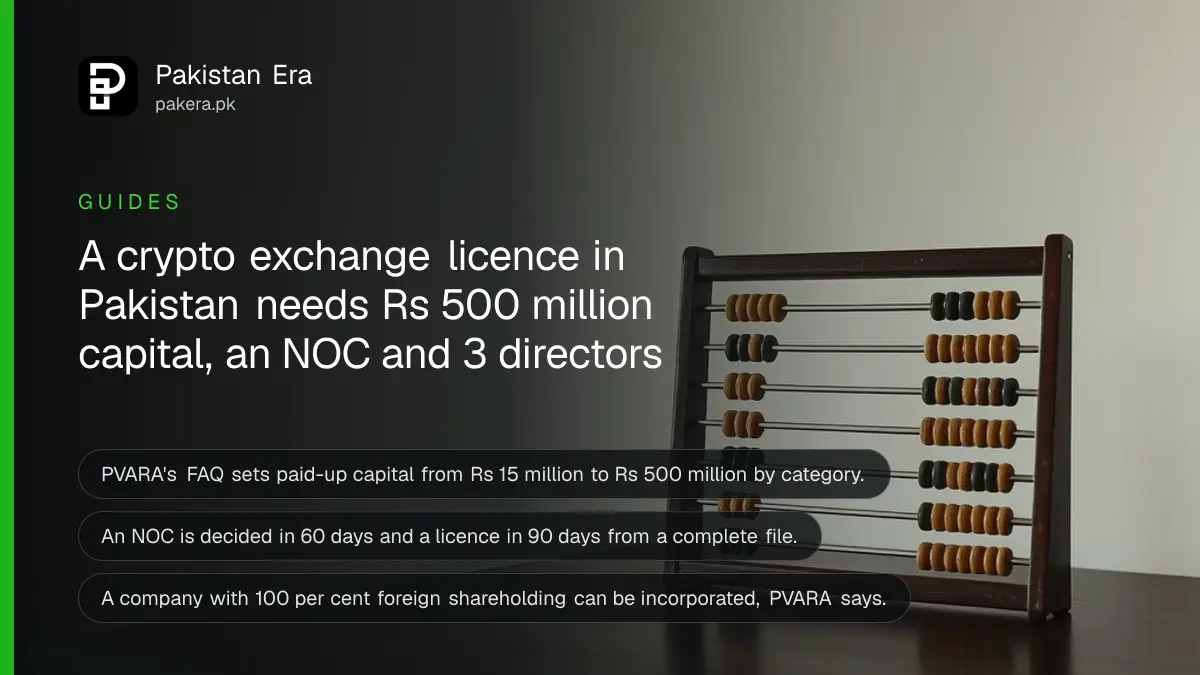
Short answer: To run a crypto exchange in Pakistan you need a Pakistani company with at least 3 directors, Rs 500 million paid-up capital, a PVARA No Objection Certificate (NOC) first, and then a licence. PVARA says an NOC takes up to 60 days and a licence decision up to 90 days.
A founder with a trading app and a small team asks the obvious question: what does it cost to do this properly? PVARA's own FAQ answers it with a table of capital figures, and the numbers decide who can enter the market at all.
We read PVARA's FAQ on the Pakistan Virtual Asset Services Regulations, 2026 and the Activity Specific Regulations, 2026 on 12 October 2026. Both were notified on 21 August 2026. This guide turns that FAQ into a plain checklist. PVARA says its FAQ is not legal advice and the Act and Regulations prevail.
Minimum paid-up capital runs from Rs 15 million to Rs 500 million
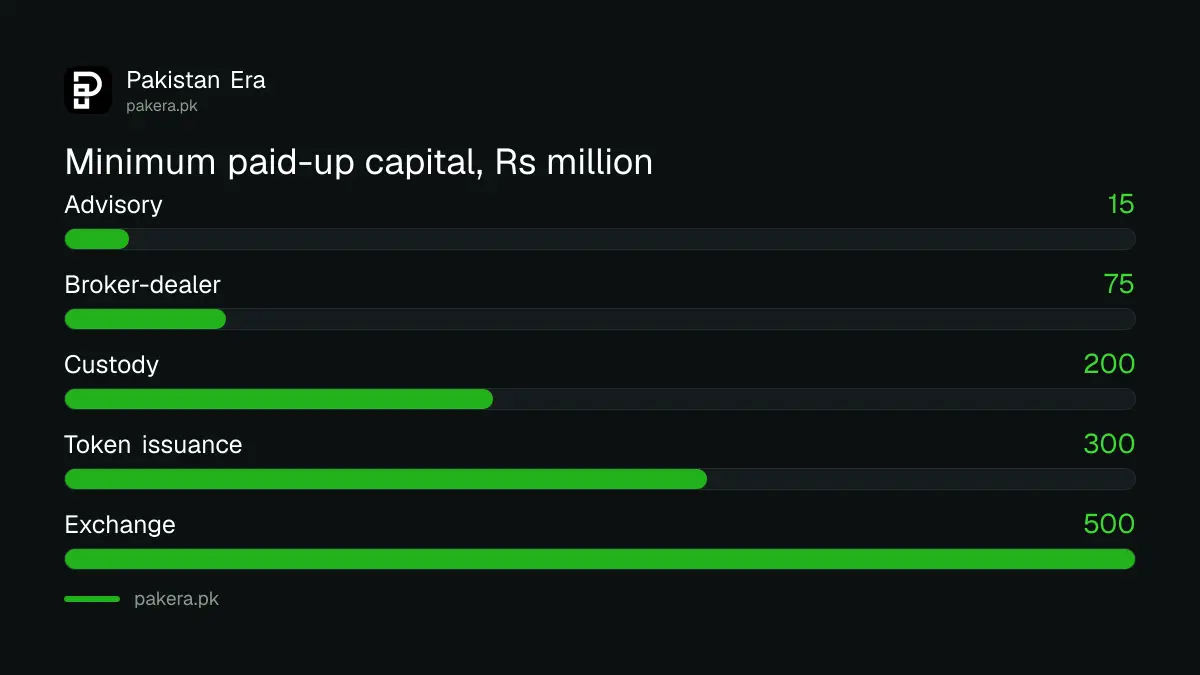
PVARA's FAQ sets the minimum paid-up capital by licence category. "Paid-up capital" is the money shareholders have actually put into the company. An exchange needs Rs 500 million. An advisory firm needs Rs 15 million.
| Licence category | Minimum paid-up capital (Rs) |
|---|---|
| Advisory Services | 15,000,000 |
| Broker-Dealer Services | 75,000,000 |
| Custody Services | 200,000,000 |
| Management and Investment Services | 200,000,000 |
| Transfer and Settlement Services | 200,000,000 |
| Fiat-Referenced or Asset-Referenced Token Issuance | 300,000,000 |
| Exchange, Lending and Borrowing, Derivatives, Mining Related | 500,000,000 |
In every case the applicant must be a company incorporated under the Companies Act, 2017 with a minimum of 3 directors, and must submit financial statements.
The route is NOC first, then incorporation, then licence
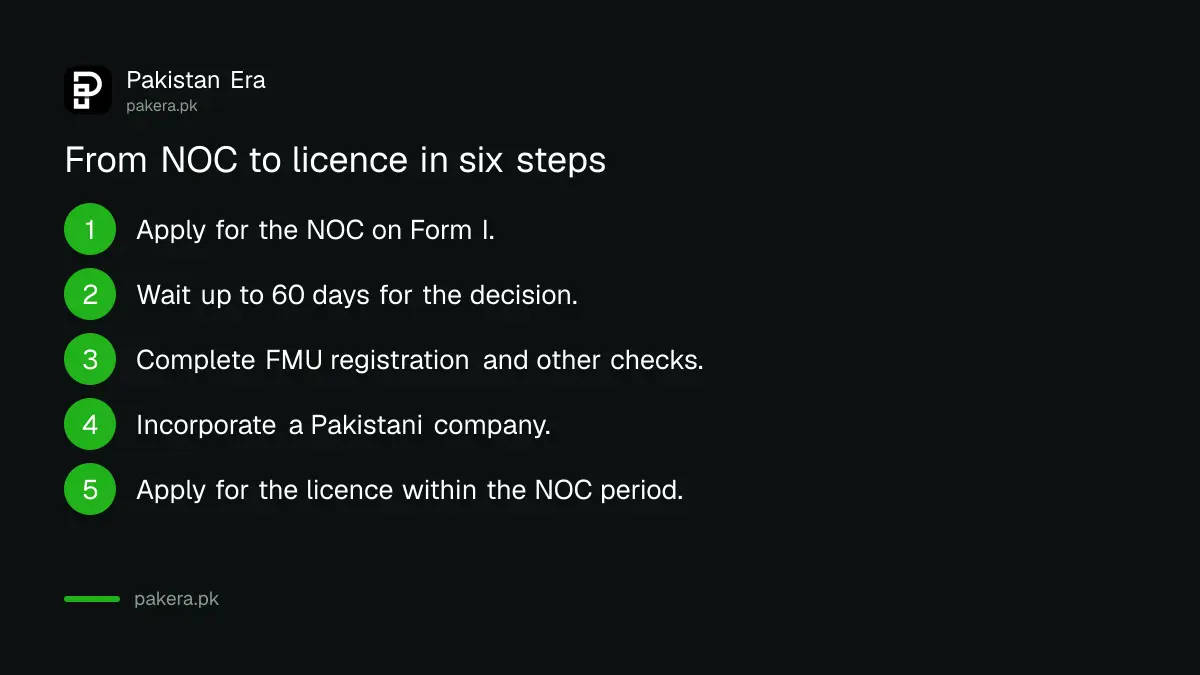
PVARA's outline has three stages. Apply for an NOC using Form I. After the NOC, incorporate the company in Pakistan. Within the NOC's validity, apply for one or more licence categories with the documents in the Annexure to Form I and the non-refundable processing fee.
- Apply for the NOC on Form I with your business plan and corporate documents.
- Wait for the decision. PVARA has 60 days from a complete application.
- Complete registration with the Financial Monitoring Unit and other requirements, as the PVARA apply page lists.
- Incorporate a Pakistani company. Our guide to registering a private limited company with SECP shows that step.
- Apply for the licence within the NOC's validity.
- Wait for PVARA's decision, up to 90 days from a complete application.
We did not find the amount of the processing fee in the FAQ. Check the application portal for it.
Timelines and validity are written into the regulations
An NOC is valid for 3 months from issue and can be extended once by up to 3 months on an application made before it expires. PVARA decides a complete licence application within 90 days, and may extend that by up to 60 days for complex cases or novel risks.
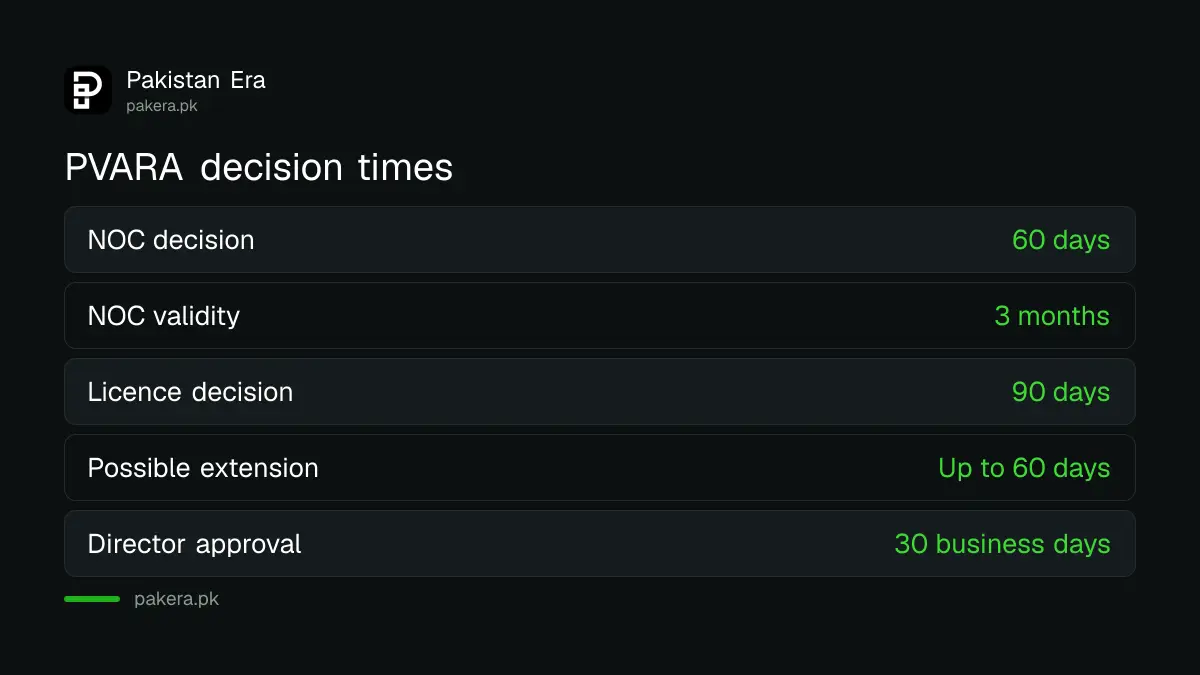
The clock only starts when PVARA confirms in writing that the application is complete. If it asks for more information, the time stops until you provide it. That is the part that surprises founders: "90 days" can be much longer in real life.
An NOC is not a licence. PVARA's FAQ says it does not allow you to start operating, and it can be withdrawn if the information given was false, misleading or incomplete. Firms already operating had to apply by 5 September 2026, which our report on the crypto licence deadline covers.
Foreign owners are allowed, and a sandbox is an alternative
The FAQ says a company with 100 per cent foreign shareholding can be incorporated. The Act and the Regulations require no Pakistani shareholder and cap no foreign ownership. The company still has to be incorporated in Pakistan with at least 3 directors.
A firm testing a new product can use the regulatory sandbox instead. If it completes testing to PVARA's satisfaction it may apply directly for a licence and does not need a separate NOC. Sandbox participation gives no right to a licence. A firm that already holds or applied for an NOC under the 2025 NOC Regulations does not need to start again.
Directors and the board need approval and independence
A director or managing director cannot take office until PVARA approves them as fit and proper. PVARA must decide within 30 business days of a complete application. The board must include independent directors, normally at least one third of the board.
The board must collectively hold skills in risk management, technology and cybersecurity, and financial crime compliance. It stays responsible for safeguarding customer assets and anti-money laundering controls. A founder who plans a two person company should read this section first.
Common questions
How much capital does a crypto exchange need in Pakistan?
PVARA's FAQ sets the minimum paid-up capital for Exchange Services at Rs 500 million.
Can a foreigner own 100 per cent of a crypto company here?
Yes, according to PVARA's FAQ. The company must still be incorporated in Pakistan under the Companies Act, 2017.
How long does the NOC take?
PVARA must grant or refuse within 60 days of a complete application. The NOC is valid for 3 months and can be extended by up to 3 months.
Does an NOC let me start trading?
No. PVARA says an NOC does not authorise any Virtual Asset Service. You need the licence.
Is there a deadline to apply now?
For firms operating before 5 March 2026 the date was 5 September 2026. Others may apply as and when they meet the requirements.
How we verified this
What we checked, where we read it, and what we could not confirm.
We read the PVARA FAQ and the PVARA home page on 12 October 2026. Capital figures and timelines are PVARA's own. The processing fee and the full Form I are on PVARA's application portal, which we did not open.
About the author

Public Services and Education Journalist
Fajr Riaz is a journalist and content writer at Pakistan Era, based in Lahore. She covers the questions people meet in everyday life in Pakistan: how a public service works, what a change in the rules means, and where to find a reliable answer.