Is 9 November a Holiday for Private Offices, Factories and Shops in Pakistan? What the Law Says
Is 9 November a holiday for private companies in Pakistan? What factories, shops and Standing Orders laws say in each province, with sections and pay.
یہ صفحہ اردو میں پڑھیں
A government holiday notice, like the one for Iqbal Day on 9 November 2026, binds government offices. It does not by itself order a private company to close. But Pakistan's labour laws give factory workers every declared festival holiday with pay, and give shop and office staff ten paid festival holidays a year that the employer must list in January. If you are made to work, the factories laws owe you two extra days off, and Punjab's new Labour Code pays three times the hourly rate.
That is the short answer to the question every private employee asks before a long weekend. The details depend on two things: where you work (a factory, a shop or an office) and which province you are in, because labour is a provincial subject. We read each law on the official code portals and give the section numbers below, so you can quote them to your employer.
A Cabinet Division holiday notice binds government offices, not private firms
The federal holiday list is an order to government offices. Private employers are bound by labour laws, and those laws link paid holidays to the days the government declares. So the notice matters to private workers, but only through the labour law that covers their workplace.
On 5 November 2026 the Cabinet Division confirmed that Monday 9 November is a public holiday "throughout the country", as reported in the Iqbal Day holiday confirmation. Its copy list names ministries, provincial chief secretaries, courts and the State Bank. It does not name private businesses, and it does not need to.
Punjab's Services and General Administration Department did the same for its own offices. Its notification of 19 January 2026 says the holidays "declared by the Federal Government" will be observed in offices under the Punjab government, and Allama Iqbal Day on 9 November is number 10 on that list.
Factory workers get every declared festival holiday with pay
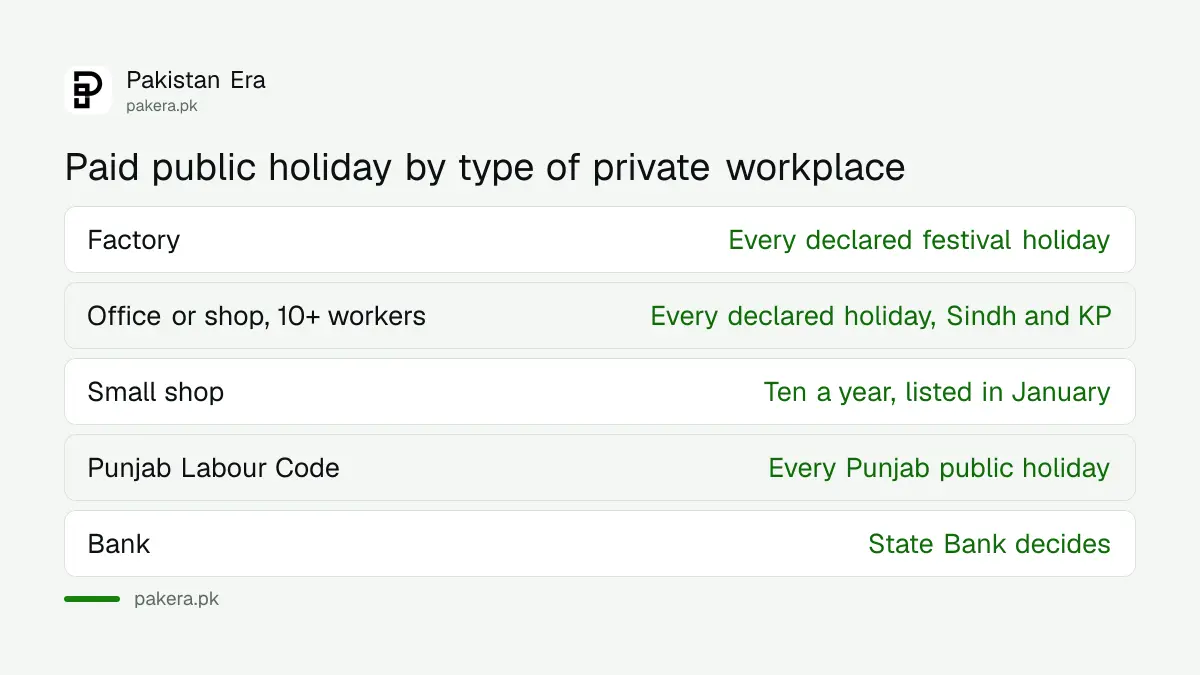
Every factories law we read gives workers all government-declared festival holidays with pay. A worker can be required to work that day, but then gets one extra paid compensatory holiday plus a substitute holiday. That is two days back, not one.
The wording differs on one point: whose declaration counts. The federal Factories Act 1934, as published on Pakistan Code, says "declared by the Provincial Government". Sindh's 2015 Act accepts a declaration by the Sindh government or the federal government. Khyber Pakhtunkhwa's 2013 Act defines "Government" as the KP government, so a KP declaration is the one that counts there.
For 9 November 2026, Punjab's January notification lists the day. We did not find a 2026 notice for the day from Khyber Pakhtunkhwa or Balochistan, though the provinces normally adopt the federal list and the Cabinet Division sent its release to every chief secretary.
| Law | Section | Which holidays are paid | If you are made to work |
|---|---|---|---|
| Factories Act 1934 (federal text) | 49I | All days declared by the Provincial Government to be festival holidays | One extra compensatory holiday with full pay, plus a substitute holiday under section 35 |
| Sindh Factories Act 2015 | 80 | All days declared by the Sindh or federal government | Same, substitute holiday under section 55 |
| KP Factories Act 2013 | 79 | All days declared by the KP government | Same, substitute holiday under section 54 |
| Punjab Labour Code 2026 | 183 and 179(3)(c) | All public holidays declared by the Punjab government | Three times the hourly rate, or by agreement a substitute day off and a compensatory rest day within 7 days |
| Balochistan Factories Act 2021 | Not read | The labour department lists the Act, but its copy did not open for us | Not read |
Section 35 of the 1934 Act sets the rule for the substitute day. A worker kept on duty on the weekly holiday must get a whole day off within the three days before or after it, and the manager must notify the inspector and put up a notice in the factory first. Paid leave in general is set out in your leave entitlement at work.
Shop and office staff get ten festival holidays chosen by the employer
Shops and commercial offices fall under the shops and establishments laws. Most give ten festival holidays a year on full wages, and the employer picks the dates and tells staff at the start of the year. So 9 November is a paid holiday for a shop worker only if it is on that list, except in Khyber Pakhtunkhwa.
Section 16 of the West Pakistan Shops and Establishments Ordinance 1969, on Pakistan Code, reads: "Every employee shall be allowed ten days festival holidays with full wages in a year. The days and dates for such festival holidays shall be notified to the employees by the employer in the beginning of the calendar year." Sindh's 2015 Act repeats it word for word in its section 16. The same 1969 text is on the Balochistan Code.
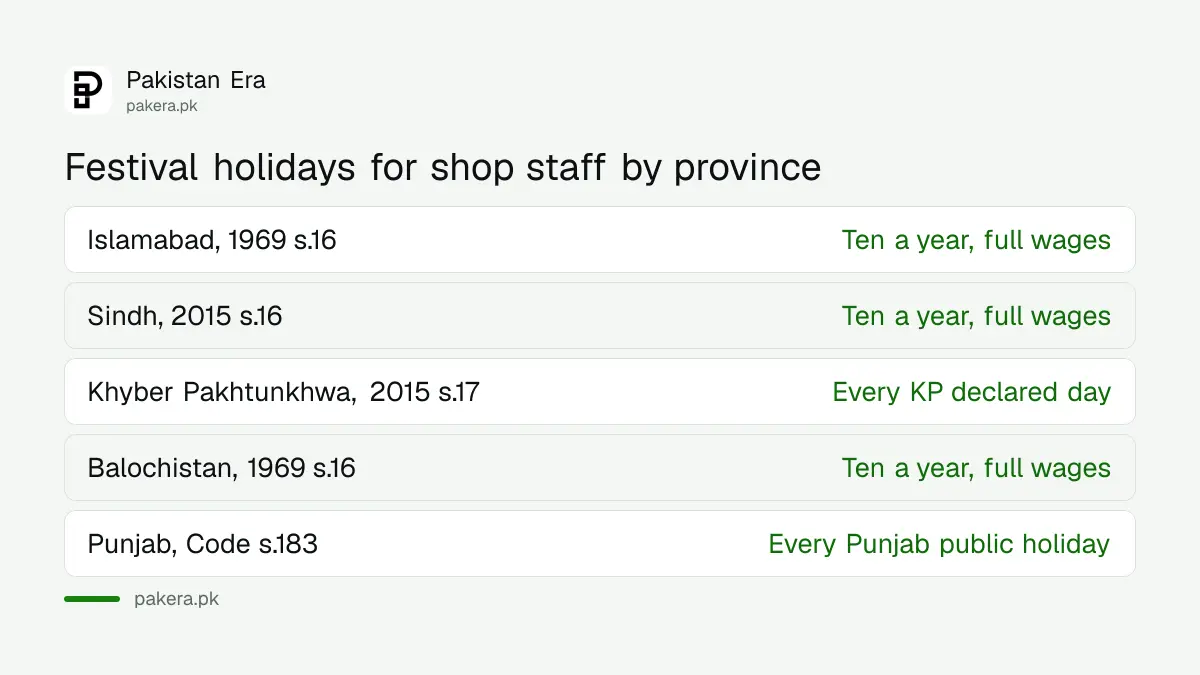
Khyber Pakhtunkhwa is different. Section 17 of the KP Shops and Establishment Act 2015 gives holidays with pay "on all days declared by Government to be festival holidays", with no cap of ten, and still asks the employer to notify the dates in January. Its section 19 switches off sections 15, 16 and 18 for establishments with fewer than 10 employees, but section 17 is not on that list. In Punjab, the shop rules are set out in what a shop worker in Punjab is owed.
| Province | Shops law and section | Festival holidays |
|---|---|---|
| Islamabad and Balochistan | Shops and Establishments Ordinance 1969, s.16 | Ten a year on full wages, dates notified by the employer in January |
| Sindh | Sindh Shops and Commercial Establishment Act 2015, s.16 | Ten a year on full wages, dates notified by the employer in January |
| Khyber Pakhtunkhwa | KP Shops and Establishment Act 2015, s.17 | Every day declared by the KP government, dates notified in January |
| Punjab | Ordinance 1969, s.16, or Labour Code 2026, s.183 | Ten under the Ordinance; every public holiday under the Code |
None of the shops laws we read sets a special rate for working on a festival holiday. Each one, in section 9, pays double the ordinary rate for overtime beyond the daily and weekly limits, so a holiday shift that pushes you past those limits is paid at double for the extra hours.
Bigger offices and factories follow the Standing Orders, which point to the factories law
An industrial or commercial establishment with 10 or more workers also falls under the Standing Orders laws in Sindh and KP. Those send leave and festival holidays to Chapter IV-A of the Factories Act 1934, so staff there get every declared festival holiday with pay, not just ten.
Standing Order 9 of the Sindh Terms of Employment (Standing Orders) Act 2015 says: "Every worker shall be allowed holidays with pay on all days declared by Government or Federal Government to be festival holidays." Standing Order 10 of the KP Industrial and Commercial Employment (Standing Orders) Act 2013 gives festival holidays "as provided for in Chapter-IV-A of the Factories Act, 1934". The 1969 Ordinance and the Sindh shops Act both say, in section 18, that their own leave sections do not apply to these commercial establishments.
So a 15-person office in Karachi owes every declared holiday, while a 4-person shop in Karachi owes its ten listed days. That is the line most employees never hear about.
Punjab's Labour Code 2026 pays three times for work on a public holiday
The Punjab Labour Code 2026 (Act IX of 2026) is written to replace the Factories Act, the Standing Orders Ordinance and the Shops Ordinance in Punjab. Section 183 gives every employee all public holidays declared by the Punjab government with pay. Work on such a day earns three times the normal hourly pay.
Section 179(3)(c) sets that rate. Its proviso lets the employer and employee agree instead on "both a substitute day-off and a compensatory rest day within seven days". Section 179(1)(a) says overtime needs the employee's agreement, and section 3 says the Code cannot be excluded by contract. Section 435 lists the laws it repeals.
One caution. Section 1(3) says the Code starts on a date the Punjab government notifies in the Gazette. It was reported in late May 2026 to have been brought into force, but we have not read that Gazette notice. Until you confirm it with the labour department, quote both the Code and the older laws. The Code's overtime rules are explained in Punjab Labour Code overtime.
Banks, private schools, hospitals and exporters work to their own rules
Banks follow the State Bank, private schools follow the provincial education department and their own calendar, and essential services keep running. The worker on duty is still owed what their labour law says.
- Banks: the State Bank's BPRD Circular Letter No. 23 of 2026 says the State Bank will be closed on 9 November. Bank branches close on the 9 November holiday too.
- Private schools: we found no statute that orders a private school to close. Most follow the government calendar. Ask the school, and check the provincial education department's notice.
- Hospitals, power, water and rescue: these stay open. A private employee rostered that day is owed the compensatory and substitute holidays, or the Punjab Code's rate.
- Exporters: the Cabinet Division's 2026 holiday circular lets export businesses work on public holidays if they pay overtime.
What to do if your employer refuses a holiday you are owed
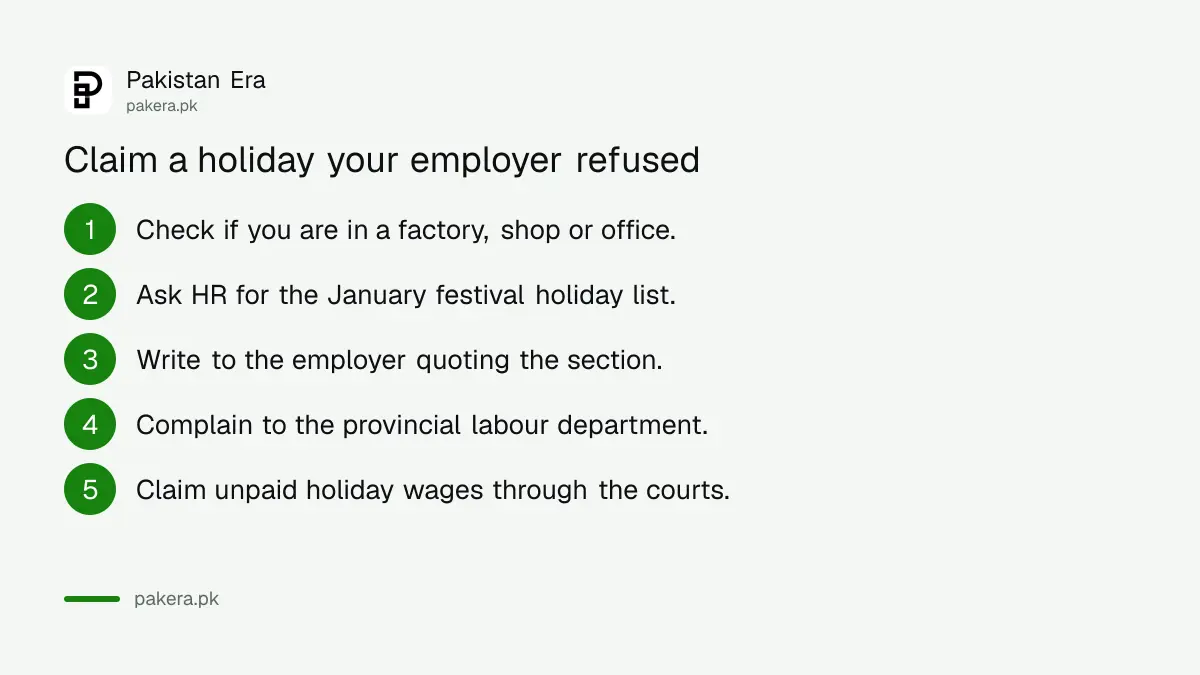
Raise it in writing first, then go to the provincial labour department, which has inspectors for factories and shops. For a grievance under the federal industrial relations law, there are fixed time limits.
- Check which law covers you: factory, shop, or an establishment with 10 or more workers.
- Ask HR for the festival holiday list the employer had to notify in January.
- Write to the employer quoting the section, and keep a copy.
- Complain to the provincial labour department. In Punjab, use the online form at labour.punjab.gov.pk, which lists 042-99263671 and 042-99263672.
- For unpaid holiday wages, use the wage claim or labour court route.
In Islamabad and in businesses spread over more than one province, section 33 of the Industrial Relations Act 2012 applies. You give your grievance to the employer in writing within 90 days. The employer must answer within 15 days, and you can then take it to the National Industrial Relations Commission within 60 days. In Punjab, the routes for money owed are in claiming unpaid salary in Punjab and going to the labour court.
Common questions
Is 9 November a holiday for private companies in Pakistan?
The government notice does not close private firms by itself. Factory workers, and staff of establishments with 10 or more workers in Sindh and KP, are owed it with pay. Shop staff are owed it if it is on the employer's ten-day list.
Can my employer make me work on a public holiday?
Yes, under the factories laws. You then get one extra paid compensatory holiday and a substitute holiday. Under the Punjab Labour Code, overtime needs your agreement and is paid at three times.
Do I get double pay for working on a public holiday?
Not as a rule. The factories laws give two days off instead. The Punjab Code pays three times. The shops laws pay double only for overtime hours.
Are private schools closed on 9 November?
Most follow the government calendar, but no law we read forces them to. Confirm with the school.
How many festival holidays does a shop worker get?
Ten a year on full wages in Islamabad, Sindh, Balochistan and under Punjab's 1969 Ordinance. In KP, every day the provincial government declares.
What if my employer never gave us a holiday list?
The shops laws require the employer to notify the dates at the start of the year. Ask for it in writing, and report the failure to the labour department.
How we verified this
What we checked, where we read it, and what we could not confirm.
We read these texts on 5 November 2026: the Factories Act 1934, sections 35 and 49I, and the West Pakistan Shops and Establishments Ordinance 1969, sections 9, 16 and 18, on Pakistan Code; the Industrial Relations Act 2012, section 33, on Pakistan Code; the Sindh Factories Act 2015, section 80, the Sindh Shops and Commercial Establishment Act 2015, sections 9, 16 and 18, and the Sindh Terms of Employment (Standing Orders) Act 2015, on sindhlaws.gov.pk; the KP Factories Act 2013, section 79, the KP Shops and Establishment Act 2015, sections 9, 17 and 19, and the KP Standing Orders Act 2013, on kpcode.kp.gov.pk; the Punjab Labour Code 2026, sections 1, 3, 179, 183 and 435, on punjablaws.punjab.gov.pk; and the Punjab S&GAD holiday notification of 19 January 2026. The 1969 Ordinance was also read on the Balochistan Code. The Balochistan Factories Act 2021 and Shops and Establishment Act 2021 did not open for us. The exporters' clause comes from our earlier reading of the Cabinet Division circular. This is a plain reading of the law, not legal advice for a particular dispute.
About the author

Tax, Bills and Technology Writer
Ali Akhtar is a young and curious voice here at Pakistan Era. He is currently pursuing his A-Levels and has a growing interest in Pakistan’s changing industrial landscape and educational trends. Ali likes to write in a way that helps him explain and explore the world around him. His writing reflects the perspective of the new generation navigating the evolving trends of Pakistan where technology, youth innovation, and shifting opportunities are reshaping the country’s future.