Customs Act Changes in Pakistan 2026: Retailing Smuggled Goods, Scanning and State Warehouses
The Finance Act 2026 changes the Customs Act: retailing smuggled goods counts as removal, warehouse tampering carries up to 5 years and scanning gets cover.
The Finance Act 2026 changes the Customs Act in 14 places. The ones that matter most to traders: "removal" of smuggled goods now includes retailing them, tampering with goods in a State Warehouse carries up to 5 years in prison, and a terminal operator's penalty rises to Rs 5 million. Scanning also gets legal cover as a way to examine goods.
These changes took effect on 1 July 2026 unless the Act says otherwise. We read the Act in the Gazette of 26 June 2026 and FBR's Notes on Clauses for the Finance Bill 2026-27, both on FBR's own site. This page is for importers, clearing agents and shopkeepers who stock imported goods.
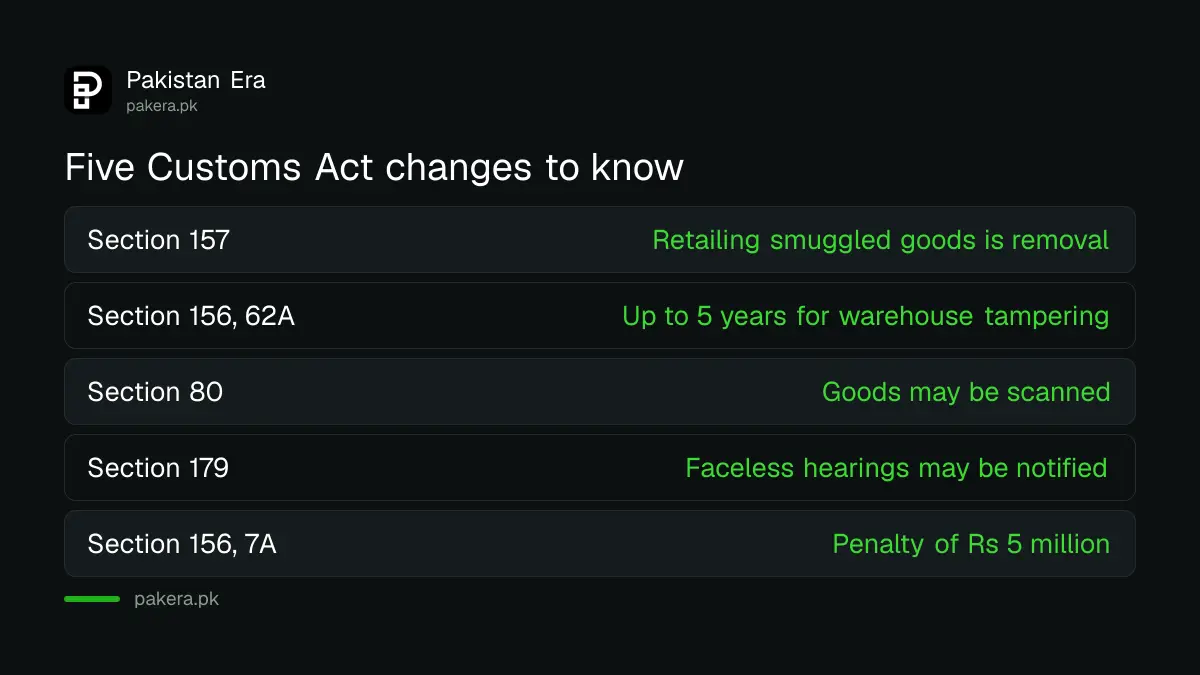
Retailing smuggled goods now counts as removal under section 157
The Act adds an Explanation to section 157(2) of the Customs Act. It says "removal" includes, and is deemed always to have included, carrying, transporting, depositing, harbouring, keeping, concealing, retailing or any other act involving movement of smuggled goods.
FBR's Notes on Clauses describe the aim as covering all types of illegal movement of smuggled goods. The words "deemed always to have included" matter. They say the wider meaning was always the law, not just from 1 July 2026.
For a shopkeeper, the plain lesson is this. Selling a smuggled item is not outside the law just because you did not bring it in. Keep the supplier's invoice and customs papers for imported stock. Our guide to bidding at a customs auction shows how to buy seized goods through a legal sale instead.
Tampering with goods in a State Warehouse carries up to five years
The Act defines a State Warehouse as any place authorised by the Collector of Customs to store detained, seized or confiscated goods. It adds serial number 62A to the penalty table in section 156(1).
A person found involved in, or abetting, removal, substitution, damage or other tampering with goods at such a warehouse faces a penalty of up to two times the value of the goods. On conviction by a Special Judge, the person can also face up to five years in prison, or a fine, or both.
Another change is in section 170. When another authority detains or seizes goods that are liable to confiscation, customs can confirm this in writing and that authority must deposit the goods with customs. The Notes say this applies without waiting for the other case to end.
The Act lists the main Customs Act changes in one place
| Section | What the Finance Act 2026 does |
|---|---|
| 2 (new clause) | Defines "State Warehouse" |
| 32(3), 32(3A) | Removes the words "in a case", so mis-declaration cases can be framed across multiple declarations |
| 80(4) | Adds "scanned" next to "examined", giving cover to scanning |
| 82 | Board, with the Minister's approval, may waive or reduce a penalty; auctions may be outsourced competitively |
| 156(1) S.No. 7A | Penalty rises from Rs 500,000 to Rs 5 million |
| 157(2) | "Removal" includes retailing smuggled goods |
| 170 | Other authorities must hand over goods liable to confiscation |
| 179(6) | Board may notify faceless adjudication |
| 185A(6) | Special Judge may freeze an accused person's assets in illegal fund transfer cases |
| 196JJ | Independent committee approves customs appeals to the High Court and Supreme Court |
One figure differs between two official papers. The Act sets the S.No. 7A penalty at "five million". FBR's Notes on Clauses, written for the Bill, say ten million rupees. We use the Act, because it is the final text. The Notes describe that penalty as being for terminal operators who ignore delay and detention certificates issued by customs.
Importers face scanning, faceless hearings and appeal control
Section 80(4) now says goods may be examined or scanned. FBR's Notes call this legal cover for non-intrusive examination. For an importer, that means your container can be checked by scanner, and the Act treats that as a valid examination.
Section 179(6) lets the Board notify a procedure for faceless adjudication, with no face-to-face meeting between the adjudicating officer and the respondent. The Act says only that the Board may notify it. We did not find a notified procedure.
If you disagree with a customs order, the usual first appeal is to the Collector (Appeals). We explain the steps in the guide to appealing a customs order within 30 days. Section 196JJ affects the other side: a customs officer can take a case to the High Court only after an independent committee approves it.
That committee has a retired judge as chairman, an advocate with at least 15 years of customs and commercial litigation experience, and a serving or retired officer of Director or Collector rank. Its recommendations bind the Collector or Director.
Check your own exposure in five steps
You do not file anything under these changes. You can still reduce risk. Most of it comes from stock and paperwork.
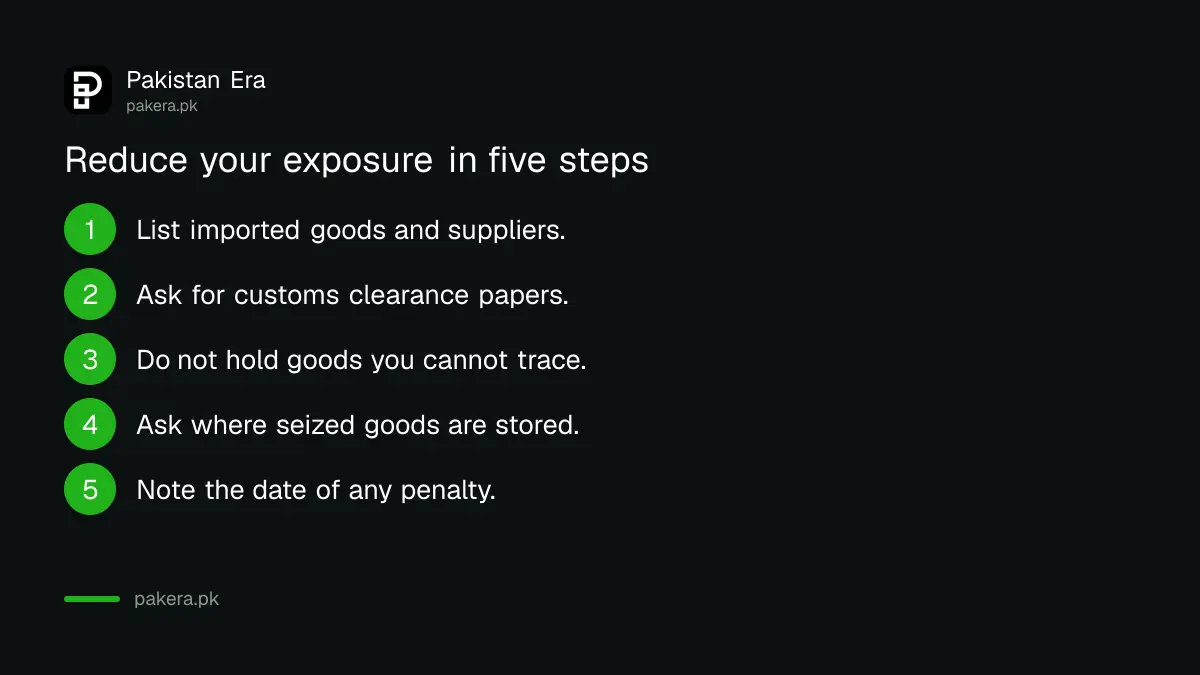
- List the imported goods you stock and the supplier for each.
- Ask each supplier for the customs clearance papers or a sales tax invoice.
- Do not store or move goods you cannot trace to a legal import.
- If customs holds your goods, ask in writing where they are stored and whether the place is a State Warehouse.
- If a penalty is imposed, note the date, because appeal time limits are short. See how to contest an overstayed cargo penalty on WeBOC.
Common questions about the Customs Act changes
Is selling smuggled goods covered by the new section 157 wording?
The Explanation to section 157(2) says removal includes retailing smuggled goods. What penalty follows depends on the rest of the Customs Act, which we did not read in full.
What is a State Warehouse?
It is a place authorised by the Collector of Customs to store detained, seized or confiscated goods.
What is the penalty for tampering with goods in a State Warehouse?
Up to two times the value of the goods, and on conviction by a Special Judge, up to five years in prison, or a fine, or both.
Can customs scan my goods?
Yes. Section 80(4) now says goods may be examined or scanned.
Has faceless adjudication started?
The Act lets the Board notify it. We did not find a notified procedure, so we cannot say it has started.
How we verified this
What we checked, where we read it, and what we could not confirm.
Last checked 14 October 2026. The changes come from section 3 of the Finance Act 2026, published in the Gazette of 26 June 2026 at download1.fbr.gov.pk. The reasons come from FBR's Notes on Clauses for the Finance Bill 2026-27. We did not read the full Customs Act or any notified rules.
About the author

Senior Writer, Public Services and Technology
Shahid joined us in 2024 as an author. He is a senior contributor to Pakistan's leading technology websites. He writes detailed articles, mostly covering his expertise in the latest tech, mobiles, apps, gadgets, and step-by-step guides. His ideology is to help people understand the latest trends and explain complex methods through very easy-to-understand guides.