Deported or Refused Entry Abroad? What Pakistan Immigration Does When You Return
FIA's Travel Guide says refused or deported Pakistanis are cleared for entry once identity is confirmed, with no legal action, and pay the airline themselves.
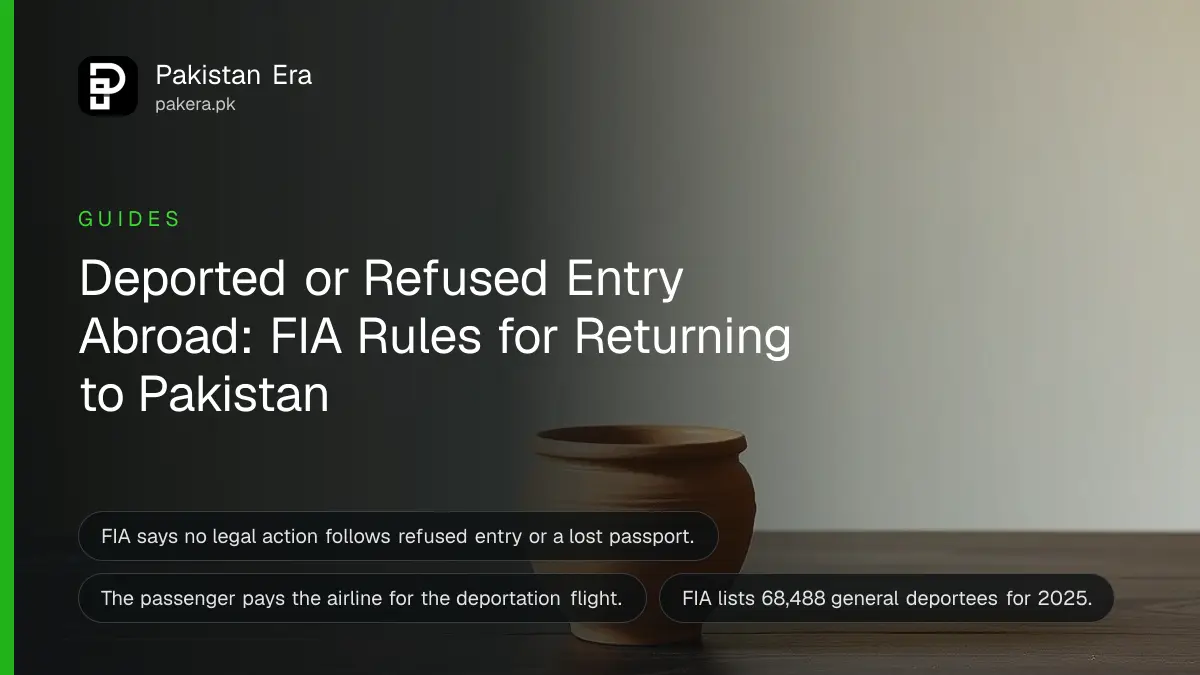
If another country refuses your entry or deports you, FIA's Travel Guide says Pakistan will clear you for entry once your identity is confirmed, and no legal action follows for that reason alone. You must pay the airline for the return flight yourself. FIA also says it set up reception desks for deportees.
A man is stopped at a foreign airport, held for hours and put on the next flight home. His first fear is not the money. It is what waits at the Pakistani counter. FIA's Travel Guide answers that fear in a few short paragraphs. We opened the Travel Guide page and PDF at fia.gov.pk on 15 October 2026, and we read the FIA Annual Administration Report 2025 for the deportee numbers. Here is what both say, and what they leave out.
Pakistan clears refused and deported citizens for entry
The guide says passengers who were refused entry, deported for overstay, or who returned by choice after losing their passport will be cleared for entry once they satisfy the immigration officer on duty about their identity. FIA says no legal action will be taken against them under Pakistani law for that reason.
This is a narrow promise. It covers the act of being refused or deported. It does not cover any other offence, such as a forged document. FIA's report counts those cases on their own line, under "deported on forged documents". The guide's promise is only about Pakistani law applying to the return itself.
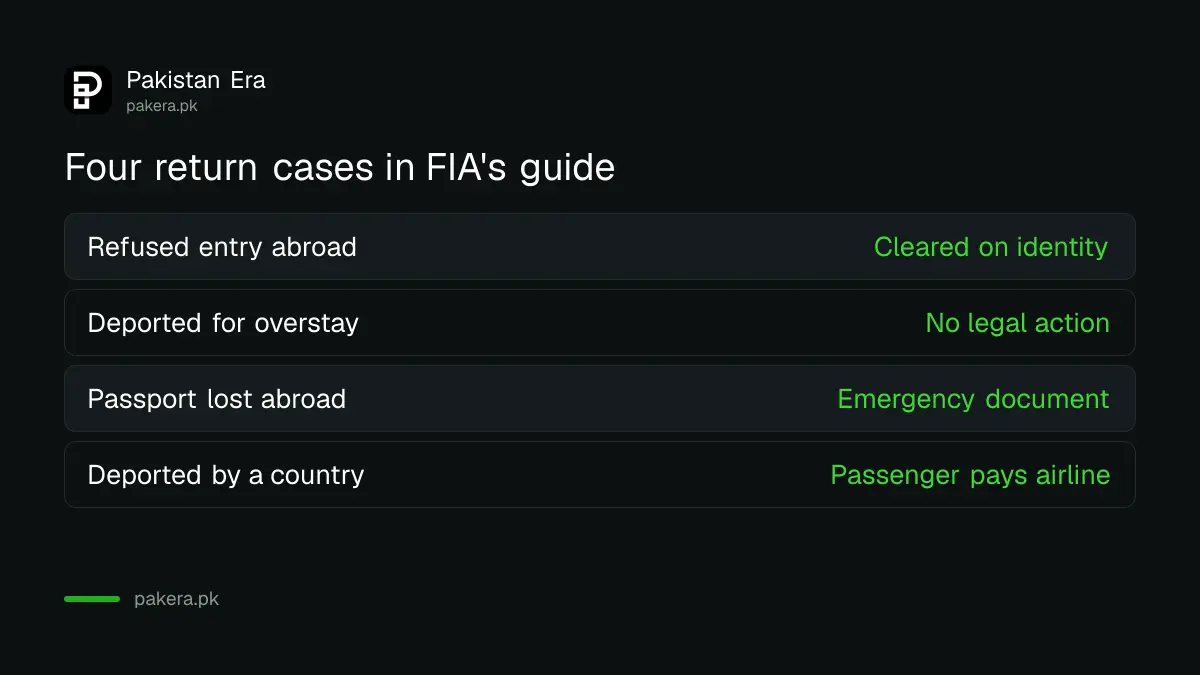
| Situation | What FIA's guide says |
|---|---|
| Refused entry abroad | Cleared for entry after identity is confirmed |
| Deported for overstay | Cleared for entry, no legal action on that ground |
| Returned after losing passport | Cleared with emergency travel document and proof |
| Deported by a foreign country | Passenger pays the airline for the return |
The passenger pays the airline for a deportation flight
FIA says that when a foreign country deports a passenger, it is the legal and moral responsibility of that passenger to pay the airline for the return journey. The guide gives no price. The cost is whatever the airline charges for the ticket.
That makes the return ticket advice in the same guide more important. A traveller who holds a return ticket loses a trip, not a second large bill. The airline's own rules decide what happens to the unused ticket, and the guide does not cover that.
What to show at the counter after you are sent back
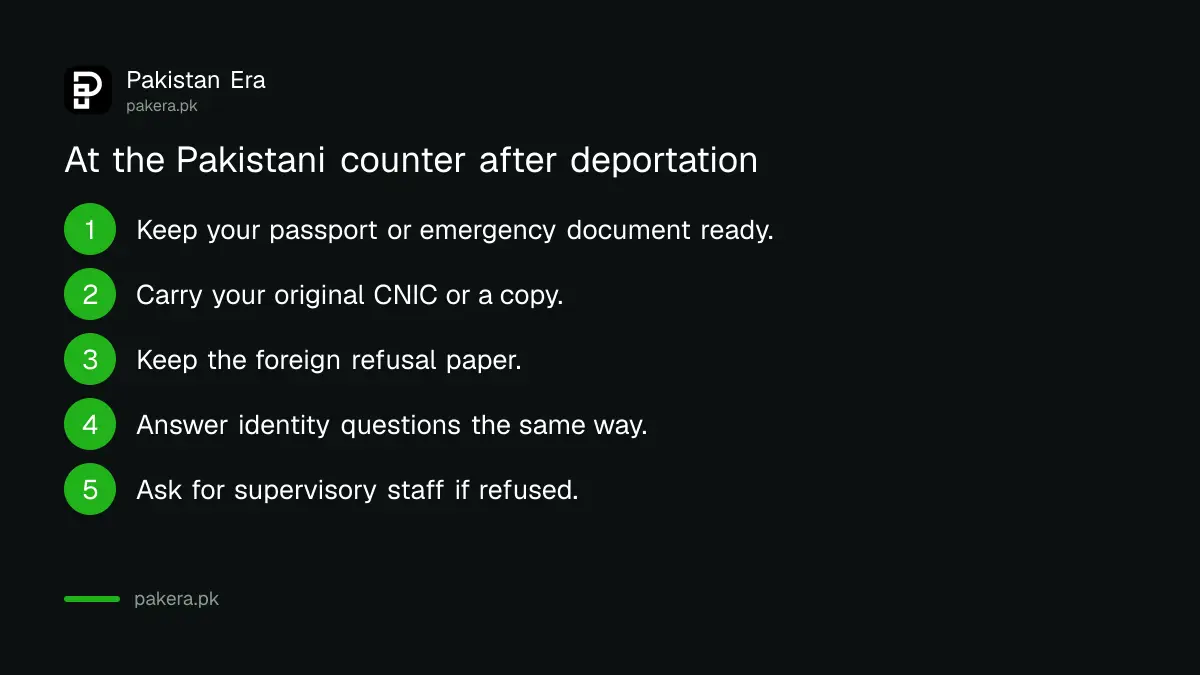
You prove who you are. A Pakistani passport, valid or expired, is accepted as evidence. If it was lost, show the emergency passport or travel document from the Pakistani mission, with a copy of the lost passport or your CNIC. Keep the foreign refusal or deportation paper too.
If you are stuck abroad without papers, start with the mission. The numbers and steps are in how to get Foreign Office and embassy help when stuck abroad, and pilgrims can follow the Jeddah route for an emergency travel document.
- Keep your passport or emergency document in hand.
- Carry your original CNIC or a copy.
- Keep any paper the foreign authority gave you.
- Answer identity questions clearly and the same way each time.
- Ask for the supervisory staff if a refusal feels unjust.
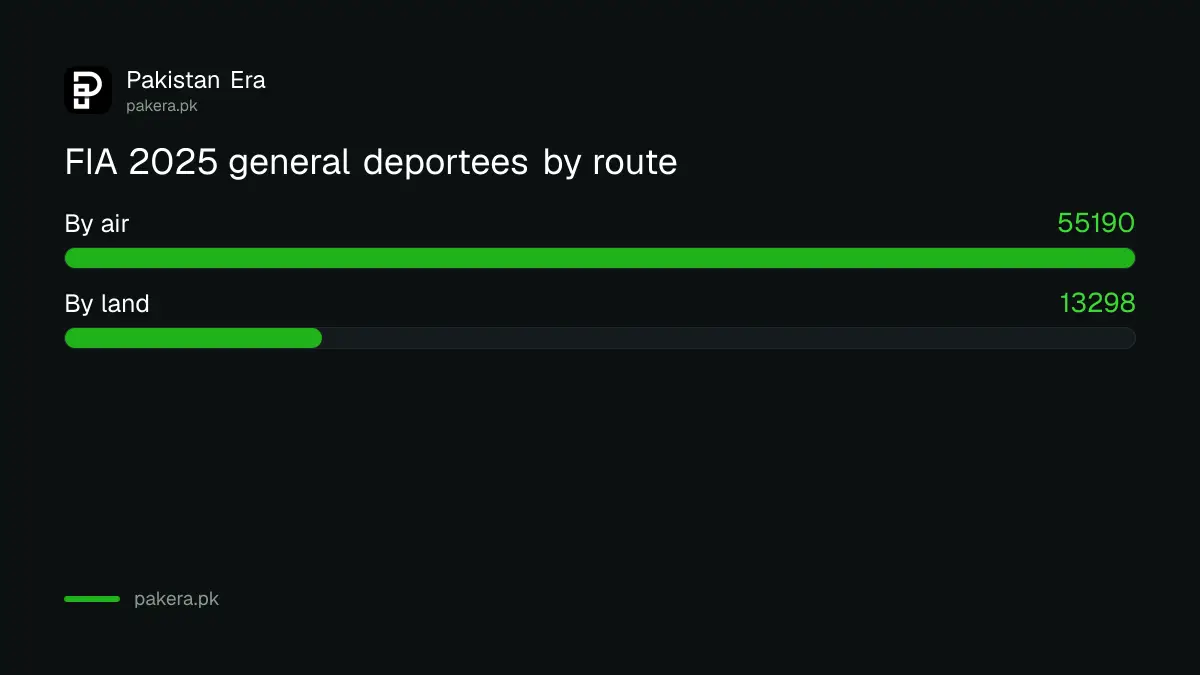
FIA reports 68,488 general deportees for 2025
The Annual Administration Report 2025 lists 68,488 general deportees for the year, 55,190 by air and 13,298 by land. It also says FIA operationalised Airport Reception Desks for deportees, meant to receive returning nationals in an orderly and dignified way.
The report does not say which airports have a desk or what staff do there, so we cannot give a location or a number. If you plan to meet a returning family member, ask the airline or the airport's FIA office on the day. The report is FIA's own account and we did not test a desk.
| 2025 FIA figure | Number |
|---|---|
| General deportees, total | 68,488 |
| By air | 55,190 |
| By land | 13,298 |
An unjustified refusal at the Pakistani counter can be reported
FIA's note says that if a returning passenger shows one of the accepted documents and an official still refuses entry or creates difficulty without a good reason, the matter should go to the supervisory staff at the point of entry. FIA says it will take strict action against the official.
Ask for the shift in charge, write down the time and the officer's name, and keep your boarding pass. Each airport's Immigration Wing is headed by a Deputy Director FIA. The FIA document checklist for the departure side covers what to carry on your next trip.
Common questions about deportation and refused entry
Will I be arrested in Pakistan for being deported?
FIA's guide says no legal action will be taken for refused entry, overstay deportation or losing a passport, once identity is confirmed.
Who pays for my flight home after deportation?
The passenger. FIA says it is the passenger's responsibility to pay the airline for the return journey.
What if my passport was lost?
Show the emergency passport or travel document from the Pakistani mission, with a copy of the lost passport or your CNIC.
Does this cover forged documents?
No. The guide's promise is about refusal, overstay and lost passports. FIA counts forged document cases separately.
Where is the airport reception desk for deportees?
The report does not say. It only says the desks were operationalised in 2025.
How we verified this
What we checked, where we read it, and what we could not confirm.
Last checked 15 October 2026. The entry rules and the payment rule come from the FIA Travel Guide page and PDF at fia.gov.pk/travel. The deportee figures and the reception desk reform come from FIA's Annual Administration Report 2025 on the same site. Both documents are FIA's own statements, the guide PDF has no issue date, and we did not test a counter or a desk.
About the author

Public Services and Education Journalist
Fajr Riaz is a journalist and content writer at Pakistan Era, based in Lahore. She covers the questions people meet in everyday life in Pakistan: how a public service works, what a change in the rules means, and where to find a reliable answer.