ECC Approves Rs 11.3 Billion to Finish Closing Utility Stores
Pakistan's ECC approved Rs 11.329 billion on 8 October 2026 to finish closing Utility Stores, within Rs 41 billion of grants. See each decision and its cost.
Pakistan's Economic Coordination Committee (ECC) has approved Rs 11.329 billion for the Utility Stores Corporation, to meet its immediate funding needs and finish its closure. The decision came at a meeting in Islamabad on Thursday, 8 October 2026, chaired by Finance Minister Muhammad Aurangzeb. It was one of 17 items on the agenda.
The ECC is the cabinet committee that signs off on spending and economic decisions between budgets. Its decisions normally go to the full federal cabinet for ratification. On 8 October it approved about Rs 41 billion in extra grants across 11 items, on our count of the official statement.
We read the Finance Division's statement on the meeting, issued through the Press Information Department on 8 October. Every decision below comes from that statement. Where it leaves something out, we say so.
Utility Stores get Rs 11.3 billion to finish closing
The ECC approved a technical supplementary grant of Rs 11.329 billion for the Utility Stores Corporation (USC). The statement says the money will "meet the immediate funding requirements" of USC and "facilitate completion of its closure process". The summary came from the Industries and Production Division.
A technical supplementary grant gives money to a purpose the budget did not fund, or did not fund enough. The statement does not say whether this sum is new spending or is covered by savings elsewhere in the budget.
Utility Stores outlets were reported closed from 31 July 2025, as we noted in our list of government schemes that have stopped. More than a year later, the closure still needs money. The statement does not break the Rs 11.329 billion down. It does not say how much goes to staff dues, debts or suppliers.
For households, the practical point has not changed. There are no subsidised Utility Stores to shop at. Support for low-income families now runs mainly through cash transfers such as BISP, not through cheap shops.
The ECC approved about Rs 41 billion in grants
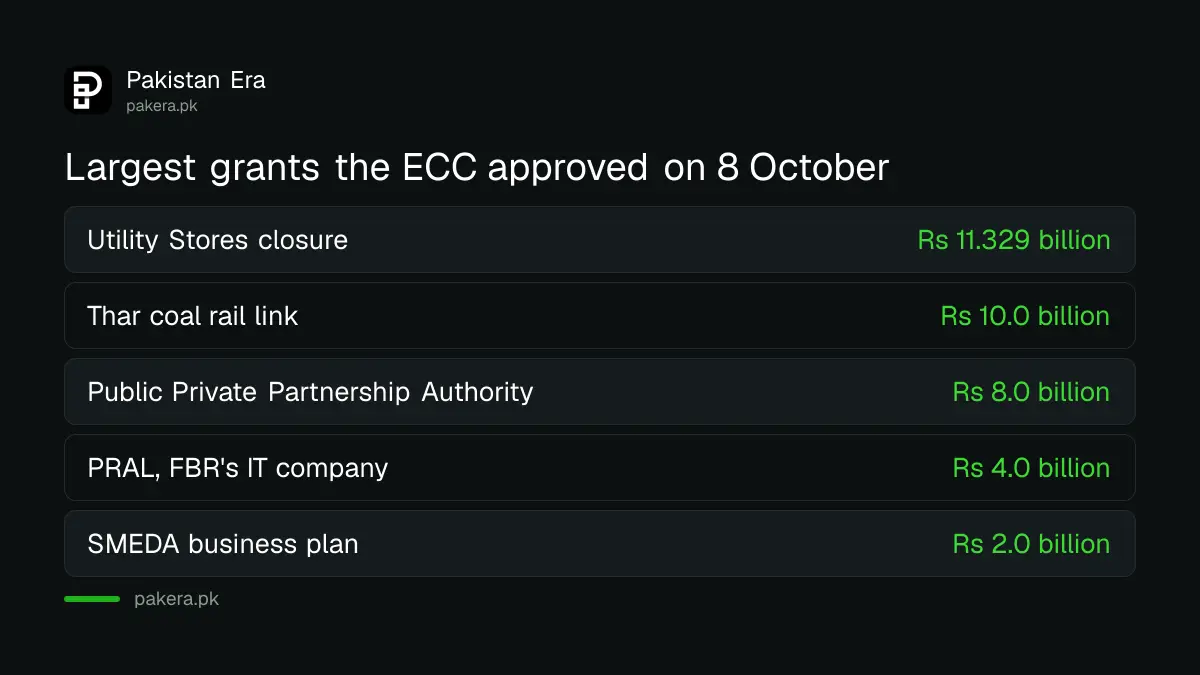
Eleven of the 17 items were technical supplementary grants. Added together, they come to about Rs 40.98 billion, on our arithmetic. The largest five account for Rs 35.3 billion of that.
| Who gets the grant | Amount | Purpose |
|---|---|---|
| Utility Stores Corporation | Rs 11.329 billion | Funding needs and completing closure |
| Ministry of Railways | Rs 10.0 billion | Thar Coal Rail Connectivity Project |
| Public Private Partnership Authority | Rs 8.0 billion | Infrastructure projects with private partners |
| PRAL, FBR's IT company | Rs 4.0 billion | Restructuring and FBR's Transformation Plan |
| SMEDA | Rs 2.0 billion | Its approved business plan |
| Election Commission | Rs 2.0 billion | Local government election materials |
| Agricultural training in China | Rs 1.666 billion | Short-term training for 1,000 professionals |
| Pakistan Sports Endowment Fund | Rs 934.5 million | Starting the fund |
| Election Commission | Rs 596.2 million | Revalidated funds for elections and delimitation |
| Capital Development Authority | Rs 300 million | Repairs at the PM Office and staff colony |
| Ministry of Climate Change | Rs 150 million | Attending COP31 in Antalya, Turkiye |
The Election Commission had asked for Rs 17.873 billion for local government election materials in Punjab, Khyber Pakhtunkhwa, Islamabad and cantonment boards. The ECC released Rs 2.0 billion of that straight away. The statement does not say when the rest will come. The Punjab local government election schedule is still in draft.
Housing loans get a wider credit guarantee
The ECC approved a change to the Credit Guarantee Trust Fund (CGTF). The change expands its scope so the existing guarantee can be used "more effectively" to support affordable housing finance. A credit guarantee means the government covers part of a bank's loss if a borrower does not repay.
That matters because banks lend more readily when part of the risk is covered. The government's low-cost housing loans run through banks under State Bank rules, as we set out in the four Apna Ghar circulars of 2026. The statement does not say how much cover is added, or when banks can use it.
Microfinance banks can now join small-loan risk schemes
The ECC approved a State Bank framework that lets microfinance banks and non-bank lenders join the government's risk coverage schemes for small enterprises and small farmers. They join as "Agency Financial Institutions", through wholesale and agency arrangements.
Until now, these schemes mainly worked through commercial banks. Microfinance lenders reach many borrowers in small towns and villages that big banks do not. So a small shop owner or a farmer with a few acres may find a guaranteed loan easier to get once lenders sign up.
This is a framework, not a loan offer. Borrowers will need to wait until individual lenders announce products. A related State Bank guarantee for women borrowers is explained in our page on business loans for women.
Tyres, tobacco and other decisions
The ECC approved six other items that were not grants. Some may affect prices later, but the statement gives no rates or figures for them.
- Tyres: an amendment to SRO 693(I)/2006 on the additional customs duty on imported tyres of types made in Pakistan. The aim is to promote local manufacturing. The new duty rate was not stated.
- Tobacco: minimum indicative prices for the 2026 tobacco crop, and revised cess rates for 2026-27. Neither figure was published in the statement.
- Export Development Fund: its money can be invested in government securities, under an approved framework.
- Housing guarantee: the CGTF change described above.
- Microfinance: the risk coverage framework described above.
- PASSCO: a plan to recover PASSCO's dues from provinces by deducting them at source was deferred for more consultation.
PASSCO is the federal body that buys and stores wheat. The deferred item concerns money the provinces owe it, so it does not change flour prices directly.
What these grants mean for the budget
About Rs 41 billion is small next to the federal budget, but it is not nothing. Pakistan spent Rs 6,948 billion on interest alone in 2025-26, according to the Finance Division's annual debt review. Extra grants during the year make it harder to hit the deficit targets agreed with the IMF.
Two of the larger grants support loss-making or closing state bodies. That fits a wider pattern. Federal state companies owe Rs 10.1 trillion in interest-bearing obligations, as we explained in our page on state company debt. Closing USC is meant to stop one source of those losses.
Common questions
How much did the ECC approve for Utility Stores?
Rs 11.329 billion, as a technical supplementary grant on 8 October 2026, to meet immediate funding needs and complete the closure of the Utility Stores Corporation.
Are Utility Stores reopening?
No. The grant is to finish closing the corporation. The statement says nothing about reopening any outlet.
What is a technical supplementary grant?
It is money approved during the year for a purpose the budget did not fully fund. The ECC statement does not say where these sums come from.
Will tyre prices change?
Possibly, but we cannot say by how much. The ECC amended the additional customs duty on imported tyres made locally, and did not publish the new rate.
Does the cabinet still need to approve these decisions?
ECC decisions are normally ratified by the federal cabinet. The statement of 8 October does not mention a cabinet date.
How we verified this
What we checked, where we read it, and what we could not confirm.
We last checked this on 9 October 2026. All decisions and amounts come from the Finance Division's statement on the ECC meeting of 8 October 2026 (PR No. 100), issued through the Press Information Department. The Rs 41 billion total is our own sum of the 11 grants listed. The interest figure comes from the Finance Division's Annual Debt Review for 2025-26. The statement does not give the tyre duty rate, the tobacco prices, a breakdown of the Utility Stores grant or a cabinet ratification date.
About the author

Global Affairs & Political Economy Writer
Muhammad Hatim is a book lover who started writing because he enjoys it. At Pakistan Era he writes about international relations, geopolitics and the global economy, with a particular interest in South Asia and the forces behind current events.