eSIM Price in Pakistan: Zong Rs 1,500, Jazz Rs 2,000, Ufone Prints Both, and PTA's Cap Is Rs 1,500
Zong charges Rs 1,500 for an eSIM, Jazz Rs 2,000 and Ufone prints both, against PTA's reported Rs 1,500 cap. See the IMEI rule and what to do if overcharged.
An eSIM costs Rs 1,500 at Zong, Rs 2,000 at Jazz, and either Rs 1,500 or Rs 2,000 at Ufone depending on which part of Ufone's own page you read. PTA's reported cap on the eSIM fee is Rs 1,500, in force since mid August 2026, so two of the three operator pages we read on 19 October 2026 still quote a price above it. You pay at a service centre or franchise after biometric verification, and you walk out with a QR code, not a card.
We read the eSIM pages of Jazz, Zong and Ufone on 19 October 2026. Telenor's page blocked our request three times, so Telenor is missing below and we say so rather than guess. Here is what each operator charges, what you need to bring, the phone rules that trip people up, and what to do if you are quoted more than the cap.
Zong quotes Rs 1,500, Jazz Rs 2,000, and Ufone prints both figures
Zong's eSIM page says the charge is Rs 1,500, paid at a Zong customer service centre. Jazz's page says Rs 2,000, excluding standard number charges. Ufone's page says Rs 1,500 in its price section, for a new customer or a physical SIM conversion, and Rs 2,000 for a new sale in its FAQ and terms.
| Operator | eSIM fee on its page, 19 October 2026 | Where to get it | Phone rule |
|---|---|---|---|
| Zong | Rs 1,500 | Customer service centre or franchise | Biometric verification, compatible handset |
| Jazz | Rs 2,000, excluding number charges | Experience centre, franchise or eligible retailer | Biometric verification, both IMEIs sent to 8484 |
| Ufone | Rs 1,500 in the price section, Rs 2,000 in the FAQ and terms | Service centre, franchise, 24-hour self-service booth, joint shop | Biometric verification, unlocked handset |
| Telenor | Could not read, page blocked | Not confirmed | Not confirmed |
PTA's cap of Rs 1,500 and ten free transfers between handsets were reported in August 2026, and PTA's own notification could not be read on its site at the time. The details are in the report on PTA's eSIM fee cap and free transfers. On the operator pages we read, only Zong's price matches the cap outright.
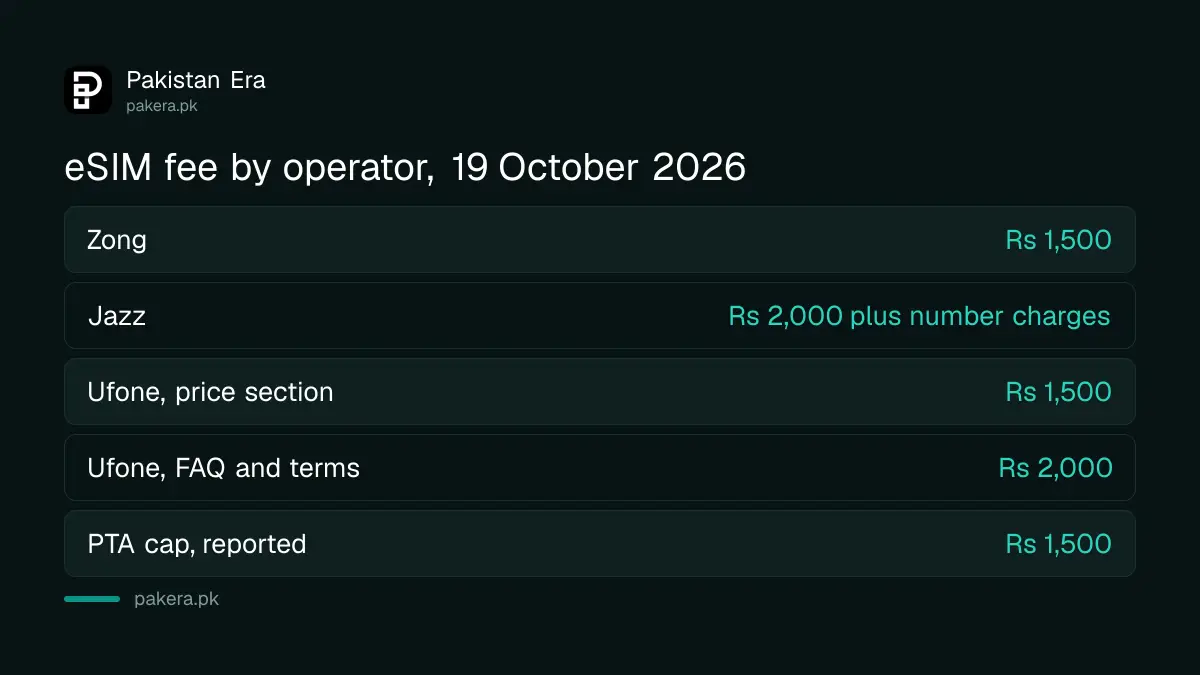
Jazz's Rs 2,000 and Ufone's second figure sit above PTA's reported cap
The cap, as reported, limits the initial cost of an eSIM to Rs 1,500. Jazz's page still prints Rs 2,000. Ufone's page prints Rs 1,500 in one place and Rs 2,000 in another and does not explain the difference. Either the pages are out of date, or the cap is applied at the counter and not on the website. We could not tell which.
What you can do is simple. Ask the price before biometric verification starts. If you are quoted more than Rs 1,500, say that PTA's cap is Rs 1,500 and ask the staff to confirm the current fee on their system. If they insist, pay only if you must, keep the receipt, and file a complaint with PTA quoting the receipt.
Jazz's wording also matters: Rs 2,000 excludes standard number charges. A new number with a special pattern costs extra on every operator, and that is separate from the eSIM fee. A conversion of your existing number should not carry a number charge.
You need biometric verification, a compatible phone and registered IMEIs
All three pages say biometric verification comes before activation. All three say you need an eSIM-compatible handset. Jazz and Zong both add a step people miss: send both IMEIs of the phone to 8484 and email screenshots of both to typeapproval@pta.gov.pk so the second IMEI, the one the eSIM uses, is whitelisted and not blocked by DIRBS.
The IMEI rule is the one that causes the most trouble. A dual SIM phone has two IMEIs. If only the first was registered when you bought the phone, the eSIM slot may show no service even though the QR code scanned fine. The fix is in fixing a phone with one SIM slot registered and the other not.
Ufone adds that a carrier-locked handset will not work, so unlock it first, and that an iPhone XS, XS Max or XR needs iOS 12.1 or later. Zong lists the longest set of supported phones, from the iPhone XR to the iPhone 18 Pro, Pixel 3 to Pixel 11, and many Samsung, Infinix, Tecno, Xiaomi, Oppo, vivo and Realme models.
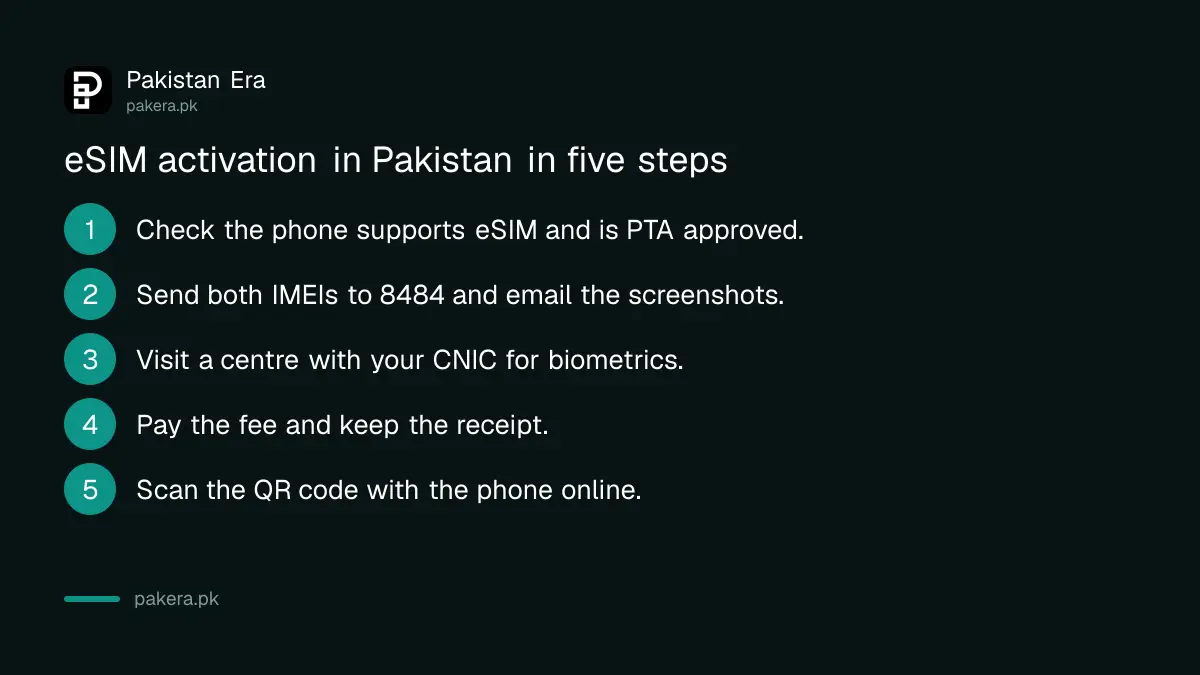
How to get an eSIM, step by step
The process is the same shape on all three operators. You verify in person, receive a voucher with a QR code, and scan it on the phone with an internet connection. Zong and Ufone both say the phone must be online during the scan. Jazz says the eSIM activates within about five minutes.
- Check the phone supports eSIM and is PTA approved. The steps are in checking PTA status in the DVS app.
- Send both IMEIs to 8484 and email the screenshots to typeapproval@pta.gov.pk, as Jazz and Zong instruct.
- Visit a service centre or franchise with your CNIC and complete biometric verification.
- Choose a new number or convert your existing number. Pay the fee and keep the receipt.
- On iPhone, go to Settings, Cellular, Add Cellular Plan and scan the QR code. On Android, go to Settings, SIM Card Manager, eSIM, Add Mobile Plan and scan. Ufone says to enter the PIN 0000 if asked.
Activating an eSIM for a number deactivates the physical SIM for that number, Jazz says, and frees the slot for another SIM. Your existing packages and tariffs carry over on all three operators.
Keep the QR code private, and know what happens on a factory reset
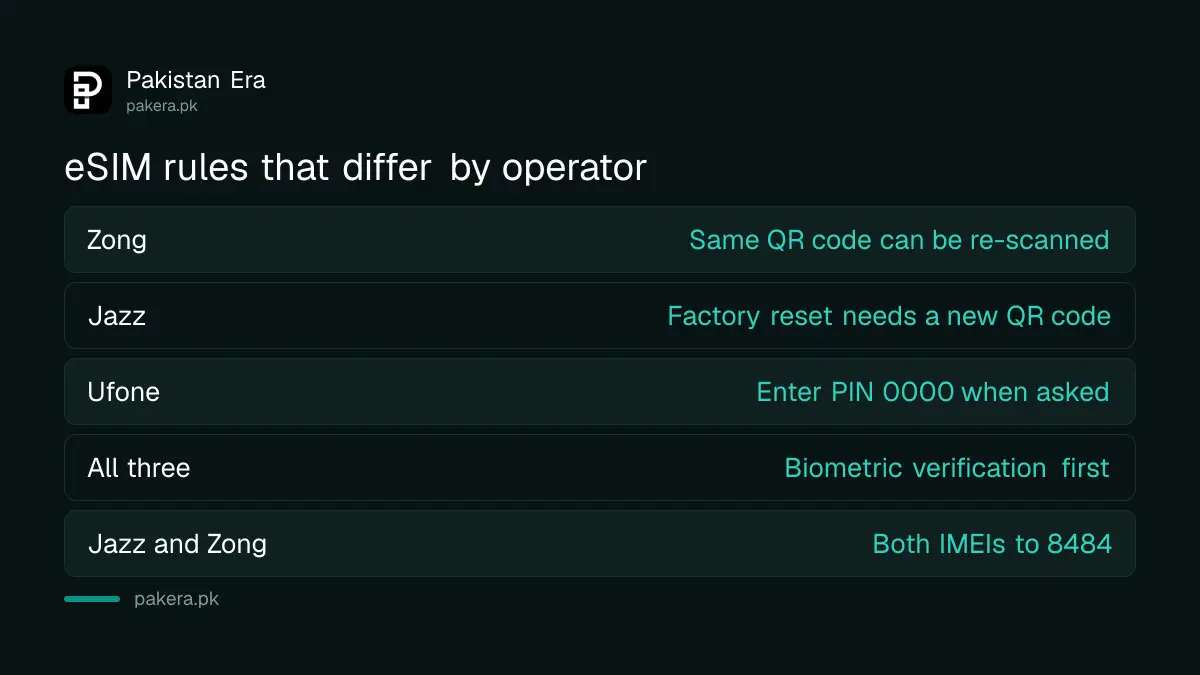
All three operators say not to share the QR code with anyone. Zong says you can re-scan the same code if you change phones or the profile was deleted. Jazz says a factory reset removes the eSIM and you must visit a centre for a new QR code. Ufone says a lost or stolen phone means a visit for a new code.
That difference is why the reported ten free transfers matter more than the fee cap. Before the cap, every phone change could mean paying for a fresh eSIM. Under the reported policy, the first ten moves between handsets are free, but each operator's page still describes the old process, so ask at the counter.
Jazz adds one more useful line. If you lose a QR code you have not scanned yet, call 111 or visit a centre to deactivate it, so nobody else can use it.
What to do if you are charged more than Rs 1,500
Pay only what you are told after asking, keep the receipt, and complain. The operator's helpline comes first: Jazz on 111, Zong on 310, Ufone on 333 from their own numbers. If the operator does not refund the difference, PTA's complaint route is in how to complain to PTA about a telecom service.
Before you spend any money, read the general steps in how to activate an eSIM in Pakistan for the phone-side settings. And if you are only visiting Pakistan, a travel eSIM on a foreign number is a different product with its own PTA rules.
Common questions about eSIM prices in Pakistan
How much does an eSIM cost in Pakistan?
Zong charges Rs 1,500 and Jazz Rs 2,000 on their pages read on 19 October 2026. Ufone prints Rs 1,500 and Rs 2,000 in different sections of one page. PTA's reported cap is Rs 1,500.
Can I convert my existing number to an eSIM?
Yes, on Jazz, Zong and Ufone. Your services and tariffs carry over. Biometric verification is required and the physical SIM stops working for that number once the eSIM is active.
Which phones support eSIM in Pakistan?
iPhone XR and later, Google Pixel 3 and later, and many Samsung Galaxy S, Z and A models. Zong's page lists models from Infinix, Tecno, Xiaomi, Oppo, vivo and Realme too. Check your model on the operator's list before you visit.
Do I have to register both IMEIs for an eSIM?
Jazz and Zong say yes. Send both IMEIs to 8484 and email the screenshots to typeapproval@pta.gov.pk. If only one IMEI is registered, the eSIM slot may show no service.
What happens to my eSIM if I reset the phone?
Jazz says a factory reset removes the eSIM and you need a new QR code from a centre. Zong says its code can be re-scanned. Back up the phone first either way.
Does Telenor offer an eSIM?
We could not read Telenor's eSIM page on 19 October 2026 because it blocked our requests. Ask at a Telenor franchise and treat the Rs 1,500 cap as the price to expect.
How we verified this
What we checked, where we read it, and what we could not confirm.
Last checked 19 October 2026. Fees, locations, phone rules and activation steps come from Jazz's eSIM page, Zong's eSIM page and Ufone's eSIM page, all read on 19 October 2026. Telenor's eSIM page returned an access block on three attempts and is not covered. PTA's Rs 1,500 cap and ten free transfers are reported, because PTA's notification could not be read on its website, which also refused our connection on 19 October 2026. We did not buy an eSIM or visit a centre.
About the author

Technology Journalist & Multimedia Producer
Ahmad Ali is a technology journalist and multimedia producer at Pakistan Era, joining the team in October 2026. He covers consumer technology and digital life for Pakistani readers, combining research with hands-on product testing.