FBR Notifies Faceless Tax Audit Rules in S.R.O. 1665, but They Have Not Started Yet
FBR notified faceless audit and assessment rules in S.R.O. 1665(I)/2026. Replies go through IRIS, officers stay hidden, and start dates are still to come.
FBR has notified the final rules for faceless tax audit and assessment under S.R.O. 1665(I)/2026, dated 29 September 2026. The rules add a new Chapter XX to the Income Tax Rules, 2002. They do not start yet: each case class begins on a date FBR will announce by a separate notification.
That matters because a taxpayer may hear "faceless audit" and think it already applies to them. It does not, until FBR names the cases and the start date. We read the notification on the FBR website on 13 October 2026, along with FBR's own explanation of the Finance Act 2026.
The rules are final, but the start date is open
Rule 233 says the new chapter covers only the proceedings, persons and cases the Board specifies under section 122E of the Income Tax Ordinance, 2001. It comes into force on a date the Board notifies in the Gazette, and different dates can be set for different cases.
The draft was published as S.R.O. 1651(I)/2026 on 25 September. The final text followed four days later. FBR's list also shows a parallel sales tax notification, S.R.O. 1663(I)/2026, on faceless audit under the Sales Tax Rules.
The centre itself was set up on 25 September. Our report on the National Faceless Centre explains what it is and who runs it.
Every reply goes through your IRIS account
Rule 239 says every reply, document, evidence or application in a faceless case must be sent through the taxpayer's "designated account", which is the account on IRIS. Documents must be in the electronic format FBR specifies. Paper replies and meetings with an officer are not part of this system.
Every notice or order from the centre must be generated on FBR's computer system and carry a Digital Identification Number (DIN), under rule 238. It is served in the way section 218 of the Ordinance lays down. A notice with no DIN is a reason to ask questions. Our guide to checking whether an FBR notice is real lists the steps.
Three different officers handle each case
Under rule 237, a computer program called the allocation algorithm gives the audit, the assessment and the quality check of one case to separate officers. No officer may do more than one of those jobs for the same case and tax year. The taxpayer is not told who the officers are.
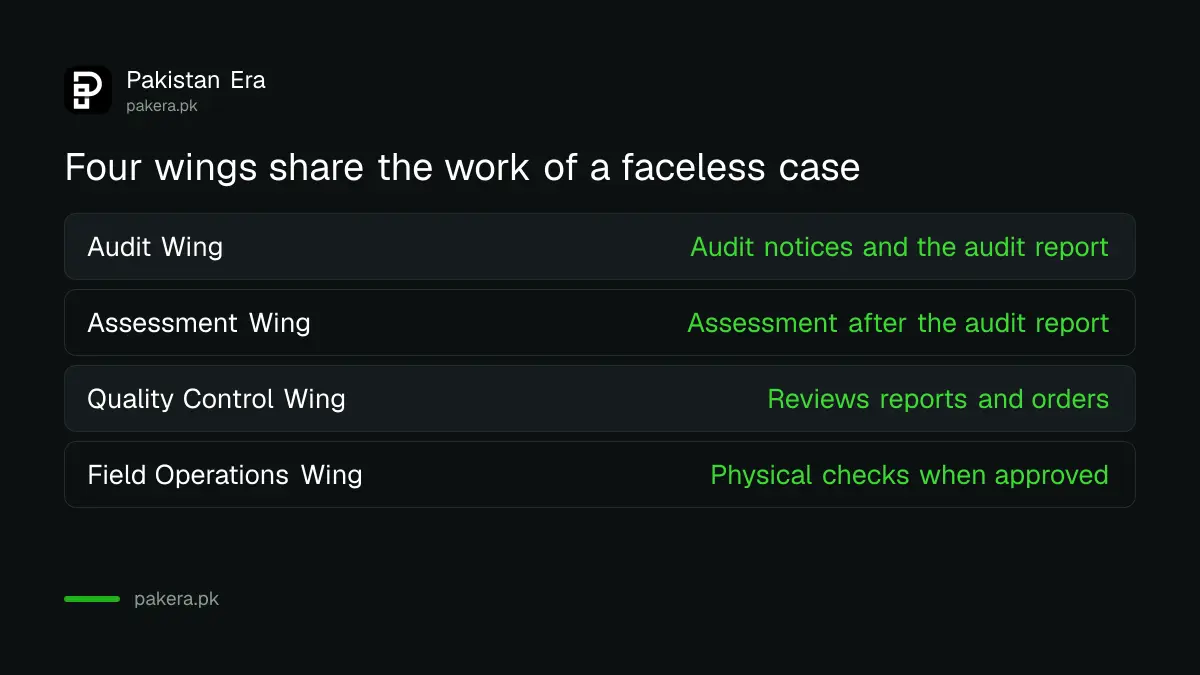
| Stage | Who does it | What the rules say |
|---|---|---|
| Audit | Audit Wing unit officer | Can issue further notices under sections 176 and 177 and issue the audit report |
| Assessment | Assessment Wing unit officer | Receives the record after the audit report is issued |
| Quality control | Quality Control Wing | Reviews audit reports and assessment orders and gives its observations |
| Physical checks | Field Operations Wing | Acts only when the Chief Commissioner approves a request |
Hearings are held as electronic hearings. A statement on oath can also be recorded in an electronic hearing. Penalties and default surcharge arising from the proceeding are issued through the centre in the same way.
Some cases can still leave the centre
Rule 244 lets the Chief Commissioner of the centre recommend that a case be moved to the local Commissioner. The reasons include a large physical record, repeated physical checks, a search or seizure, or a link to a case already before the local office.
The Board can also move a case on its own. For the taxpayer, the main effect is that a faceless label does not guarantee a faceless case from start to finish.
The Finance Act 2026 also created an algorithmic settlement route, under which a taxpayer may accept a computer offer within ten days. That route is not in these rules. Accepting such an offer works through a revised return, which is explained in our guide to revising an income tax return.
What a taxpayer should do before the start date
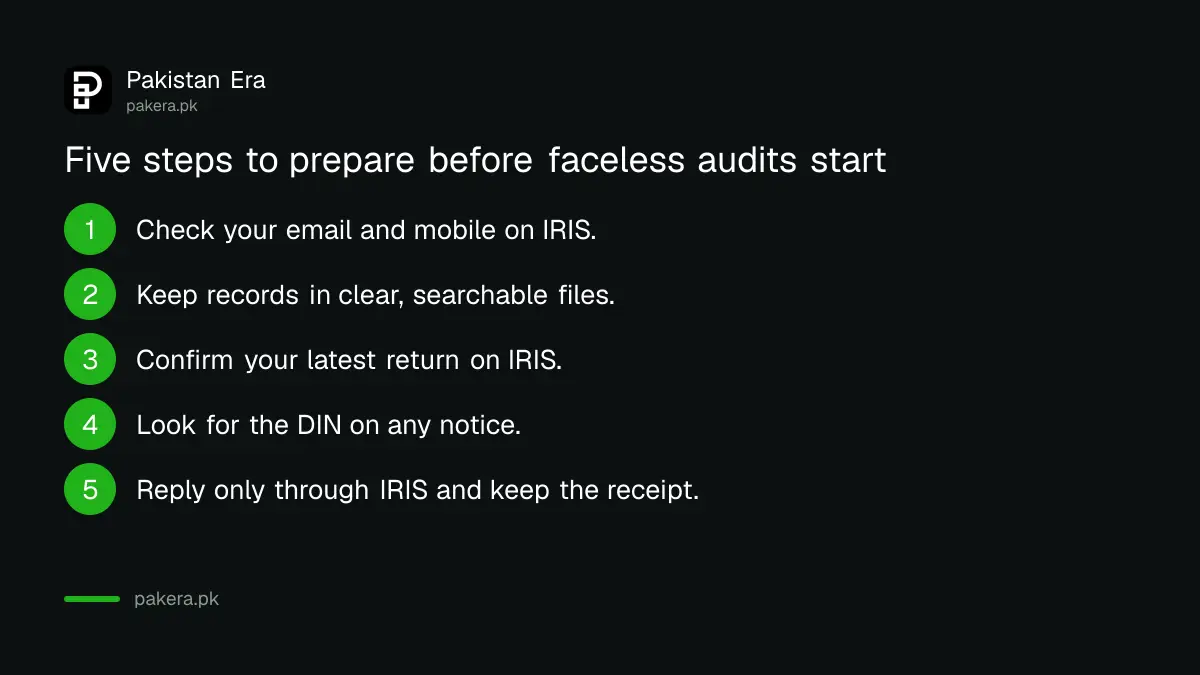
- Log in to your IRIS account and confirm your email address and mobile number are current.
- Keep bank statements, invoices and wealth records in clear, searchable files, not scanned images.
- Check the NTN and the return you filed for the latest year with the IRIS return check.
- When a notice arrives, look for the DIN and the date, and note the reply deadline.
- Reply only through the IRIS account named in the notice, and keep the acknowledgement.
Common questions
Are faceless audits already happening under S.R.O. 1665?
No. The rules start on a date FBR will notify, and it can differ by class of case. We found no start date on the FBR site on 13 October 2026.
Can I reply to a faceless notice in person at my tax office?
Not under these rules. Rule 239 says replies go through the designated IRIS account in the format FBR specifies.
Will I know which officer is auditing me?
No. The identity of the officer stays confidential. A notice or order cannot be challenged only because the officer's identity was hidden.
Does the faceless regime cover sales tax?
FBR's SRO list shows a separate notification, S.R.O. 1663(I)/2026, that amends the Sales Tax Rules for faceless audit and assessment. We did not read its full text for this page.
Can a case be taken out of the faceless system?
Yes. The Chief Commissioner can recommend a transfer under rule 244, and the Board can move a case on its own motion.
How we verified this
What we checked, where we read it, and what we could not confirm.
Last checked on 13 October 2026, Pakistan time. We read S.R.O. 1665(I)/2026 in the FBR income tax SRO list and FBR's Circular No. 02 of 2026-27 on the Finance Act 2026 in its income tax circulars. We did not read the sales tax notification in full, and we found no commencement date.
About the author

Global Affairs & Political Economy Writer
Muhammad Hatim is a book lover who started writing because he enjoys it. At Pakistan Era he writes about international relations, geopolitics and the global economy, with a particular interest in South Asia and the forces behind current events.