FBR Allows One Electronic Invoice for Sales Tax, Excise Duty and Islamabad Services Tax
FBR's S.R.O. 1666(I)/2026 lets one electronic invoice carry sales tax, federal excise duty and Islamabad services tax, with no second integration or licence.
FBR now allows one electronic invoice to carry sales tax, federal excise duty and Islamabad's tax on services, with each tax shown on its own line. The change is in S.R.O. 1666(I)/2026, dated 29 September 2026, which amends the Sales Tax Rules, 2006.
For a business that sells goods or services with more than one tax, this means one integrated invoicing system, not three. We read the notification on the FBR website on 13 October 2026. The notification text we read does not give a separate start date.
One invoice can carry three taxes
The new proviso to rule 150S says that where sales tax, federal excise duty and Islamabad tax on services apply to the same sale, a single electronic invoice with separately identifiable particulars of each tax is enough. A business does not need a second invoice for the duty.
Federal excise duty is a tax on certain goods and services listed under the Federal Excise Act, 2005. The Islamabad Capital Territory (Tax on Services) Ordinance, 2001 taxes certain services provided in the federal capital. Before this change, the electronic invoice system was built around sales tax.
The notification also says it does not change how any of the taxes is charged, collected, paid, adjusted or shown in a return. It changes the invoice, not the tax.
Businesses already integrated do not integrate twice
New sub-rules in rule 150Q apply the electronic invoicing chapter to anyone who must issue an e-invoice under the Federal Excise Act, 2005, or who provides services taxed in Islamabad. An explanation then says a person already integrated with FBR's system need not integrate again only because of those two laws.
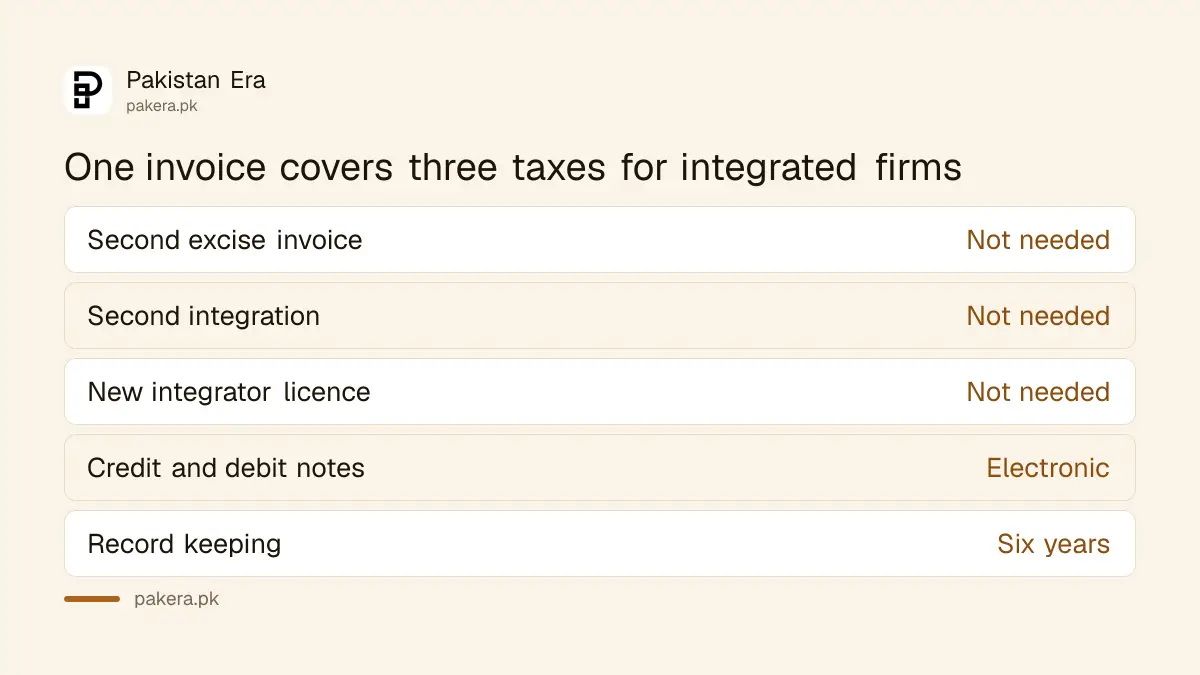
A new sub-rule in the integrator licensing rules also says a licence for a licensed integrator under the chapter covers integration for federal excise and Islamabad services too. No separate integrator licence is needed on that ground alone.
| Question | What the notification says |
|---|---|
| Need a second invoice for excise duty? | No, one invoice with separate lines is enough |
| Need to integrate again? | Not if you are already integrated with FBR's system |
| Need a new integrator licence? | No, the existing licence covers all three taxes |
| Are credit and debit notes electronic? | Yes, along with advance receipt invoices |
| How long are records kept? | Six years |
New invoice fields for excise duty
Under rule 150R, the electronic invoice must now show extra data when federal excise duty applies. The notification lists the fields: the type of duty, its rate, the price per unit, the amount payable otherwise than in sales tax mode, and the SRO or schedule reference with its serial number.
A business that sells excisable goods should ask its software vendor to add these fields before the next filing. An invoice missing them may fail validation in the FBR system. The notification does not say how the system will reject it, and we did not test the live system.
Unrecorded sales now trigger recovery of all three taxes
Rule 150XD changes what happens when an integrated person does not account for a sale. If a supply has no invoice with a QR code or FBR invoice number, or an invoice was sent but never shown in the annex or the return, an Inland Revenue officer may work out the tax or duty and recover it.
The officer can also take other penal action under the relevant law. The Commissioner recovers the tax, duty or services tax after a report from FBR's enforcement network, under the change to rule 150XQ.
This sits next to FBR's other push to trace sales, including the point of sale rule explained in our note on the 10 per cent tax credit for integration equipment, and the order on sealing factories and seizing goods.
Steps for a business with more than one tax
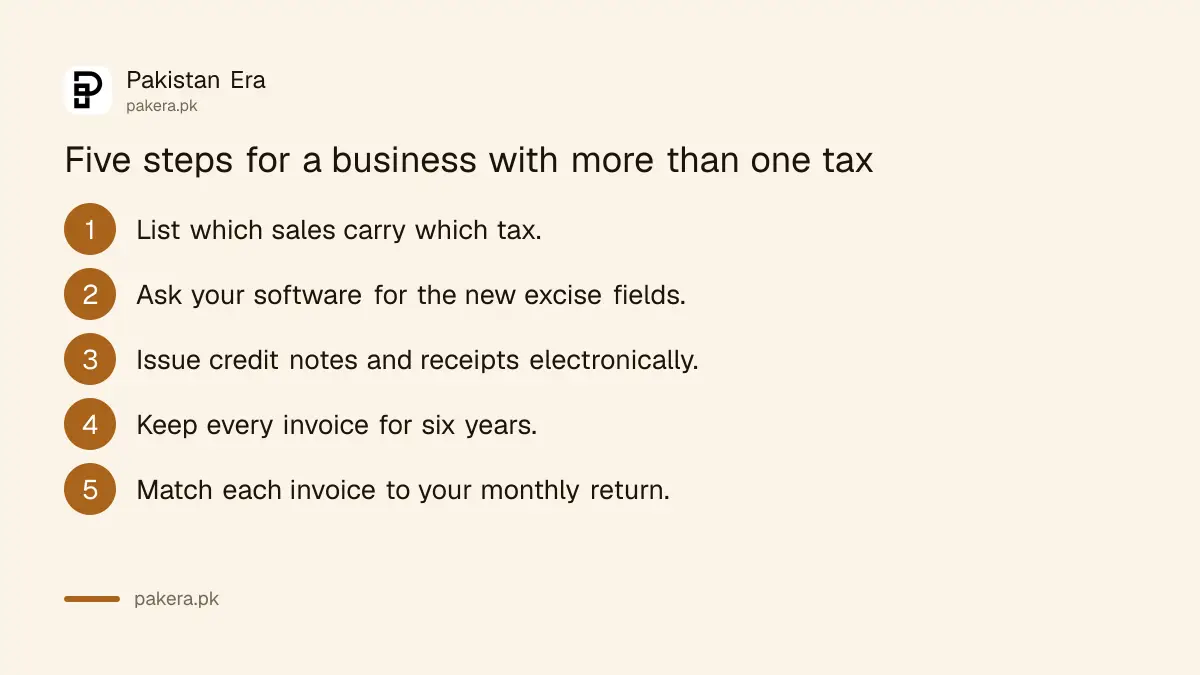
- List which of your sales carry sales tax, excise duty or Islamabad services tax.
- Ask your software or integrator whether it supports the new excise fields in rule 150R.
- Check that credit notes, debit notes and advance receipts are also issued electronically.
- Keep all invoices for six years.
- Reconcile every invoice with your monthly return, so no QR coded sale is missing from it.
Retailers that must integrate their shops can see how far this has gone in the count of 13,731 integrated retailers.
Common questions
Does S.R.O. 1666(I)/2026 add a new tax?
No. It changes only how the invoice is issued and what data it carries. The levy, rate and payment of each tax stay under their own laws.
Who must issue an electronic invoice under federal excise?
The notification applies the invoicing chapter to anyone required to issue an e-invoice or integrate under the Federal Excise Act, 2005 or its rules and notifications.
Are services in Islamabad covered?
Yes. Persons providing services chargeable to tax under the Islamabad Capital Territory (Tax on Services) Ordinance, 2001 are covered.
Do I need a new integrator?
No. A licence granted under the chapter also authorises integration for federal excise and Islamabad services tax, so no separate licence is required on that ground.
When does it start?
The notification we read gives no separate start date. Ask FBR or your integrator before assuming a date.
How we verified this
What we checked, where we read it, and what we could not confirm.
Last checked on 13 October 2026, Pakistan time. We read S.R.O. 1666(I)/2026 in the FBR sales tax SRO list. The PDF has some unclear characters, so we checked each rule number against its context. We did not test the live invoicing system or confirm a start date.
About the author

Global Affairs & Political Economy Writer
Muhammad Hatim is a book lover who started writing because he enjoys it. At Pakistan Era he writes about international relations, geopolitics and the global economy, with a particular interest in South Asia and the forces behind current events.