FBR Section 114C Restrictions on Non-Filers in Pakistan: Thresholds, Eligibility and Why They Are Not in Force Yet
Section 114C would bar ineligible persons from cars above Rs 7 million, property above Rs 100 million and Rs 50 million in shares. See the 130% test and status.
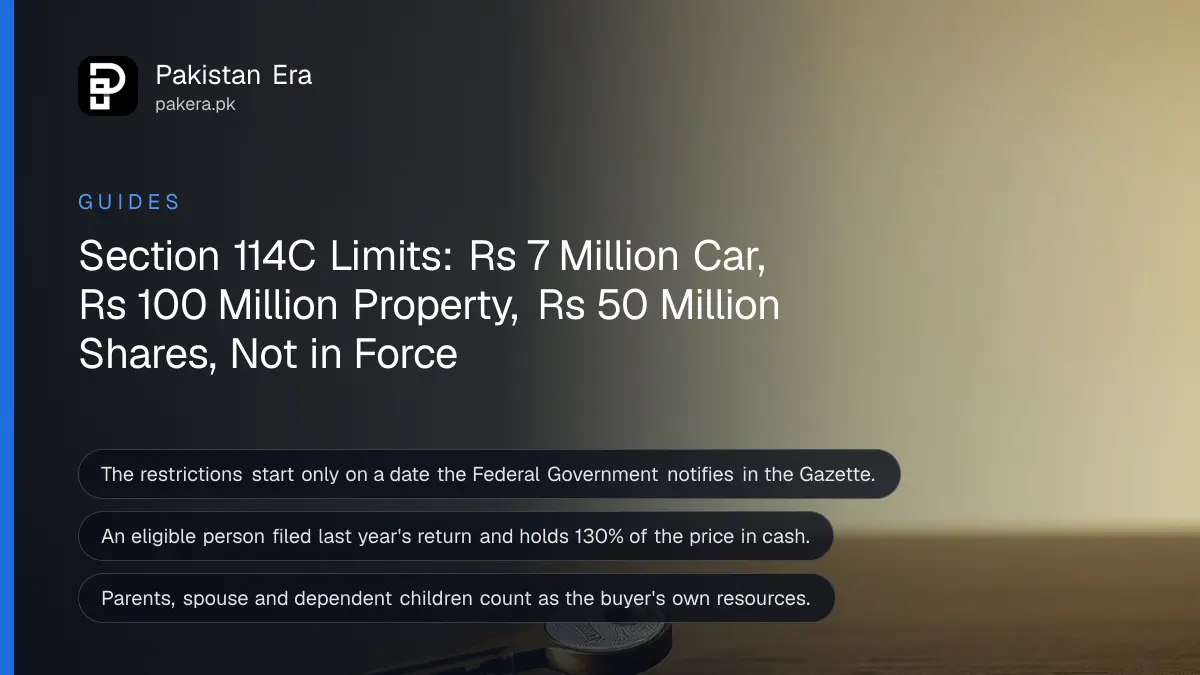
Section 114C of the Income Tax Ordinance, 2001 would stop an "ineligible person" from booking or registering a car worth more than Rs 7 million, transferring property worth more than Rs 100 million, or putting more than Rs 50 million a year into shares and mutual funds. It is in the law but not in force: sub-section (5) says the restrictions start on a date the Federal Government notifies in the Gazette, and we found no such notification on the FBR website on 19 October 2026.
The section was inserted by the Finance Act 2025, with its thresholds in a new Fifteenth Schedule. A year and a half later the question of when it begins still comes up every time a car dealer or a housing society asks for a filer certificate. We read section 114C and the Fifteenth Schedule in FBR's consolidated Ordinance amended up to 30 June 2026.
Four transactions are restricted once the section starts
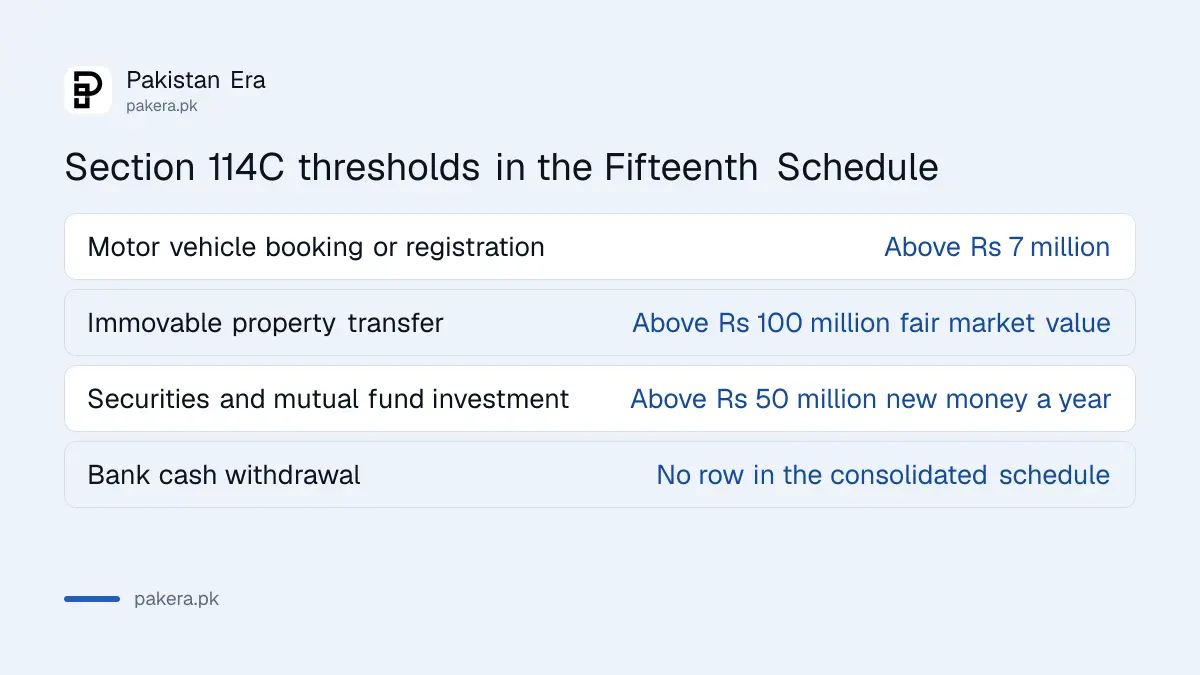
Sub-section (1) lists them. A manufacturer or an Excise and Taxation registering authority may not accept an application by an ineligible person to book, buy or register a motor vehicle above the threshold. A registrar may not accept an application from an ineligible person to record or attest a transfer of immovable property above the threshold. A broker or fund may not open or maintain a securities, mutual fund or similar account where the ineligible person's investment exceeds the threshold. And a bank may not allow a cash withdrawal above the threshold from any person's account.
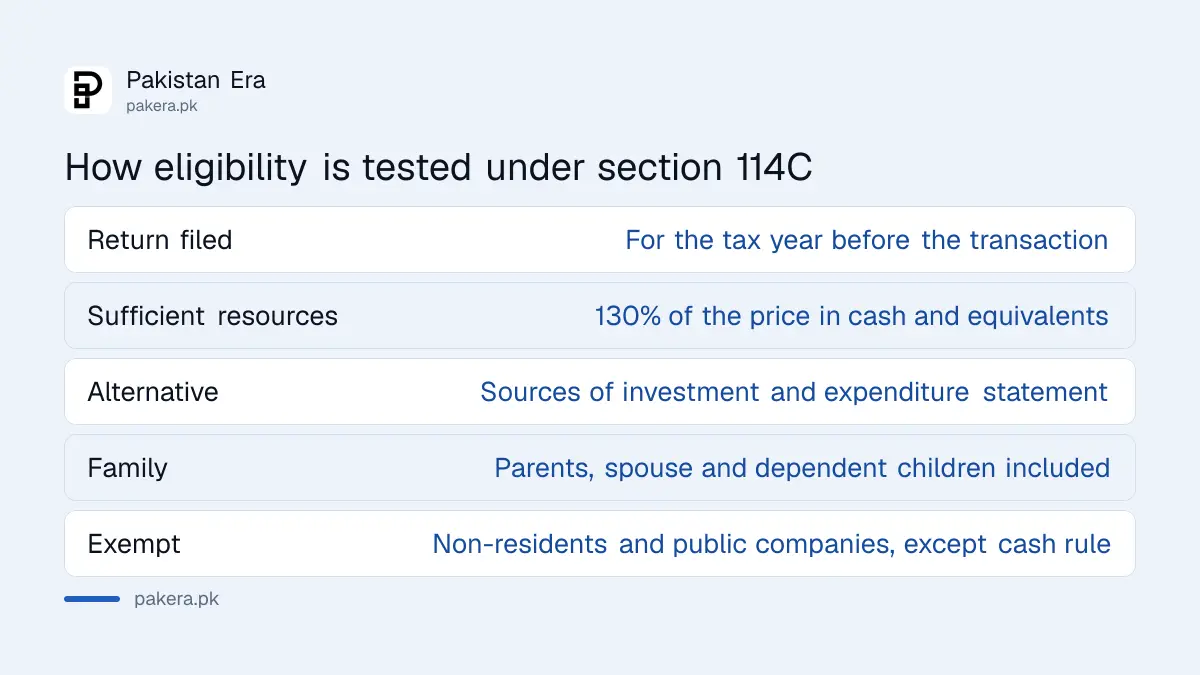
Sub-section (2) exempts non-residents and public companies from the first three, but not from the cash withdrawal rule.
| Transaction | Value measured as | Threshold in the Fifteenth Schedule |
|---|---|---|
| Booking, purchase or registration of a motor vehicle | Invoice value for a local vehicle; import value assessed by Customs including all duties and taxes | Exceeding Rs 7 million |
| Registering, recording or attesting a transfer of immovable property | Fair market value under section 2(22AA) | Exceeding Rs 100 million |
| Investment in securities, debt securities, mutual fund units or money market instruments | Acquisition cost of new investment in a financial year, excluding reinvestment | Exceeding Rs 50 million |
| Cash withdrawal from a bank account | Not specified | No row in the consolidated schedule |
The consolidated schedule we read carries three rows. Section 114C(1)(d) refers to a cash withdrawal threshold "as specified in Fifteenth Schedule", but no row for it appears in the text, so the bank limit cannot operate until one is added.
Eligible means a filed return plus enough declared resources
This is not the same as being on the active taxpayers' list. Sub-section (4)(a) defines an eligible person as one who filed a return for the tax year immediately before the transaction and has "sufficient resources" in the wealth statement, or in the financial statements for a company or AOP, for that transaction; or one who has filed a "sources of investment and expenditure statement" on FBR's portal declaring sufficient resources for the particular purchase.
For an individual, the eligible person includes immediate family members, defined as parents, spouse and dependent children. So a dependent child buying a car can rely on a parent's declared resources. Anyone who is not eligible is ineligible, under sub-section (4)(c).
Being a filer still matters for everything else, from the lower withholding rates to the filer status checks that banks and registrars already run. Section 114C adds a second test on top.
Sufficient resources means 130% of your declared cash and near-cash
Sub-section (4)(e) sets the measure. "Sufficient resources" means 130% of the cash and equivalent assets declared in the latest wealth statement or sources statement: cash in local or foreign currency, the fair market value of gold, the net realisable value of stocks, bonds and receivables, and other cash equivalents the Board may prescribe. For a company or AOP it is the cash and equivalents in the financial statements attached to the latest return.
A proviso covers exchanges: where the new asset is bought by disposing of a capital asset already declared, the disposal counts as cash to the extent of the value in the agreement. A Rs 10 million car therefore needs Rs 13 million of declared cash or equivalents, or the sale of a declared asset worth Rs 10 million, in the last wealth statement. Sub-section (3) adds that the sources statement and the resources test are not to be read as the "nature and source" explanation for section 111, so filing one does not settle an unexplained-income query.
Nothing starts until the Federal Government notifies a date
Sub-section (5) is the key line: "All or any of the restrictions or limitations imposed on the ineligible person under this section shall come into force on such date as the Federal Government may, by notification in official Gazette, appoint", with such reductions or increases in the thresholds as it thinks appropriate. The government can switch on one restriction and not another, and change the limits when it does.
We searched FBR's SRO pages for income tax notifications and found none appointing a date, and FBR's Circular No. 02 of 2026-27 on the Finance Act 2026 does not mention the section. Reports through 2026 have said enforcement is pending the notification; we treat the section as not in force until one appears. The existing non-filer measures, such as the higher withholding on cash withdrawals and the higher advance tax on vehicle registration, work through rates, not refusals, and are unaffected.
What to do if a dealer or registrar cites section 114C today
Until the Gazette notification exists, a registering authority has no power under this section to refuse an application. The thresholds and the resources test are still worth planning for, because a notification can arrive with the same thresholds or lower ones.
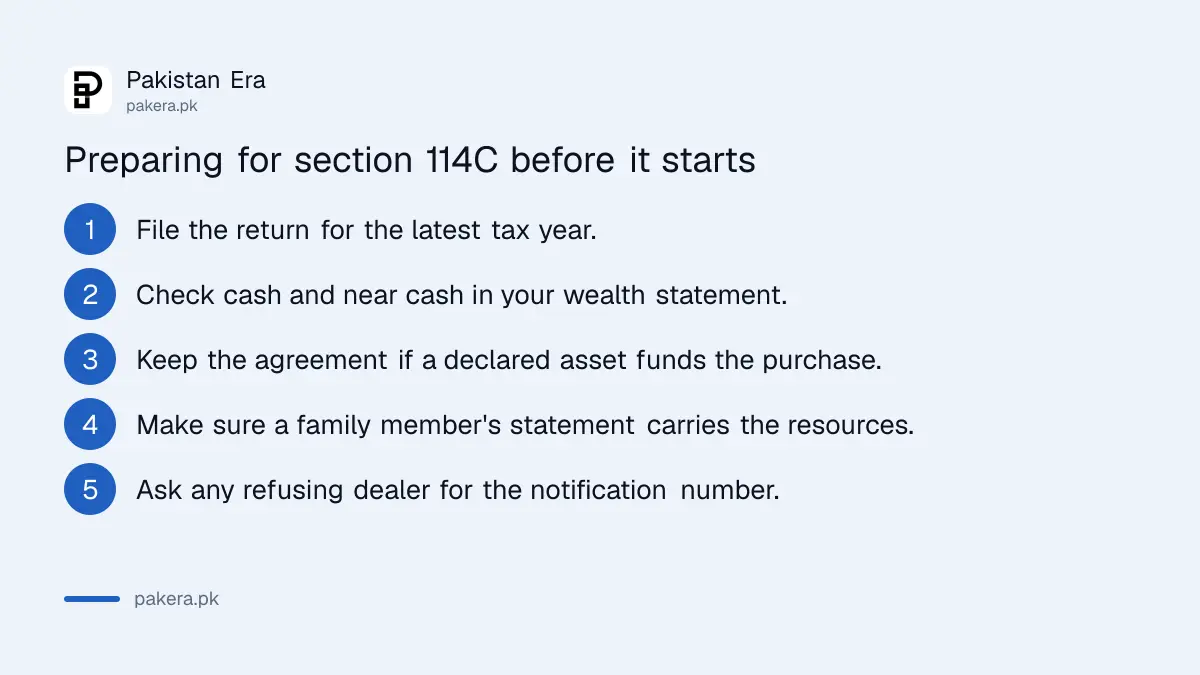
- File the return for the latest tax year; eligibility starts with the return for the year immediately before the transaction.
- Check the cash, gold, shares and receivables in your last wealth statement against 130% of the planned purchase.
- If the purchase will be funded by selling a declared asset, keep the agreement, because the proviso counts the disposal as cash.
- For a purchase by a spouse or dependent child, make sure the family member's or the parent's wealth statement carries the resources.
- If a dealer or registrar refuses on 114C grounds, ask for the notification number and date; sub-section (5) requires one.
The wealth statement is the document that decides eligibility, so the way assets are entered matters more than before; the mechanics are in our guide to filling the wealth statement.
Common questions
Is section 114C in force in Pakistan?
No. Sub-section (5) makes it start on a date the Federal Government notifies in the Gazette, and we found no such notification on the FBR website on 19 October 2026.
What is the car limit under section 114C?
Rs 7 million, measured by the invoice value for a locally made vehicle or the customs-assessed import value including all duties and taxes.
What is the property limit?
Fair market value exceeding Rs 100 million, using the definition in section 2(22AA), which points to FBR's valuation tables.
Is the restriction the same as being a non-filer?
No. An eligible person must have filed the previous year's return and have sufficient declared resources, meaning 130% of the transaction in cash and equivalents, or file a sources of investment and expenditure statement.
Can my parents' wealth statement cover my purchase?
Yes. For an individual, the eligible person includes immediate family members: parents, spouse and dependent children.
Is there a cash withdrawal limit?
The section provides for one, but the Fifteenth Schedule as consolidated has no cash withdrawal row, so no limit is set.
How we verified this
What we checked, where we read it, and what we could not confirm.
Last checked 19 October 2026. We read section 114C and the Fifteenth Schedule in FBR's consolidated Income Tax Ordinance, 2001 amended up to 30 June 2026, searched the FBR SRO pages for a commencement notification, and read Circular No. 02 of 2026-27. We could not find a Gazette notification under sub-section (5), and we could not verify whether a cash withdrawal threshold exists outside the consolidated text.
About the author

Senior Writer, Public Services and Technology
Shahid joined us in 2024 as an author. He is a senior contributor to Pakistan's leading technology websites. He writes detailed articles, mostly covering his expertise in the latest tech, mobiles, apps, gadgets, and step-by-step guides. His ideology is to help people understand the latest trends and explain complex methods through very easy-to-understand guides.