Check If Your FCVA or NRVA Account Exempts You From Tax Filing in Pakistan
The Finance Act 2026 widens tax relief for FCVA, FCBVA, NRVA and NRBVA holders in Pakistan, but five income types limit it. See which income breaks the relief.
Short answer: Section 114(1)(ae) says every person whose income is subject to final tax must file a return. Section 181 requires registration. The Finance Act 2026 says neither applies to a person holding an FCVA, FCBVA, NRVA or NRBVA account with an authorised bank in Pakistan. The relief ends if that person has Pakistan source taxable income beyond five listed kinds.
Foreign currency and non-resident rupee accounts are popular with overseas Pakistanis. They want to know if holding one pulls them into the tax system. The Finance Act 2026 gives a partial answer, and it widens the accounts covered.
We read the clause on FBR's own download site on 13 October 2026. This page explains what the Act says, which income breaks the relief, and what we could not confirm.
Four account types now sit in one clause
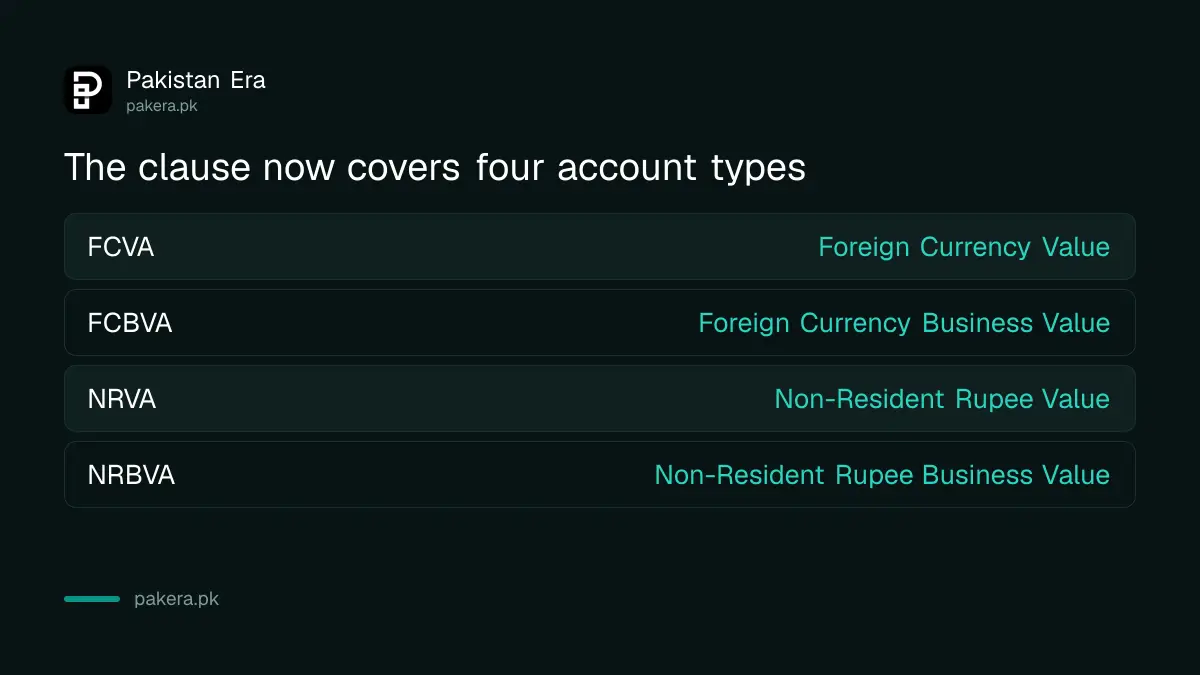
Clause (114A) of Part II of the Second Schedule now names four account types. They are the Foreign Currency Value Account (FCVA), the Foreign Currency Business Value Account (FCBVA), the Non-Resident Rupee Value Account (NRVA) and the Non-Resident Rupee Business Value Account (NRBVA).
| Account | Short form |
|---|---|
| Foreign Currency Value Account | FCVA |
| Foreign Currency Business Value Account | FCBVA |
| Non-Resident Rupee Value Account | NRVA |
| Non-Resident Rupee Business Value Account | NRBVA |
The accounts must be with authorised banks in Pakistan, under the foreign exchange rules of the State Bank of Pakistan. Our guide to opening an FCVA or NRVA account explains how the accounts work.
Two duties stop applying to account holders
Section 114(1)(ae) of the Ordinance requires every person whose income for the year is subject to final taxation to file a return. Section 181 requires a taxpayer to register. The Finance Act 2026 clause says both do not apply to a person who maintains one of the four accounts.
The old clause was narrower. We read the Ordinance as amended up to 31 July 2025 on FBR's download site. It limited the relief to a non-resident individual holding a Pakistan Origin Card, NICOP or CNIC, with only an FCVA or NRVA. The new clause speaks of a person holding any of the four accounts. The clause does not say an account holder is free of every tax duty.
Five kinds of Pakistan income break the relief
The relief does not apply if the account holder has Pakistan source taxable income other than five listed kinds. In plain words, income outside this list means the clause no longer protects you.
- Profit on debt on the FCVA, FCBVA, NRVA or NRBVA account itself.
- Profit on Government of Pakistan securities, conventional or Shariah compliant, bought with money from those accounts.
- Capital gain on selling immovable property bought with money from an FCVA or NRVA.
- Capital gain on shares traded on the Pakistan Stock Exchange and on mutual fund units bought with money from those accounts.
- Dividend from shares traded on the Pakistan Stock Exchange and from mutual funds bought with money from those accounts.
So an overseas Pakistani who also earns rent from a house, a salary in Pakistan or business profit there has income outside the list. That person should assume the clause does not protect them. Our guide to filing a tax return as an overseas Pakistani covers what to declare in that case.
Banks must deduct tax on some capital gains
The Act also replaces section 152(1DA). Banks that maintain these four account types must deduct tax from capital gain on disposal of debt instruments and Government securities, including Shariah compliant ones, bought through the accounts. The rate sits in Division II of Part III of the First Schedule.
We did not read that rate in this Act, so we do not state it. Ask your bank which rate it applies. The clause only says the tax is deducted at the source by the bank.
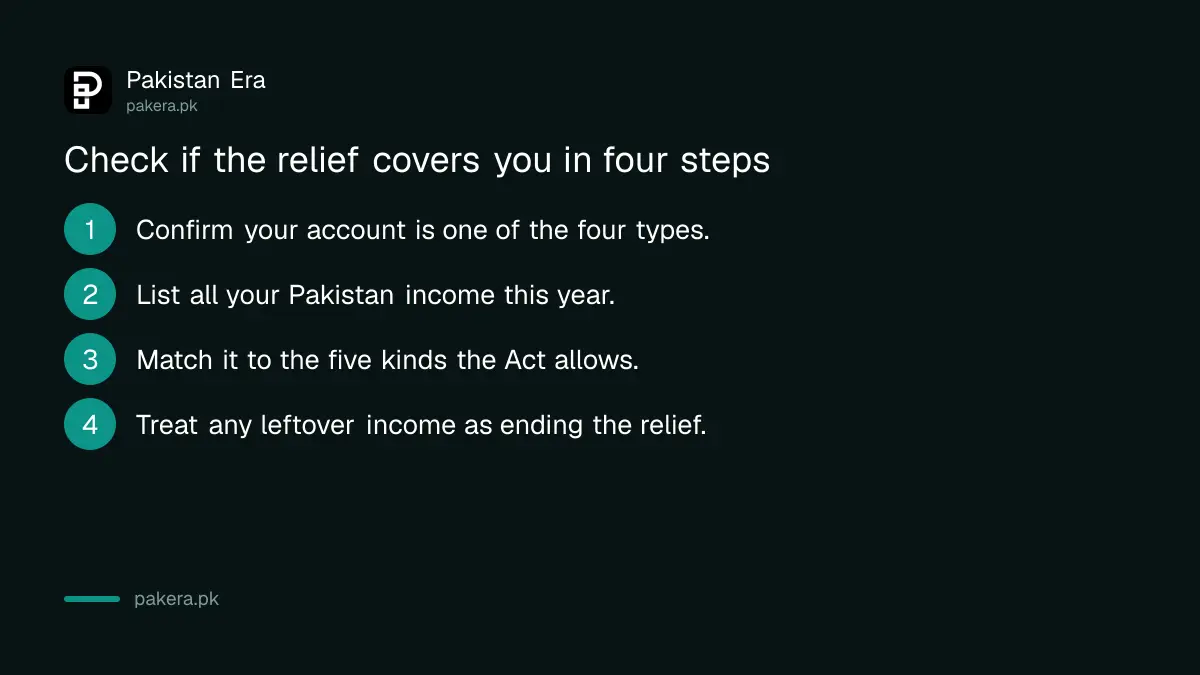
Check your own position in four steps
Use this short check before you decide that you do not need to file. It follows the Act's own list. If any answer points to income outside the five kinds, take professional advice or ask FBR.
- Confirm your account is one of the four types and is with an authorised bank in Pakistan.
- List every source of Pakistan income you had in the tax year.
- Tick off the ones that match the five listed kinds above.
- If anything is left over, treat the clause as not protecting you and read the guidance on filing.
Roshan Digital Account holders should also read tax rates on a Roshan Digital Account, since it has its own rules.
Common questions
Do NRVA holders have to file a tax return in Pakistan?
The Act says the return duty in section 114(1)(ae) and the registration duty in section 181 do not apply to them, unless they have Pakistan source income outside five listed kinds. Check your own income against the list.
Does the clause cover business accounts?
Yes. The Act now names the FCBVA and the NRBVA as well as the FCVA and NRVA.
Does rent from a house in Pakistan break the relief?
Rent is not one of the five listed kinds, so we read it as income that breaks the relief. Confirm with a tax adviser.
Is profit on my account taxed?
Profit on the account is one of the five kinds the clause allows. The Act does not give a rate for it in the parts we read.
Which banks can hold these accounts?
The Act says authorised banks in Pakistan under the foreign exchange regulations of the State Bank of Pakistan.
When did this start?
The Finance Act 2026 came into force on 1 July 2026 unless it says otherwise. We found no later start for this clause.
How we verified this
What we checked, where we read it, and what we could not confirm.
Last checked on 13 October 2026, Pakistan time. We read clause (114A) and section 152(1DA) as amended by the Finance Act 2026 on FBR's download site. We also read the Ordinance as amended up to 31 July 2025 for the earlier clause and for sections 114 and 181. We did not read the Division II rate, so we do not state it. This page is general information and not tax advice.
About the author

Senior Writer, Public Services and Technology
Shahid joined us in 2024 as an author. He is a senior contributor to Pakistan's leading technology websites. He writes detailed articles, mostly covering his expertise in the latest tech, mobiles, apps, gadgets, and step-by-step guides. His ideology is to help people understand the latest trends and explain complex methods through very easy-to-understand guides.