How to File a Right to Information Request in Khyber Pakhtunkhwa
File a right to information request in Khyber Pakhtunkhwa: no reason needed, 10 working days to reply, 20 free pages and a free complaint to the Commission.
Short answer: Write to the public information officer of the Khyber Pakhtunkhwa office that holds the record, name the record, give your address and keep the receipt. The office must reply within 10 working days, or 20 at most. Filing is free, the first 20 pages are free, and a complaint to the KP Information Commission is free too.
A contractor in Peshawar wants the award letter for a road scheme in his own district. A parent wants the funds a school received last year. Both can ask for that record in writing under a provincial law that has been in force since November 2013.
We read the Khyber Pakhtunkhwa Right to Information Act, 2013 (Act No. XXVII of 2013) and its 2015 amendment on the Provincial Assembly's website on 13 October 2026. The steps below follow those texts. We did not file a request ourselves.
Any citizen can ask, and no reason is needed
Every citizen has the right to see information held by a public body. The request must be in writing, identify the record, and give an address for delivery. The Act says you are never required to give reasons for your request.
Public bodies include every department, the Chief Minister's and Governor's secretariats, the Provincial Assembly, boards and commissions created by law, the district courts and tribunals, and any body owned or substantially funded by them. The 2015 amendment changed the title "designated officer" to "public information officer", so use that title when you ask for the right person.
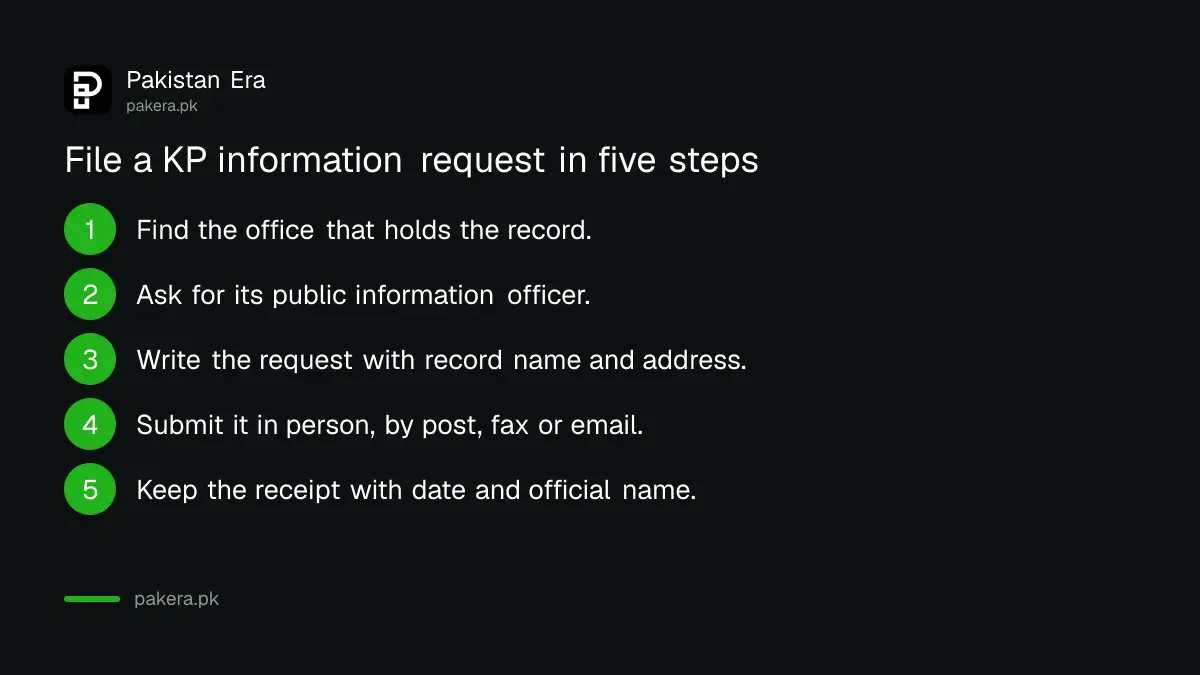
- Identify the office that holds the record.
- Ask for its public information officer.
- Write the request with the record name, years and your address.
- Submit it in person, by post, fax or email.
- Get a receipt showing the date and the name of the official handling it.
If you cannot write, the officer must put your request into writing and give you a signed, dated copy. An office that does not hold the record must send your request to the body that does, or return it and say so.
The office has 10 working days and can take 10 more
A public body must respond within ten working days of receiving the request. It may extend that by at most ten more working days if many records or several offices are involved. Information needed to protect life or liberty must come in two working days.
The reply must be a written notice. It can accept the request, reject it because it breaks the rules, point you to where the record is already published, reject it as vexatious, or reject it as exempt. An exempt notice must name the exact exception and tell you how to appeal.
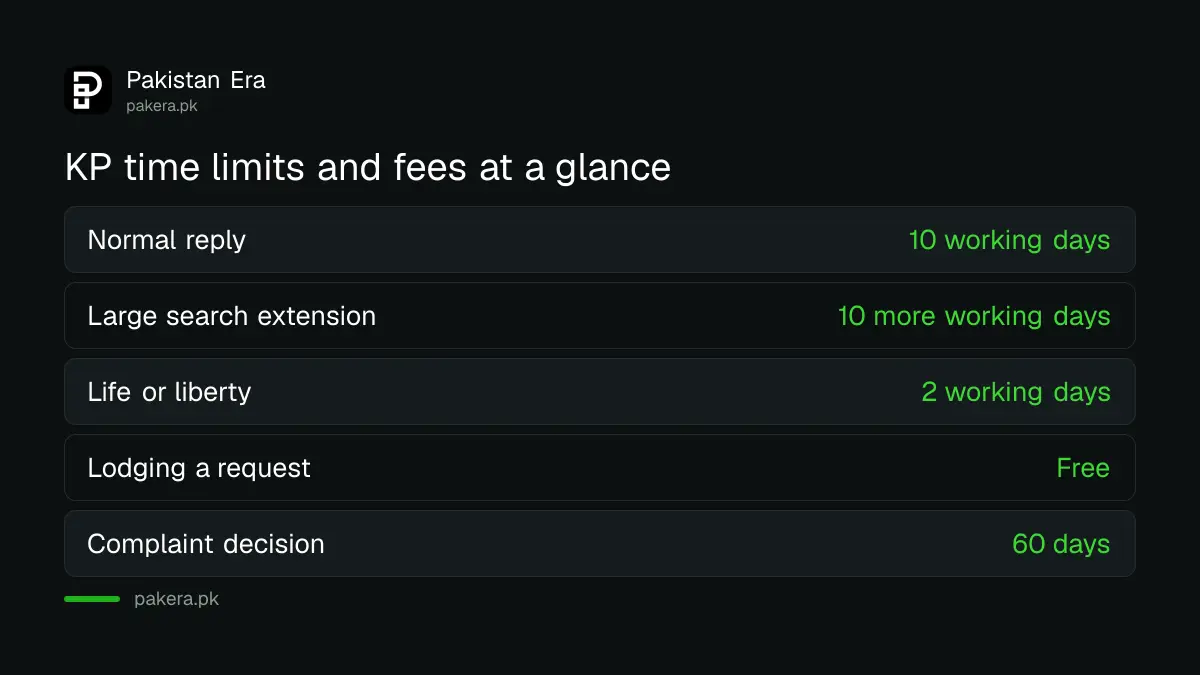
| Step | Limit in the KP Act |
|---|---|
| Normal reply | 10 working days |
| Extension for large searches | Up to 10 more working days |
| Life or liberty at stake | 2 working days |
| Lodging a request | Free |
| Copies | First 20 pages free |
| Complaint to the Commission | Free, decided in 60 days |
Lodging is free and only copying can be charged
It costs nothing to lodge a request. The office may charge only the actual cost of copying and posting, using a fee schedule adopted by the Information Commission. No fee applies to the first 20 pages, or if you are below the poverty line.
We could not find that fee schedule on an official page, so ask the office to state the charge and the rule behind it in writing. If you ask for a physical attested copy, an electronic copy or an inspection, the body must give it in that form unless this would harm the record.
A complaint goes straight to the Information Commission
If the body refuses, delays or gives a wrong answer, you can complain to the Khyber Pakhtunkhwa Information Commission. The complaint is free, the Commission must decide within 60 days, and the public body carries the burden of proving that it followed the Act.
The Act we read has no separate internal review step, so the complaint is the first appeal. The Commission can order the body to disclose, make it compensate you for a failure, and fine an official who wilfully obstructs disclosure Rs 250 a day, up to Rs 25,000. A decision not appealed within 30 days is registered with the court, and ignoring it is treated like contempt. After the 2015 amendment that court is the court of the District and Sessions Judge, and offences under the Act are bailable and triable by that judge on the Commission's complaint.
Exemptions are listed and the public interest can override them
A body may refuse requests that would harm national security, law enforcement, the economy before a tax change, policy discussion, personal privacy, legal privilege or trade secrets. Even then, information must be given if the public interest favours disclosure.
The Act says there is a strong presumption in favour of disclosing information that exposes corruption, criminal wrongdoing, serious breaches of the law, human rights abuse or serious harm to public safety. Where only part of a record is exempt, the rest must be given. Several of the exceptions lapse after twenty years.
The right to information suits records, such as a tender award, a scheme list or a sanction order. For a land entry, use the portal in the KP e-Fard launch with a QR code or the route in how to check land records in KP online. For a service failure, see how to complain to the KP Ombudsman, and for policing, the steps to complain against police in Khyber Pakhtunkhwa.
Common questions
Do I need to give a reason for my request in Khyber Pakhtunkhwa?
No. The Act says a requester shall never be required to give reasons. You only need to identify the record and give a delivery address.
How long does a KP office have to reply?
It has ten working days, and it can extend by at most ten more working days for large or multi-office searches. Life or liberty cases need an answer in two working days.
Is there a fee?
Lodging a request is free. Copying costs can be charged under the Commission's schedule, but not for the first 20 pages or if you are below the poverty line.
Where do I complain if the office refuses?
Complain in writing to the Khyber Pakhtunkhwa Information Commission. The complaint is free and the Commission must decide within 60 days.
Can I use this law for a federal office in Peshawar?
No. This Act covers provincial public bodies. Federal offices are covered by a federal information law and a different commission.
Are district courts covered by the Act?
Yes. The Act lists the courts of District and Sessions Judges, Civil Judges and Magistrates, and tribunals, as public bodies.
How we verified this
What we checked, where we read it, and what we could not confirm.
Last checked on 13 October 2026, Pakistan time. We read the Khyber Pakhtunkhwa Right to Information Act, 2013 and the 2015 amendment on the Provincial Assembly website. We could not confirm the Commission's current address, helpline or fee schedule from an official page, so none is quoted. We did not check for later amendments beyond 2015.
About the author

Public Services and Education Journalist
Fajr Riaz is a journalist and content writer at Pakistan Era, based in Lahore. She covers the questions people meet in everyday life in Pakistan: how a public service works, what a change in the rules means, and where to find a reliable answer.