How to File Under FBR's Small Shopkeeper Scheme: 1% Tax, Rs 25,000 Minimum
File your 2026 return under FBR small shopkeeper scheme: 1% of sales or Rs 25,000, whichever is higher. Who qualifies, worked examples and the 15 October date.
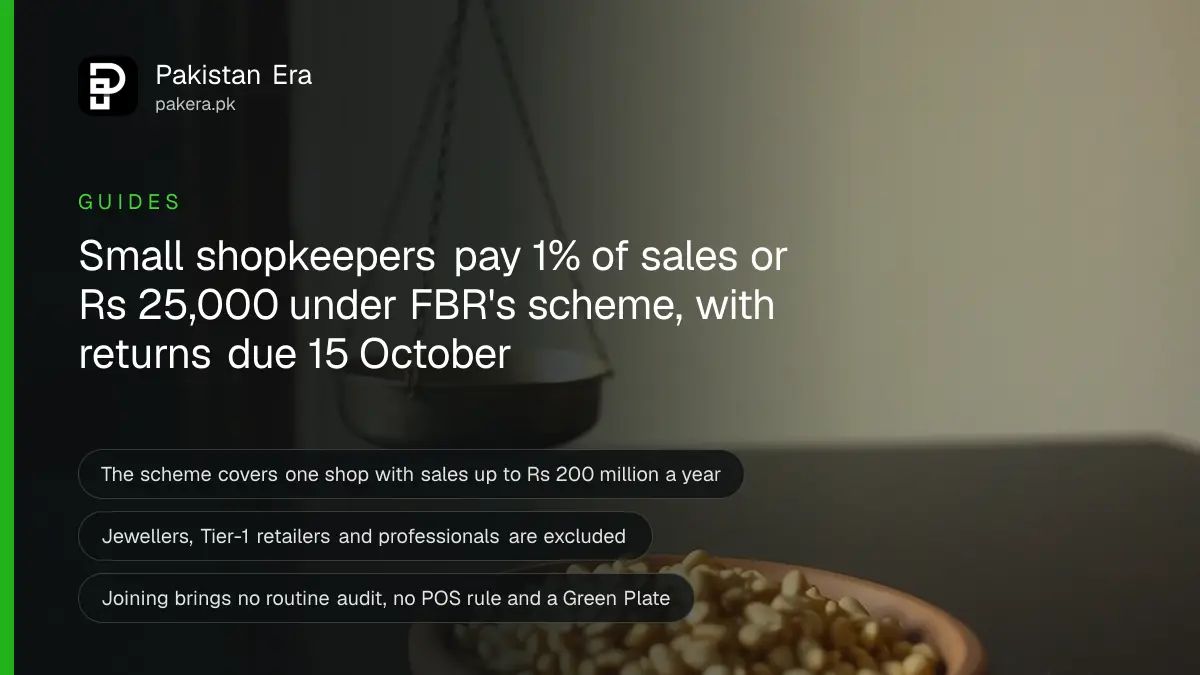
Short answer: if you run one shop with sales up to Rs 200 million a year, you can file your 2026 tax return under the FBR's Special Procedure for Small Shopkeepers. You pay 1 per cent of your yearly sales, less tax already deducted from you, but never less than Rs 25,000 in cash with the return. The last date for Tax Year 2026 returns is 15 October 2026.
We read the final rules, S.R.O. 1166(I)/2026 dated 27 July 2026, and the draft before it on the FBR's own website, plus FBR Circular No. 3 of 2026-27 that moved the deadline. Below is who qualifies, how to work out what you owe, and how to file.
Who can use the small shopkeeper scheme
The scheme is for individuals who earn mainly from a retail shop with annual sales, called turnover, of up to Rs 200 million. It is optional. You can use it, or file a normal income tax return instead. It covers Tax Year 2026, the year that ended on 30 June 2026.
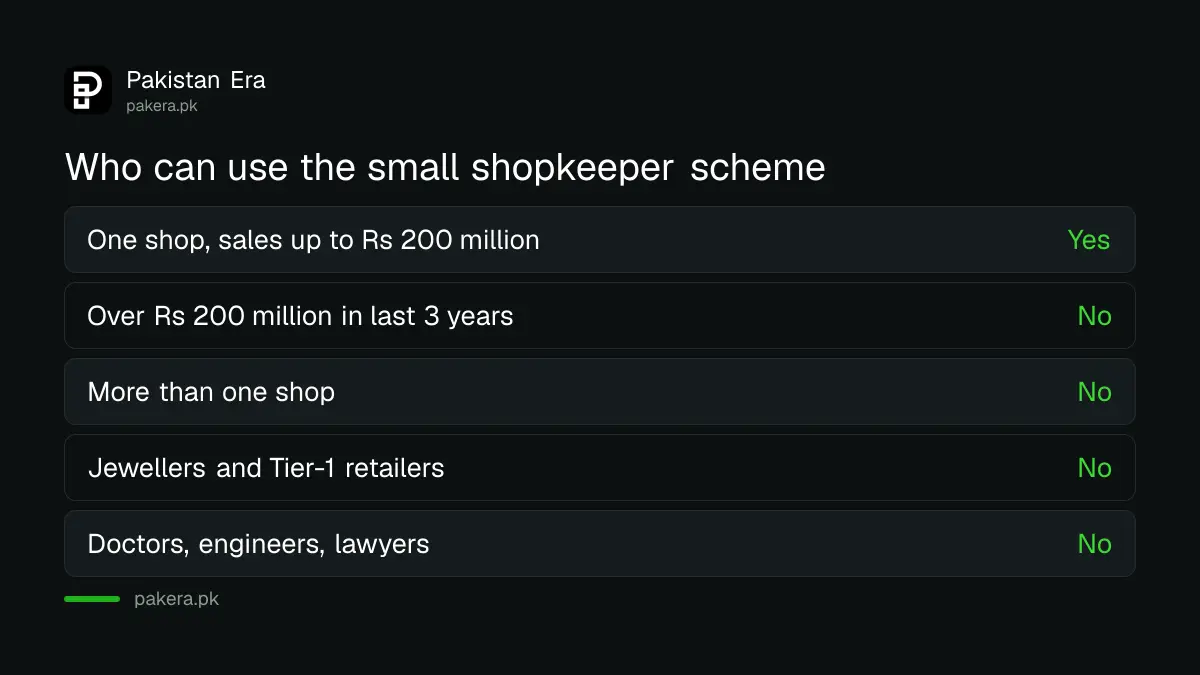
The rules shut several groups out. Read this table before you pick the scheme, because a jeweller or a doctor who files under it is filing under the wrong rules.
| Your situation | Can you use the scheme? |
|---|---|
| One retail shop, sales up to Rs 200 million a year | Yes |
| Sales above Rs 200 million in any of the last 3 years | No |
| You own more than one shop | No |
| Tier-1 retailer, the large retail category | No |
| You sell jewellery | No |
| Doctor, engineer, lawyer or other professional service | No |
| You filed a 2025 return | Yes, if your tax is not lower than in 2025 |
That last row matters. A shopkeeper who already files cannot switch to the scheme just to pay less than last year. The rules also bar anyone who split or renamed a business to fit under the limits.
You pay 1 per cent of sales or Rs 25,000, whichever is higher
Tax under the scheme is 1 per cent of gross sales. You can subtract tax already withheld from you, such as tax on your electricity bill. But you must still pay at least Rs 25,000 in cash with the return, and extra withholding is never refunded.
The scheme covers shop income only. Rent from a property, bank profit or a salary are left out of it, so they still need to be declared and taxed the normal way.
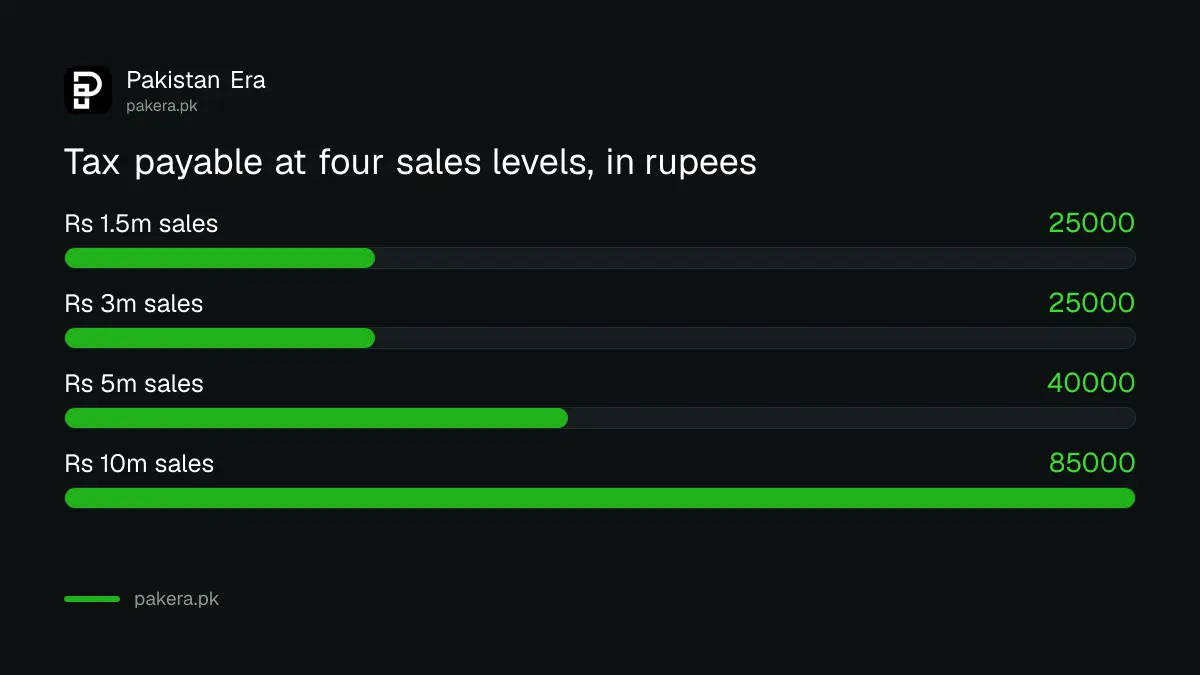
Here is how the rule works out at four sales levels. The figures are our own arithmetic from paragraphs 5 and 6 of the notification, with example withholding amounts.
| Yearly sales | 1 per cent | Tax already withheld | You pay with the return |
|---|---|---|---|
| Rs 1,500,000 | Rs 15,000 | Rs 5,000 | Rs 25,000, the minimum |
| Rs 3,000,000 | Rs 30,000 | Rs 8,000 | Rs 25,000, the minimum |
| Rs 5,000,000 | Rs 50,000 | Rs 10,000 | Rs 40,000 |
| Rs 10,000,000 | Rs 100,000 | Rs 15,000 | Rs 85,000 |
So the scheme costs at least Rs 25,000 for everyone. A shop selling Rs 2 million a year pays more than 1 per cent of its sales. For bigger shops, the 1 per cent rate takes over once sales minus withholding pass that floor.
How to register and file under the scheme
The rules allow three ways in: the IRIS web portal, the FBR's shopkeepers' mobile application, or a visit to your nearest tax office for help. The return itself is a short form in Urdu and regional languages, filed on IRIS or the app.
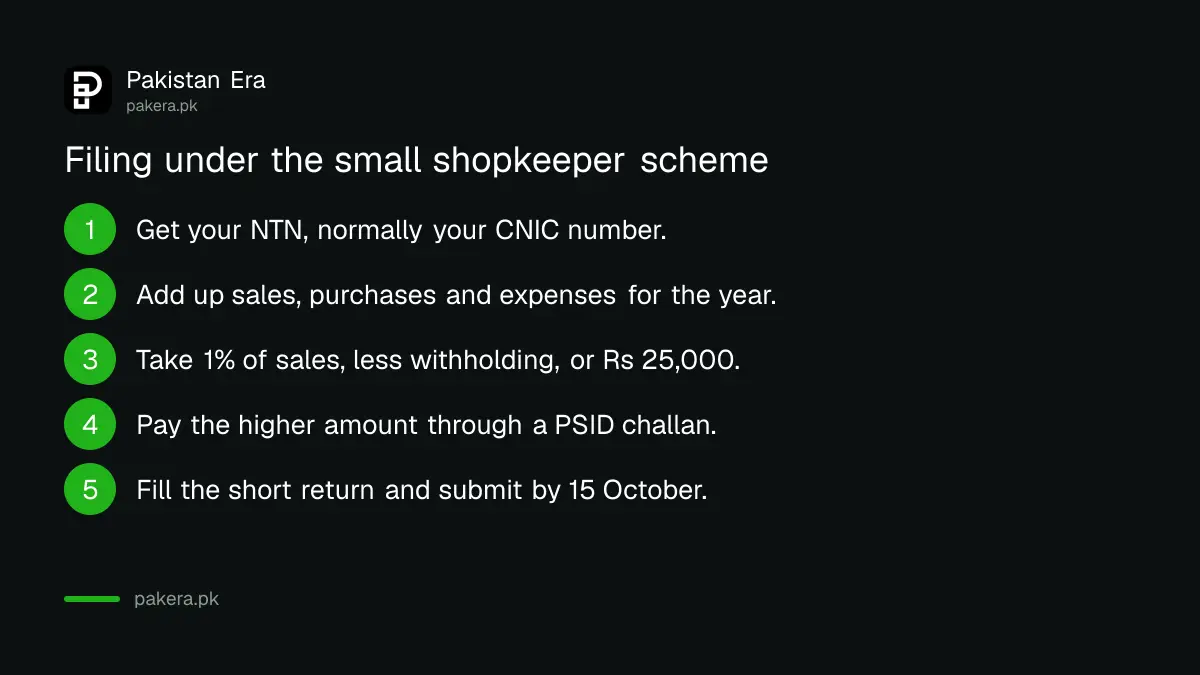
- Get your NTN. For an individual it is normally your CNIC number, and you can check your filer status to see if you are already on the FBR's list.
- Add up last year's figures from 1 July 2025 to 30 June 2026: total sales, total purchases and shop expenses.
- Work out 1 per cent of sales, subtract tax withheld from you, and compare the result with Rs 25,000. Pay the higher figure.
- Pay that amount through a PSID challan. The steps to pay income tax with a PSID online are the same for this tax.
- Fill the simplified return: sales, purchases, expenses, net profit, other income, tax paid and your assets.
- Submit it by 15 October 2026 and save the acknowledgement.
The form also asks for your assets: business capital, property, cash in bank and cash in hand. Fill this part honestly. The rules let you count the tax you pay as support for your household spending and new assets, which is called imputable income, so an accurate list now protects you later.
What you get for joining: no audit, no POS, a Green Plate
A shopkeeper under the scheme is generally not audited, does not need a sales tax POS machine, and gets a Green Plate with a QR code for the shop front. The rules say no FBR official shall enter a shop showing that plate over the tax affairs of a genuine shopkeeper.
- Audit. Action is allowed only after talking to trade association representatives, and only if FBR gets outside information about big transactions, expensive assets or misuse of the scheme.
- POS. Genuine shopkeepers in the scheme are excused from the POS integration rules that apply to larger retailers.
- Withholding. You do not have to deduct tax when you pay suppliers under section 153.
- Minimum tax. The usual minimum tax under section 113 and the 1.25 per cent rate do not apply.
- Green Plate. It shows your name, NTN, address and an FBR QR code, and goes outside the shop.
Missing the deadline costs Rs 10,000, then Rs 25,000, then Rs 50,000
A shopkeeper who neither files a normal return nor opts for the scheme by the due date faces penalties of Rs 10,000 for the first default, Rs 25,000 for the second and Rs 50,000 for the third. The rules require at least one month between each.
The due date for Tax Year 2026 is 15 October 2026. The FBR moved it from 30 September under section 214A, in its Circular No. 3 of 2026-27. There is no sign of a further extension on the FBR website as of 10 October.
Uptake has been slow. A government review on 25 September found that 9,806 shopkeepers had joined in the first month but only 428 had filed, as set out in our report on the Asan Tax Scheme figures. On 9 October the Finance Minister said the scheme should not be seen as a one-year arrangement, which we cover in the retailers' tax scheme news. The notified rules still say Tax Year 2026 only.
Common questions
Who can file under the FBR small shopkeeper scheme?
An individual earning mainly from one retail shop with sales up to Rs 200 million a year. Jewellers, Tier-1 retailers, owners of more than one shop and professionals cannot.
How much tax does a small shopkeeper pay under the scheme?
1 per cent of yearly sales, less tax already withheld, or Rs 25,000, whichever is higher. The Rs 25,000 must be paid in cash with the return.
What is the last date to file under the scheme?
15 October 2026 for Tax Year 2026, the date set by FBR Circular No. 3 of 2026-27.
Will I get a refund if more tax was withheld than I owe?
No. The rules say no refund is issued if withholding is more than the tax payable under the scheme.
Does the scheme cover my rent or bank profit?
No. It covers shop income only. Other income stays outside it and is taxed under the normal rules.
How we verified this
What we checked, where we read it, and what we could not confirm.
Last checked on 10 October 2026. We read S.R.O. 1166(I)/2026 of 27 July 2026, the final Special Procedure for Small Shopkeepers, and the draft S.R.O. 1109(I)/2026 of 14 July 2026, both on download1.fbr.gov.pk. We read FBR Circular No. 3 of 2026-27 of 30 September 2026 for the 15 October date, and Press Information Department release No. 116 of 9 October 2026 for the Finance Minister's statement. The worked examples are our own arithmetic. We did not file a return under the scheme ourselves, so we have not described the screens of IRIS or the mobile app.
About the author

Tax, Bills and Technology Writer
Ali Akhtar is a young and curious voice here at Pakistan Era. He is currently pursuing his A-Levels and has a growing interest in Pakistan’s changing industrial landscape and educational trends. Ali likes to write in a way that helps him explain and explore the world around him. His writing reflects the perspective of the new generation navigating the evolving trends of Pakistan where technology, youth innovation, and shifting opportunities are reshaping the country’s future.