Who Needs Tamiflu for Flu in Pakistan: NIH's High-Risk Groups and When to See a Doctor
NIH says flu is self-limiting, and Tamiflu is for severe cases and higher risk groups. See who is at risk in Pakistan, the 38 C rule and what to do first.
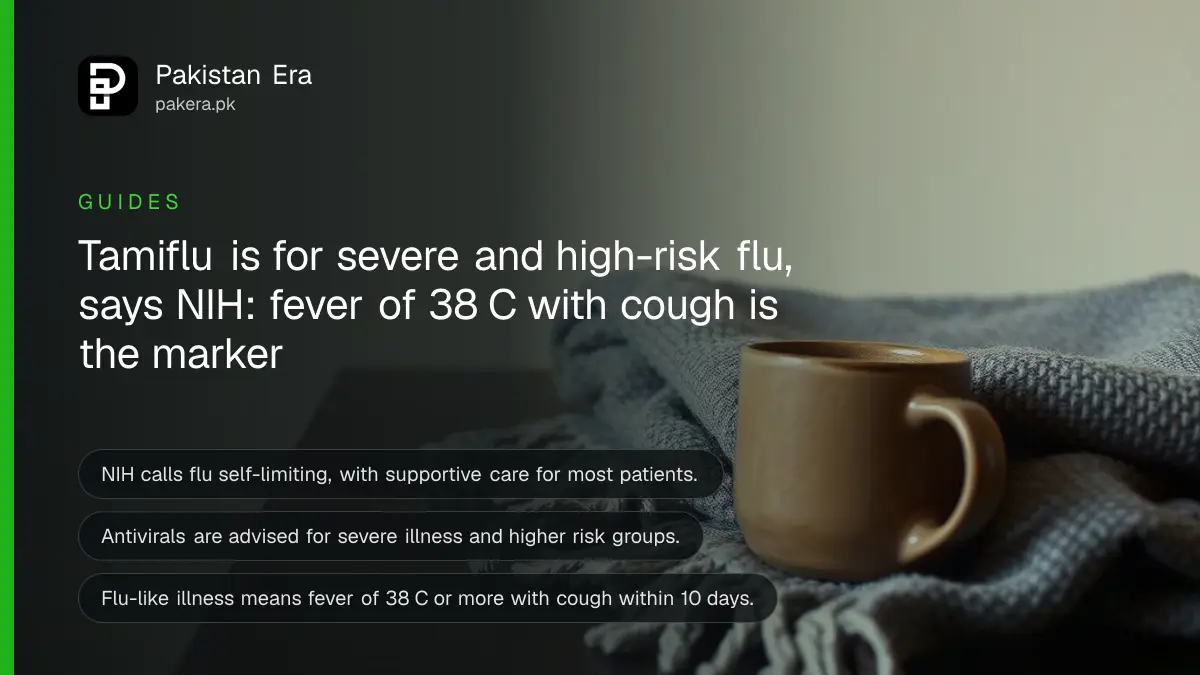
Short answer: Most flu in Pakistan clears with rest and fluids, and NIH calls it self-limiting. The antiviral drug oseltamivir, sold as Tamiflu, is advised for people in hospital with severe illness and for those at higher risk, such as children under 2, adults 65 and over, pregnant women and people with chronic disease. A doctor must prescribe it.
A mother in Faisalabad has a child with a hot forehead and a hard cough. The neighbour says, "Just give Tamiflu." The pharmacist is not sure. Who actually needs the drug, and who just needs rest?
We read the National Institute of Health (NIH) advisory on seasonal influenza (H3N2), No. F.1-22/Advisory/CDC/2025, dated 15 December 2025, in full on 13 October 2026. It is the latest influenza advisory on NIH's list. It was written for health departments before last winter, and we have turned it into plain steps. It is not a prescription.
NIH says flu is usually self-limiting
NIH's advisory states that influenza is a self-limiting disease, so treatment is mainly supportive. That means rest, fluids and care for fever and cough. The drug is not meant for every sneeze, and it is not a replacement for a doctor's judgement.
Flu spreads through droplets when a person coughs, sneezes or talks, and through touching contaminated surfaces. Crowded and poorly ventilated rooms raise the risk. NIH says the season runs from November to April.
The same advisory warns that Pakistan's flu season can be severe, because of limited access to healthcare, weak infection control habits and low awareness. It reported 340,856 suspected influenza-like illness cases from week 44 to 49 of 2025, with 12 percent of tested samples positive for H3N2.
Who NIH puts in the higher risk group
NIH lists adults aged 65 and over, children under 5, overweight or obese people, people with weak immunity, people with chronic conditions such as diabetes, heart disease and lung disease, and pregnant women as most at risk of severe flu.
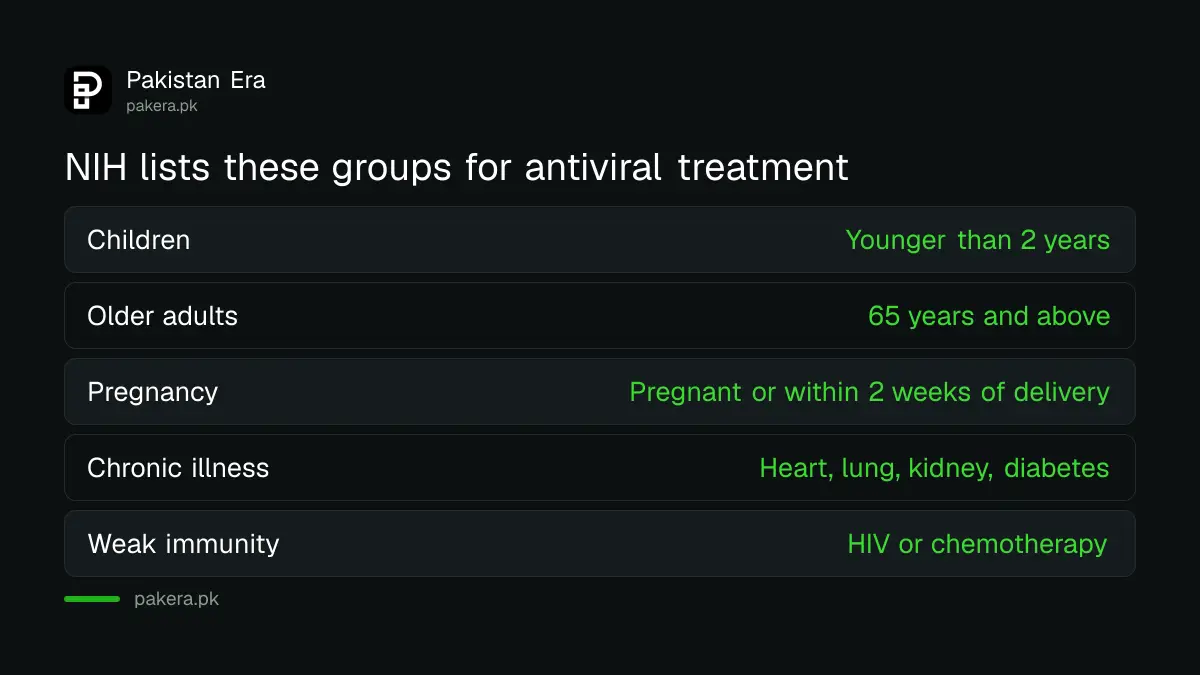
For antiviral treatment the list is a little different. NIH says oseltamivir is advised for patients in hospital with severe, complicated or worsening illness. It also names higher risk groups who should be considered for treatment.
- Children younger than 2 years
- Adults aged 65 years and older
- People with other long term illnesses
- People with weak immunity, including from medicines or HIV
- Pregnant women, and women within 2 weeks after delivery
- People under 19 on long term aspirin
- Very obese people, and residents of nursing homes
The case definitions doctors use
NIH defines influenza-like illness (ILI) as an acute respiratory infection with fever of 38 degrees Celsius or more and cough, with onset in the last 10 days. Severe acute respiratory illness (SARI) is the same picture, but the patient needs to be admitted to hospital.
These are surveillance definitions, used to count cases. They are still a useful yardstick at home. A fever above 38 with a cough in the last 10 days is flu-like. If it is bad enough to need a bed, it is already in the severe group.
The latest weekly figure is 44,336 flu-like illness cases in a week, from NIH's week 38 bulletin.
Steps to follow when flu hits your home
The steps below follow NIH's advice on prevention and care. They put the doctor, not the pharmacy shelf, in charge of the antiviral decision.
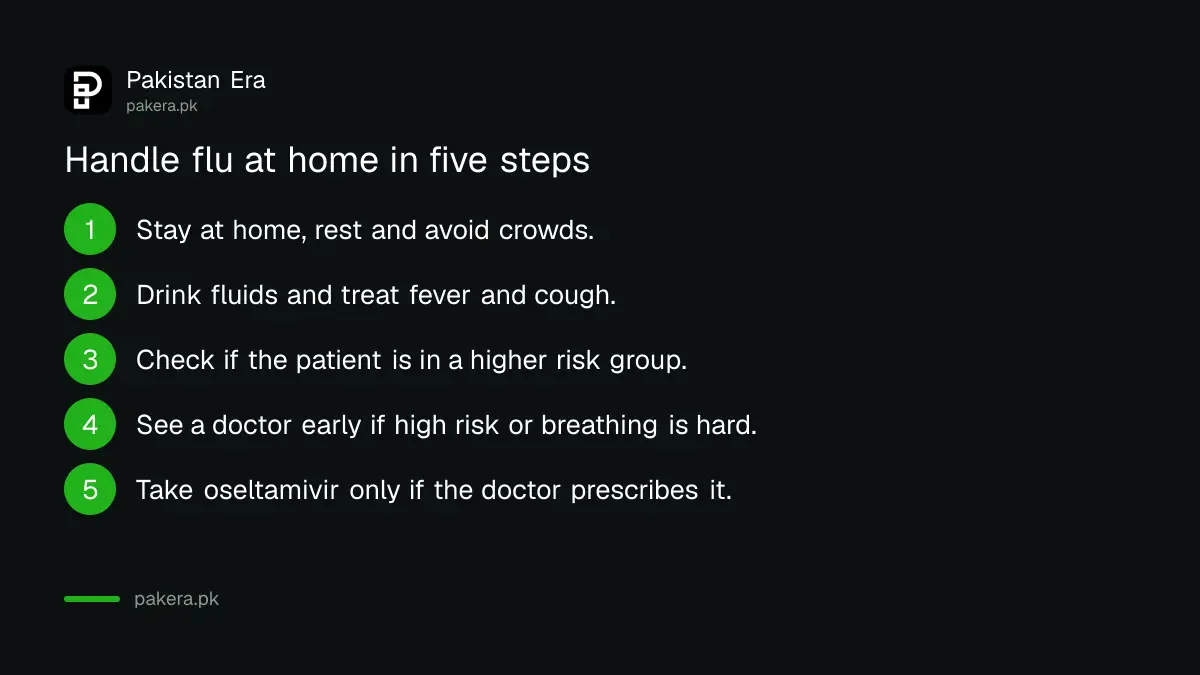
- Stay at home, rest and avoid crowds until you recover.
- Drink fluids, and treat fever and cough as your doctor advises.
- Check whether the patient is in a higher risk group from the list above.
- See a doctor early if the patient is high risk, or if breathing is hard.
- Take oseltamivir only if the doctor prescribes it.
Fast breathing in a child is a separate danger sign, and the breathing rates are listed in how to check a child for pneumonia.
| Person | What NIH's advisory points to |
|---|---|
| Healthy adult, mild flu | Supportive care at home, rest, fluids |
| Child under 2 years | Higher risk, see a doctor, antiviral may be advised |
| Adult 65 or older | Higher risk, see a doctor early |
| Pregnant or within 2 weeks of delivery | Higher risk, antiviral may be advised |
| In hospital with severe illness | Oseltamivir recommended |
Prevention: soap, elbow and the vaccine
NIH asks sick people to wash hands often with soap and water, cover the mouth and nose with the elbow when coughing, stay home and rest, and avoid crowds until they recover. It calls the flu vaccine the most effective way to prevent infection and severe outcomes.
The World Health Organization (WHO) priority groups, which NIH repeats, are pregnant women first, then children, elderly people, people with chronic conditions and health workers. Where and when to get the shot is covered in the flu vaccine guide for 2026.
NIH notes that the vaccine can still reduce severity of illness and death even when the virus drifts.
Common questions
Can I buy Tamiflu from a pharmacy without a prescription?
You should not. NIH advises oseltamivir for specific patients under medical care, so ask a doctor first. We did not check pharmacy rules or prices.
Does everyone with flu need an antiviral drug?
No. NIH says flu is self-limiting and care is mainly supportive. The drug is for patients in hospital with severe illness and for people at higher risk.
Is a pregnant woman at higher risk of severe flu?
Yes. NIH lists pregnant women, and women within 2 weeks after delivery, among those at higher risk of complications who may be considered for treatment.
How is influenza-like illness defined?
NIH defines it as fever of 38 degrees Celsius or more with cough, starting within the last 10 days. If the patient must be hospitalised, it is called severe acute respiratory illness.
When does flu season run in Pakistan?
NIH says influenza cases rise in the winter season from November to April. Last season, a new H3N2 subclade called K caused an early rise.
How we verified this
What we checked, where we read it, and what we could not confirm.
Last checked on 13 October 2026, Pakistan time. We read NIH's advisories page and its advisory PDF on seasonal influenza (H3N2), dated 15 December 2025. NIH's list did not show a 2026 to 2027 influenza advisory. We could not check which strains are circulating this season, or the price and stock of oseltamivir in Pakistan. This page does not replace a doctor.
About the author

Public Services and Education Journalist
Fajr Riaz is a journalist and content writer at Pakistan Era, based in Lahore. She covers the questions people meet in everyday life in Pakistan: how a public service works, what a change in the rules means, and where to find a reliable answer.