Free Childhood Cancer Medicines Coming to 4 Pakistan Hospitals, WHO Says
WHO says 4 Pakistani hospitals are preparing to get free childhood cancer medicines by March 2027, with 7 more in 2027. What it covers and the signs to know.
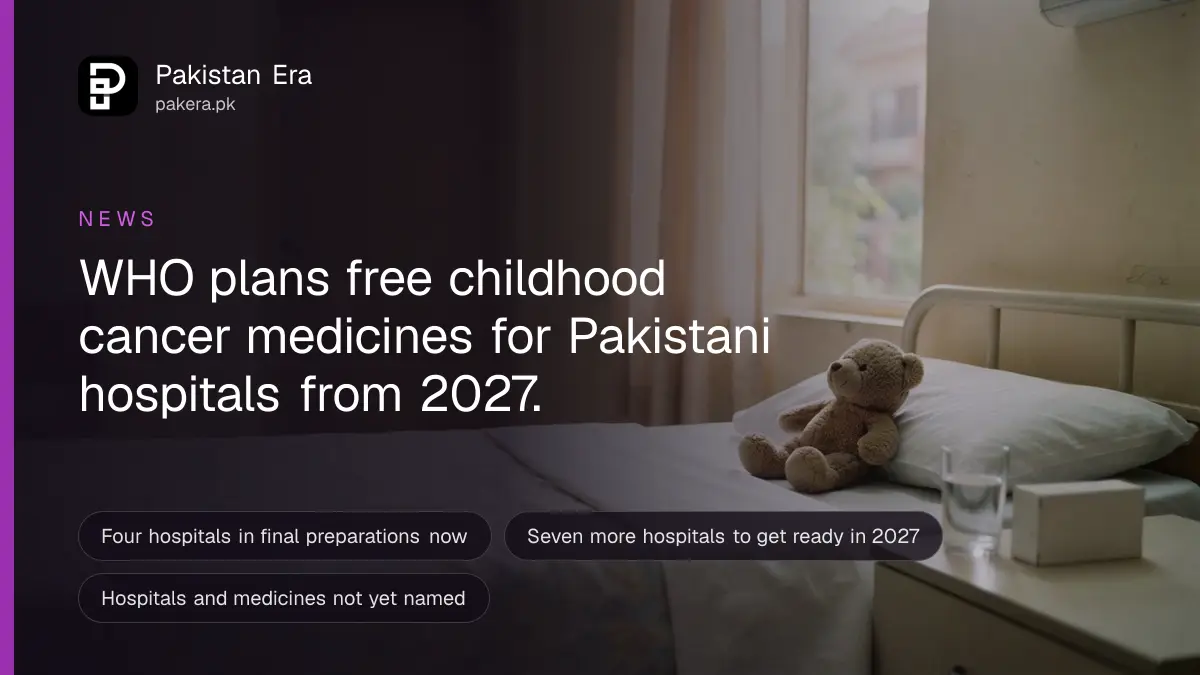
Four Pakistani hospitals are preparing to receive free childhood cancer medicines from the World Health Organization (WHO), with the aim of receiving them by the end of March 2027. Seven more hospitals are expected to get ready during 2027. WHO said the long-term goal is free medicines for every hospital in Pakistan that treats children with cancer.
WHO's Islamabad office announced this in a press release on Friday 25 September 2026, during Childhood Cancer Awareness Month, as carried by Radio Pakistan. The medicines come under an agreement between WHO and Pakistan's Ministry of National Health Services, Regulations and Coordination.
We could not find the press release itself on WHO's Pakistan news page when we checked on 27 September. The details below are from Radio Pakistan's report of it, and the background on childhood cancer is from WHO's own fact sheet. WHO did not name the hospitals.
Four hospitals first, then seven more through 2027
Four hospitals are already working with WHO on the final preparations needed before the medicines arrive, targeted for the end of the first quarter of 2027. Seven more are expected to put WHO's technical recommendations in place through 2027, so they are ready for supplies too.
| Stage | Hospitals | Timing, as WHO put it |
|---|---|---|
| First group | 4 hospitals | Final preparations, medicines by end of first quarter 2027 |
| Second group | 7 more hospitals | Technical recommendations through 2027 |
| End goal | All hospitals treating childhood cancer | No date given |
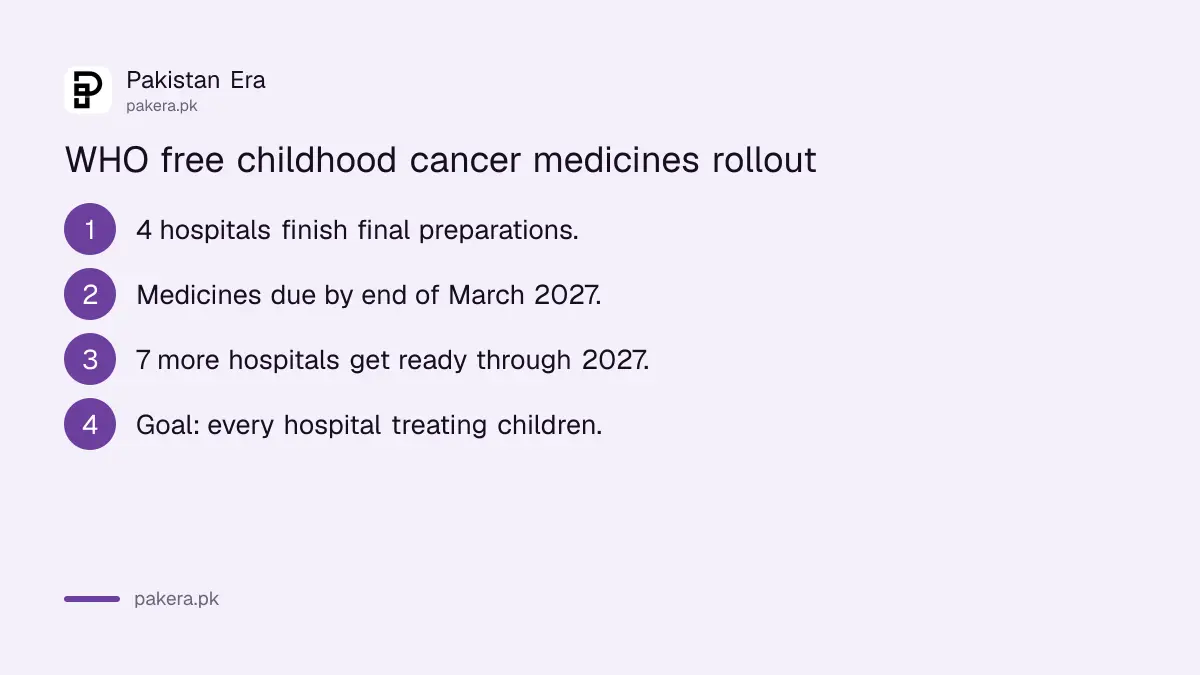
WHO describes the medicines as "quality-assured" and free of cost. The Global Platform exists to give hospitals an unbroken supply of such medicines, as explained below.
WHO did not say which hospitals are in the first group, where they are, or which medicines will be supplied. We will add the list if WHO or the health ministry publishes it.
Childhood cancer can usually be cured with cheap medicines
WHO's message is that childhood cancer is curable. Most types can be cured with generic medicines, plus surgery or radiotherapy where needed. The problem in countries like Pakistan is access and delay, not a lack of known treatment.
WHO's fact sheet on cancer in children sets out the gap in numbers:
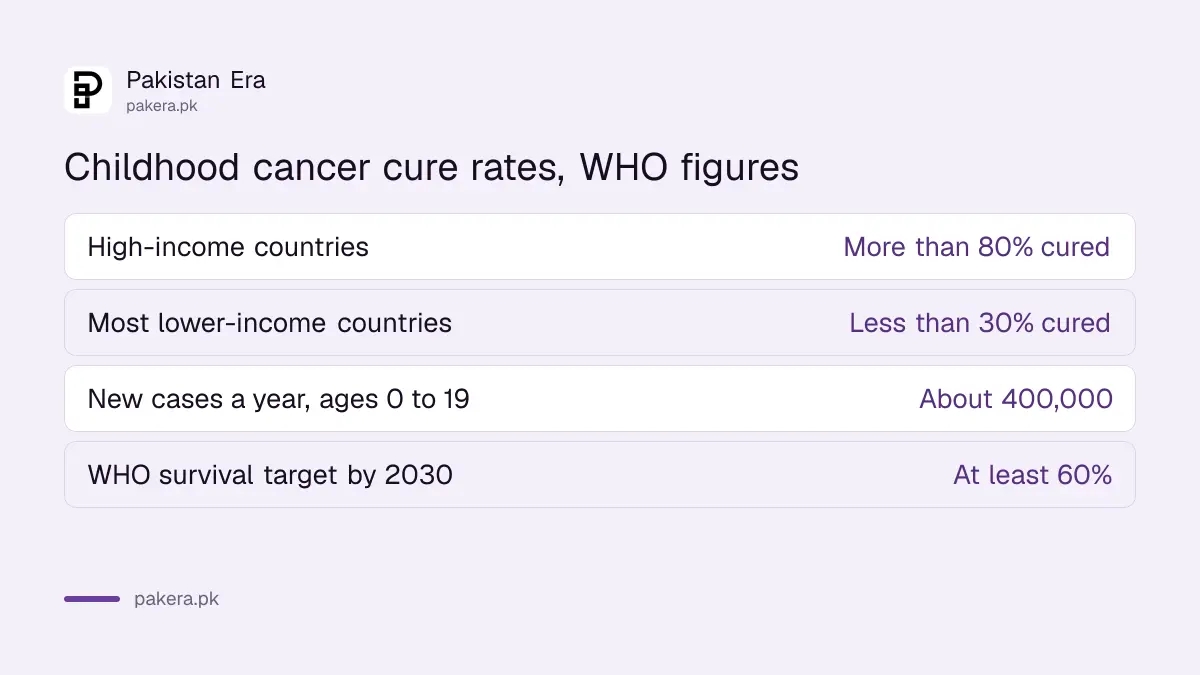
- About 400,000 children and teenagers aged 0 to 19 develop cancer each year worldwide.
- In high-income countries, more than 80% of children with cancer are cured.
- In most low- and middle-income countries, less than 30% are cured.
- Only 29% of low-income countries report that cancer medicines are generally available, against 96% of high-income countries.
WHO lists the reasons children die of cancers that could have been treated: no diagnosis or a late one, a wrong diagnosis, trouble reaching care, families stopping treatment, side effects and relapse. A steady free supply is aimed at the access problem, though it cannot fix late diagnosis on its own.
The Global Platform supplies the medicines
The medicines come through WHO's Global Platform for Access to Childhood Cancer Medicines, launched in December 2021 with St. Jude Children's Research Hospital in the United States. It aims to give hospitals an unbroken supply of quality-assured medicines, with support from selection through to dispensing.
WHO's representative in Pakistan, Dr Luo Dapeng, said the organisation is proud of its partnership with Pakistan through the Global Platform. He said WHO "will not stop working to give every child the opportunity to recover from cancer and lead a healthy life", as quoted by Radio Pakistan.
The platform sits under a wider WHO programme, the Global Initiative for Childhood Cancer, started in 2018. Its target is at least 60% survival for all children with cancer by 2030, which WHO says is roughly double the current cure rate.
Warning signs families should not ignore
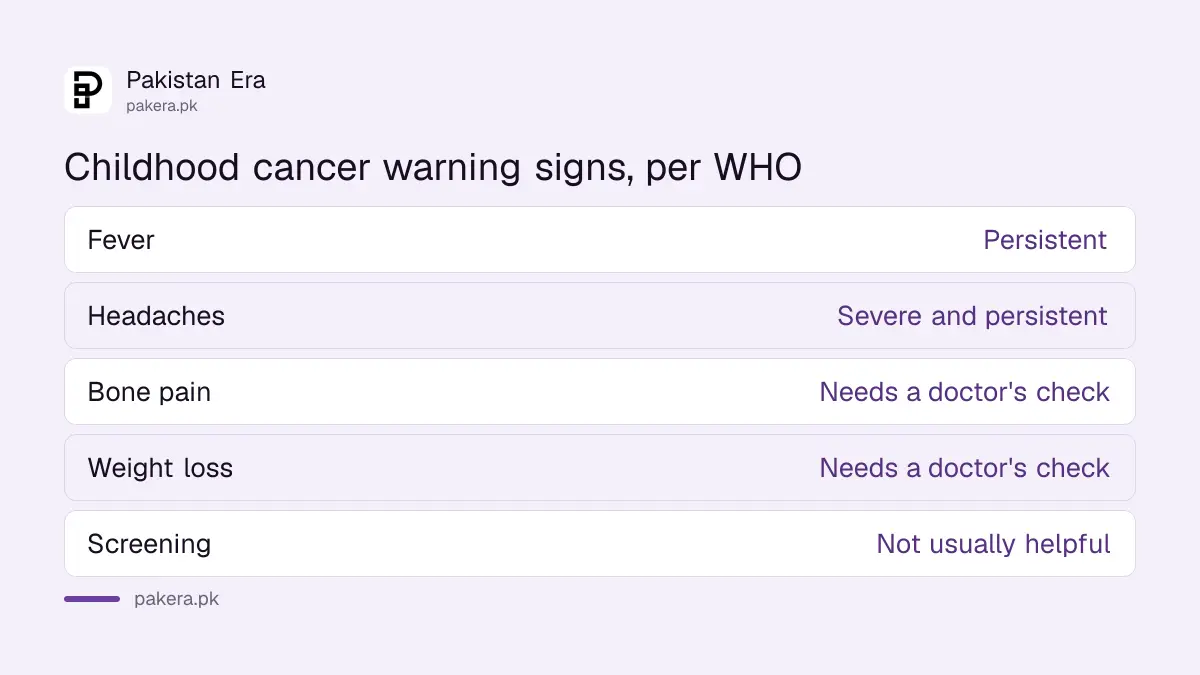
Childhood cancer usually cannot be prevented or found by screening, WHO says, so early diagnosis is the best defence. Warning signs include fever, severe and persistent headaches, bone pain and weight loss. These have many ordinary causes too, but persistent ones need a doctor.
Based on WHO's advice on early diagnosis, this is what a family can do:
- See a doctor if a child has a fever, headache, bone pain or weight loss that does not go away.
- Ask for a referral to a hospital with a children's cancer unit if the doctor suspects cancer.
- Get the diagnosis confirmed, because each cancer needs its own treatment plan.
- Finish the full course of treatment, even if the child seems better.
- Keep follow-up appointments after treatment ends, to catch any relapse early.
WHO also notes that some infections raise the risk of cancer later in life. It advises vaccination against hepatitis B, to help prevent liver cancer, and against human papillomavirus, to help prevent cervical cancer. Pakistan's free HPV vaccine for girls is part of that second step.
Free cancer care already on offer in Punjab
Until WHO's medicines reach hospitals, families rely on public hospitals and provincial schemes. In Punjab, the provincial government says a cancer centre in Multan now treats patients at every stage free of charge, and a new cancer hospital in Dera Ghazi Khan has been approved.
According to the Punjab government's information department, the Multan centre was inaugurated in September 2026. On 26 September, Punjab approved the Kulsoom Nawaz Cancer Hospital in Dera Ghazi Khan, according to Radio Pakistan. Neither announcement said anything specific about children's cancer services.
Families with a Sehat Card should check what cancer treatment it covers at their chosen hospital before admission. Punjab also runs other free health programmes beyond the Sehat Card, including medicine schemes for some long-term illnesses.
Common questions
Are childhood cancer medicines free in Pakistan now?
Not yet through WHO. Four hospitals are preparing to receive free WHO medicines by the end of March 2027.
Which Pakistani hospitals will get the free WHO medicines?
WHO has not named them. It said four hospitals are in final preparations and seven more will follow through 2027.
Can childhood cancer be cured?
Yes, in most cases. WHO says more than 80% of children are cured where full services are available, mostly with generic medicines.
What are the early signs of cancer in children?
WHO lists fever, severe and persistent headaches, bone pain and weight loss. Any of these that does not go away needs a doctor.
Who is paying for the medicines?
WHO says they are provided free of cost under its agreement with Pakistan's health ministry, through its Global Platform.
How we verified this
What we checked, where we read it, and what we could not confirm.
Last checked on 27 September 2026. The four and seven hospital figures, timing, free quality-assured medicines, the health ministry agreement and Dr Luo Dapeng's words are from WHO's Islamabad press release of 25 September 2026 as carried by Radio Pakistan. We could not find the release on WHO's Pakistan news page that day. Global figures, warning signs, the Global Platform and Global Initiative are from WHO's cancer in children fact sheet. The Multan centre is from a Punjab DGPR statement of 20 September 2026. The Dera Ghazi Khan approval is from Radio Pakistan on 26 September 2026.
About the author
Public Services and Education Journalist
Fajr Riaz is a journalist and content writer at Pakistan Era, based in Lahore. She covers the questions people meet in everyday life in Pakistan: how a public service works, what a change in the rules means, and where to find a reliable answer.