How Fuel Efficiency Affects Your Monthly Budget in Pakistan
At Rs 377.91 a litre, 1,000 km a month costs Rs 37,791 in a 10 km/l car and Rs 17,178 at 22 km/l. See the full cost table and how to measure your mileage.
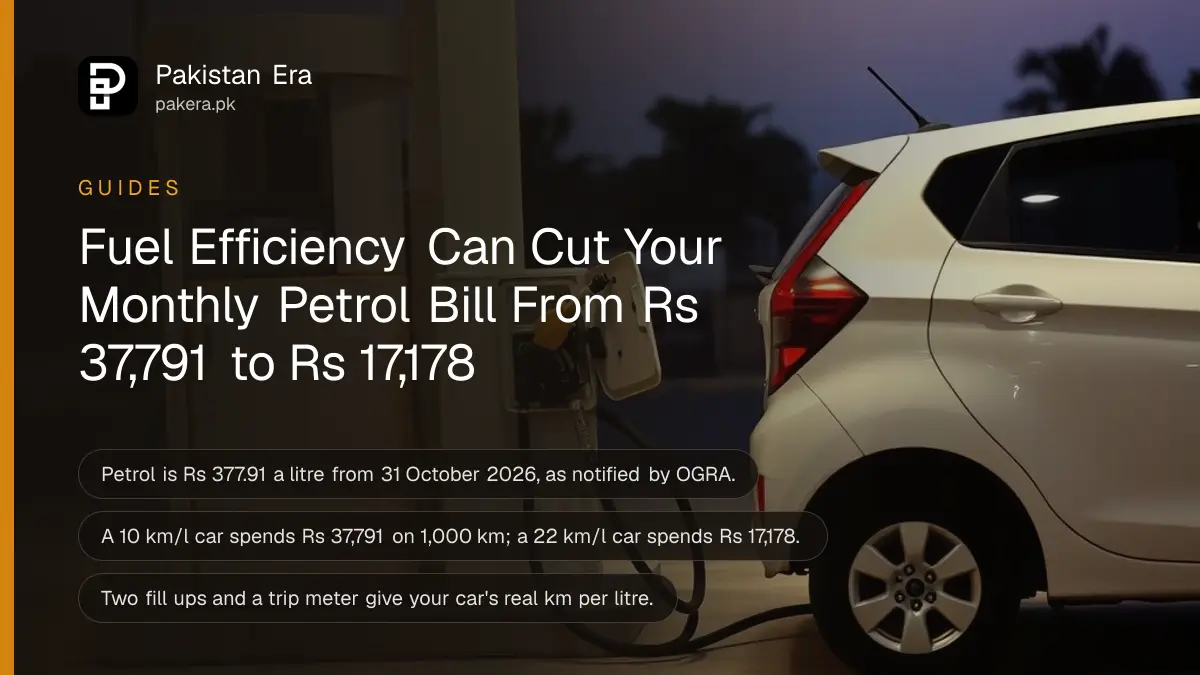
Short answer: fuel efficiency decides most of your monthly petrol bill. Petrol is Rs 377.91 a litre from 31 October 2026, as notified by the Oil and Gas Regulatory Authority (OGRA). At that price, 1,000 km a month costs Rs 37,791 in a car that does 10 km a litre, and Rs 17,178 in a car that does 22 km a litre. The gap is more than Rs 20,000 every month.
Fuel is one of the biggest running costs of owning a car in Pakistan. Petrol prices move often, and every move lands on your budget. A fuel efficient car does not make petrol cheaper. It makes you buy less of it. Below we show what efficiency means, what it costs you in rupees, and how to measure and improve your own car's figure.
Fuel efficiency is the distance your car covers on one litre
Fuel efficiency, also called mileage or fuel average, is the number of kilometres a car travels on one litre of fuel. In Pakistan it is written as km per litre, or km/l. A car that does 15 km/l goes 15 km on one litre. A car that does 10 km/l goes only 10 km on the same litre.
So the higher the number, the less petrol you buy for the same trips. On a 300 km trip, the 15 km/l car uses 20 litres and the 10 km/l car uses 30 litres. That is 10 litres more, or about Rs 3,779 at today's price, for one trip.
Be careful with the figure in a brochure. Makers test cars in controlled conditions, and real driving is different. Traffic, road conditions, driving habits and maintenance all change the number you actually get. When you compare the latest car prices in Pakistan, treat the claimed mileage as a best case, not a promise. The only figure that matters for your budget is the one your own car gives on your own roads.
Fuel efficiency changes your monthly budget by thousands of rupees
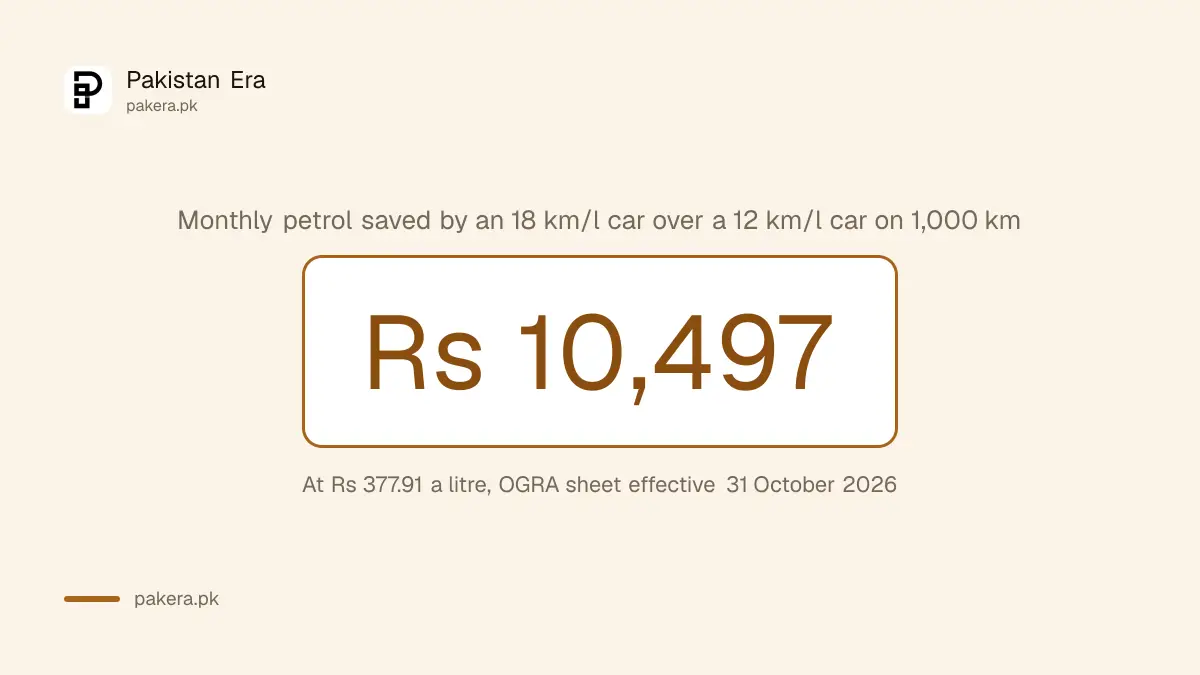
Your monthly fuel bill is the distance you drive, divided by your km per litre, times the petrol price. At Rs 377.91 a litre and 1,000 km a month, a 12 km/l car needs about 83 litres and an 18 km/l car about 56. That gap of 27 litres costs about Rs 10,497 a month.
The table below runs the same 1,000 km a month through five common mileage figures. We used the petrol price of 31 October 2026, Rs 377.91 a litre, and rounded to the nearest rupee.
| Car mileage | Litres for 1,000 km | Cost per km | Monthly fuel cost | Yearly fuel cost |
|---|---|---|---|---|
| 10 km/l | 100.0 | Rs 37.79 | Rs 37,791 | Rs 453,492 |
| 12 km/l | 83.3 | Rs 31.49 | Rs 31,493 | Rs 377,910 |
| 15 km/l | 66.7 | Rs 25.19 | Rs 25,194 | Rs 302,328 |
| 18 km/l | 55.6 | Rs 21.00 | Rs 20,995 | Rs 251,940 |
| 22 km/l | 45.5 | Rs 17.18 | Rs 17,178 | Rs 206,133 |
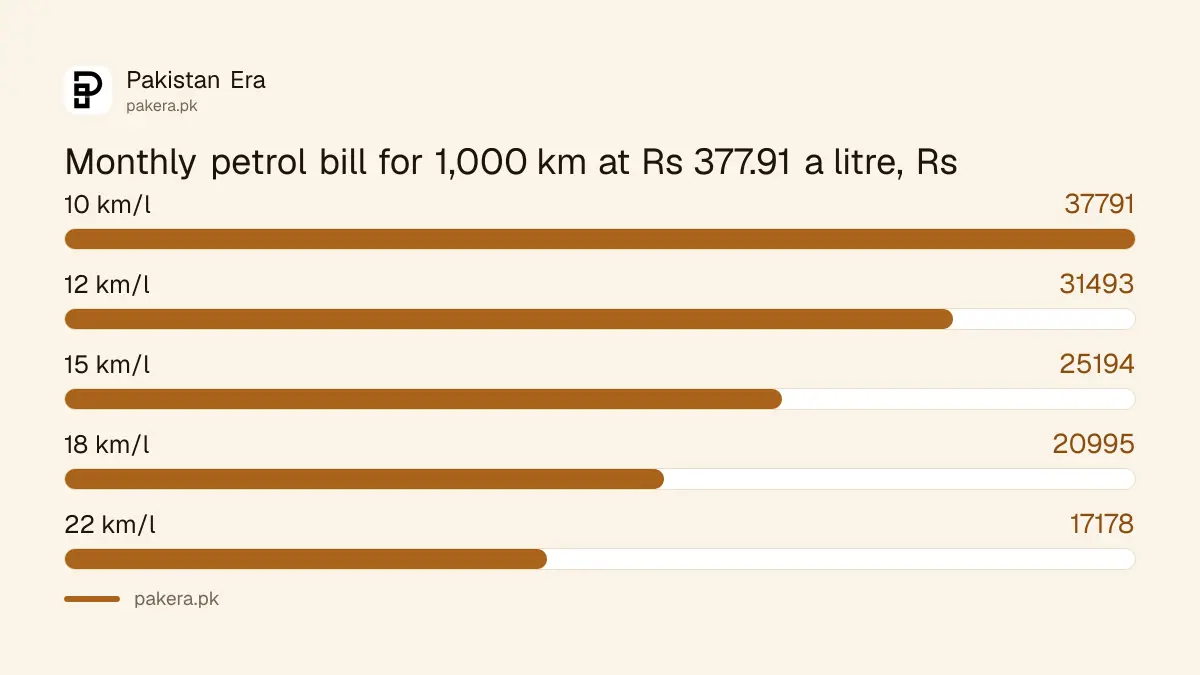
Look at the two ends of the table. Over a year, the 10 km/l car spends Rs 247,359 more on petrol than the 22 km/l car. For many families that is more than a year of school fees.
The gap grows for people who drive more. Daily office commuters, delivery riders who use a car, and anyone who drives between cities can easily pass 1,500 or 2,000 km a month. Double the distance and every number in the table doubles.
Price rises also hit a thirsty car harder. A Rs 10 rise in the litre price adds Rs 1,000 a month to the 10 km/l car on 1,000 km, because it burns 100 litres. The 22 km/l car burns about 45 litres, so the same rise costs it about Rs 455. Prices are set daily now, so check the official price at your pump before you plan the month. To work out the bill for your own distance, the same arithmetic is set out step by step in how to work out your petrol cost per kilometre.
Six things decide how much fuel your car uses
Engine size, weight, driving style, traffic, maintenance and air conditioning decide most of your car's fuel use. You cannot change the engine or weight after you buy. You can change the last four every day, and they often matter more than people think.
| Factor | What it does | Can you change it? |
|---|---|---|
| Engine size | Bigger engines usually burn more fuel, but give more power | Only when you buy |
| Vehicle weight | A heavier car or a loaded boot needs more energy to move | Partly, by removing extra load |
| Driving style | Hard starts, sudden braking and high speed waste fuel | Yes, every trip |
| Traffic | Stop and go traffic in cities uses more fuel than open roads | Partly, by route and timing |
| Maintenance | Dirty filters, old oil and soft tyres lower efficiency | Yes, with regular service |
| Air conditioning | The AC puts extra load on the engine, most of all in city traffic | Yes, use it sensibly |
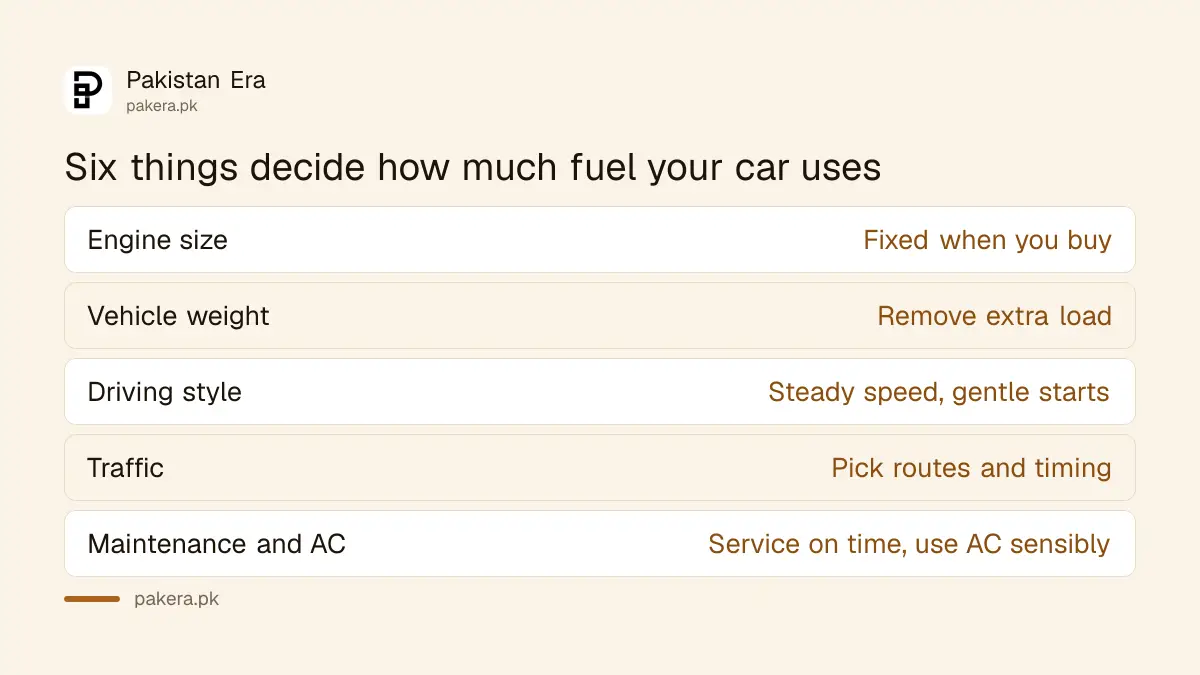
Traffic is the one most Pakistani drivers underestimate. A car that gives a good figure on the motorway can give a much lower one in Karachi or Lahore rush hour, because the engine keeps burning fuel while the car sits still.
Choose a car on running cost, not just the price tag
A cheap car with poor mileage can cost more over five years than a dearer car with good mileage. Before you buy, add the purchase price, the fuel bill for your monthly distance, the loan cost and the yearly token tax. That total is what the car really costs you.
Take two cars from the table. If you drive 1,000 km a month, the 18 km/l car saves Rs 125,970 a year in petrol over the 12 km/l car at today's price. Over five years that is about Rs 630,000, before any further price rise.
Small engine cars and hybrids usually give better mileage in city use. A hybrid uses an electric motor and battery to help the petrol engine, which saves fuel in stop and go traffic. But hybrids cost more to buy and are taxed differently, so check the full numbers on the hybrid SUVs on sale in Pakistan and compare them with the makers' own car prices for October 2026. Information platforms such as JustCars.pk can help you check price details and compare models.
If you are borrowing, run the instalment through the car loan calculator and read what a car loan in Pakistan costs. In Punjab, the token tax calculator shows the yearly tax by engine size. Some owners also look at gas: if you are thinking of that, read how to fit a CNG or LPG kit legally first.
Buying used? A worn engine burns more fuel than its badge suggests. A proper used car inspection before buying can catch smoke, oil leaks and other signs of a tired engine.
Eight practical habits cut your fuel bill
Correct tyre pressure, regular service, less idling, a lighter boot, steady speed, smart routes, combined errands and sensible AC use all lower fuel use. None of them costs money. Each one saves a little, and together they add up over a month.
- Keep tyres at the right pressure. Soft tyres drag on the road. Check them once a week when they are cold, at the pressure printed on the door frame or in the manual.
- Service the car on time. Change the oil and filters on schedule. Makers publish these intervals, for example the Suzuki service schedule sets oil changes by model.
- Do not idle for long. If you are waiting more than a minute or two, switch off the engine.
- Remove extra weight. Empty the boot of tools, bags and things you do not need every day.
- Drive at a steady speed. Speed up gently, look ahead and avoid sudden braking.
- Plan your route. A slightly longer route with free moving traffic can use less fuel than a short, jammed one.
- Combine errands. One trip for the market, the bank and the school run uses less fuel than three trips from a cold start.
- Use the AC sensibly. Do not run it at full power the whole time. Set a comfortable temperature instead.
Track your fuel spending to find your real mileage
Your real km per litre comes from two fill ups, not from the brochure. Fill the tank, note the distance until the next fill up, then divide the kilometres by the litres you put in. Repeat it each month and you will see your real cost and any sudden drop.
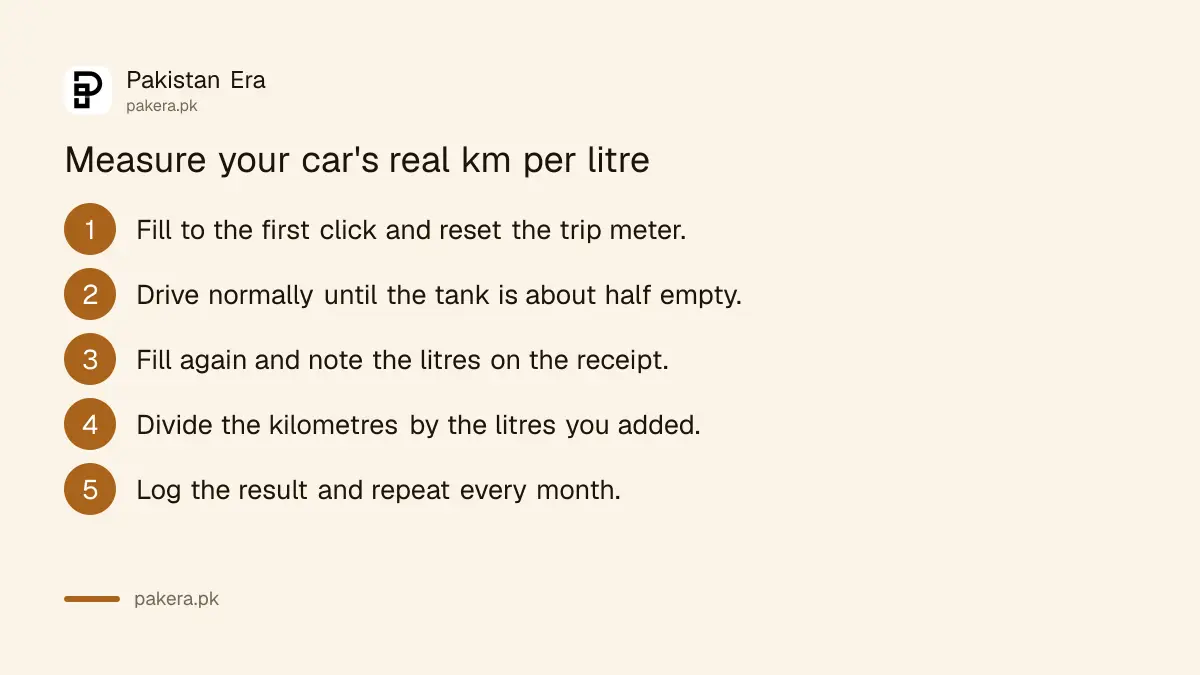
Here is the fill up method in five steps:
- Fill the tank until the nozzle clicks off, and reset the trip meter to zero. If your car has no trip meter, write down the odometer reading.
- Drive normally for a week or until the tank is about half empty.
- Fill the tank again at the same pump if you can, until the nozzle clicks off. Note the litres on the receipt.
- Divide the kilometres on the trip meter by the litres you just added. That is your real km per litre.
- Write the date, kilometres, litres and rupees in a notebook or phone note. Repeat each month.
Once you know your figure, set a fixed monthly fuel budget. Divide the budget by the petrol price to see how many litres it buys, then multiply by your km per litre to see how far it takes you. For example, Rs 25,000 buys about 66 litres at Rs 377.91, which is about 990 km in a 15 km/l car.
Watch for a sudden drop. If your car normally does 14 km/l and suddenly does 11 with the same driving, something has changed. Common causes are low tyre pressure, a clogged air filter, old spark plugs or a fault that needs a mechanic. Catching it early saves fuel and a bigger repair bill.
Fuel efficiency is a long term saving
Fuel efficiency is not only about the car. It is also about how you drive and how you look after it. Good habits, regular service and a sensible choice at the time of buying can save tens of thousands of rupees a year at today's price.
When you buy your next car, look past the sticker price. Work out what it will cost to drive every month. Then measure what your car really does, and keep measuring.
Common questions
How much petrol does a car use for 1,000 km?
It depends on mileage. A 10 km/l car uses 100 litres, a 15 km/l car about 67 litres, and a 22 km/l car about 45 litres for 1,000 km.
How much does 1,000 km of petrol cost in Pakistan?
At Rs 377.91 a litre from 31 October 2026, it costs Rs 37,791 at 10 km/l, Rs 25,194 at 15 km/l and Rs 17,178 at 22 km/l.
How do I calculate my car's real km per litre?
Fill the tank, reset the trip meter, drive, then fill again. Divide the kilometres driven by the litres you added in the second fill up.
Does using the AC increase fuel consumption?
Yes. The AC adds load to the engine, so the car burns more fuel, and the effect is larger in slow city traffic than on open roads.
Why has my car's mileage suddenly dropped?
Common causes are low tyre pressure, a dirty air filter, old spark plugs, old engine oil or a fault. If basic checks do not fix it, see a mechanic.
Is a hybrid always cheaper to run in Pakistan?
It usually uses less fuel in city traffic, but it costs more to buy. Add the price, tax and fuel bill for your distance before you decide.
How we verified this
What we checked and where we read it.
The petrol price of Rs 377.91 a litre is from OGRA's daily sheet effective 31 October 2026, which we read for our 31 October price report. Prices change often, so check OGRA's price publications for the current figure. The mileage figures in the tables are examples for comparison, not test results for any model, and the rupee costs are our own arithmetic.
About the author

Senior Writer, Public Services and Technology
Shahid joined us in 2024 as an author. He is a senior contributor to Pakistan's leading technology websites. He writes detailed articles, mostly covering his expertise in the latest tech, mobiles, apps, gadgets, and step-by-step guides. His ideology is to help people understand the latest trends and explain complex methods through very easy-to-understand guides.