How to Apply for the Fulbright Scholarship From Pakistan Through USEFP
The 6 October Fulbright deadline is for US citizens. USEFP's Pakistan round closed on 1 April 2026. Check eligibility, GRE score and how to prepare for 2028.
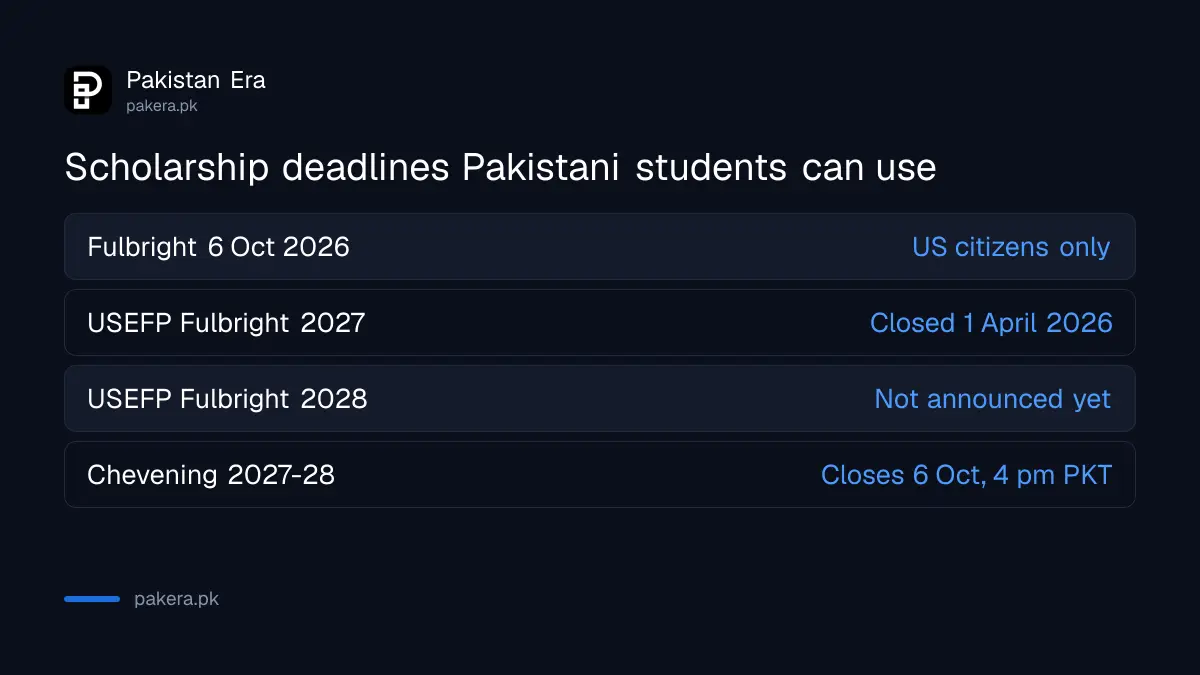
The Fulbright deadline of 6 October 2026 that is being shared in Pakistan is not for Pakistani students. It belongs to the Fulbright U.S. Student Program, which sends American citizens to Pakistan. Pakistanis apply through USEFP, and USEFP's round for 2027 closed on 1 April 2026.
If a Master's or PhD in the United States is your plan, the useful work now is preparing for the next USEFP round, which has not been announced yet. If you want a funded master's with a deadline you can still meet, Chevening in the UK closes on 6 October 2026 at 11:00 UTC, which is 4:00 pm in Pakistan.
We read USEFP's Fulbright Degree page, its 2027 flyer and its press releases on 26 September 2026. We also read the Pakistan page of the U.S. Student Program and Chevening's own timeline. The U.S. government gave Fulbright scholarships to 85 Pakistani students in 2026, 71 for master's and 14 for PhDs, according to USEFP's release of 17 July 2026.
The 6 October Fulbright deadline is for American applicants
The 6 October 2026 date comes from the Fulbright U.S. Student Program, which is for U.S. citizens going abroad. Its Pakistan page says the 2027-2028 competition closes on 6 October 2026 at 5 pm Eastern Time. A Pakistani citizen cannot apply there.
The same page says it plainly: a non-U.S. citizen applies "through the Fulbright Commission or U.S. Embassy in your home country". In Pakistan that commission is the United States Educational Foundation in Pakistan, or USEFP, a joint body set up by the two governments in 1950.
The mix-up is easy to make. Both programmes carry the name "Fulbright", and both say "Pakistan" on the page.
| What you saw | Who it is for | Status for Pakistanis |
|---|---|---|
| Fulbright deadline 6 October 2026, 5 pm Eastern Time | U.S. citizens going to Pakistan | Not open to you |
| USEFP Fulbright 2027, deadline 1 April 2026 | Pakistani citizens going to the U.S. | Closed |
| USEFP Fulbright 2028 | Pakistani citizens going to the U.S. | Not announced yet |
| Chevening 2027-28, closes 6 October 2026, 11:00 UTC | Citizens of eligible countries, Pakistan included | Open now |
USEFP's Fulbright 2027 round opened in February and closed on 1 April
USEFP opened applications for the 2027 Fulbright Student Program on 20 February 2026, with a deadline of 1 April 2026. Its Fulbright Degree page now shows the status as "Closed". The next one, the 2028 round, has no date yet.
The cycle is long. USEFP says interviews run until August and results come in mid-September. University placement runs until April, visa interviews from June to August, and scholars leave from July onwards. So a 1 April 2026 applicant starts in the U.S. in late 2027.
Do not assume the next deadline will fall on the same day. USEFP's own news archive shows the 2023 round closed on 11 May 2022, and the 2021 round was extended to 22 July 2020. The dates move, so treat the USEFP page, not a repost, as the only calendar.
Who can apply for the Fulbright scholarship from Pakistan
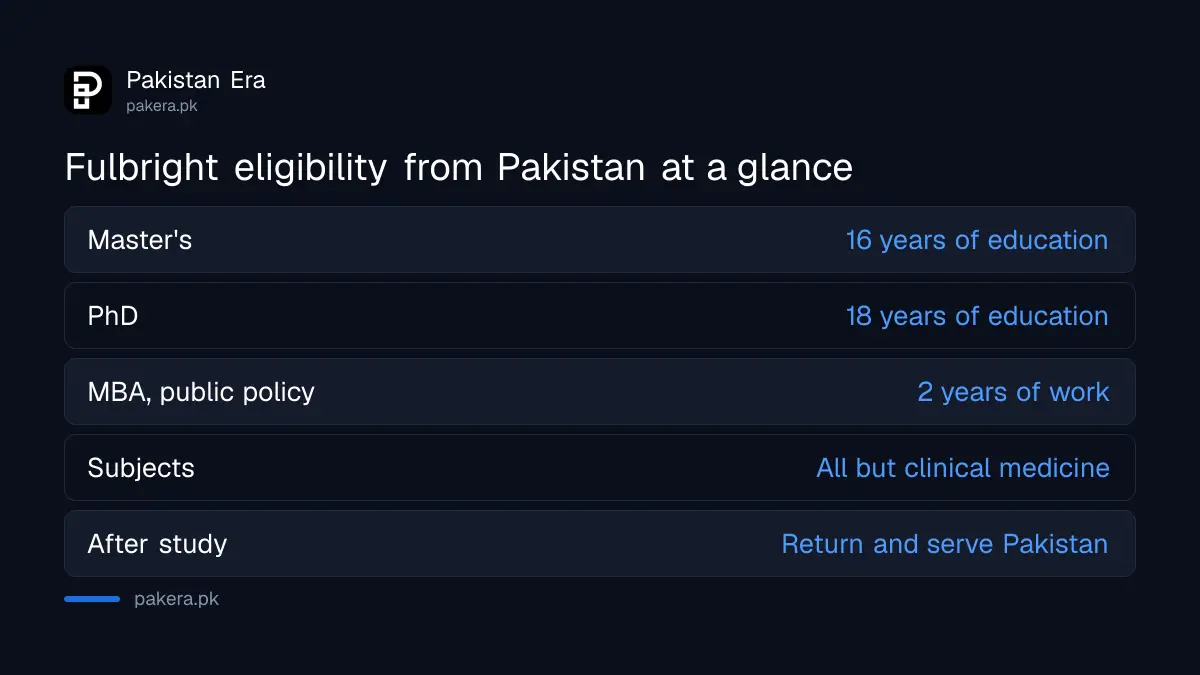
You must be a Pakistani citizen living in Pakistan throughout the process, with 16 years of education for a Master's or 18 years for a PhD. All subjects qualify except clinical medicine. You need the GRE General test and must agree to return and serve Pakistan.
- Master's: a four-year Bachelor's, or a Bachelor's and Master's that add up to 16 years. Recent graduates can apply, except for MBA and public policy or administration, which need two years of work in the field.
- PhD: a Master's, MPhil or similar, 18 years in total. Work in teaching, research or the public sector is "highly desirable".
- Subjects: everything except clinical medicine. Non-clinical public health is welcome. USEFP says science, technology and AI, trade and economics, and natural resource management are "particularly encouraged".
- English: strong spoken and written English. Only selected candidates take the TOEFL, later.
Some people cannot apply at all. These include dual U.S. and Pakistani nationals, anyone whose spouse or child over 18 is a U.S. citizen or permanent resident, anyone who has already had any Fulbright award, and anyone already studying in the U.S. or holding a work, residence or student visa in any country. Staff of the Fulbright organisation, the U.S. State Department or USAID, and their close family, are also excluded.
Selected scholars sign a contract with USEFP, and PhD scholars also sign a bond with the Higher Education Commission. Both require you to return and serve Pakistan for as many years as the scholarship lasted.
The GRE score and documents a Fulbright application needs
USEFP asks every applicant for a GRE General score of at least 145 in Verbal and 145 in Quantitative, with a higher score in the section closest to your field. A full application also needs the online form, three reference letters and scanned transcripts, all submitted online.
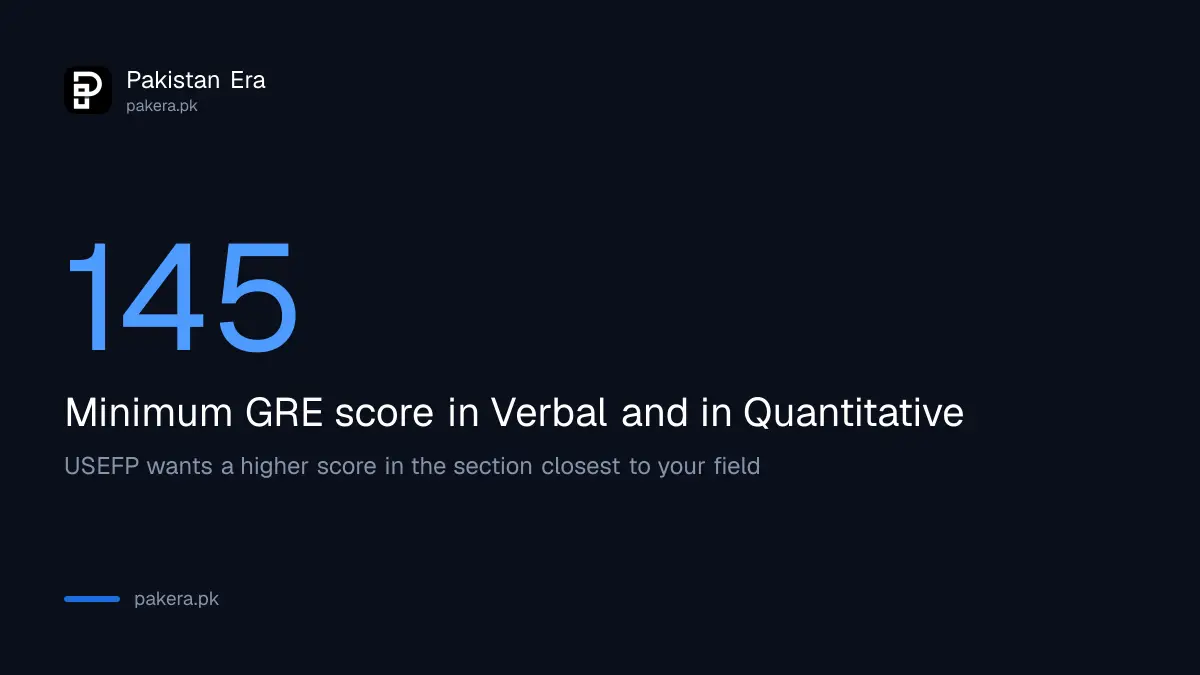
The GRE is the step that takes longest, so start there. Book a test date early enough that the official score report reaches USEFP before the deadline. This is a separate matter from the HEC rule on GRE or HAT for local MS and PhD admissions, which affects Pakistani universities, not Fulbright.
In the 2027 round, USEFP offered to refund the GRE fee to up to 30 applicants from HEC-approved public universities who scored at least 300 in science and engineering, or 290 in humanities. We do not know yet if the offer will return.
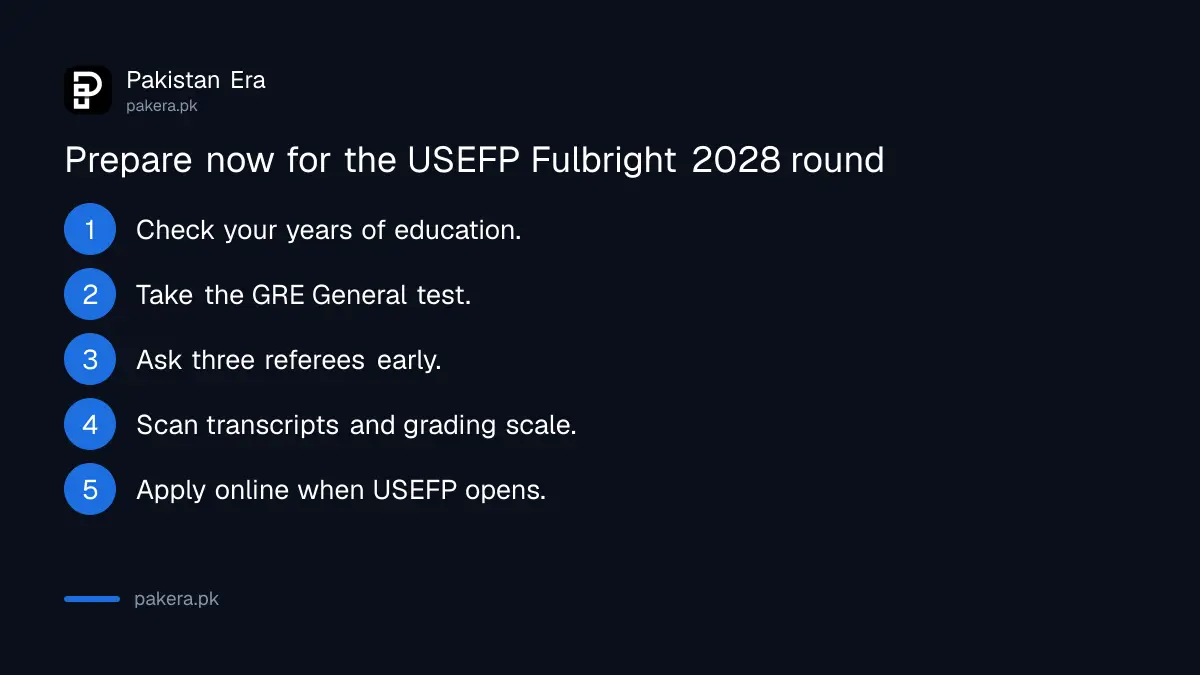
Here is the order we would work in, based on what USEFP asks for:
- Check your years of education and, for an MBA or public policy degree, your two years of work.
- Book and take the GRE General test, aiming above 145 in both sections.
- Ask three referees now. USEFP publishes its own reference letter form on usefp.org.
- Scan every transcript, with the page that explains your university's grading scale.
- Get degrees attested by HEC if you can. USEFP prefers it, but accepts attestation by the issuing university at the application stage.
- Write your essays yourself and submit online once USEFP opens the 2028 round.
That last point is a rule, not advice. USEFP's 2027 flyer says the use of generative AI to write Fulbright essays is prohibited, and that plagiarism or false publications lead to disqualification at any stage.
Chevening is the funded master's still open before 6 October
Chevening, the UK government's scholarship, closes on 6 October 2026 at 11:00 UTC, or 4:00 pm Pakistan time. It funds a one-year UK master's and needs two years of work. Fulbright funds a Master's or PhD in the U.S. and needs the GRE.
Chevening's eligibility page asks for an undergraduate degree, at least two years of work after that degree, equal to 2,800 hours, and a promise to return home for two years. You apply to three UK courses and need one unconditional offer by 8 July 2027. Results come in mid-June 2027. We set out the essays and scam warnings in the Chevening scholarship for Pakistanis.
| Point | Fulbright (USEFP) | Chevening |
|---|---|---|
| Country | United States | United Kingdom |
| Degree | Master's or PhD | One-year master's |
| Next deadline | 2028 round not announced; 2027 round closed 1 April 2026 | 6 October 2026, 11:00 UTC |
| Test | GRE General, 145 minimum per section; TOEFL later if selected | None listed in Chevening's eligibility criteria |
| Work experience | Not needed, except MBA and public policy (2 years) | 2 years, 2,800 hours, after your degree |
| Return rule | Serve Pakistan for as many years as the grant lasted | Return home for at least 2 years |
| Covers | Tuition, books, airfare, living stipend, health insurance | Fully funded, including tuition and living costs |
For a doctorate, look at the U.S. or at the HEC and DAAD PhD scholarship in Germany, because Chevening does not fund PhDs.
Common questions
Is the Fulbright deadline for Pakistani students 6 October 2026?
No. That date is for U.S. citizens in the Fulbright U.S. Student Program. Pakistanis apply through USEFP, whose 2027 round closed on 1 April 2026.
When will USEFP open the Fulbright 2028 round?
USEFP has not announced it. The 2027 round opened on 20 February 2026, but past rounds have closed in April, May and July, so check usefp.org.
What GRE score does Fulbright Pakistan need?
At least 145 in Verbal and 145 in Quantitative on the GRE General test, with a higher score in the section closest to your field.
Do I need IELTS or TOEFL to apply for Fulbright?
Not at the application stage. USEFP says selected candidates will be asked to take the TOEFL later.
Can a medical graduate apply for Fulbright?
Not for clinical medicine, which is excluded. Non-clinical public health applications are accepted.
Does Fulbright cover the full cost?
Yes. It covers tuition, required textbooks, airfare, a living stipend and health insurance, subject to USEFP's budget for that year.
How we verified this
What we checked, where we read it, and what we could not confirm.
Last checked on 26 September 2026. The eligibility rules, the GRE minimum, the document list, the return contract and HEC bond, the ineligibility list, the GRE refund offer, the cycle timings and the "Closed" status with a 1 April 2026 deadline are read on USEFP's Fulbright Degree page and its Fulbright 2027 flyer. The 20 February 2026 opening, the 85 awards in 2026 and the August 2026 agreement with HEC are read in USEFP's press releases, and the 2021 and 2023 deadlines in its news archive. The 6 October 2026 date and the instruction for non-U.S. citizens are read on the Fulbright U.S. Student Program Pakistan page. Chevening's dates are read on its application timeline, and its criteria on its eligibility page. We did not submit an application.
About the author
Public Services and Education Journalist
Fajr Riaz is a journalist and content writer at Pakistan Era, based in Lahore. She covers the questions people meet in everyday life in Pakistan: how a public service works, what a change in the rules means, and where to find a reliable answer.