Get an Allergy Test at the NIH Allergy Centre Islamabad: Timings and Skin Prick Test
NIH Allergy Centre in Islamabad is open 8 am to 4 pm on weekdays and to 1 pm on Saturday. See the skin prick test, the 3 year vaccine and how to book a visit.
The NIH Allergy Centre in Islamabad runs skin prick tests and a three year allergy vaccine course. It is open Monday to Friday from 8 am to 4 pm and on Saturday from 8 am to 1 pm, with a private evening clinic after that. The main NIH phone line is +92 (51) 9255110. NIH describes the centre as the only public sector allergy centre in the country.
NIH also has an Urdu allergy booklet. Call for the fee before you travel.
The centre treats adults under 60 and children over 10
NIH says the centre treats allergy-related problems such as asthma and immune system disorders. Its page names adults below 60 and children above 10 as the patients it serves. A younger child or an older adult should ask by phone first.
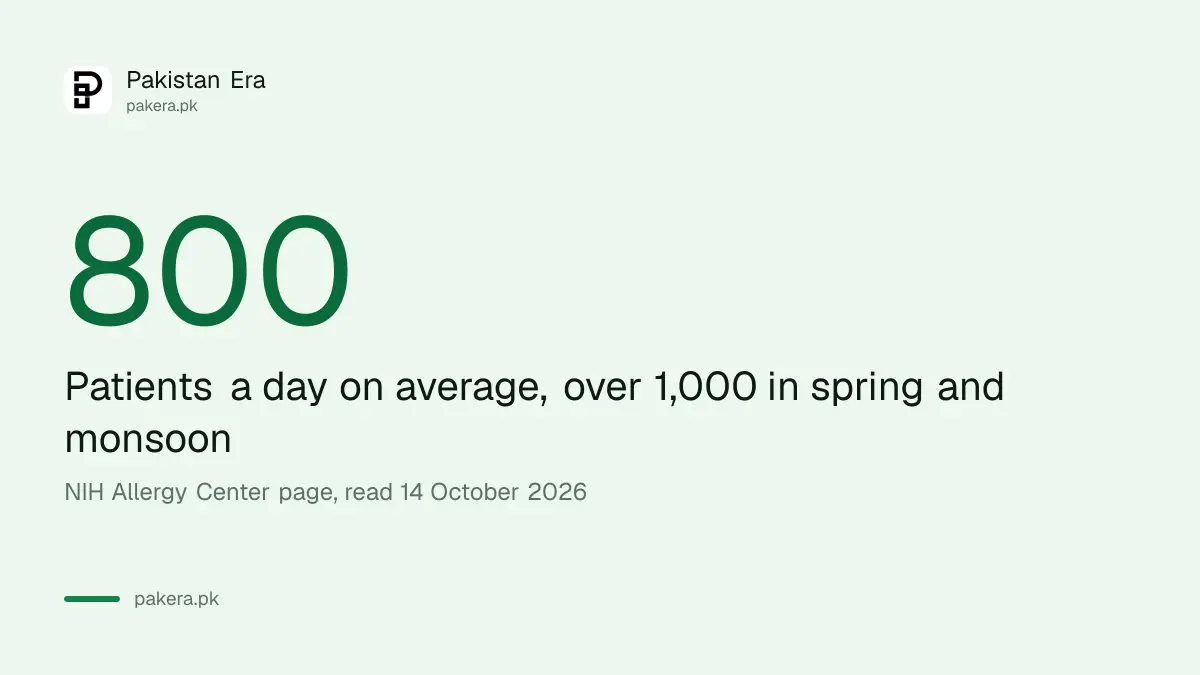
The page says the centre handles an average of 800 patients a day. That is more than 70,000 to 80,000 patients a year. In spring and in the monsoon, NIH says the daily count passes 1,000. So expect a queue, and go early.
Opening hours are 8 am to 4 pm on weekdays and 8 am to 1 pm on Saturday
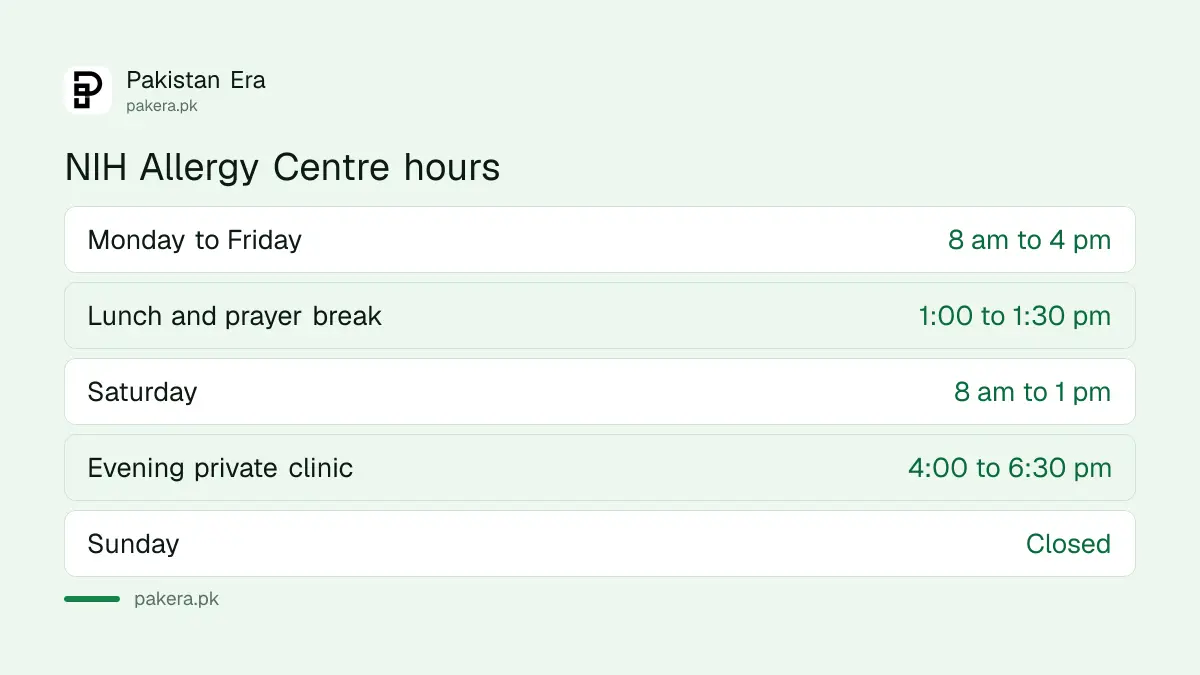
The NIH site lists the Allergy Center at 8 am to 4 pm, Monday to Friday, with a lunch and prayer break from 1:00 to 1:30 pm. Saturday runs 8 am to 1 pm. Sunday is closed. A private evening practice follows.
| Session | Weekdays | Saturday | Sunday |
|---|---|---|---|
| Allergy Center (public) | 8 am to 4 pm | 8 am to 1 pm | Closed |
| Lunch and prayer break | 1:00 to 1:30 pm | Not listed | Closed |
| Evening private practice | 4:00 to 6:30 pm | 1:00 to 4:00 pm | Closed |
| NIH office (general) | 8 am to 4 pm | Closed | Closed |
NIH's older Urdu booklet gives different patient hours, and it also names a different phone number. That booklet has no date on it. Use the hours in the website footer, and confirm by phone before you go.
The skin prick test shows a result in 15 to 20 minutes
NIH says the doctor cleans your skin, places a drop of allergen extract and pricks the skin with a lancet, a small sterile needle. After 15 to 20 minutes, a raised, red, itchy bump means a positive reaction. The test checks non-food allergens such as dust and pollen.
The page lists dust, pollen, cotton, dampness, mould, animal fur and cockroach parts among the triggers it tests for. It also names food triggers such as eggs, fish, chicken, red meat and rice. The doctor may also order a blood test for IgE, a protein your body makes in an allergic reaction.
If the test is positive, NIH says the centre gives vaccination, also called immunotherapy. That means small, repeated doses of the trigger to train your body to react less.
The allergy vaccine is a three year course with a doctor's referral
NIH says the vaccine course lasts three years and slowly lowers the body's allergic response. The booklet says your treating doctor must refer you for it. It also says the vaccine goes under the skin, and you should wait 30 minutes at the centre after each dose.
The booklet lists cases where the vaccine may not suit you, such as pregnancy and severe asthma with weak lung function. It also says to stay away from hard exercise and hot baths for several hours after a dose. These points come from NIH's own text, and the doctor at the centre decides what applies to you. We give no medical advice beyond that.
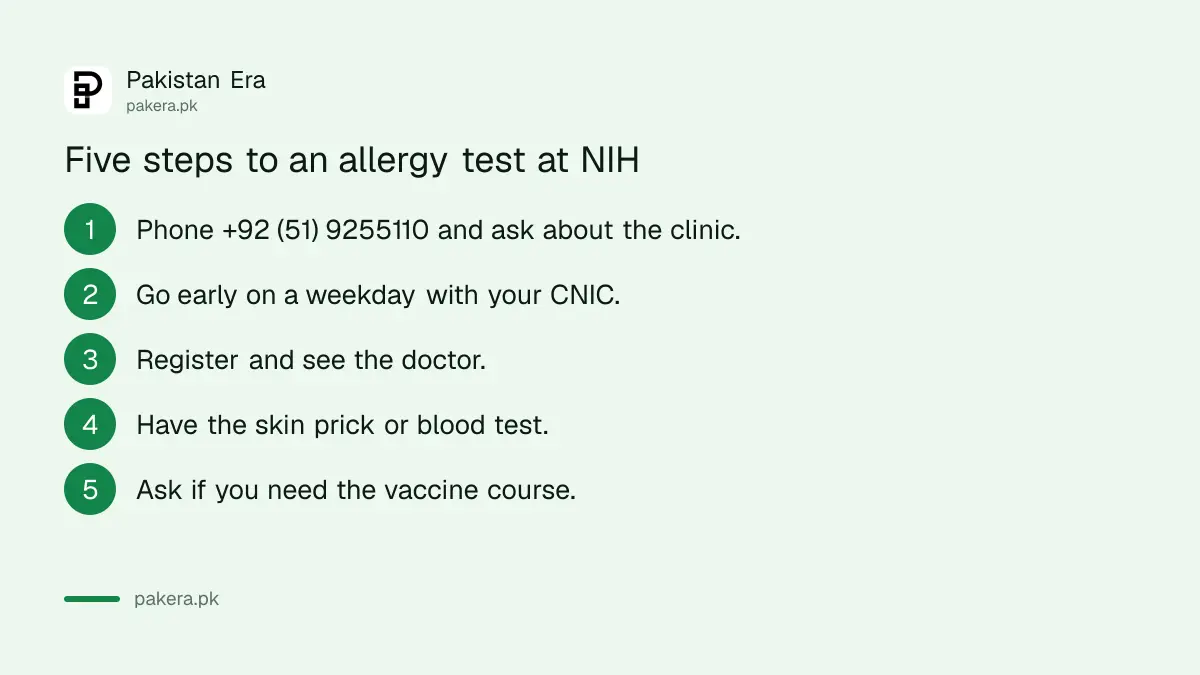
- Phone the NIH exchange on +92 (51) 9255110 and ask about the day's allergy clinic.
- Go early on a weekday with your CNIC and any old prescriptions or reports.
- Register at the centre and see the doctor.
- Have the skin prick test or the blood test the doctor orders.
- Ask the doctor whether you need the vaccine course, and how often to come.
Spring and monsoon are the busiest seasons
NIH's booklet says pollen counts in Islamabad rise sharply in spring, and the monsoon brings damp, mould and dust mites. If your symptoms follow the seasons, plan a visit just before spring. The page's own advice is to keep windows shut in pollen season and avoid thick carpets.
If a cough or fever is part of the picture, it may not be an allergy. Our guide to pneumonia signs in a child lists the breathing signs that need a doctor now. For a cold that is not an allergy, see how to tell a cold from flu.
Common questions about the NIH Allergy Centre
Where is the NIH Allergy Centre?
It is part of the National Institutes of Health in Islamabad. NIH's own page says the National Health Center started in 1965 near Rawal Lake, about 10 kilometres from Zero Point. Ask the exchange for the exact gate.
Does the centre treat children?
Yes, children above 10, according to NIH's page. For a younger child, call first, because the page does not say who sees them.
How much does the skin prick test cost?
Ask the exchange or the registration desk for the fee before the test.
How long is the allergy vaccine course?
NIH says three years. Your doctor sets the schedule and the dose for you.
Do I need a referral?
NIH's booklet says the treating doctor must refer you for the vaccine. Ask when you phone whether the test also needs a referral.
How we verified this
What we checked and where we read it.
Last checked 14 October 2026. Hours, patient ages, test descriptions and patient numbers come from the NIH Allergy Center page and the footer of NIH's website. Vaccine details come from NIH's undated Urdu allergy booklet. Hours can change, so confirm by phone.
Free on WhatsApp
Get last dates and rule changes on WhatsApp
We post new last dates, fee changes and fixes for common problems, a few short posts a day.
Follow Pakera on WhatsAppOther followers cannot see your number.
Pakera Solves It
Which online process wasted your time this week?
A portal that will not load, a form nobody explains, a complaint that went nowhere. Tell us. Every week we pick one, solve it step by step and publish the answer.
About the author

Public Services and Education Journalist
Fajr Riaz is a journalist and content writer at Pakistan Era, based in Lahore. She covers the questions people meet in everyday life in Pakistan: how a public service works, what a change in the rules means, and where to find a reliable answer.