Google November 2026 Core Update: What Pakistani Website Owners Should Check, and When
Google's November 2026 core update began on 10 November and may take 2 weeks. When Pakistani site owners should check Search Console, and what to fix after.
Google started the November 2026 core update on 10 November 2026 at 10:06 Pacific time, which was 11:06 pm in Pakistan. Google says the rollout may take up to 2 weeks. It applies to every country and every language, so Pakistani sites in English and Urdu are both in scope.
If your clicks moved this week, do not rewrite anything yet. Google's own advice is to wait until the rollout ends, then wait a full week more, and only then compare. Changing pages in the middle of a rollout makes it harder to see what the update did.
That waiting period is the hard part for a small Pakistani business or blog owner who sees traffic fall. But the numbers you look at during a rollout are moving every day, and a page that drops on Thursday can come back on Sunday.
The November 2026 core update started on 10 November and can run 2 weeks
Google posted the update on its Search Status Dashboard on 10 November 2026. The note says the update applies globally and to all languages, and that the rollout may take up to 2 weeks. That puts the likely end around 24 November 2026.
Google will mark the incident as finished on the same dashboard. Until then, treat every ranking change as provisional. The dashboard also listed the September 2026 spam update, which started on 24 September and ran for about 13 days, so a drop you saw in early October may belong to that update instead.
| Date (2026) | What happens | What you do |
|---|---|---|
| 10 November, 11:06 pm PKT | Core update starts | Note the date in your records |
| 10 to about 24 November | Rollout, rankings move | Watch, do not change working pages |
| Rollout end date | Google marks it complete | Start the one-week wait |
| One full week after the end | Data settles | Compare in Search Console |
A core update is not a penalty and does not target one site
Google says core updates are broad changes to its ranking systems. They do not target specific sites or single pages. A drop means other pages now look more helpful for those searches, not that your site broke a rule or got a manual action.
That difference matters. A manual action shows up in Search Console under Manual actions, with a reason. A core update shows nothing there. If you see a message under Security issues or Manual actions, that is a separate problem with its own fix, such as a site Google has flagged as hacked.
Google makes big core updates several times a year. It also says most sites will not notice one at all.
Check your traffic in Search Console only after the rollout ends
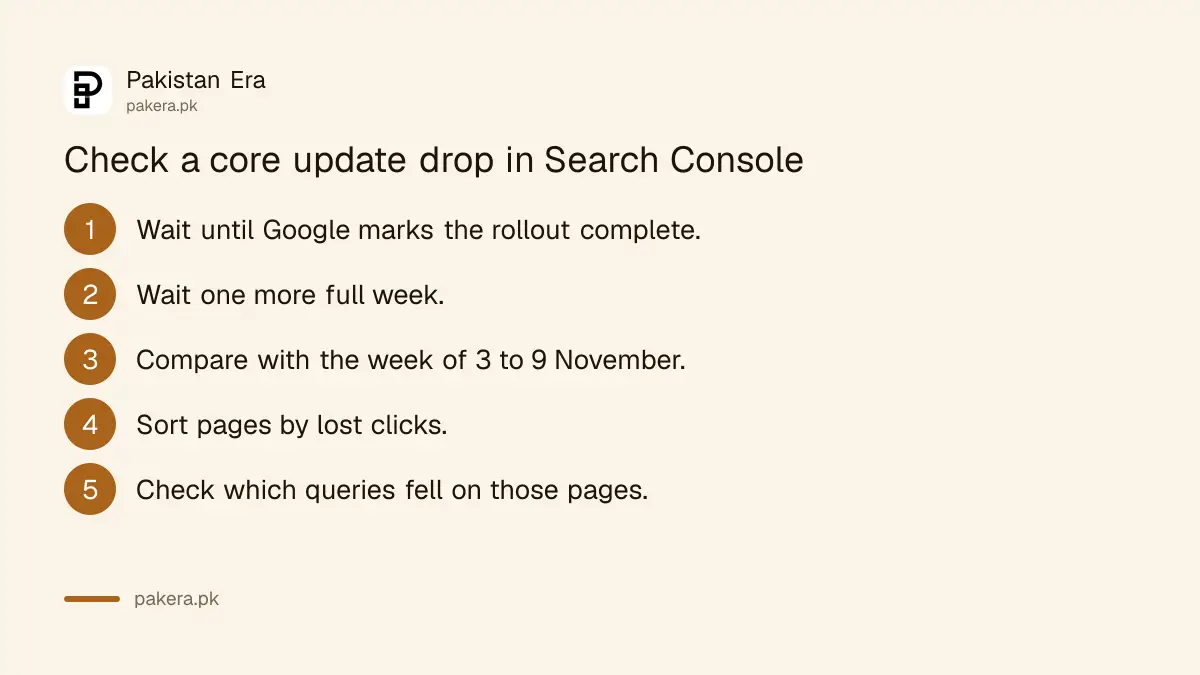
Google recommends waiting at least a full week after a core update completes before you analyse your site in Search Console. Then compare the week after the update with the week before it started. For this update, the "before" week is 3 to 9 November 2026.
- Open Search Console and go to Performance, then Search results.
- Click the date filter and choose Compare.
- Set the first range to the week after the rollout ended, and the second to 3 to 9 November 2026.
- Open the Pages tab and sort by the change in clicks.
- Open the Queries tab for the pages that lost the most, and note which searches fell.
- Switch the search type between Web, Image, Video and News, because a drop can sit in one type only.
Split brand searches from the rest while you do this. A drop in searches for your shop name means something different from a drop in general searches, and branded and non-branded queries can be separated in the same Performance report.
Also check that the problem is ranking, not crawling. If Google stopped reaching your pages, the Crawl Stats report will show it, and that fix has nothing to do with the update.
A small drop needs no changes, a large one needs a full review
Google separates the two cases. For a small drop, it says to avoid changing content that already performs well, because positions move a little after every update. A large, lasting drop calls for an honest review of the whole site against Google's helpful content questions.
| What you see | What Google advises |
|---|---|
| Top pages slip one or two places | Leave working pages alone |
| Clicks down a little across the site | Wait for more data before acting |
| Main pages fall off page one | Review the site against the helpful content questions |
| One section lost most traffic | Compare those pages with what now ranks |
| Thin pages nobody can improve | Delete only as a last resort |
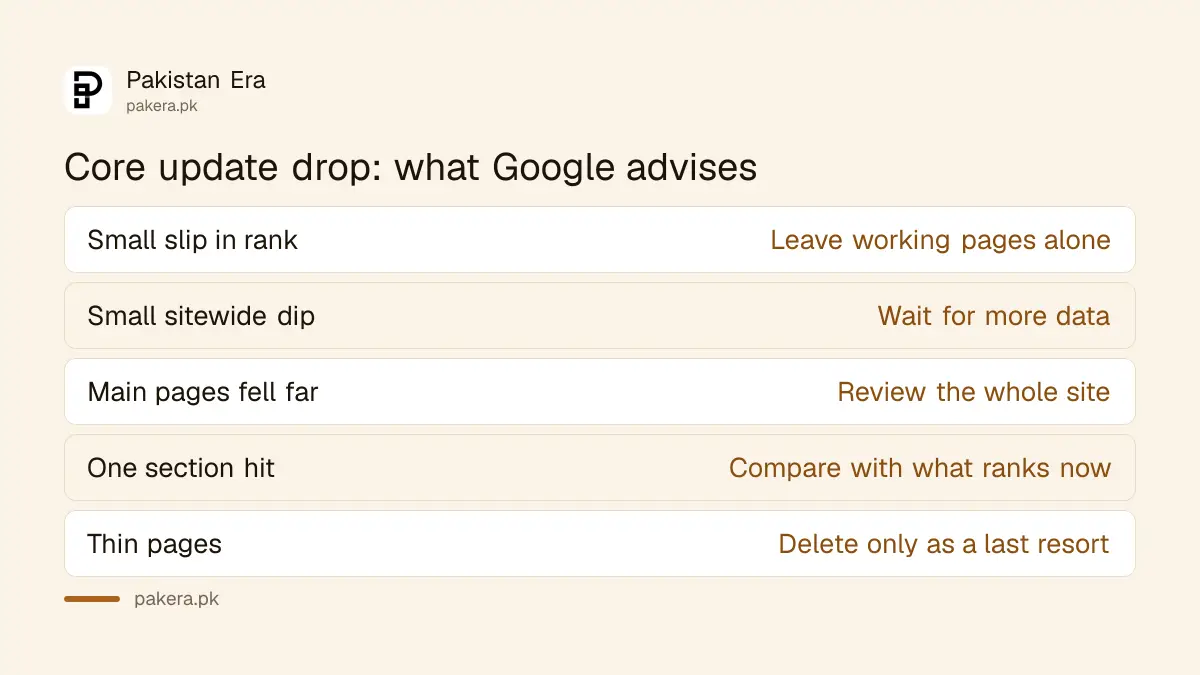
For the review, look at the pages that fell, then search those queries yourself and open what now ranks above you. Be honest. If the new top result answers the question faster, has the current fee or price, or shows real first-hand checking, that is the gap.
Google's own questions show what to fix on the pages that fell
Google publishes a list of self-assessment questions for helpful content. They ask whether a page has original information, a complete answer, a clear title that does not exaggerate, and no easy factual errors. Answer them for your worst affected pages, page by page.
- Does the page give original information, reporting, research or analysis?
- Does it describe the topic in a complete way, or leave the reader searching again?
- Does the title give a helpful summary, without exaggeration or shock?
- Does it have spelling problems, or look hastily made?
- Would someone leave knowing enough to finish what they came to do?
Google also asks who made the content, how and why. Clear bylines help. So does saying how a page was produced when readers might wonder, including any use of AI. Content made mainly to attract search traffic, rather than to help visitors, is the kind Google says it does not want.
For Pakistani sites, the usual weak spots are copied price lists, old fees, and posts rewritten from a news story with nothing added. A page that shows the 2026 fee from the official notice beats one still showing last year's figure.
Avoid quick fixes, and expect recovery to take months
Google warns against quick fixes, such as removing page parts because of a supposed SEO rule. It wants real improvements, like rewriting or restructuring content so it is easier to read. Some changes show in days, but Google says confirming a site's improvement could take several months.
Recovery does not always wait for the next big update. Google makes smaller core updates between the named ones, and those can lift improved pages. It also says there is no guarantee, and positions can rise or fall at any time.
Do not use Request Indexing on hundreds of pages hoping to speed things up. Request Indexing in URL Inspection is for a page you have actually changed, and it has a daily limit. Use it for the few pages you rewrote.
Keep a simple log: the date of each change, the page, and what you changed. When the next update arrives, you will know which work helped. The Google Search Status Dashboard lists every update with its dates, so you can match each traffic change to an update.
Common questions
When did the Google November 2026 core update start?
It started on 10 November 2026 at 10:06 Pacific time, which was 11:06 pm Pakistan time, according to Google's Search Status Dashboard.
How long will the November 2026 core update take?
Google says the rollout may take up to 2 weeks, which points to an end around 24 November 2026. Google marks the end date on the dashboard.
Does the core update affect Urdu websites in Pakistan?
Yes. Google says this update applies globally and to all languages, so Urdu and English sites are both included.
Is a core update drop a Google penalty?
No. Google says core updates do not target specific sites. A penalty would appear as a manual action in Search Console, with a reason.
Should I change my pages during the rollout?
No. Google advises waiting until the update completes, plus one full week, before you analyse the change. Then improve only the pages that dropped a lot.
How we verified this
What we checked and where we read it.
Last checked 15 November 2026. Start time, scope and rollout length come from the Google Search Status Dashboard entry for the November 2026 core update, which at our check had no end date yet. Advice on waiting, comparing and fixing comes from Google Search Central's guidance on core updates and creating helpful, reliable, people-first content. The PKT time is our conversion from US Pacific time.
About the author

Founder and Editor
Umer Kureshi founded Pakistan Era in July 2024 and runs it as administrator, SEO lead and writer, overseeing website operations, search growth, content strategy and coverage of technology and current affairs.