HEC Plagiarism Policy on ChatGPT: the 19% Rule, AI Detectors and Every Penalty
HEC's 2023 policy calls copied ChatGPT text plagiarism and treats 19% similarity as a warning. See the 9% and 5% rules, penalties and what AI scores prove.
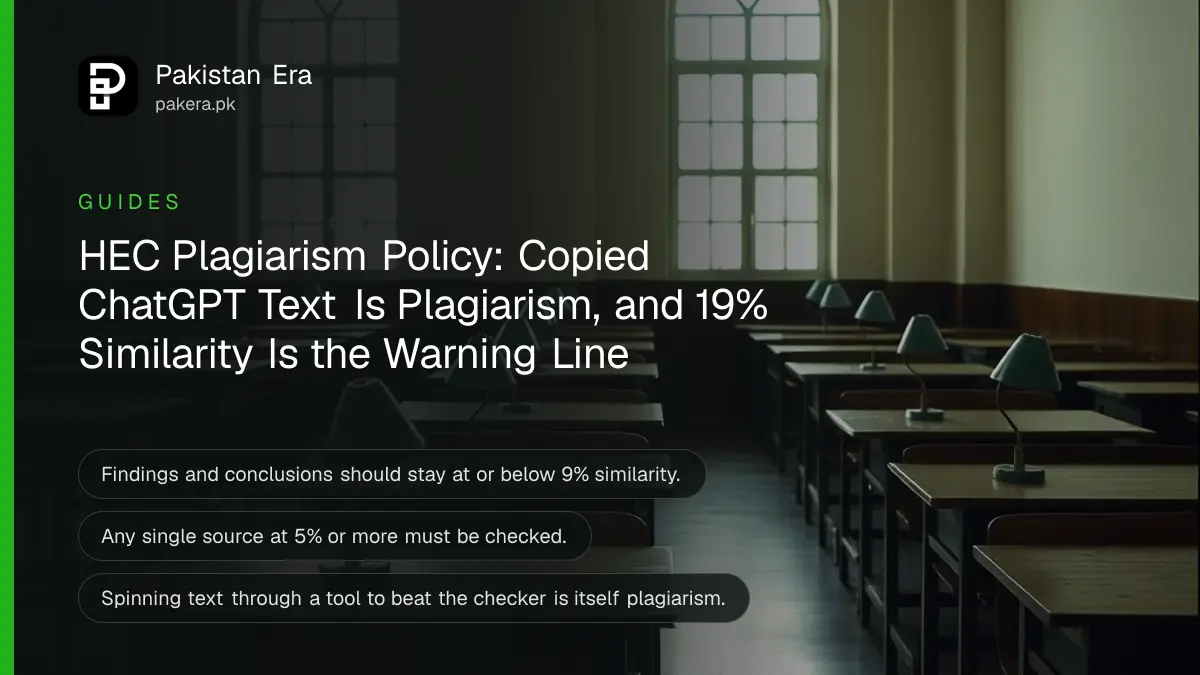
Under HEC's Anti-Plagiarism Policy (Version 2.0, August 2023), using ChatGPT counts as plagiarism if you copy and reproduce its text without proper attribution, and a similarity index above 19% signals possible plagiarism in any assignment, thesis or paper. The policy also names AI-adjacent tricks, such as running text through a spinner or translation tool to dodge detection, as plagiarism.
Every term, Pakistani students ask the same thing: will the university's checker catch AI text, and what happens if it does? We read HEC's full policy PDF and its Turnitin guidelines on 1 November 2026. Here is what the rules actually say about ChatGPT, the 19% and 9% numbers, the penalties, and what an AI detector score can and cannot prove.
HEC says ChatGPT use is plagiarism when it is copied without attribution
The policy's FAQ answers the question directly: using ChatGPT is plagiarism if the text is copied and reproduced without proper attribution. Researchers may use AI to understand basic ideas, but not to replace core work such as analysing data or drawing conclusions. Authors stay responsible for everything.
The same document lists "use of ChatGPT and similar machine-generated text" among technology-driven activities that count as cheating if done without permission. It sits beside copying images from websites and remixing copyrighted media.
So the line is not "AI is banned". It is closer to this: AI may help you understand, but the words, analysis and conclusions you submit must be yours, and anything taken from a tool must be acknowledged. Your own department may set stricter rules for a course, so read the course outline too.
The 19% similarity index is a warning sign, not an automatic verdict
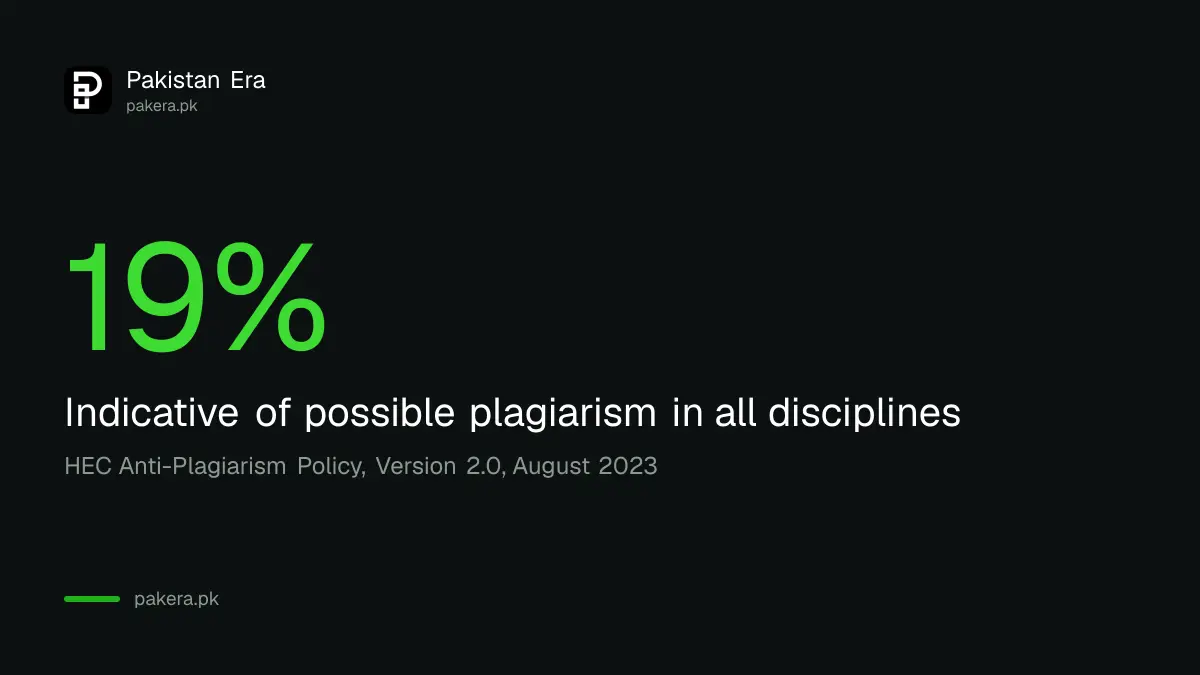
HEC treats a similarity index of 19% as indicative of possible plagiarism in all disciplines. The findings and conclusion section should not exceed 9%, and any single source at 5% or more needs a closer look. Below 19%, the author may get the benefit of the doubt.
| Number | What HEC's policy says |
|---|---|
| 19% overall | Indicative of possible plagiarism, all disciplines |
| 9% in findings and conclusion | The maximum for that section |
| 5% from one source | Must be checked as possible plagiarism |
| At or below 19% | Benefit of the doubt may be given |
The policy is clear that the score alone is not proof. It calls the similarity index a guideline and an alert, says quoted and cited text can show up as a match, and says a subject expert must read the full report in context before deciding anything.
Tables, graphs and formulas are not matched, because the checker compares text only. And matches against your own earlier submission in the student repository may be ignored if it is genuinely the same work.
Penalties depend on the percentage and on intent
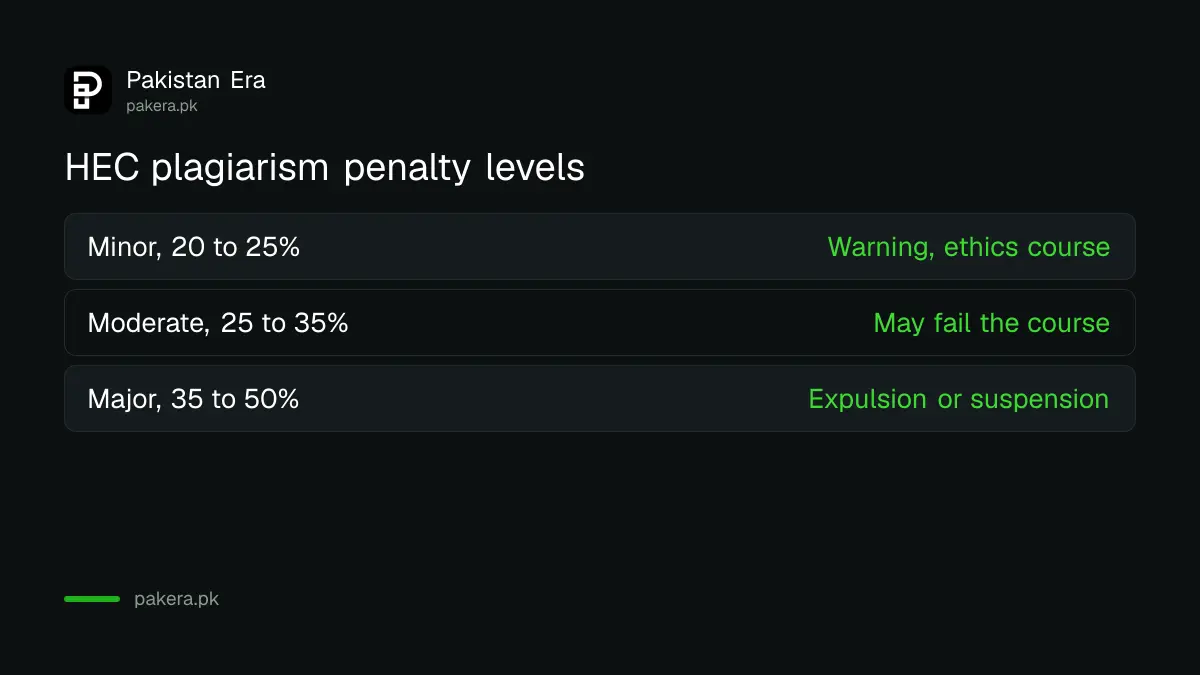
HEC's policy sets three levels. Minor cases are around 20 to 25% similarity and unintentional; moderate cases are deliberate and around 25 to 35%; major cases are deliberate, duplicated, or around 35 to 50%. Students face anything from a warning to expulsion.
| Level | Typical grounds | Student penalties listed |
|---|---|---|
| Minor | Unintentional, 20 to 25% overall or 10% in findings | Proposal revision, Research Ethics Course, formal warning on file |
| Moderate | Deliberate, 25 to 35% overall or 20 to 30% in findings | May fail the course |
| Major | Deliberate, duplicate, translation only, or 35 to 50% | Expulsion, two semester suspension, one year bar from higher education |
Major cases can also bar someone from HEC scholarships, travel grants and fellowships for two years. For faculty, the penalties run up to dismissal and withdrawal of promotions gained from the plagiarised work.
AI humaniser and paraphrasing tools are named as plagiarism too
The policy lists "software-based text modification" as plagiarism: taking someone else's writing and running it through a text spinner or translation engine to evade detection. "Manual text modification" to mislead the checker is listed separately. Both describe what AI humaniser apps sell.
That matters because many students now paste ChatGPT output into a paraphrasing site to lower the detector score, and some of the AI tools Pakistani students use are sold exactly for that. Under HEC's own wording, the intent to beat the software is itself the offence, whatever percentage the report shows afterwards.
Contract cheating is listed as well: paying, or getting free help from, someone else to do an individual assignment. An AI tool that writes the whole thing for you sits uncomfortably close to that idea.
An AI detector score cannot decide your case on its own
HEC's policy is built around text matching, which checks copied words against databases, and says a subject expert must interpret every report. A separate AI writing score is a different kind of estimate. Neither HEC document we read sets an AI score threshold.
We tried to read Turnitin's own pages on its AI writing indicator, but its site refused our requests, so we do not state how it scores text or what its error rates are. Treat any AI percentage as one piece of evidence, never the whole story.
If you are accused, HEC's process gives you a route. Complaints go to the University Anti-Plagiarism Standing Committee, which investigates, and anonymous complaints are not entertained. The policy even requires action against people who make false plagiarism claims.
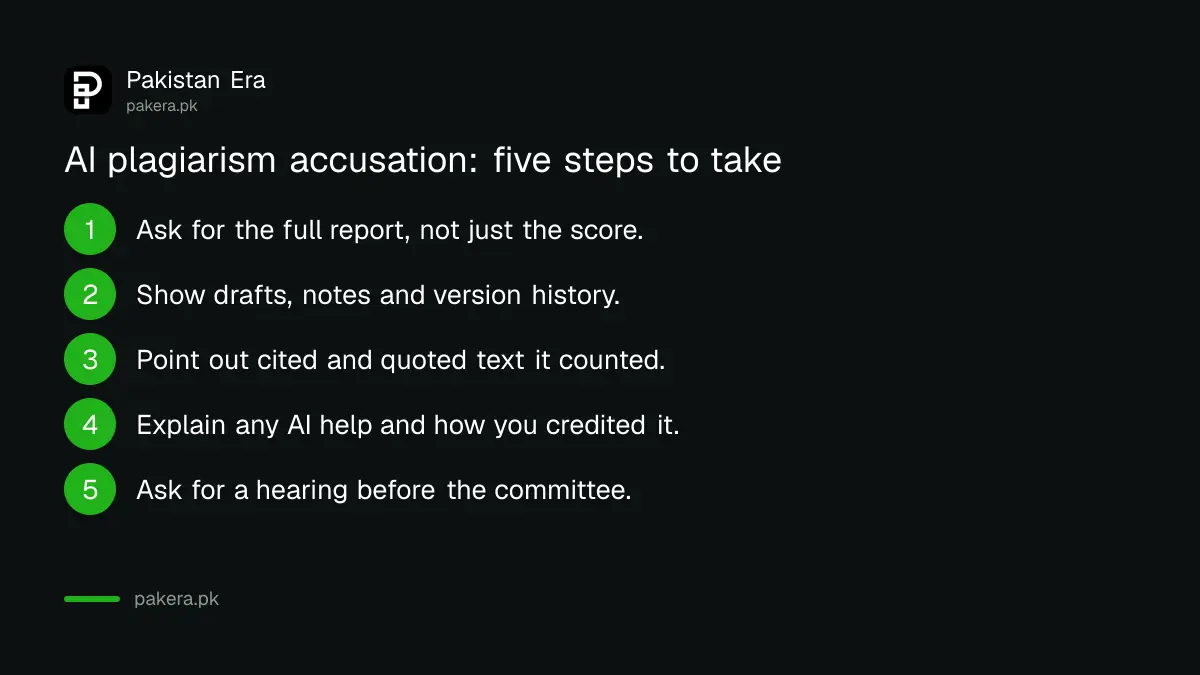
- Ask for the full similarity or AI report, not just the percentage.
- Show your drafts, notes and version history from Google Docs or Word.
- Point out quoted, cited or reference-list text that the report counted.
- Explain any AI help you used and how you acknowledged it.
- Request a hearing before the university's plagiarism committee if it goes further.
For honest ways to use AI in study, such as quizzing yourself, see how ChatGPT study mode helps exam prep. To check whether an image or video was made with Google's AI, the SynthID detector works differently from text checkers.
Common questions
Is using ChatGPT plagiarism under HEC rules?
Yes, if you copy and reproduce its text without proper attribution. HEC allows AI to help you understand ideas, not to replace your own analysis.
How much plagiarism does HEC allow?
HEC says plagiarism is not allowed at all, but a similarity index up to 19% may be acceptable, with under 5% from any single source.
Can Turnitin detect ChatGPT?
Turnitin's site refused our requests, so we cannot confirm its AI scoring. HEC's policy treats any checker report as something an expert must interpret.
Is using a paraphrasing tool to beat the checker allowed?
No. HEC lists running text through a spinner or translation engine to evade detection as plagiarism.
Can a student be expelled for plagiarism in Pakistan?
Yes. For major, deliberate cases, HEC's policy lists expulsion, a two semester suspension, or a one year bar from higher education.
How we verified this
What we checked, where we read it, and what we could not confirm.
We downloaded and read HEC's Anti-Plagiarism Policy, Version 2.0, August 2023 on 1 November 2026, including the penalty grounds, Annexure 3 on similarity reports and the FAQ on ChatGPT, plus HEC's guidelines on Turnitin listed on its plagiarism policy page. Turnitin's own pages refused our requests, so we state nothing about its AI scoring. Individual universities may add their own AI rules, which we did not survey.
About the author

Technology Journalist & Multimedia Producer
Ahmad Ali is a technology journalist and multimedia producer at Pakistan Era, joining the team in October 2026. He covers consumer technology and digital life for Pakistani readers, combining research with hands-on product testing.