IESCO Load Shedding Schedule 2026: Feeder List for Islamabad, Rawalpindi, Attock, Jhelum, Chakwal and AJK
Find your feeder in IESCO's 2026 load shedding schedule for Islamabad, Rawalpindi, Attock, Jhelum, Chakwal and AJK, and read its hours at each shortage level.
IESCO's load shedding schedule is on iesco.com.pk/load-shedding, as six Excel files, one each for Islamabad, Rawalpindi City and Cantt, Attock, Jhelum, Chakwal and AJK. Find your feeder name in the file for your circle, and the row shows the exact hours your area would lose power at each level of shortage, from 2 hours a day up to 12.
We downloaded and read all six files on 24 October 2026. Between them they list 1,105 feeders on 116 grid stations. The schedule is a plan for shortages, not a daily timetable: IESCO's own heading says it will be applied "according to generation shortfall" or a frequency problem on the grid. Below is how to find your feeder, how to read its row, and sample times for Blue Area, G-9 and Rawalpindi.
IESCO publishes one schedule file for each of its six circles
The Loadshedding Management page on IESCO's website has a table with six rows, one per circle, each dated Sep-2026 with a "Click to View" link to an Excel file. Pick the circle that matches your bill and open its file on a phone or computer.
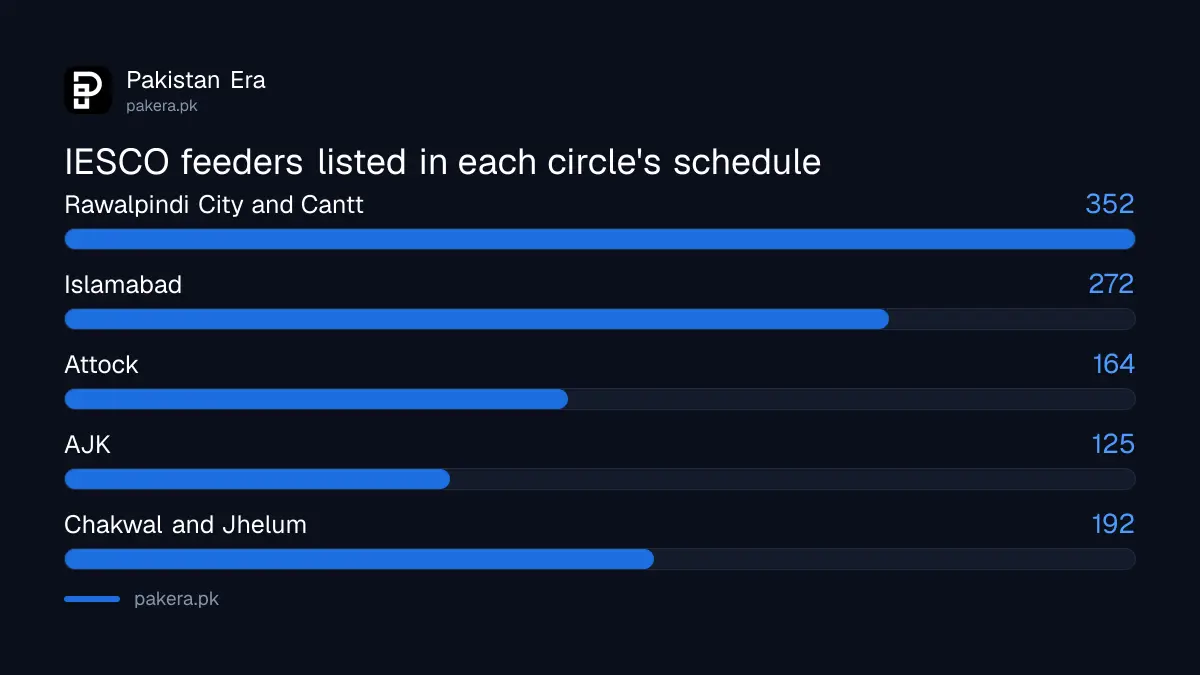
| Circle on IESCO's page | Feeders listed | Grid stations | Largest grids in the file |
|---|---|---|---|
| Islamabad | 272 | 24 | Zero Point, F-11, Tramri, G-9, F-6, Murree |
| Rawalpindi City and Cantt | 352 | 33 | Chaklala, Satellite Town, Pir Widhai, Cantt |
| Attock | 164 | 18 | New Wah, Faqirabad, B-17, Taxila |
| Jhelum | 90 | 10 | Jhelum, Gujar Khan, Dina |
| Chakwal | 102 | 13 | Talagang, Chakwal, Padshahan |
| AJK | 125 | 18 | Mirpur, Kotli, Rawalakot, Bagh |
The counts are ours, made by reading every row. Note that the Islamabad file includes Murree, and some Rawalpindi grids such as DHA and Giga Mall sit in the Rawalpindi file, not the Islamabad one.
Your feeder's row shows its hours at six levels of shortage
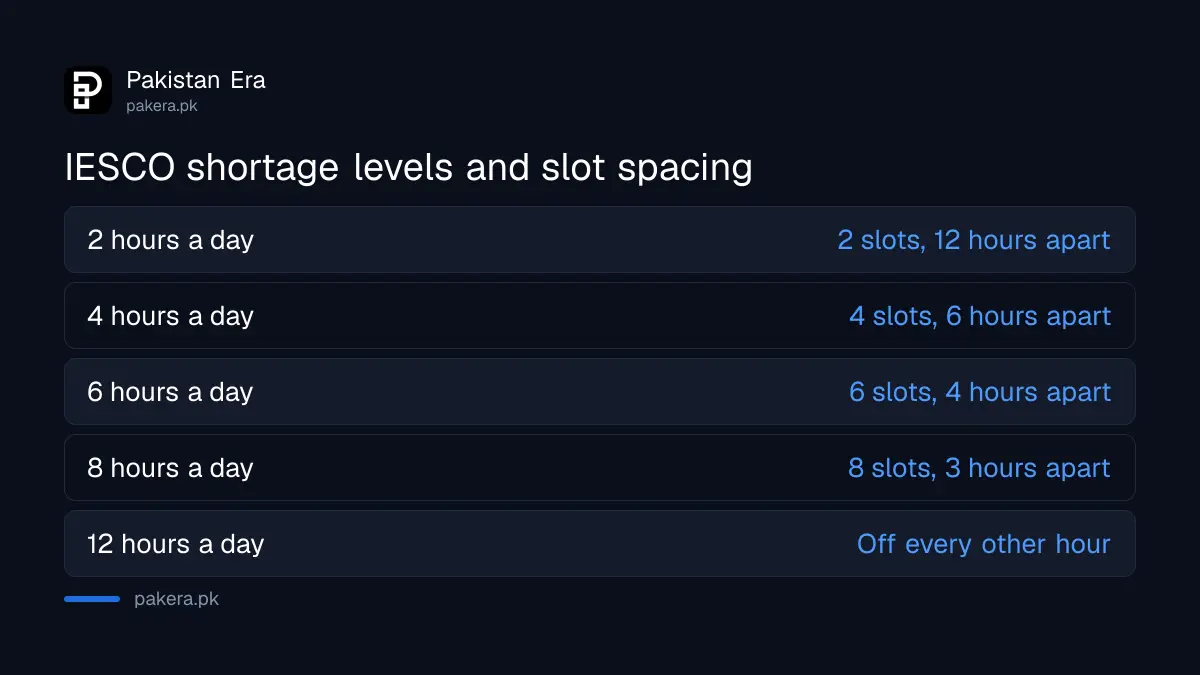
Each row has the grid name, feeder name, feeder code and six columns: 2, 4, 6, 8, 10 and 12 hour interruption schedules. The column that applies depends on how short of power the system is that day. Read across to the level IESCO announces.
The slots are one hour long and spread evenly through the day. At the 2 hour level, a feeder loses power twice, 12 hours apart. At 4 hours, four times, 6 hours apart. At 12 hours, it is off every other hour. Here is the pattern for three real feeders from the files:
| Feeder (grid) | 2 hour level | 4 hour level |
|---|---|---|
| Malik Altaf, F-6 Blue Area (F-6) | 2 to 3 am, 2 to 3 pm | 2 to 3 am, 8 to 9 am, 2 to 3 pm, 8 to 9 pm |
| Jinnah Super (F-6) | 4 to 5 am, 4 to 5 pm | 4 to 5 am, 10 to 11 am, 4 to 5 pm, 10 to 11 pm |
| Chaklala (Chaklala, Rawalpindi) | 10 to 11 am, 10 to 11 pm | 4 to 5 am, 10 to 11 am, 4 to 5 pm, 10 to 11 pm |
| Westridge (KTM, Rawalpindi) | 10 to 11 am, 10 to 11 pm | 4 to 5 am, 10 to 11 am, 4 to 5 pm, 10 to 11 pm |
The files write times in 24 hour form, such as "14--15" for 2 to 3 pm. Neighbouring feeders on the same grid are staggered by an hour, so they do not all go off together.
Finding your feeder takes five steps
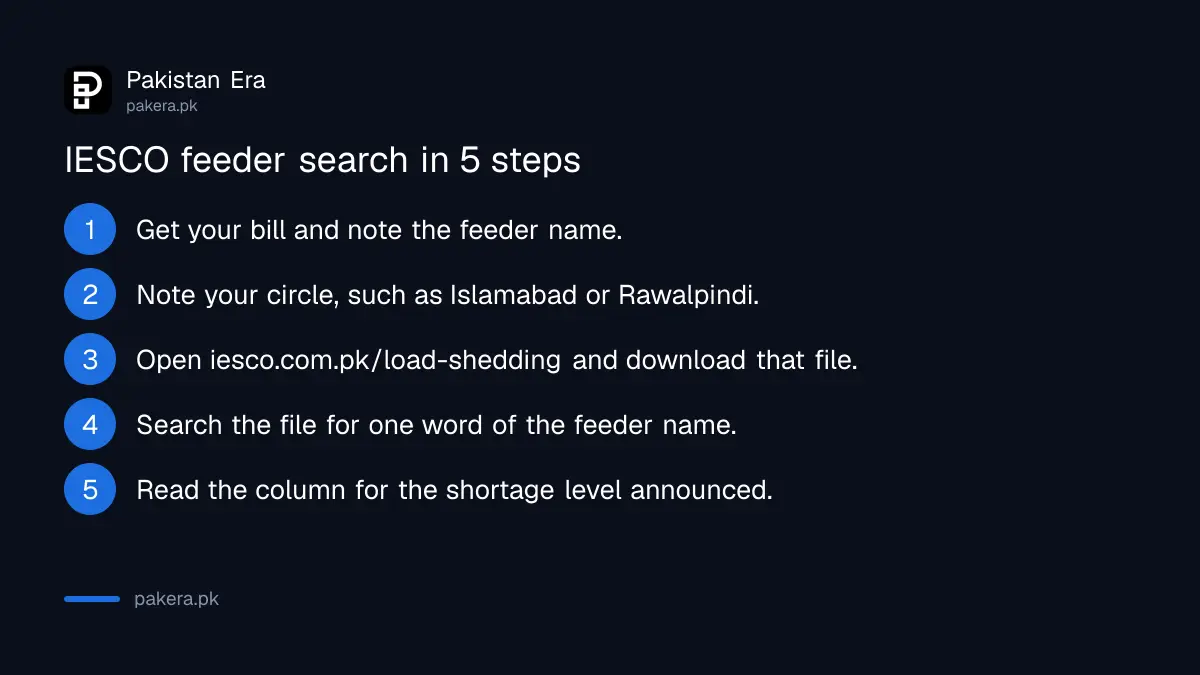
You need your bill, because the feeder name is printed on PITC bills. Without a paper copy, print a free duplicate first. Then match the feeder name in the Excel file for your circle and read your row.
- Open your IESCO bill online with the 14 digit reference number, or take any recent paper bill.
- Note the feeder name on the bill, and which circle you are in: Islamabad, Rawalpindi, Attock, Jhelum, Chakwal or AJK.
- Open iesco.com.pk/load-shedding and press "Click to View" beside your circle. The Excel file downloads.
- Search the file for your feeder name. If several match, use the feeder code or the grid name to pick the right row.
- Read across to the 2 hour column for light shortages, or to the level IESCO announces on a bad day.
Feeder names in the files are written in capitals and sometimes abbreviated, such as "NEW MARVI ( MARVI ROAD )". Search for one distinctive word rather than the full name.
The file date and the planned shutdown list are two different things
IESCO labels all six files "Sep-2026", but the files themselves sit in a January 2026 folder and the server dates them 14 January 2026. Treat them as IESCO's standing 2026 plan. Repair shutdowns are listed separately on IESCO's maintenance schedule page.
That difference matters. Load shedding is a cut forced by a power shortage, and it follows this rota. A planned shutdown is a cut IESCO chooses so it can repair a line or change a transformer, and it can last several hours in one go. Those appear on the maintenance schedule, explained in checking planned shutdowns in IESCO areas.
If your area is losing power far more often than any column shows, or at times outside your slots, it may be a fault or a loss based cut. NEPRA has rules on that, and checking whether your load shedding is legal walks through how to complain.
Planning around the schedule saves money and stress
Knowing your one hour slots lets you charge phones and the UPS before each cut, pump water before it, and avoid running heavy appliances just after power returns. On the 2 hour level, most feeders lose only one daytime hour.
- Charge the UPS and phones in the hour before your slot, not during the evening peak. IESCO's area follows the national electricity peak hours.
- If you are choosing a UPS, size it for one hour of your essential load, since each slot is one hour long.
- For a complaint about cuts outside your slot, call 118 and give your feeder name and code from the file.
Common questions
Where is the IESCO load shedding schedule?
On iesco.com.pk/load-shedding, as six Excel files: Islamabad, Rawalpindi City and Cantt, Attock, Jhelum, Chakwal and AJK.
How do I find my feeder name?
It is printed on your IESCO bill. Print a free duplicate with your 14 digit reference number if you have no paper copy.
Does IESCO cut power every day at these times?
No. IESCO's heading says the schedule is applied according to generation shortfall or a frequency problem, so it is used only when there is a shortage.
How long is each IESCO load shedding slot?
One hour. A feeder gets two slots a day at the 2 hour level and up to twelve at the 12 hour level.
Is Murree in the IESCO schedule?
Yes. Murree grid feeders are in the Islamabad circle file, with 14 feeders listed.
Who do I call if power goes outside my slot?
Call 118 or send an SMS to 8118, and give your feeder name and code.
How we verified this
What we checked, where we read it, and what we could not confirm.
Last checked 24 October 2026. We read the IESCO Loadshedding Management page and downloaded all six Excel files it links, then counted feeders and grid stations ourselves and read the slot times row by row. The heading about generation shortfall and the column names come from the files. The January 2026 file date comes from the server's own date on each download. The complaint numbers come from the IESCO homepage. We could not confirm which level, if any, IESCO is applying today, because the page does not say.
About the author

Senior Writer, Public Services and Technology
Shahid joined us in 2024 as an author. He is a senior contributor to Pakistan's leading technology websites. He writes detailed articles, mostly covering his expertise in the latest tech, mobiles, apps, gadgets, and step-by-step guides. His ideology is to help people understand the latest trends and explain complex methods through very easy-to-understand guides.