IMF Fiscal Monitor October 2026 on Pakistan: Revenue 15.3%, Spending 18.8% and a 2% Primary Surplus in FY27
The IMF's October 2026 Fiscal Monitor puts Pakistan's revenue at 15.3% of GDP, spending at 18.8% and the primary surplus at 2% in FY27. See what interest costs.
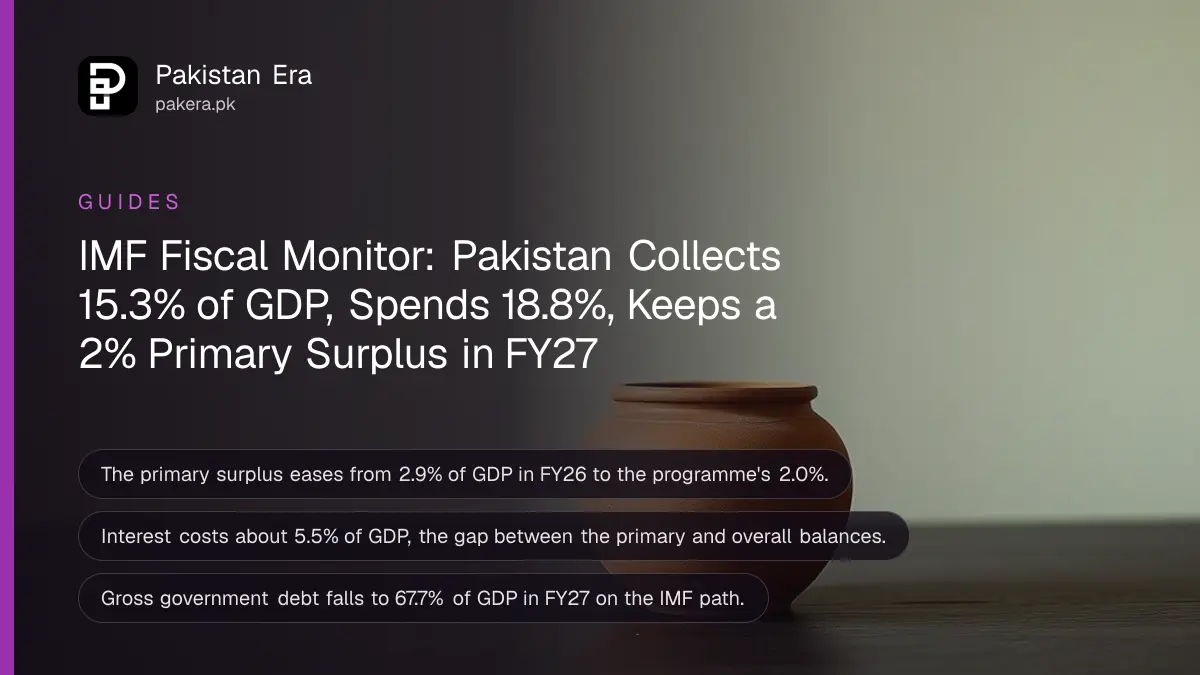
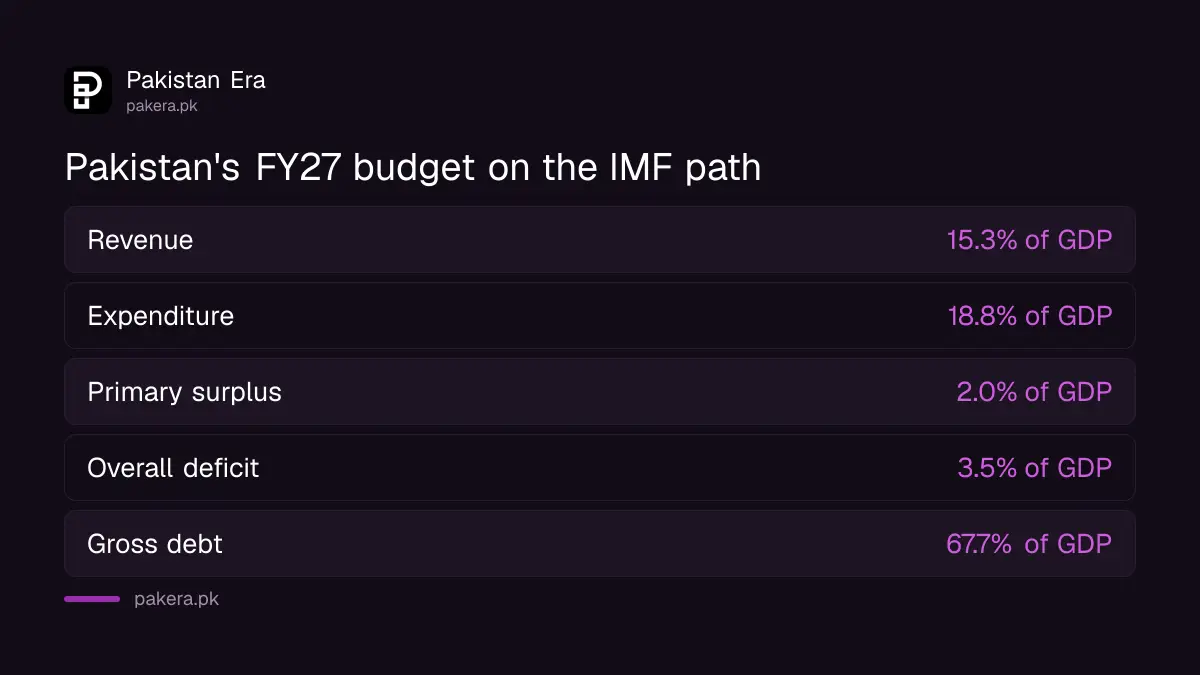
The IMF's October 2026 Fiscal Monitor expects Pakistan's government to collect revenue worth 15.3 per cent of GDP in FY27, spend 18.8 per cent, and run a primary surplus of 2.0 per cent, down from 2.9 per cent in FY26. The primary surplus is the budget balance before interest, and 2.0 per cent is exactly the figure the IMF programme requires for this year. The Monitor's path says Pakistan is expected to hit it, not beat it.
We pulled Pakistan's fiscal series from the IMF's data service on 19 October 2026. Revenue, expenditure and the primary balance are labelled "Fiscal Monitor (October 2026)"; the overall deficit and gross debt are labelled "World Economic Outlook (October 2026)". The IMF names each financial year by the June it ends in, so "2027" is the FY27 budget year, July 2026 to June 2027.
Revenue holds near 15 per cent of GDP, lower than the 15.8 per cent peak of FY25
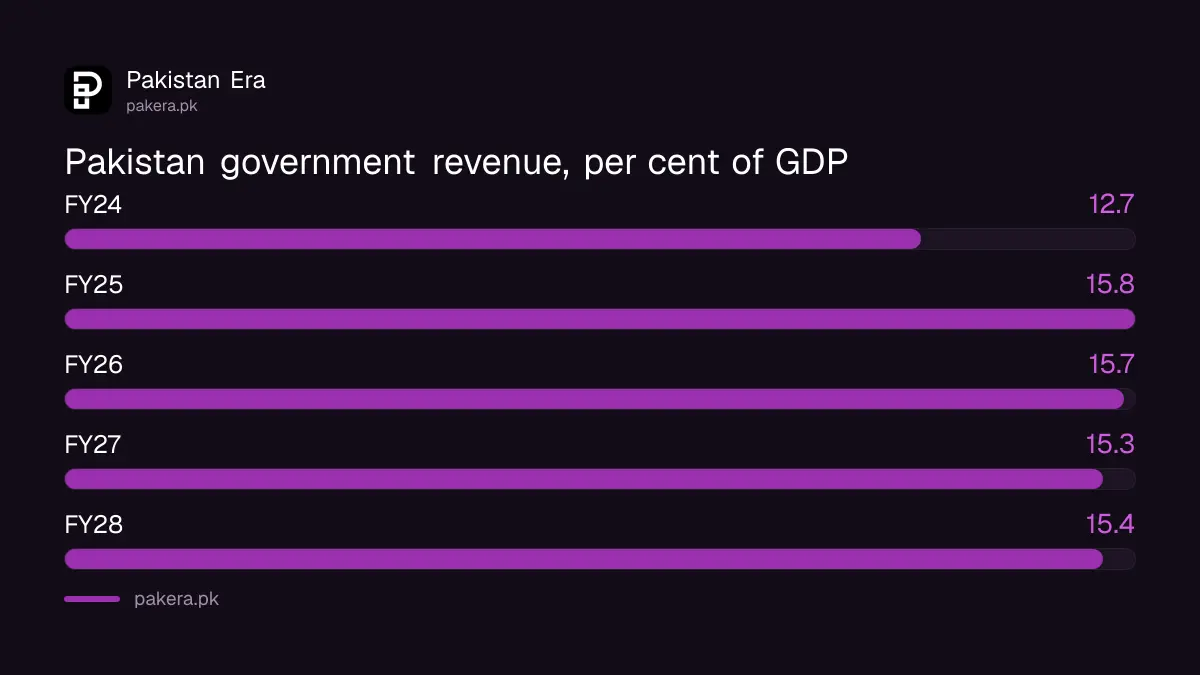
Government revenue was 12.7 per cent of GDP in FY24, jumped to 15.8 per cent in FY25, and the IMF puts it at 15.7 per cent in FY26, 15.3 per cent in FY27 and 15.4 per cent in FY28. The jump in FY25 came from the tax measures of that budget. The slight slide after it says the IMF does not expect the same pace of new taxes, only that the base keeps up with the economy.
| Financial year | Revenue, % of GDP | Expenditure, % of GDP | Primary balance, % of GDP | Overall balance, % of GDP |
|---|---|---|---|---|
| FY24 (to June 2024) | 12.7 | 19.4 | +1.0 | -6.8 |
| FY25 | 15.8 | 21.2 | +2.4 | -5.4 |
| FY26 | 15.7 | 18.3 | +2.9 | -2.6 |
| FY27 | 15.3 | 18.8 | +2.0 | -3.5 |
| FY28 | 15.4 | 18.6 | +2.0 | -3.2 |
For a taxpayer, 15.3 per cent of GDP is the size of the state's take from the whole economy. The IMF's asks for FY27 are about where that take comes from rather than how big it is: risk-based audits, digital invoicing and third-party data, which it listed in its 7 October statement, as our report on what the IMF asked of Pakistan set out.
Spending rises to 18.8 per cent of GDP in FY27, after a sharp cut in FY26
Expenditure fell from 21.2 per cent of GDP in FY25 to 18.3 per cent in FY26, a cut of nearly three points in one year. The IMF expects it to rise again to 18.8 per cent in FY27 and settle at 18.6 per cent in FY28. The FY26 cut is what produced the 2.6 per cent deficit, the lowest in years, which the Finance Division's own table confirmed in our report on the FY26 fiscal deficit of Rs 3.31 trillion.
The half point rise in FY27 has a home. The IMF wants health and education spending to go from 2.5 per cent of GDP in FY26 to 2.8 per cent in FY27, and it wants targeted cash transfers to grow. Those two items alone account for the increase the Monitor shows. Spending is not being cut further; it is being moved.
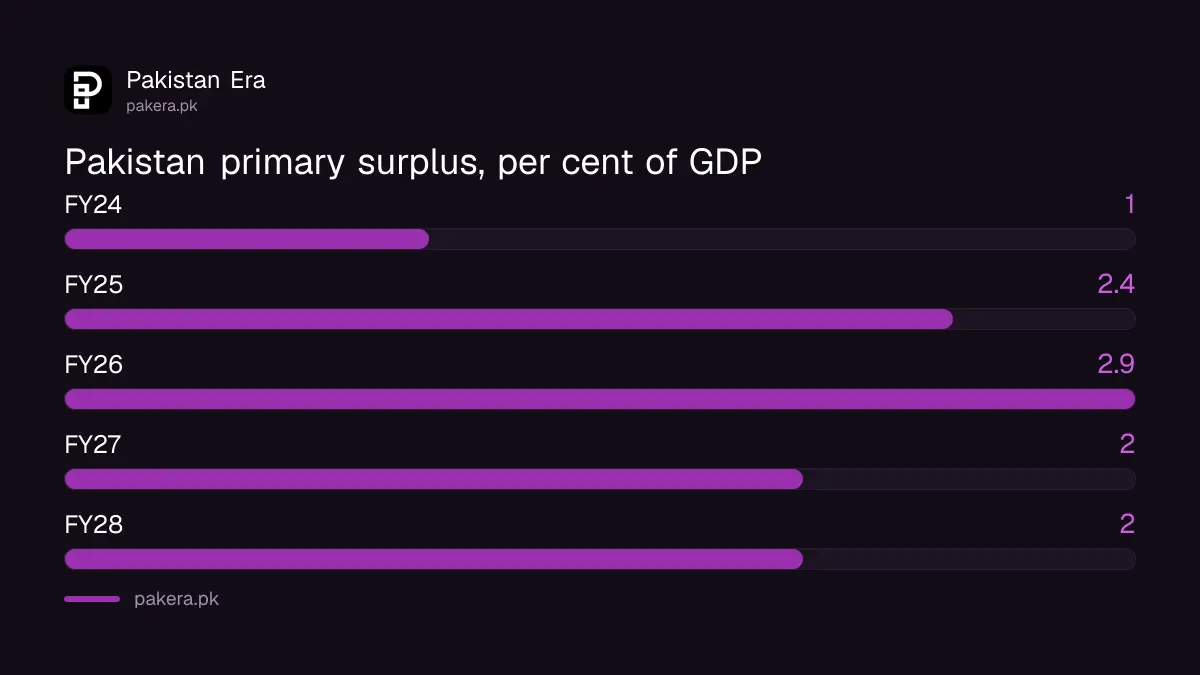
The primary surplus eases from 2.9 per cent to the 2.0 per cent the programme demands
A primary surplus of 2.9 per cent of GDP in FY26 was the best in the series and well above the programme floor. For FY27 the IMF expects 2.0 per cent, which is the "underlying primary surplus of 2.0 percent of GDP" its statement says the FY27 budget is anchored on. It holds at 2.0 per cent in FY28.
Read together with revenue and spending, the arithmetic is tight. Revenue falls 0.4 points and spending rises 0.5 points, so the surplus gives up 0.9 points. Any slip in collection, or any new subsidy outside the budget, would push the surplus under 2.0 per cent and into a programme problem. That is the context for the IMF's demand that the fuel relief scheme be phased out, which our report on the fuel scheme phase-out covers.
Interest still eats about 5.5 per cent of GDP, the gap between the two balances
The difference between the primary balance and the overall balance is interest. In FY26 that gap is 2.9 plus 2.6, or 5.5 per cent of GDP. In FY27 it is 2.0 plus 3.5, again 5.5 per cent. Our arithmetic from the IMF's two series, and it matches the Finance Division's outturn of Rs 6.95 trillion of interest in FY26, which our report on Pakistan's Rs 6.95 trillion interest bill showed was 35 per cent of revenue.
So the state earns a surplus before interest of 2 to 3 per cent of GDP and still borrows 2.6 to 3.5 per cent of GDP to pay the interest on past debt. That is why the IMF's statement spends a paragraph on lowering debt service costs and lengthening maturities. Every point shaved off the interest line is a point that does not have to come from taxpayers or from the development budget.
Debt falls to 67.7 per cent of GDP in FY27 on the IMF's path
General government gross debt is expected at 69.8 per cent of GDP in FY26, 67.7 per cent in FY27 and 64.5 per cent in FY28, down from 78.5 per cent in FY23. The ratio falls because nominal GDP grows faster than the debt, not because debt is repaid in absolute terms. A primary surplus of 2 per cent and growth of 3.5 per cent, the IMF's own forecast, are what make the line go down.
If you want to check the numbers yourself, the IMF publishes them without a login. Here is the route.
- Open the IMF DataMapper and select Pakistan.
- Under fiscal indicators choose Revenue, Expenditure or Primary net lending/borrowing. The source line should read "Fiscal Monitor (October 2026)".
- For the overall balance and gross debt choose the World Economic Outlook indicators, labelled "(October 2026)".
- Read each year as the financial year ending in June of that year.
- Subtract the overall balance from the primary balance to get the interest share, as we did above.
Common questions
What primary surplus does the IMF expect from Pakistan in FY27?
2.0 per cent of GDP, down from 2.9 per cent in FY26, according to the October 2026 Fiscal Monitor series. That is the figure the IMF programme requires for the FY27 budget.
What is a primary surplus?
The budget balance before interest payments. Pakistan runs a primary surplus but an overall deficit, because interest costs about 5.5 per cent of GDP a year.
How much revenue does the IMF expect Pakistan to collect?
15.3 per cent of GDP in FY27 and 15.4 per cent in FY28, slightly below the 15.8 per cent of FY25 and 15.7 per cent of FY26.
What will the fiscal deficit be in FY27?
3.5 per cent of GDP on the IMF's October 2026 projection, up from 2.6 per cent in FY26.
Is Pakistan's debt falling?
As a share of GDP, yes: from 69.8 per cent in FY26 to 67.7 per cent in FY27 and 64.5 per cent in FY28 on the IMF's path. The rupee amount still grows.
How we verified this
What we checked, where we read it, and what we could not confirm.
Last checked 19 October 2026. Revenue, expenditure and primary balance are the Fiscal Monitor (October 2026) series, and the overall balance and gross debt are the World Economic Outlook (October 2026) series, for Pakistan on the IMF DataMapper, read through the IMF's data interface on 19 October 2026 and rounded to one decimal. The 2.0 per cent anchor and the health and education targets are from the IMF's 7 October 2026 statement. The interest share is our subtraction. We could not open the Fiscal Monitor report itself, so the country notes behind these series are unread.
About the author

Global Affairs & Political Economy Writer
Muhammad Hatim is a book lover who started writing because he enjoys it. At Pakistan Era he writes about international relations, geopolitics and the global economy, with a particular interest in South Asia and the forces behind current events.