Income Tax on Shop and Factory Electricity Bills in Pakistan: 10% Up to Rs 20,000
Section 235 charges 10% income tax on shop and factory power bills up to Rs 20,000, then Rs 1,950 plus 12% or 5%. Work out your bill and the part you can claim.
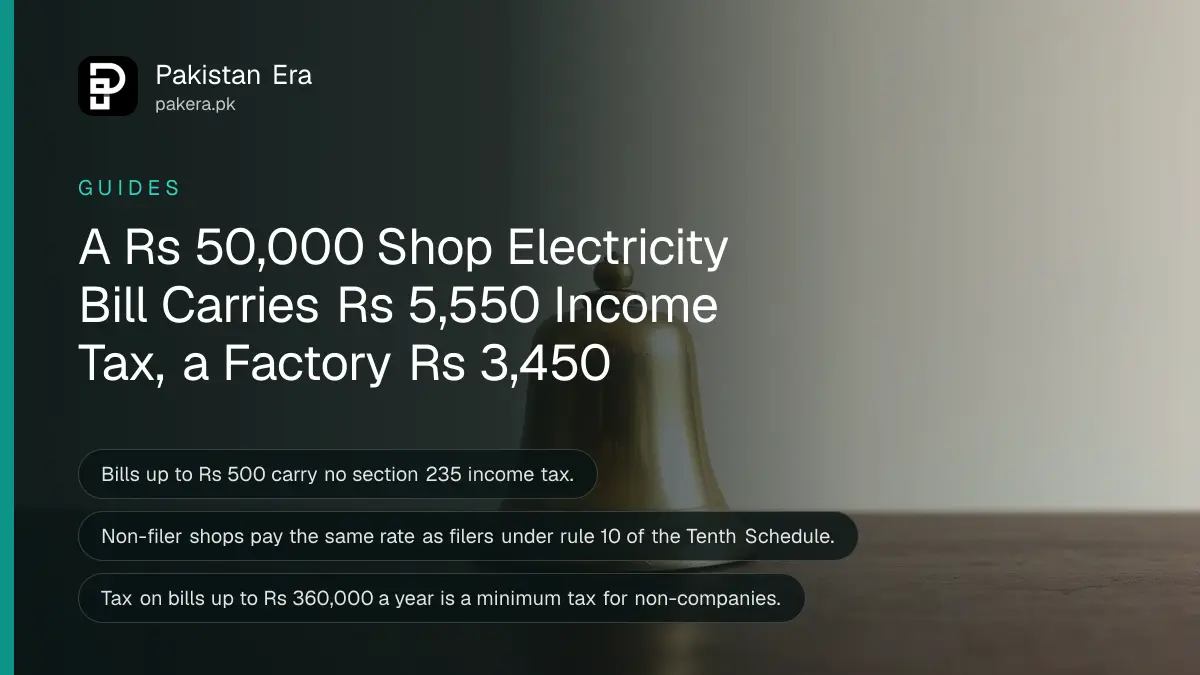
A shop or factory electricity bill in Pakistan carries advance income tax under section 235 of the Income Tax Ordinance, 2001. Bills up to Rs 500 pay nothing. From Rs 501 to Rs 20,000 the tax is 10 per cent of the bill. Above Rs 20,000 it is Rs 1,950 plus 12 per cent of the excess for shops, or plus 5 per cent for factories.
So a shop with a Rs 50,000 bill pays Rs 5,550 of income tax on top of its electricity charges. A factory with the same bill pays Rs 3,450. We worked these out from the rate table in the Ordinance as amended up to 30 June 2026, which we read on FBR's website on 20 October 2026. Being on the Active Taxpayers List does not lower these business rates.
The section 235 rates for commercial and industrial bills
Division IV of Part IV of the First Schedule sets the rate on the gross bill of a commercial or industrial consumer. Up to Rs 500 it is zero. Up to Rs 20,000 it is 10 per cent. Above that, shops and factories split into two different rates.
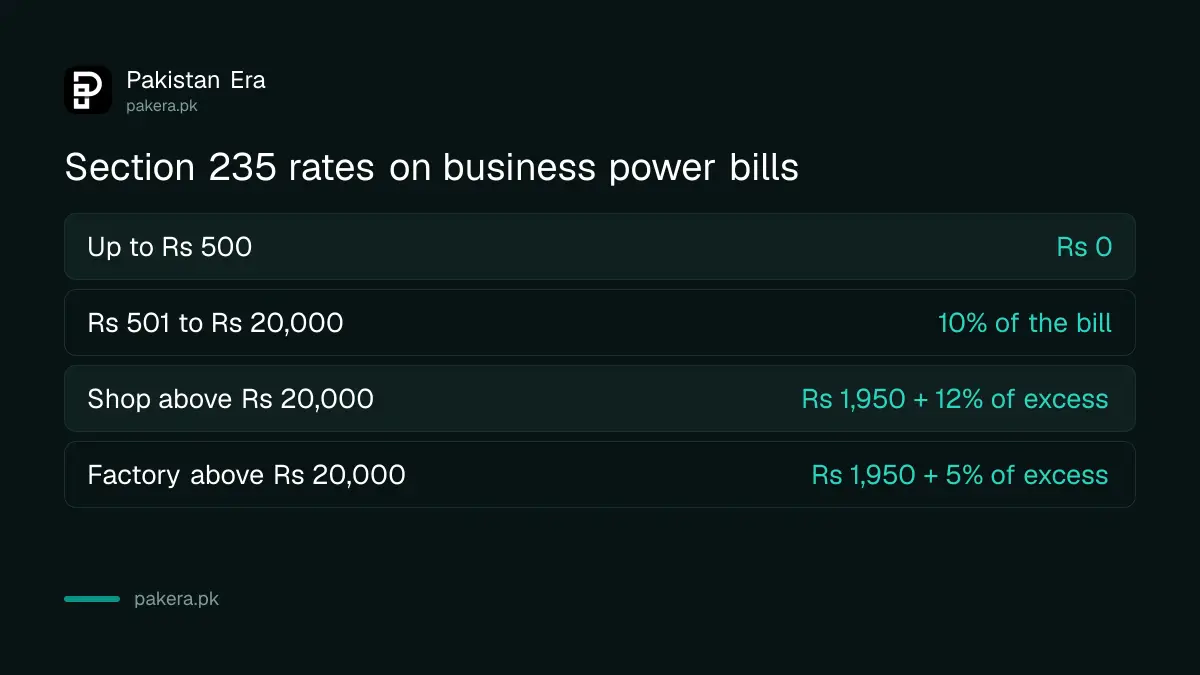
| Gross monthly bill | Shop or other commercial | Factory or industrial |
|---|---|---|
| Up to Rs 500 | Rs 0 | Rs 0 |
| Rs 501 to Rs 20,000 | 10% of the bill | 10% of the bill |
| Above Rs 20,000 | Rs 1,950 plus 12% of the amount above Rs 20,000 | Rs 1,950 plus 5% of the amount above Rs 20,000 |
FBR's withholding tax rate card for tax year 2027 gives the same figures. The card itself says the Ordinance prevails if the two ever differ, so we used the Ordinance as the main source.
One oddity is worth knowing. At exactly Rs 20,000 the tax is Rs 2,000. Just above it, the top band starts at Rs 1,950. So a shop bill of Rs 20,200 carries Rs 1,974, a little less than a Rs 20,000 bill. The dip closes at about Rs 20,417 for shops and Rs 21,000 for factories.
The tax is worked out on the whole bill, sales tax included
Section 235 says the bill means the electricity bill "inclusive of sales tax and all incidental charges". So the percentage applies to the full amount on the bill, not just the cost of units. The company that prepares the bill charges the tax in the same way it charges for electricity.
This matters more than it looks. Sales tax and other charges make up a large share of a commercial bill, as our breakdown of the commercial electricity rate for shops shows. Income tax is then charged on top of all of it.
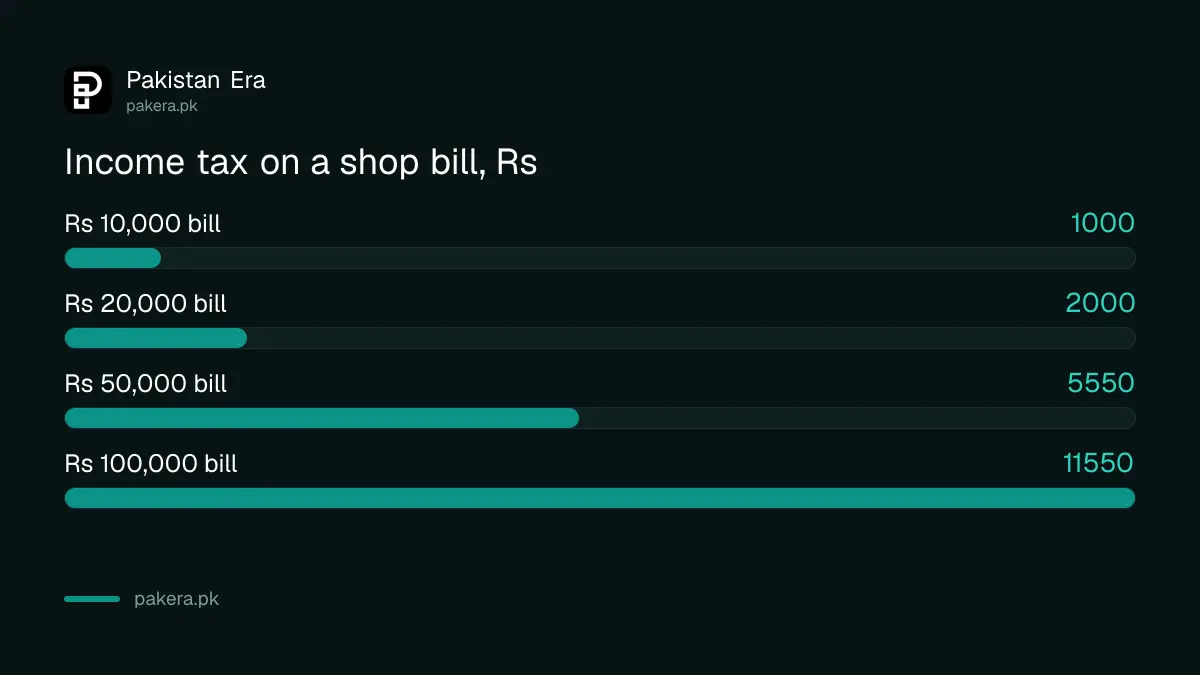
| Gross bill | Shop pays | Factory pays |
|---|---|---|
| Rs 5,000 | Rs 500 | Rs 500 |
| Rs 15,000 | Rs 1,500 | Rs 1,500 |
| Rs 30,000 | Rs 3,150 | Rs 2,450 |
| Rs 50,000 | Rs 5,550 | Rs 3,450 |
| Rs 100,000 | Rs 11,550 | Rs 5,950 |
| Rs 500,000 | Rs 59,550 | Rs 25,950 |
These are our own sums from the table. For a Rs 100,000 bill, the shop pays 11.55 per cent and the factory 5.95 per cent.
A non-filer shop pays the same rate as a filer
Most withholding taxes double for people not on the Active Taxpayers List (ATL). Section 235 is an exception. Rule 10 of the Tenth Schedule lists taxes where the higher non-ATL rate does not apply, and clause (i) names section 235.
Homes work differently. A domestic consumer on the ATL pays no section 235 tax at all, and a domestic consumer not on the list pays 7.5 per cent once the monthly bill reaches Rs 25,000. That rule is covered in our report that filers pay no advance tax on home electricity. For shops and factories, filing your return still matters for other taxes, so check where you stand on the Active Taxpayers List.
Part of the tax is a minimum tax you cannot get back
For an individual or a firm that is not a company, tax collected on bills up to Rs 360,000 a year is a minimum tax with no refund. Tax on a monthly bill above Rs 30,000 is adjustable. For a company, all of it can be adjusted against the final tax bill.
Take a shop owner with a steady Rs 25,000 bill. The tax is Rs 2,550 a month, or Rs 30,600 a year. The year's bills come to Rs 300,000, below the Rs 360,000 line. So the whole Rs 30,600 is a minimum tax for that shop, even if its income tax works out lower.
Bigger bills are less clear. The law does not give an example of how one bill above Rs 30,000 splits between the two parts. If your bills run well above that, ask a tax adviser before you claim the credit in your return.
Check the tax on your bill in five steps
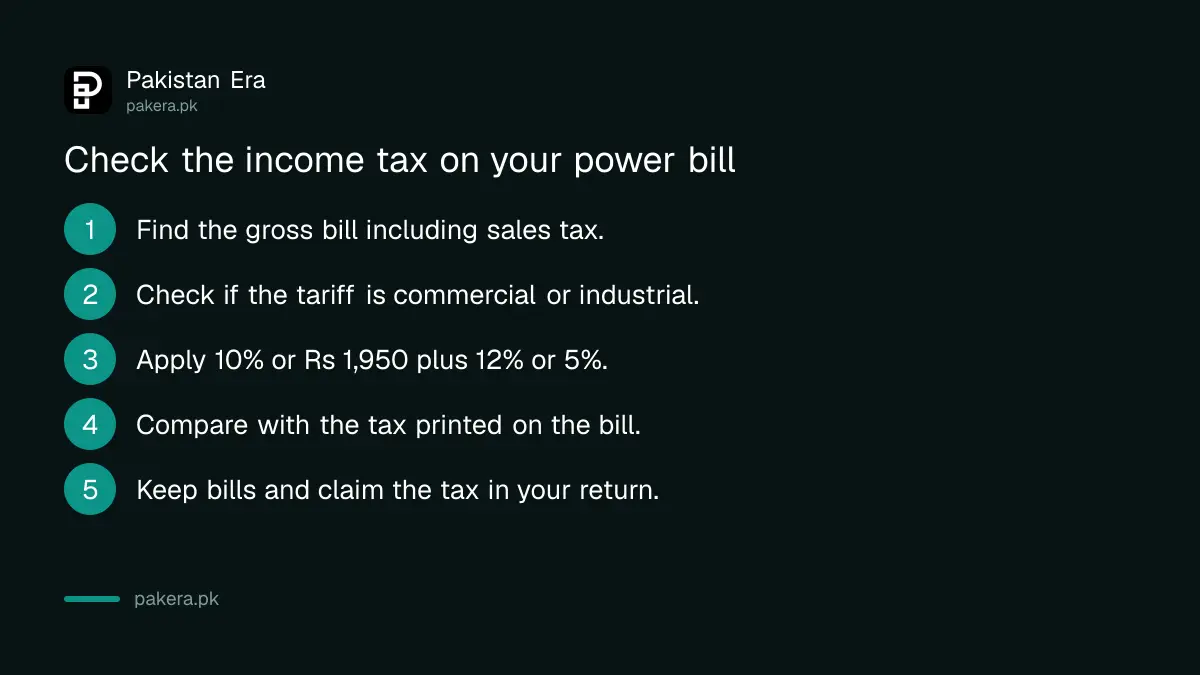
You can check the figure yourself with the bill and a calculator. Find the gross amount, apply the right band for a shop or a factory, and compare it with the income tax shown. Then keep the bill, because the adjustable part counts as tax already paid.
- Find the gross amount of the bill, including sales tax and all other charges.
- Check your tariff type on the bill: commercial or industrial.
- Apply the band: 10 per cent up to Rs 20,000, or Rs 1,950 plus 12 or 5 per cent of the excess.
- Compare your answer with the income tax amount printed on the bill.
- Keep every bill for the year and enter the tax in your return as tax deducted.
The tax shows up in your income tax return as tax already paid. The credit only counts where the money actually reached the treasury, a rule explained in our piece on claiming withholding tax credit.
Some businesses can stop the tax with a certificate
Section 235(3) says the tax shall not be collected from a person who gets a certificate from the Commissioner. The certificate must show the income is exempt, or advance tax was already paid under section 147, or all income falls in the final or minimum tax regime.
That is a narrow door. Most shopkeepers will not qualify. But an exempt body, or a business whose whole income is taxed under a final regime, should ask its Commissioner Inland Revenue before paying for a full year.
Common questions
How much income tax is on a Rs 10,000 shop electricity bill?
Rs 1,000, which is 10 per cent of the gross bill, under section 235 and Division IV of the First Schedule.
Do non-filer shopkeepers pay double tax on electricity?
No. Rule 10(i) of the Tenth Schedule keeps section 235 out of the higher non-ATL rate, so filers and non-filers with commercial meters pay the same.
Is the tax worked out before or after sales tax?
After. The Ordinance says the bill means the amount inclusive of sales tax and all incidental charges.
Can I get a refund of electricity income tax?
For a non-company, tax on bills up to Rs 360,000 a year is a minimum tax and cannot be refunded. Tax on monthly bills above Rs 30,000 is adjustable, and a company can adjust all of it.
Why is the factory rate lower than the shop rate?
Above Rs 20,000 the law charges 12 per cent of the excess for commercial consumers and 5 per cent for industrial ones. The Ordinance does not give a reason.
Did the 2026 budget change these rates?
These are the rates in the Ordinance as amended up to 30 June 2026, which includes the Finance Act 2026, and FBR's tax year 2027 rate card shows the same figures.
How we verified this
What we checked, where we read it, and what we could not confirm.
Last checked on 20 October 2026. We read section 235, Division IV of Part IV of the First Schedule and rule 10 of the Tenth Schedule in the Income Tax Ordinance, 2001 amended up to 30 June 2026, and the commercial and industrial rows of the FBR withholding tax rate card for tax year 2027. All worked figures are our own. We did not see how each power company prints the tax line, and we could not confirm how a bill above Rs 30,000 is split between minimum and adjustable tax.
About the author

Senior Writer, Public Services and Technology
Shahid joined us in 2024 as an author. He is a senior contributor to Pakistan's leading technology websites. He writes detailed articles, mostly covering his expertise in the latest tech, mobiles, apps, gadgets, and step-by-step guides. His ideology is to help people understand the latest trends and explain complex methods through very easy-to-understand guides.