How to File a Consumer Complaint in Islamabad: Court of Session, 7 Day Reply
Under the Islamabad Consumers Protection Act 1995, a consumer complaint goes to the Court of Session and the seller has 7 days to reply. See steps and proof.
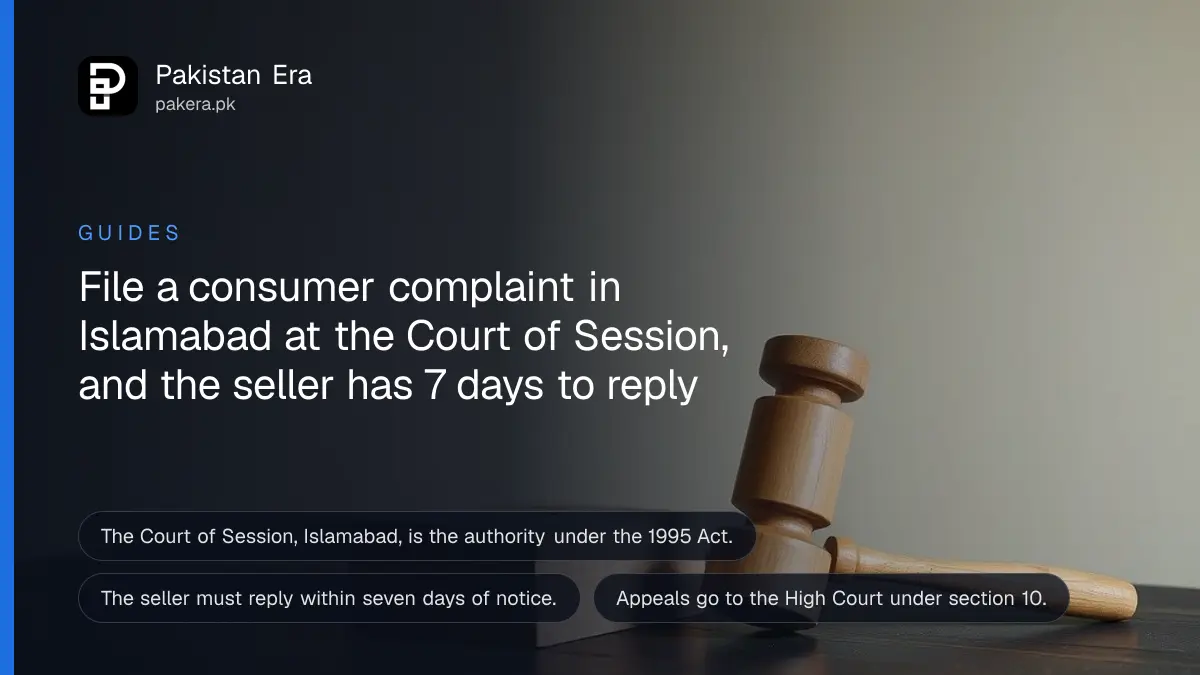
In Islamabad, a consumer complaint under the Islamabad Consumers Protection Act, 1995 goes to the Court of Session, not to a separate consumer court. You file it about goods sold or services provided. The court serves notice, and the seller must reply within seven days. This guide covers the capital only. Other provinces have their own laws.
We read the text of the Act, sections 2, 5, 8, 9 and 10. The Act text we read mentions no filing fee and no notice period before you file. Court rules or practice may add steps, so ask the court office before you go.
The Court of Session is the authority for Islamabad
Section 2 of the Act defines the "Authority" as the Court of Sessions, Islamabad. Under section 8(1), a complainant may file a complaint with the Authority about goods sold or delivered, a service provided, or an unfair trade practice.
That differs from Punjab, Sindh, Khyber Pakhtunkhwa and Balochistan, which have their own consumer courts or portals. Our guide to consumer court complaints in Pakistan gives the general picture, and the one on Punjab's complaint portal shows the contrast.
The Act also lets the Consumer Council make a complaint on its own about an unfair trade practice that comes to its notice. That is section 8(2).
You must be a buyer, not a reseller
Under section 2(3), a consumer is a person who buys goods for a consideration, or hires goods or services for a consideration. It includes users and beneficiaries. It excludes someone who obtains goods for resale or for commercial purposes.
"Services" is defined widely in section 2(5). It includes banking, financing, insurance, transport, construction work, medicine, education, catering and the supply of electrical or other energy. So a complaint about a service can be a consumer complaint, not only a complaint about a product.
"Unfair trade practice" in section 2(6) includes hoarding, black marketing, adulteration, selling expired drugs and food unfit for human consumption, and false statements about quality or performance.
Write the complaint with proof attached
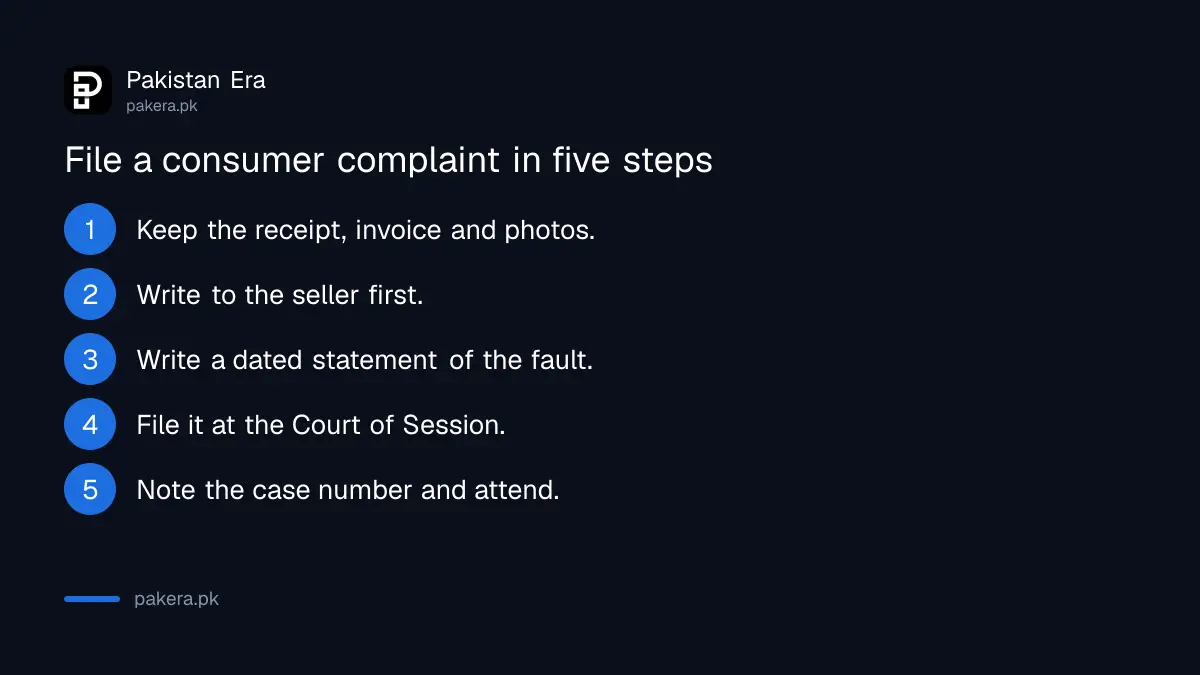
The Act does not set a form. Treat the complaint as a short written statement to the court. State who you are, who the seller is, what you bought, what went wrong and what you want.
- Keep the receipt, invoice, order message and any photos of the fault.
- Write to the seller first and keep a copy of your complaint and any reply.
- Write a dated statement: what you bought, the price, the fault and the remedy you want.
- File it at the Court of Session, Islamabad, with copies of your documents.
- Note the case number, and attend when the court serves the seller and fixes a date.
For an electronics fault, the warranty claim guide shows how to build the paper trail before you go to court.
The seller has seven days to reply
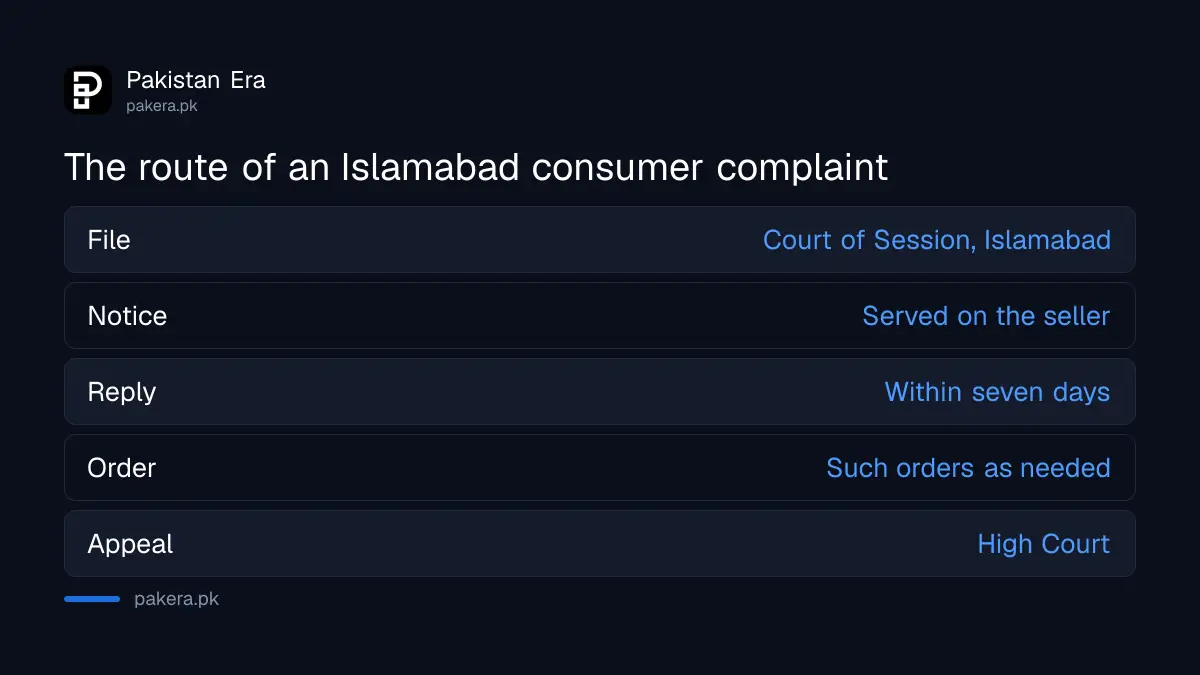
Under section 8(3), when the Authority finds that consumer rights may have been infringed, it has notice of the complaint served on the respondent. The respondent must give a reply within seven days. After hearing both sides, the Authority may pass such orders as the circumstances require, under section 8(4).
The Act sets no deadline for the final decision. So do not expect a fixed date. Ask the court for the next hearing date each time.
| Step | What the Act says | Section |
|---|---|---|
| File | Complaint to the Authority, the Court of Session | 8(1) |
| Notice | Served on the respondent | 8(3) |
| Reply | Within seven days | 8(3) |
| Order | Such orders as the circumstances require | 8(4) |
| Appeal | To the High Court | 10 |
The court can order compensation
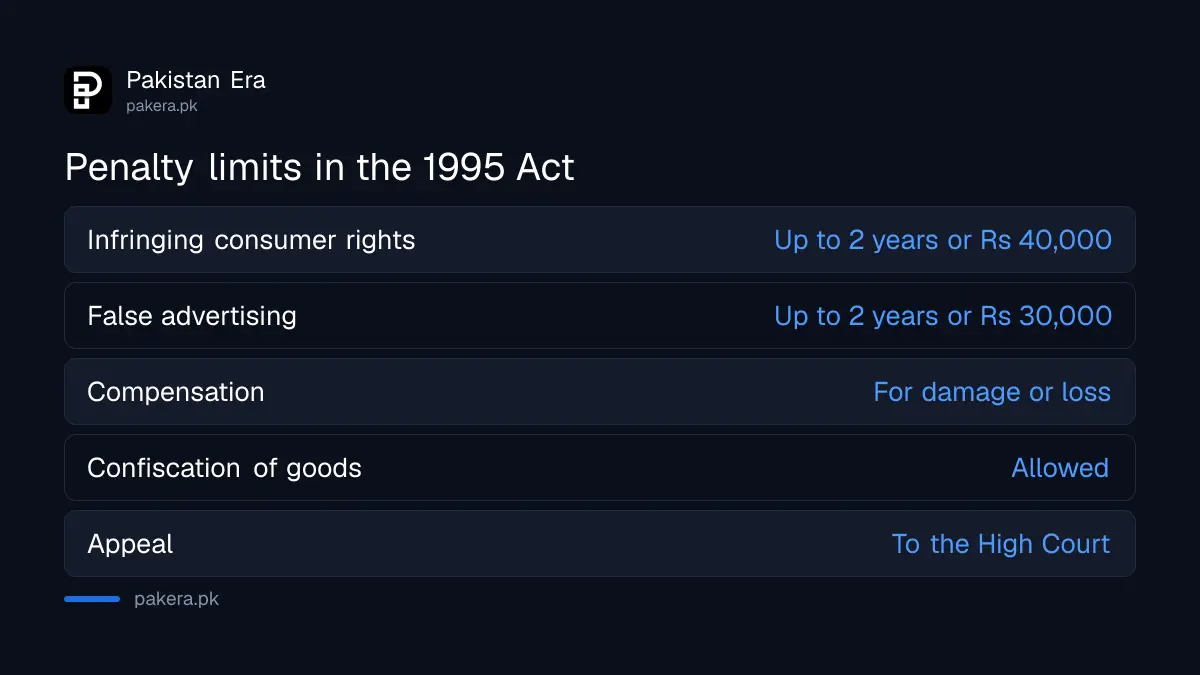
Section 9(3) lets the Authority order payment of compensation to the extent the consumer has suffered damage or loss. Section 9(4) lets it order confiscation or destruction of goods. Infringement of consumer rights is punishable by up to two years in prison or a fine of up to Rs 40,000, or both, under section 9(1).
An appeal against the Authority's order lies to the High Court under section 10, using the appeal rules of the Code of Criminal Procedure, 1898. The fine amounts in the 1995 Act are old. We did not check whether any later amendment changed them, so confirm with a lawyer.
This is general information, not legal advice. For a large claim, speak to a lawyer in Islamabad before filing.
Common questions
Where do I file a consumer complaint in Islamabad?
You file it with the Court of Session, Islamabad, which the Act names as the Authority.
Is there a fee or a notice I must send first?
The Act text we read mentions neither. Ask the court office about fees and forms, because court rules may differ.
How long does the seller have to reply?
The respondent must reply within seven days of being served notice, under section 8(3).
Can I get my money back?
The Act allows the Authority to order compensation for damage or loss, section 9(3). It does not use the word refund, so the order depends on your case.
Does this law apply in Lahore or Karachi?
No. It covers Islamabad. Punjab, Sindh, Khyber Pakhtunkhwa and Balochistan have their own consumer laws.
How we verified this
What we checked, where we read it, and what we could not confirm.
Last checked on 13 October 2026, Pakistan time. We read the text of the Islamabad Consumers Protection Act, 1995. We did not read any Islamabad court notice, so we have not confirmed fees, forms or hearing practice. We did not check later amendments. The steps in the numbered list are our own plain-language ordering of the Act.
About the author

Public Services and Education Journalist
Fajr Riaz is a journalist and content writer at Pakistan Era, based in Lahore. She covers the questions people meet in everyday life in Pakistan: how a public service works, what a change in the rules means, and where to find a reliable answer.