Joint Account Filer Status in Pakistan: One Filer Is Enough, and the Rule for a Child's Account
FBR treats a joint bank account as a filer account if one holder is on the ATL, and a child's account if a parent is. See how to make your bank apply it.
A joint bank account in Pakistan counts as a filer account if any one of its holders is on FBR's Active Taxpayers List, and an account in a child's name counts as a filer account if a parent, guardian or anyone who deposits money in it is on the list. FBR states both rules on its ATL page. If your bank still charges the non-filer rate on such an account, it has missed the rule, and you can ask it to apply it.
This matters because banks charge non-filers more on cash withdrawals and deduct more tax on profit. A family that opened a joint account with an elderly parent, or a savings account for a child, often pays the higher rate for years without knowing why. Below are the two rules, where they make a difference, how to check each holder, and how to get the bank to fix it.
One filer is enough for a joint account
FBR's page on inclusion in the ATL says joint account holders, as an entity, are deemed part of the ATL if any of the persons in the joint account meets the criteria. So a joint account with one filer and one non-filer should be treated as a filer account.
The rule works in your favour in the most common family case. A husband who files and a wife who does not, or a working son and a retired father, can share an account and still get filer treatment. It does not make the non-filer a filer for anything else. That person's own phone tax, car registration and property deals still go at non-filer rates.
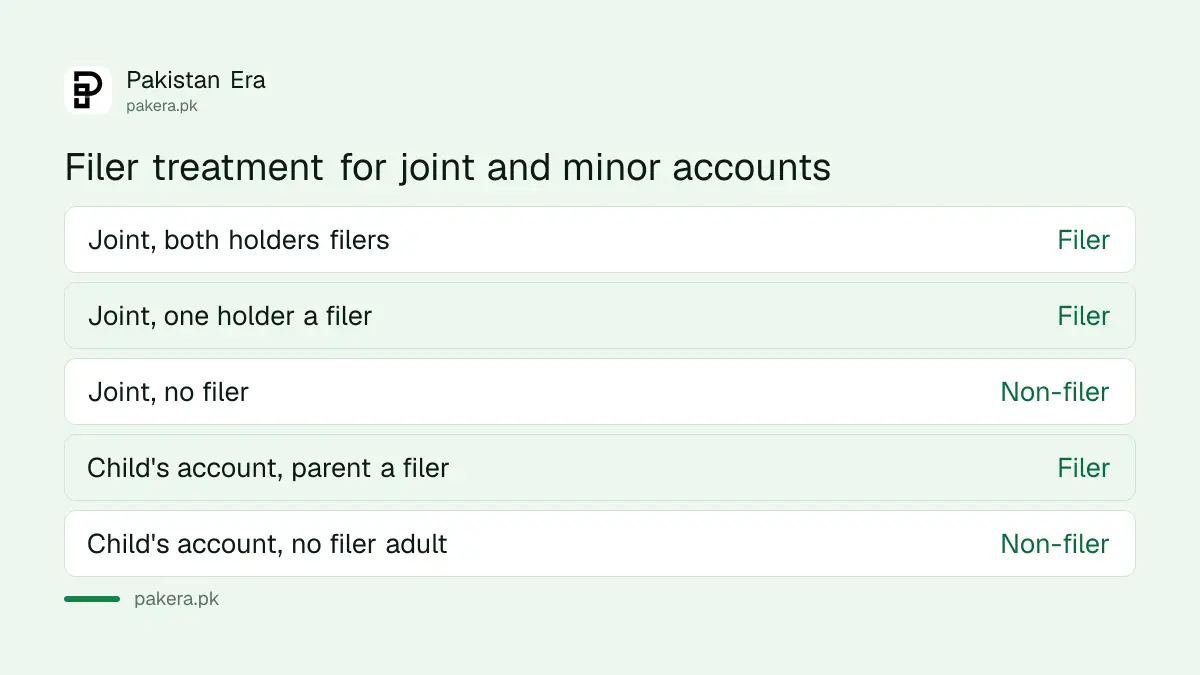
| Account | Holders on the ATL | Treated as |
|---|---|---|
| Joint, two holders | Both | Filer |
| Joint, two holders | One | Filer |
| Joint, two holders | Neither | Non-filer |
| Minor's account | Parent, guardian or depositor on the ATL | Filer |
| Minor's account | No parent, guardian or depositor on the ATL | Non-filer |
A child's account follows the parent, guardian or depositor
FBR's same page says an account held in a minor's name is considered part of the ATL if the minor's parents or guardians, or any person who has deposited money in the account, are on the list. A child cannot file a return, so the account borrows the status of the adults behind it.
The wording "any person who has deposited money" is wide. An uncle who files and deposits Eid money into a niece's account may be enough. In practice the bank needs a CNIC to check, so give it the CNIC of the parent who files, as that is the cleanest link it can verify.
The wealth statement side is separate. Section 116 of the Income Tax Ordinance asks the filer to declare the assets of minor children along with their own. So the account that gets the filer rate through you also belongs in your wealth statement as a child's asset.
The rule changes what the bank deducts
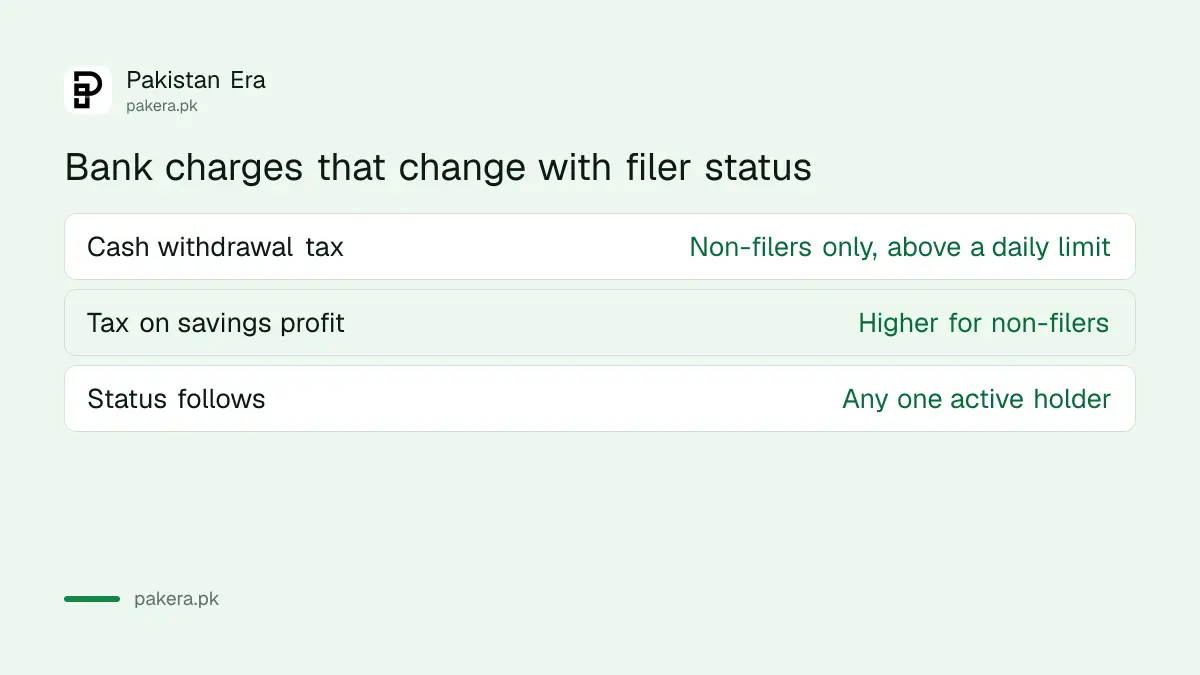
Filer status changes two common bank charges: advance tax on cash withdrawals and tax on profit from savings. On a joint or child's account, the right status can save money every month. The rates themselves change with each budget.
| Bank charge | Where filer status matters |
|---|---|
| Cash withdrawal tax | Charged on non-filers above a daily limit |
| Tax on profit from savings | Higher rate for non-filers |
The current figures are in cash withdrawal tax for non-filers and tax on bank profit and savings. The filer vs non-filer rates for 2026-27 list every other place the gap shows.
Check each holder's status before you go to the bank
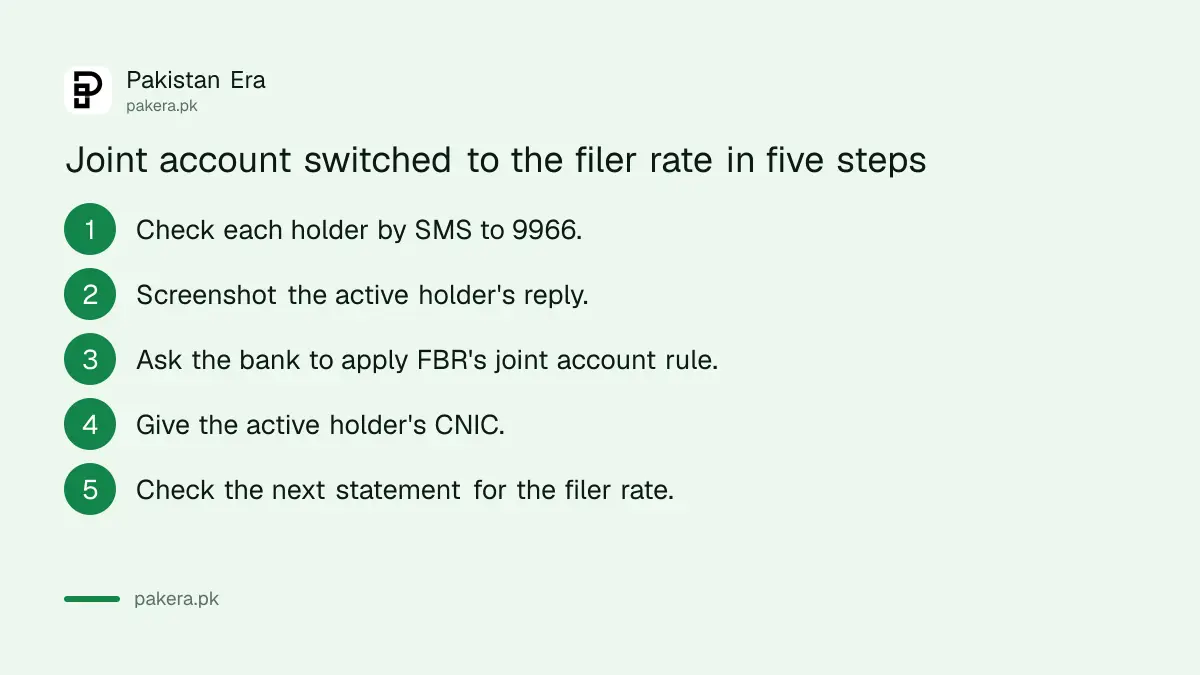
Check every holder by SMS first. Send ATL, a space and the 13-digit CNIC to 9966 for each person. If one holder shows active, you have the proof you need for a joint account. For a child's account, check the parent who files.
- Send "ATL" then a space and the first holder's CNIC, without dashes, to 9966.
- Repeat for the second holder, or for the parent or guardian on a child's account.
- Screenshot the reply that shows an active status.
- Visit the branch, or write to the bank's helpline, and ask it to apply FBR's joint or minor account rule.
- Give the CNIC of the holder who is active.
- After a month, check the statement to confirm the filer rate is now used.
The SMS format is on FBR's status page. If a holder filed but still shows inactive, checking your filer status explains the usual reasons, including a return filed after the due date.
A late return can cost the whole account its filer rate
If the only filer on a joint account misses the return date, that person drops off the ATL until the surcharge is paid, and the account loses filer treatment with them. For tax year 2026 the date was 31 October 2026.
Section 182A now charges an individual Rs 25,000 to get back on the list after a late return, or a six-month undertaking not to buy property. The full cost, including the daily penalty, is in the late return penalty after 31 October. For a family that relies on one filer, it is cheaper to put a reminder in two phones than to pay that.
Section 91 is about a child's business, not savings
Section 91 of the Income Tax Ordinance taxes a minor child's business income as the income of the parent with the higher taxable income. It covers business income only, and not a business the child inherited. It does not turn a child's bank profit into the parent's income.
We mention it because people often cite it when talking about children's accounts. The ATL rule above is what decides the bank's deduction rate. Section 91 matters only if the child actually earns business income.
Common questions
Is a joint account a filer account if only one holder files?
Yes. FBR's ATL page says joint account holders are deemed on the list if any of them meets the criteria.
Can my child's bank account get the filer rate?
Yes, if a parent, guardian or a person who deposits money in it is on the ATL, according to FBR's ATL page.
Does a joint account make my wife a filer?
No. The rule covers the account only. Her own tax on phones, cars and property still follows her own status.
How do I check if a holder is on the ATL?
Send ATL, a space and the 13-digit CNIC without dashes to 9966.
My bank deducted the non-filer rate on our joint account. What now?
Show the bank the active holder's status and ask it to apply FBR's joint account rule. Keep the reply in writing.
Should my child's account be in my wealth statement?
Yes. Section 116 includes the assets of minor children in the filer's wealth statement.
How we verified this
What we checked, where we read it, and what we could not confirm.
Last checked 31 October 2026. We read FBR's pages on inclusion in the ATL and on checking active taxpayer status, and sections 91, 116 and 182A of the Income Tax Ordinance amended up to 30 June 2026. We did not ask a bank to re-tag an account, so we cannot say how long each bank takes. FBR's ATL page still shows the old surcharge amounts; we follow the Ordinance.
About the author

Global Affairs & Political Economy Writer
Muhammad Hatim is a book lover who started writing because he enjoys it. At Pakistan Era he writes about international relations, geopolitics and the global economy, with a particular interest in South Asia and the forces behind current events.