Women in Kasur and Kamber Shahdadkot: Get a CNIC and Vote Through the ECP Pilot, December to February
Women in Kasur and Kamber Shahdadkot can get CNIC and vote help under an ECP pilot, December 2026 to February 2027. See who qualifies and what to do right now.
یہ صفحہ اردو میں پڑھیں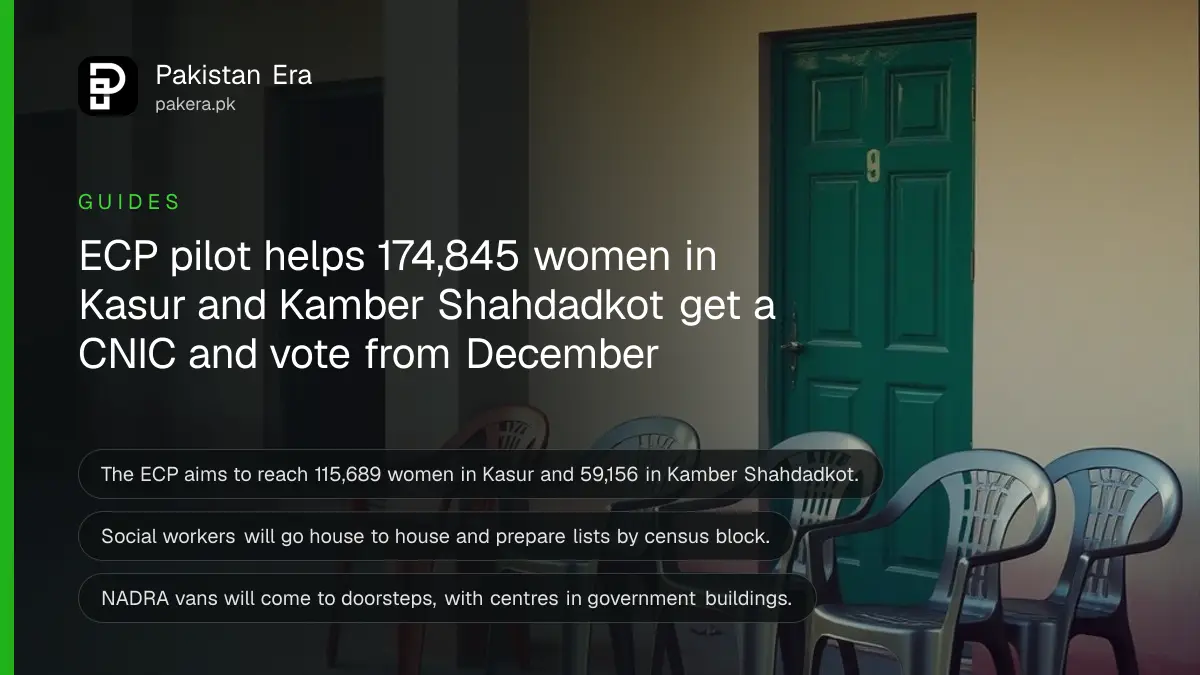
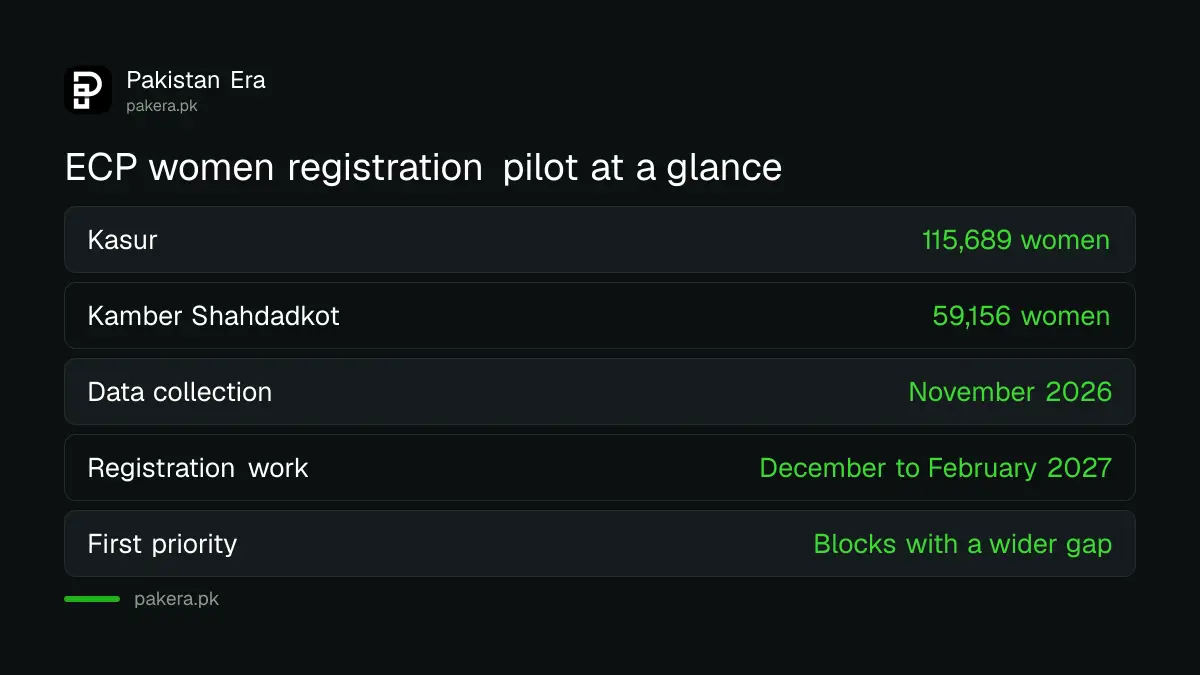
Women in Kasur and Kamber Shahdadkot can get help with a CNIC and voter registration under an Election Commission of Pakistan (ECP) pilot. Data collection is in November 2026 and registration work runs from December 2026 to February 2027. The ECP aims to reach 115,689 women in Kasur and 59,156 in Kamber Shahdadkot.
A woman with no CNIC cannot vote. This project tries to find those women block by block, rather than waiting for them to reach a NADRA office.
We read the ECP's press release dated 31 October 2026, in Urdu, on 7 November 2026. It was listed on the ECP's home page on 2 November. We have not seen the project run on the ground yet.
The pilot covers two districts and runs in two stages
The ECP says the pilot covers Kasur in Punjab and Kamber Shahdadkot in Sindh. Stage one, in November 2026, gathers the data. Stage two, from December 2026 to February 2027, is the actual registration work, with blocks having a wider gap between male and female voters taken first.
A census block is a small area, often one neighbourhood or one part of a village, used to arrange the voter list. The gender gap means the difference between the number of men and women on that list.
| Item | Kasur (Punjab) | Kamber Shahdadkot (Sindh) |
|---|---|---|
| Women to be reached | 115,689 | 59,156 |
| Data collection | November 2026 | November 2026 |
| Registration work | December 2026 to February 2027 | December 2026 to February 2027 |
| First priority | Blocks with a wider gender gap | Blocks with a wider gender gap |
Social workers will go door to door by census block
Local social workers and enumerators will go house to house and prepare block-wise lists of eligible women, the ECP says. An enumerator is a person hired to collect details from each household. They will also run an awareness drive on why a CNIC and a vote matter.
Education and health departments, civil society and community representatives are also to help. So a teacher, a health worker or a local volunteer may be the person who first talks to your family.
The release mentions no charge for the visit. Our advice: if someone at your door asks for money or your CNIC photo for a promised benefit, refuse and check with the District Election Commissioner's office.
NADRA vans and centres in government buildings will do the registration
The ECP says NADRA's Mobile Registration Vans will be brought to women's doorsteps, and registration centres will be set up in government buildings. Those are the two ways the CNIC itself gets made during this drive.
A Mobile Registration Van, or MRV, works like a small NADRA centre. Our guide to the NADRA Mobile Registration Van explains what it can do and how the first come, first served rule works. The release does not say the NADRA fee is waived, so ask at the counter about the fee for your card.
If you do not want to wait until December, you can go now. NADRA has a female desk at every centre, and our page on female NADRA centres and Family Day shows how to use them. Call NADRA on 1777 to find the centre closest to you.
Get your CNIC and your vote in five steps
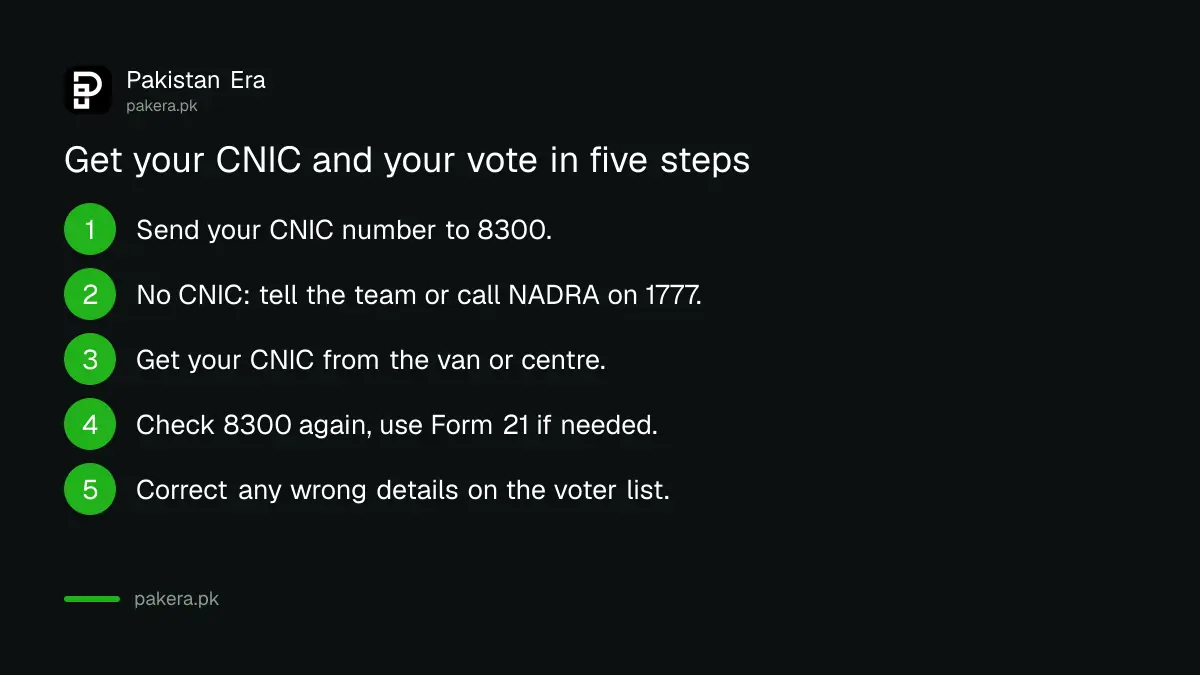
Two checks come first, because some women already have one or both. Send the CNIC number to 8300 if you have a card. If no vote comes back, the card alone has not put you on the list, and you need to use the form below.
- If you have a CNIC, send the number with no dashes or spaces to 8300 to check your vote.
- If you have no CNIC, gather your family documents and tell the visiting team or call NADRA on 1777.
- Get your CNIC from the van or the registration centre in your area.
- Check 8300 again once the card is made. If no vote shows, use Form 21 with the District Election Commissioner.
- If your name or details are wrong on the list, see how to correct details on the voter list.
Who checks the work, and why only two districts
The ECP's Gender and Social Inclusion Wing, the Provincial Election Commissioners, District Election Commissioners and its Election Monitoring and Coordination Centre will oversee the campaign, working with NADRA. The ECP says it is a test: the aim is to build a model that can be used in other districts, and to study the problems found along the way.
So if you live in another district, this project does not cover you yet. The MRV schedule and the female desks at any NADRA centre remain open to you.
| You live in | What to do now |
|---|---|
| Kasur or Kamber Shahdadkot, no CNIC | Wait for the visit or go to a NADRA centre now |
| Kasur or Kamber Shahdadkot, have a CNIC | Check your vote on 8300 |
| Any other district | Use NADRA's female desk and check 8300 |
Common questions
Which districts are in the ECP women's registration pilot?
Kasur in Punjab and Kamber Shahdadkot in Sindh, according to the ECP's press release of 31 October 2026.
When does registration start?
Registration work runs from December 2026 to February 2027. November 2026 is for collecting the data.
How many women will be helped?
The ECP says 115,689 in Kasur and 59,156 in Kamber Shahdadkot, or 174,845 in total.
Is the CNIC free under this project?
The release does not say. It speaks of making registration easier, not of waiving the fee. Ask at the NADRA van or centre before you pay.
Will someone come to my house?
The ECP says local social workers and enumerators will go house to house, starting with blocks that have a wider gender gap.
Do I need to wait for the visit?
No. You can use a NADRA centre at any time. Call 1777 to find the nearest one.
How we verified this
What we checked, where we read it, and what we could not confirm.
Last checked 7 November 2026. We read the ECP's Urdu press release of 31 October 2026 and the NADRA pages our linked guides cite. The release does not give a list of blocks, a helpline or a start date for each area.
About the author

Global Affairs & Political Economy Writer
Muhammad Hatim is a book lover who started writing because he enjoys it. At Pakistan Era he writes about international relations, geopolitics and the global economy, with a particular interest in South Asia and the forces behind current events.