Lahore High Court Rules FBR Can Pursue Money Laundering Cases Before Tax Cases End
The Lahore High Court says FBR can investigate money laundering without waiting for a tax case to finish, and dismissed every petition. What it means for you.

The Lahore High Court has ruled that the Federal Board of Revenue (FBR) does not have to wait for a person's income tax case to finish before it investigates them for money laundering. The two cases are separate and can run side by side, the court held. FBR announced the judgment on Sunday 27 September 2026 through the Press Information Department.
A two-member bench of Justice Khalid Ishaq and Justice Hassan Nawaz Makhdoom decided Writ Petition No. 2928 of 2026 and related cases. The petitions challenged the powers of FBR's Directorate General of Intelligence and Investigation, Inland Revenue, known as I&I-IR. The court dismissed all of them.
We have read FBR's release, not the judgment itself. The written judgment was not on the court's website when we checked, so what follows is the court's reasoning as FBR describes it.
The court dismissed every petition against FBR's investigators
The Lahore High Court dismissed all the petitions and held that FBR's I&I-IR wing has full legal power to register FIRs, investigate and prosecute money laundering under the Anti Money Laundering Act, 2010. An FIR is the first information report that starts a criminal case.
The petitioners lost on every point, according to the release. FBR has not named them, and we are not either.
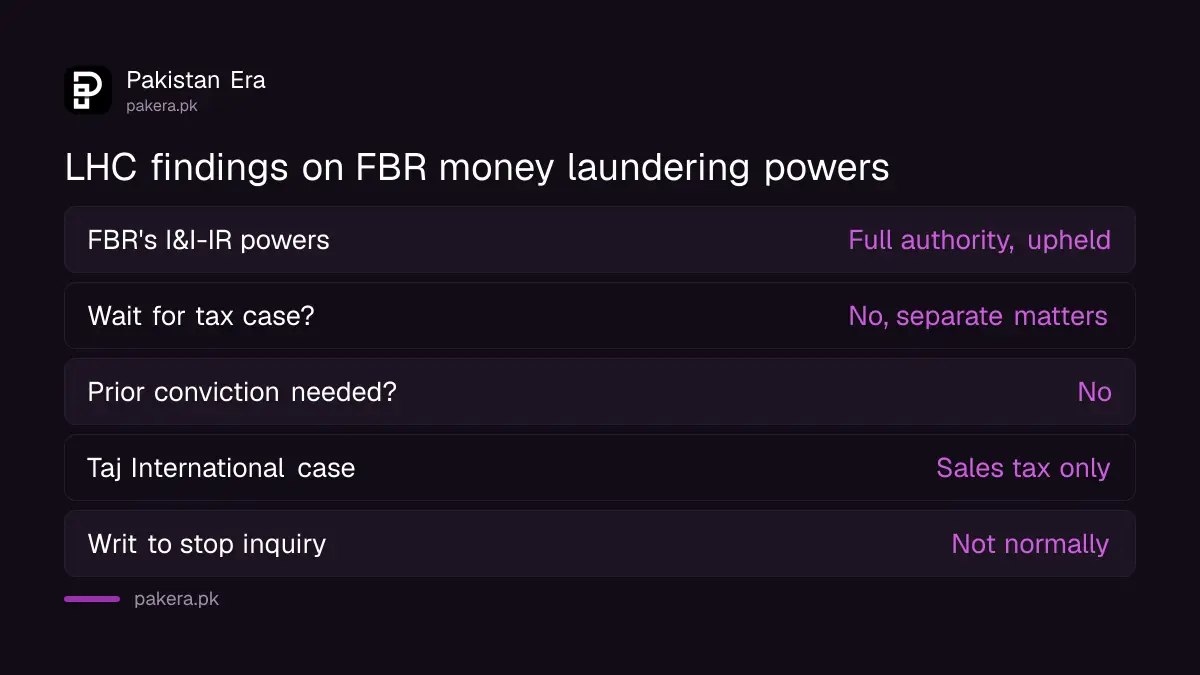
| Question before the court | What the court held, as FBR reports it |
|---|---|
| Can FBR's I&I-IR register and prosecute money laundering cases? | Yes, it has full legal authority |
| Must a tax case end before a money laundering case starts? | No, they are separate matters |
| Is a prior conviction for the original crime needed? | No |
| Can a tax dispute stop a money laundering case? | No, the special law takes priority |
| Does the Taj International judgment block these cases? | No, it covered sales tax assessment and recovery only |
| Can a writ petition stop an investigation in advance? | Not normally |
Money laundering and tax cases now run on separate tracks
A money laundering case and a tax case are two different matters, and one does not have to wait for the other, the court said. A person can be prosecuted for money laundering even without an earlier conviction for the crime that produced the money.
Money laundering, in FBR's own plain words, means "taking money earned through illegal means and moving it around so that it looks like clean, lawful income." The crime that first produces the money is called the predicate offence.
This is the heart of the ruling. In practice, a person under a money laundering inquiry cannot ask for it to pause just because the tax demand behind it is still under appeal. The Anti Money Laundering Act is a special law, it said, and it takes priority over general laws.
Bank reports to the FMU are lawful, the court said
When a bank reports a suspicious transaction to the Financial Monitoring Unit (FMU) and action follows, that happens within the law and with proper safeguards, the court held. The FMU is the government unit that receives these bank reports.
Banks file these suspicious transaction reports on their own. The ruling confirms that FBR can act on what follows from them. It does not say every report leads to a case, and the release does not suggest it does.
So a large, unexplained cash movement through your account can still draw questions. If your money is declared and your returns are filed, you have the paper trail to answer them. Filing on time also keeps you on the Active Taxpayers List, and you can check your filer status online.
What the ruling means for ordinary taxpayers
If you declare your income and pay your taxes, this judgment changes nothing for you, FBR says. It strengthens action against people who hide illegal money or try to make it look legitimate, and all such action must still follow due process.
That is FBR's summary, and it is fair as far as it goes. For most salaried people and small businesses, the practical point is simpler. Keep your records for the money that moves through your accounts.
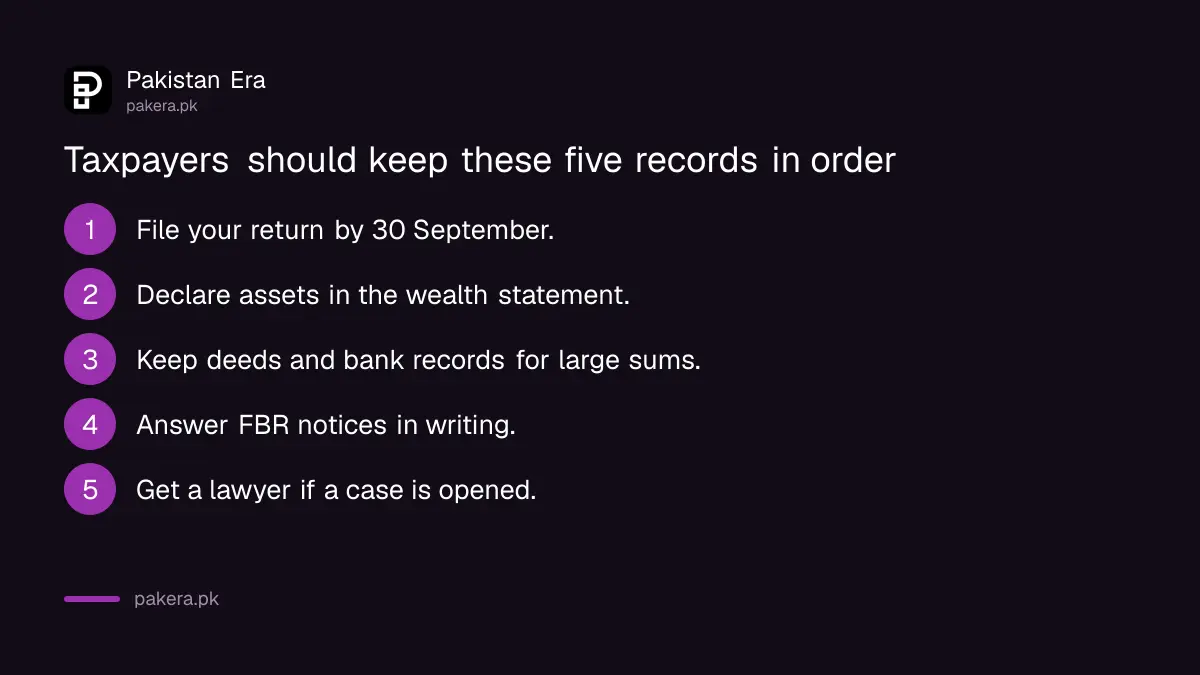
- File your income tax return. The 30 September deadline for tax year 2026 is days away.
- Declare your assets, including property, gold and bank balances, in the wealth statement.
- Keep sale deeds, gift declarations and bank records that show where large sums came from.
- Answer any FBR notice in writing and keep a copy of your reply.
- If a criminal case is opened, get a lawyer. The ruling sends questions about the source of money to the Special Courts.
The case now moves to the Special Courts
Questions about where money came from and how it was moved will be decided by the relevant Special Courts, not in writ petitions, the court held. A writ petition cannot normally be used to stop a criminal investigation before it has run.
FBR welcomed the judgment, saying it brings legal clarity and strengthens the fight against financial crime. The case was pursued under Director General I&I-IR Aqeel Ahmed Siddiqui, the release says.
The release does not say whether the petitioners will appeal. A High Court judgment can be challenged in a higher court, so this may not be the last word. Under Article 201 of the Constitution, a High Court decision binds the courts below it in that province. It also comes as FBR changes how it deals with ordinary taxpayers, through its new National Faceless Centre for audits.

Common questions
What did the Lahore High Court decide about FBR and money laundering?
That FBR can investigate and prosecute money laundering without waiting for a related tax case to finish. It dismissed all the petitions against FBR's I&I-IR wing.
Does this ruling affect people who file their taxes?
No, according to FBR. If you declare your income and pay your taxes, it says, the judgment changes nothing for you.
Which law covers money laundering in Pakistan?
The Anti Money Laundering Act, 2010. The court called it a special law that takes priority over general laws.
What is the Financial Monitoring Unit?
It is the government unit that receives suspicious transaction reports from banks. The court said action that follows such reports is lawful.
Can the petitioners appeal?
A High Court judgment can normally be challenged in a higher court. The FBR release does not say whether an appeal has been filed.
How we verified this
What we checked, where we read it, and what we could not confirm.
Last checked on 27 September 2026. The bench, the petition number, the dismissal and each point the court held are from Press Information Department release PR No. 296 of 27 September 2026, issued for FBR. We did not find the written judgment on the Lahore High Court website on that date, so the reasoning is as FBR describes it. The steps for taxpayers are our own practical advice, not part of the judgment.
About the author

Senior Writer, Public Services and Technology
Shahid joined us in 2024 as an author. He is a senior contributor to Pakistan's leading technology websites. He writes detailed articles, mostly covering his expertise in the latest tech, mobiles, apps, gadgets, and step-by-step guides. His ideology is to help people understand the latest trends and explain complex methods through very easy-to-understand guides.