Pakistan's Bond Market Plan: Bank Customers to Trade Government Securities by December 2027
Pakistan's Finance Division plans bond trading through banks by December 2027 and fixed auction result times by December 2026. See every date and who owns it.
Short answer: Pakistan's Finance Division has published a plan to deepen its rupee bond market. Its dates include a fixed release time for auction results by December 2026 and, by December 2027, a way for eligible bank customers to trade listed government securities through their banks. The plan is a set of targets, not a law.
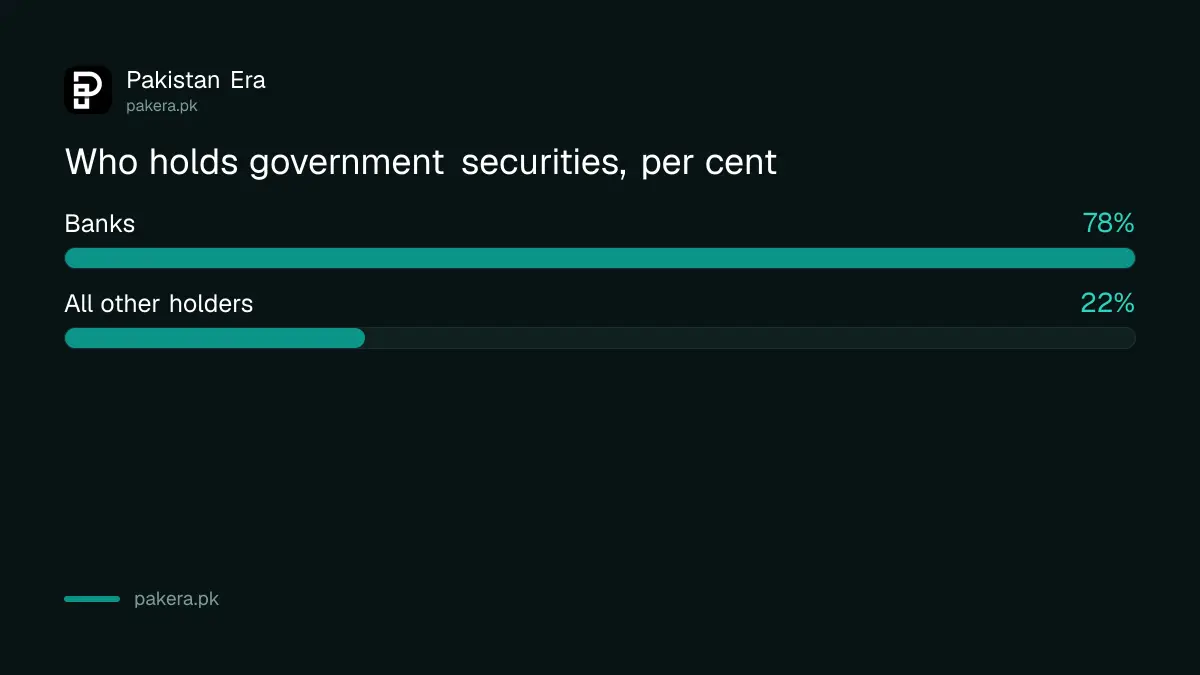
Most people meet government debt only through a National Savings certificate, if at all. Yet banks hold 78 per cent of all government securities, and that fact shapes what a bank can lend you.
We read the Strategic Action Plan for the Development of the Local Currency Bond Market on the Finance Division website on 12 October 2026. It is dated September 2026 and was listed on 29 September. The Debt Management Office wrote it with the State Bank, SECP, the Pakistan Stock Exchange (PSX), the Central Depository Company and the National Clearing Company.
The plan answers a commitment under the IMF programme
The plan says it fulfils the government's commitment under the IMF-supported programme to study what holds back the local currency bond market and to publish an action plan by end-September 2026. It builds on a joint IMF and World Bank diagnostic.
The starting facts are plain. In FY2025, 91.6 per cent of Rs 34.2 trillion in gross government borrowing was raised at home. Banks hold 78 per cent of government securities, and sovereign paper is about 62 per cent of banking system assets. The plan says this favours holding bonds over trading them and limits bank lending to the private sector.
It names the narrow investor base as the biggest gap. Pension coverage and insurance are low, and foreign and small investors take part only a little. Our report on the borrowing plan for FY2027 shows how much the government needs from that same market this year.
Bank customers may trade listed government securities by December 2027
The plan lists, as a medium priority, allowing eligible bank customers to trade exchange-listed government securities through their banks. The State Bank, SECP, PSX and the depository company are named as responsible. The target date is December 2027.
That is a goal with an owner and a date. It is not a new service you can use today. The plan gives no list of banks, no fee and no minimum amount. Today the route for most people is the one we describe in our guide on how to buy T-bills and PIBs from Rs 5,000.
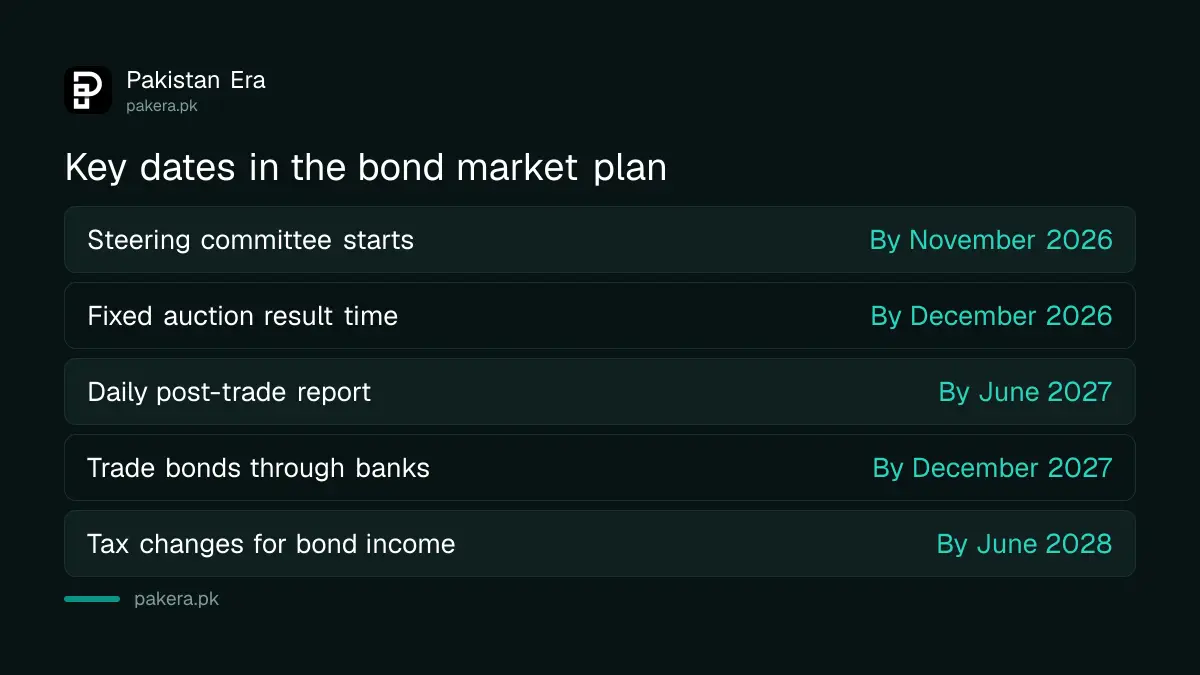
| Action in the plan | Lead bodies | Target date |
|---|---|---|
| Steering committee under the Finance Secretary starts work | Finance Division, SBP, SECP | By November 2026 |
| Fixed release time for auction results | Finance Division, SBP, PSX | By December 2026 |
| Action plan for National Savings products | Finance Division, CDNS | By December 2026 |
| Daily post-trade report for each security | SBP, PSX | By June 2027 |
| Bank customers trade listed securities via banks | SBP, SECP, PSX, CDC | By December 2027 |
Auction results are to come out at a fixed time
The plan says the delay in announcing auction results should be reduced and a fixed release time committed. The Finance Division, SBP and PSX are responsible, and the target is December 2026. It also plans target volume ranges, so bidders know what to expect.
The State Bank says it circulates results on the day of the auction. The plan still asks for less delay. It also notes that accepted volumes often differ from the announced targets. Allocation bands would limit that gap. For a saver this changes little at the counter. For a bank, it makes bidding easier to plan.
The same rules sit behind the T-bill auction calendar to December, which the State Bank already issues for three months at a time.
Small savers get more channels, and National Savings is under review
The plan names InvestPak, brokers, mutual funds and government bond exchange-traded funds as ways to widen the small investor base. It also calls for a review of National Savings products and their investment ceilings. Dates run to 2028, so your certificate is unchanged for now.
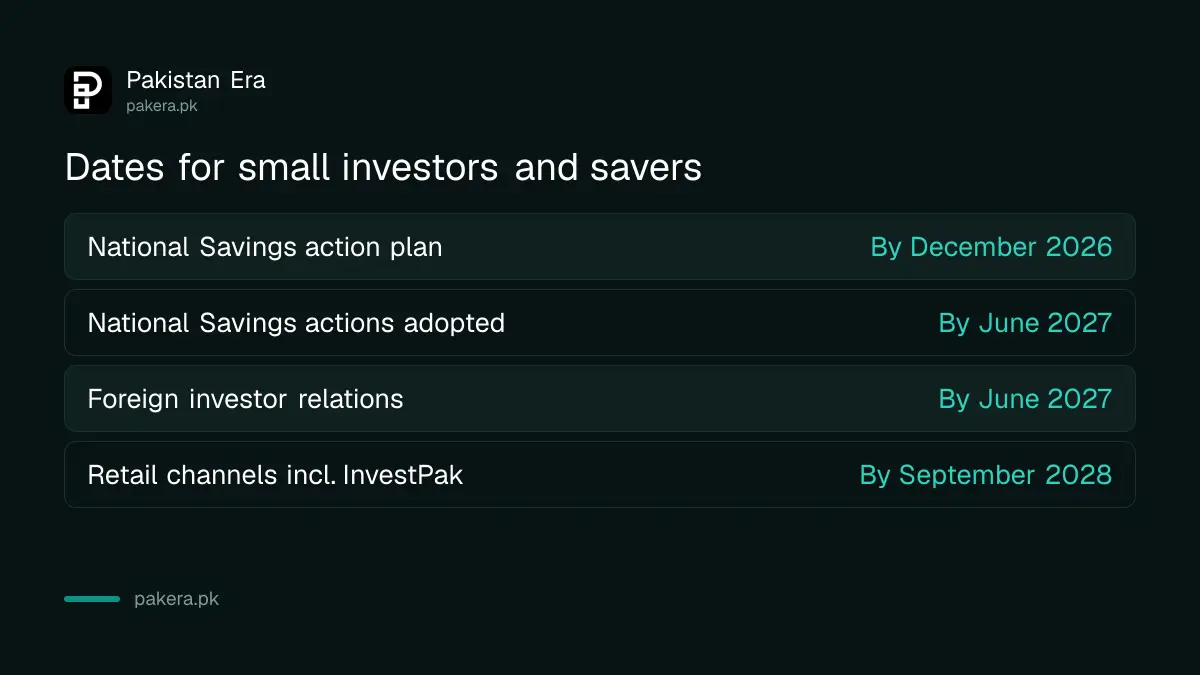
- The review of National Savings (CDNS) products has an action plan due by December 2026.
- The plan says to adopt its actions by June 2027, then keep going.
- Retail channels, including InvestPak, brokers, mutual funds and bond funds, have a September 2028 date.
- Foreign investor relations are to be formalised by June 2027, building on the bond index inclusion already achieved.
For now, the National Savings profit rates from 1 October are the ones in force. A person who wants to buy bond-linked units can read how mutual funds work with a CNIC.
Tax rules on bond income are to change by June 2028
Two changes are for the Federal Board of Revenue. One taxes coupon income only for the period a holder owned the bond. The other treats bonds held through funds like direct holdings. Both are timed for the FY2028/29 budget.
The plan says withholding tax today does not always match the period of ownership. If the change comes, the holder at redemption would face withholding only on the return that built up while they held the bond. It would still need a change in law.
Common questions
Can I trade government bonds through my bank today?
The plan says this is a goal for December 2027, so it is not a service the plan has switched on. Check your own bank before you assume it is offered.
Who wrote the local currency bond market plan?
The Debt Management Office of the Finance Division wrote it with the State Bank, SECP, PSX, the Central Depository Company and the National Clearing Company, drawing on an IMF and World Bank diagnostic.
Does the plan change National Savings rates?
No. It asks for a review of National Savings products, ceilings and digital channels, with an action plan by December 2026. No rate is set in it.
Is the plan a law?
No. It is a policy document with owners and target dates. Any tax change would need to pass through a Finance Act.
What is the biggest problem the plan names?
The narrow investor base. Banks hold 78 per cent of government securities, and pension, insurance, foreign and small investors hold little.
How we verified this
What we checked, where we read it, and what we could not confirm.
We read the plan at the Finance Division website on 12 October 2026. The listing is dated 29 September 2026. We did not check whether any target date has since been moved. The plan says progress will be reported every six months through the debt bulletins.
About the author

Global Affairs & Political Economy Writer
Muhammad Hatim is a book lover who started writing because he enjoys it. At Pakistan Era he writes about international relations, geopolitics and the global economy, with a particular interest in South Asia and the forces behind current events.