PTA's Local Peering Rules, 2026: Internet Traffic Between Pakistani Networks Must Stay Inside Pakistan
PTA's Local Peering and IXP Regulations, 2026 bar routing Pakistan to Pakistan traffic through international gateways. See what it binds and what to test.
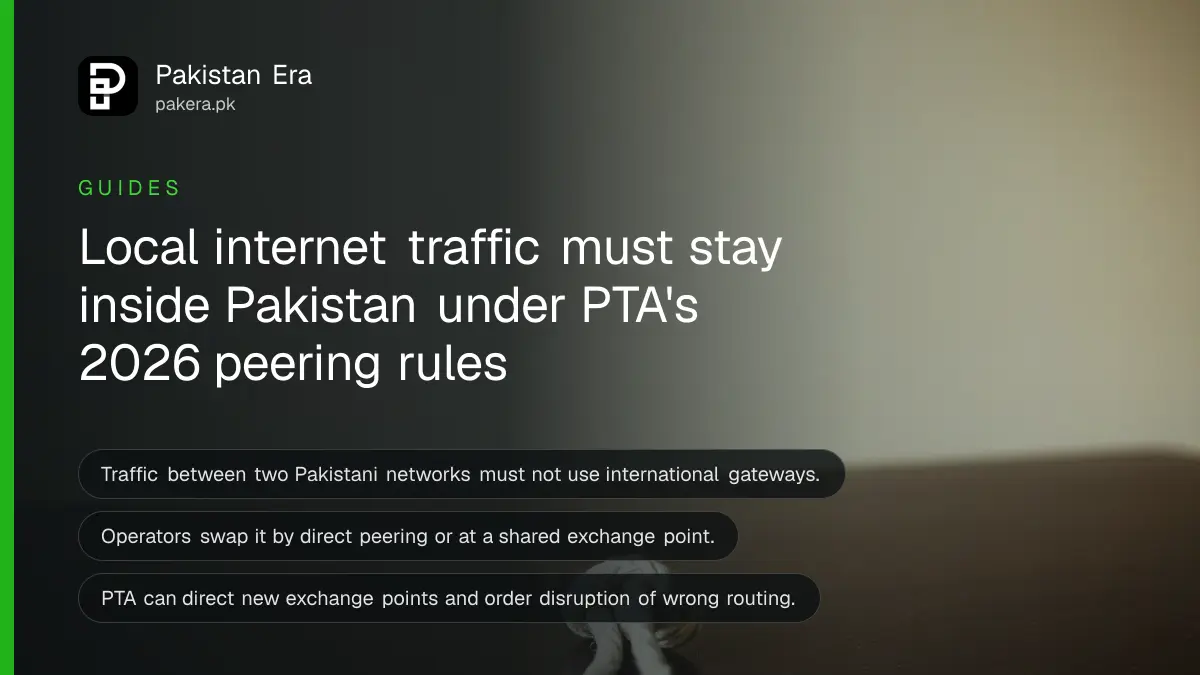
Short answer: PTA's Local Peering and Internet Exchange Points Regulations, 2026 say that internet traffic between two points inside Pakistan must not travel out through international gateways. Operators must exchange it locally, through direct peering or a shared exchange point. The rule aims at lower cost, better quality and less security risk.
When you open a Pakistani website from a Pakistani connection, you expect the data to take the short road. Often it does not. For years, traffic between two local networks could leave the country and come back. PTA wrote a rule against that in April 2026.
We read the regulations in the Gazette of Pakistan, Extraordinary, of 22 April 2026, which PTA publishes on its regulations page. They are notified as S.R.O. 661(I)/2026. The text below follows that notification. We read it as a text file, and quote only what it says.
Local traffic must stay inside Pakistan
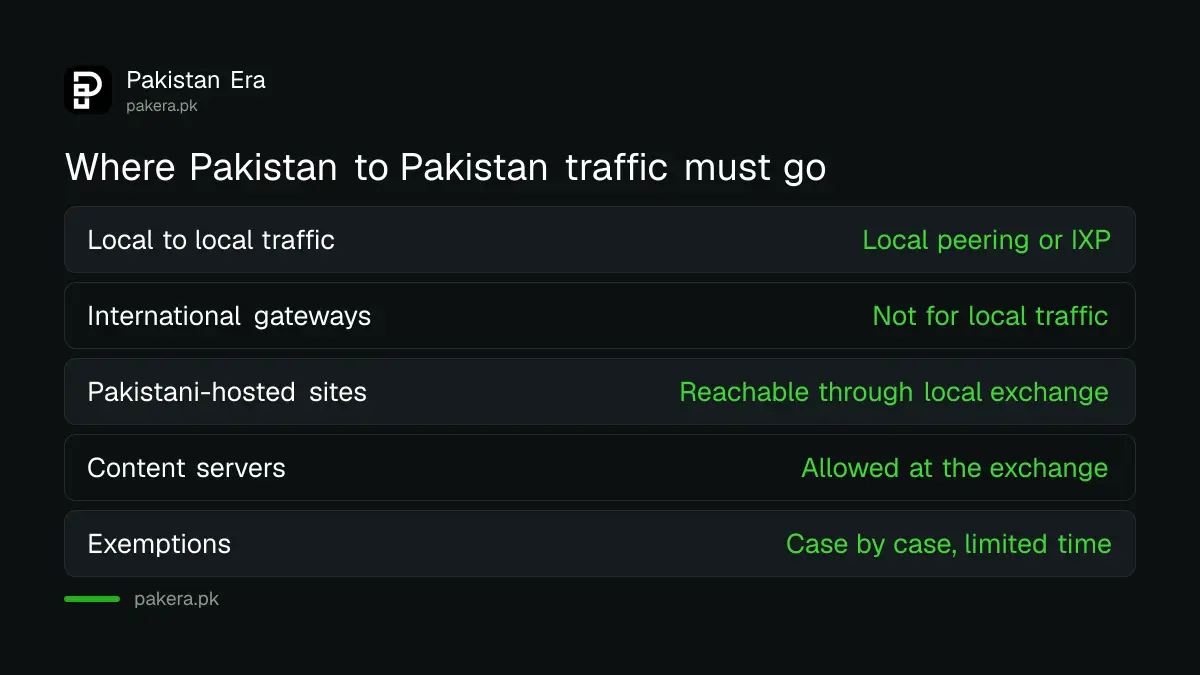
Regulation 4 says local internet traffic shall not be routed on upstream bandwidth or international gateways. It must be exchanged between licensees by local peering or at an exchange point.
The rule defines local traffic by its two ends. Traffic is local when both the source and the destination IP addresses sit in networks managed by licensees or their users within the licensed region.
Local peering means two licensees connect directly and swap traffic between their own address ranges. An internet exchange point, or IXP, is a shared physical place where many networks connect and swap traffic. The regulations allow both.
The stated aims are to cut cost, reduce the security risk of using international peering points and improve service quality. PTA did not publish a speed gain, and we do not claim one.
Who has to peer and how the exchange points are run
The rules apply to all PTA licensees that lease bandwidth to subscribers for internet use. Licensees can set up exchange points by mutual agreement and share the cost. They must connect by fibre, directly or by sharing a fibre.
A third party can host and manage an exchange point, but only with PTA's prior approval. The licensees stay responsible for every requirement. Access must be fair and non-discriminatory.
Operators that manage international gateways must peer with each other, directly or through an exchange point at a common location. This is the part that stops a local call from going abroad through one gateway and coming back through another.
PTA can study traffic patterns and direct licensees to set up an exchange point in a city or region where it sees the need. Those directions are binding. It can also give a licensee a time-limited exemption from routing local traffic locally.
| Rule | What it says | Regulation |
|---|---|---|
| Route local traffic locally | Not through international gateways | 4(1) |
| Fibre connection to the exchange | Direct or shared fibre, with per licensee traffic visibility | 4(5) |
| Traffic records | Traffic graphs kept for 12 months | 4(8) |
| Content delivery servers | Allowed at the exchange, PTA told before deployment | 4(9), 4(10) |
| Third party exchange host | Needs PTA approval first | 4(3) |
| Time-limited exemption | Case by case from PTA | 4(16) |
Content servers and Pakistani-hosted sites get a local path
Websites and apps hosted in Pakistan by licensees must be reachable for local users through local peering or an exchange point. Content delivery network servers, which store copies of popular content close to users, are allowed at the exchange level.
Operators must tell PTA about each content delivery network before deploying it. The content may be delivered to local users only through licensed channels, and unlawful content must not be hosted on them.
For a reader, the practical meaning is simple. A Pakistani site hosted in Pakistan can reach you without a trip abroad. Whether it feels faster depends on your operator and your line. We did not measure a change. For a way to measure your own line, see how to check internet speed the way PTA does.
What the rules mean for you as a user
The regulations bind operators, not users. You do not have to do anything. What you can do is know the standard your provider is held to, and measure what you get.
PTA's rule puts a duty on providers that sell you broadband or mobile data. If your local sites load slowly while international ones are fine, that is a question for your provider and then for PTA.
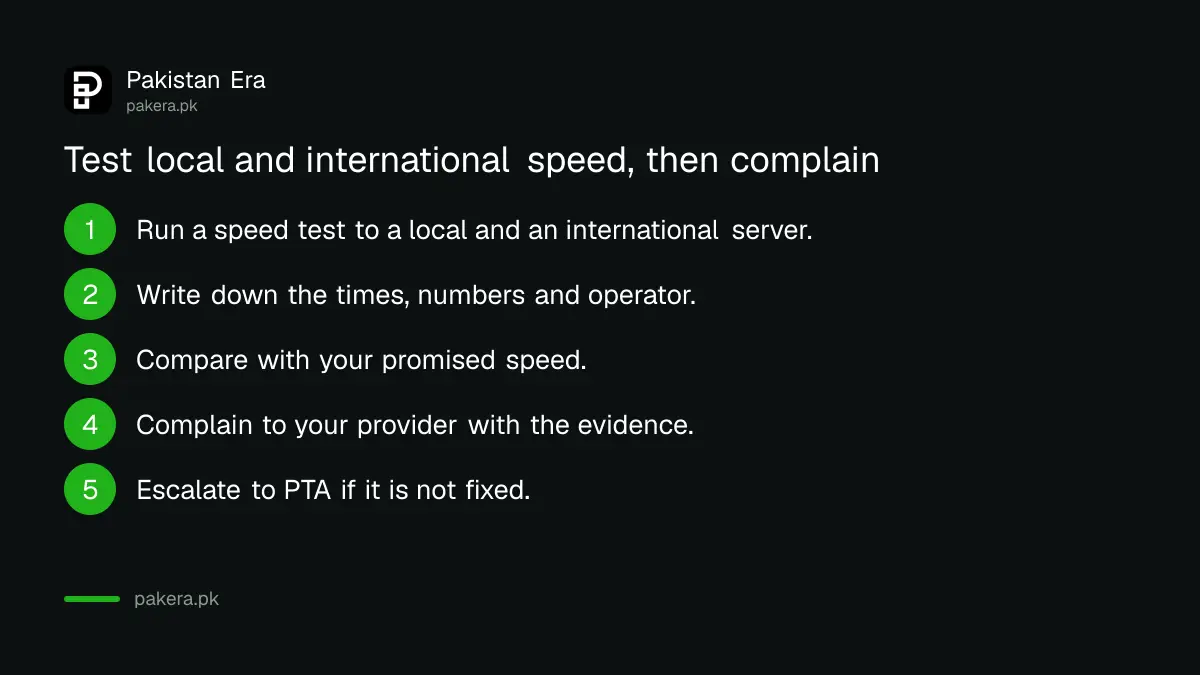
- Run a speed test to a local server and to an international server on the same connection.
- Write down the times, the numbers and your operator.
- Compare the result with the promised speed, as explained in checking home broadband against the 80 percent rule.
- Complain to your provider with the evidence.
- If it does not fix the issue, use the PTA slow internet complaint steps.
Local peering does not fix a cut cable or a power cut at a tower. Those are separate, as in the September fibre cut that slowed Islamabad and Rawalpindi.
PTA can inspect and order action
PTA may inspect premises and records of licensees and exchange setups at any time. Licensees must give the information and help. Where local traffic is routed through international gateways, PTA may issue directions for its disruption, in the interest of security risk.
Disputes that affect the running of an exchange go to PTA, and its decision is final and binding. Commercial terms between licensees are settled by the licensees.
Common questions
Does this make my internet faster?
PTA states the aims as lower cost and better quality. It gave no speed figure. The effect on your line depends on your operator and how your traffic was routed before.
Do I have to do anything under these rules?
No. The regulations bind licensees that lease bandwidth. Users do not apply for anything. You can only measure your speed and complain if it falls short.
What is an internet exchange point?
It is a shared physical place where networks connect and swap traffic directly. In the regulations it is a physical setup for networks to exchange their traffic.
Can PTA excuse an operator from local routing?
Yes, case by case and for a limited time. After that period the operator must route local traffic through local peering or an exchange point.
Is this the same as PTA's 80 percent broadband speed rule?
No. That rule is about the speed you are promised. This one is about where traffic travels. Both can matter when your connection feels slow.
How we verified this
What we checked, where we read it, and what we could not confirm.
Last checked on 13 October 2026, Pakistan time. We read the Local Peering and Internet Exchange Points Regulations, 2026 on PTA's regulations page. We could not confirm which exchange points exist today, how far operators have complied, or any measured speed change. The user steps are our own.
About the author

Technology Journalist & Multimedia Producer
Ahmad Ali is a technology journalist and multimedia producer at Pakistan Era, joining the team in October 2026. He covers consumer technology and digital life for Pakistani readers, combining research with hands-on product testing.